
The No-Nonsense Guide to Claims Management in Health Insurance
Why Medical Claims Management Is Make-or-Break for Your Practice
Medical claims management is the end-to-end process of preparing, submitting, tracking, and resolving healthcare claims so providers get paid accurately and on time.
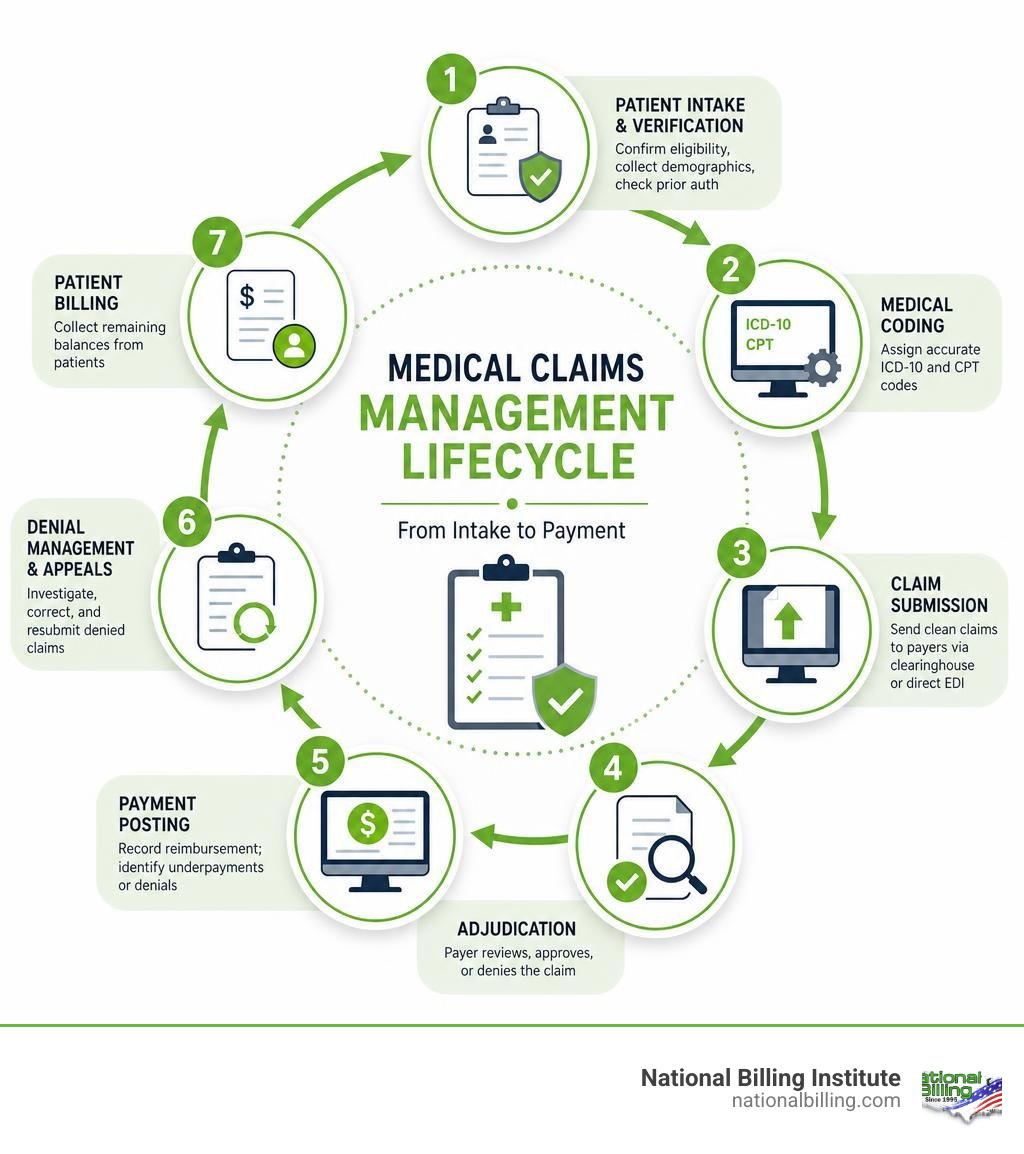
Here's what it covers at a glance:
Stage What Happens Patient Intake & Verification Confirm eligibility, collect demographics, check prior auth Medical Coding Assign accurate ICD-10 and CPT codes to services rendered Claim Submission Send clean claims to payers via clearinghouse or direct EDI Adjudication Payer reviews, approves, or denies the claim Payment Posting Record reimbursement; identify underpayments or denials Denial Management & Appeals Investigate, correct, and resubmit denied claims Patient Billing Collect remaining balances from patients
If you run a healthcare practice in 2026, the billing environment is harder than it has ever been. Around one in five claims were denied in 2024. More than four in ten organizations see at least one in ten claims rejected. And 68% of providers say submitting a clean claim is more difficult than it was just a year ago.
That's not a minor inconvenience. Denials alone account for an estimated 20% of all revenue cycle expenses — money spent chasing payments you already earned.
The pressure is real. Payers are moving faster, rules are changing constantly, and manual billing processes simply can't keep up. Every claim error is a delay. Every denial is a drain. And every dollar that slips through the cracks is revenue your practice will likely never recover.
I'm Olivia Harper, Founder of National Billing Institute and a specialist in medical claims management with over 30 years of hands-on experience helping practices across the U.S. reclaim lost revenue and reduce denials. In this guide, I'll walk you through exactly how the claims process works, where it breaks down, and what you can do to fix it.
What is Medical Claims Management and Why Does It Matter?
At its core, medical claims management is the engine that keeps your practice financially viable. Think of it as the bridge between the clinical care you provide and the financial reimbursement you deserve. Without a structured, highly efficient approach to managing this bridge, even the most clinically successful practices can find themselves struggling to keep their doors open.
The American Medical Association highlights the immense complexity of navigating private payer networks, highlighting that administrative overhead is one of the most significant burdens facing modern practices. For a detailed look at how these dynamics play out across the country, you can read more about Medical Claims Processing | AMA - American Medical Association .
When we look at the broader picture of Revenue Cycle Management Healthcare, claims management is the specific operational phase where clinical documentation is translated into financial transactions. If your claims management is weak, your cash flow slows to a crawl, administrative burdens skyrocket, and your team spends more time arguing with insurance companies than caring for patients.
Furthermore, poor claims handling directly damages the patient experience. There is nothing quite like receiving an unexpected, confusing medical bill to turn a highly satisfied patient into an incredibly frustrated one. By getting claims right the first time, we protect both our practice's bottom line and the trust we have built with our patients.
The Core Role of Medical Claims Management in RCM
To understand why this is so critical, we have to look at how claims management integrates with daily Revenue Cycle Operations. The entire claim lifecycle is dictated by an incredibly complex web of payer-specific rules. These rules dictate everything from which modifiers are acceptable to how quickly a claim must be submitted after the date of service.
When claims management is handled proactively, we align our billing processes with these constantly shifting payer guidelines. This alignment increases our reimbursement velocity—meaning we get paid in days rather than months. If we ignore payer rules or rely on outdated billing practices, our claims get stuck in "billing limbo," starving the practice of the operational capital it needs to thrive.
The 6 Key Stages of the Medical Claims Lifecycle
To master the billing process, we must treat a medical claim as a journey with six distinct, interconnected stages. If any single stage is compromised, the entire journey fails, resulting in delayed payments or flat-out denials.
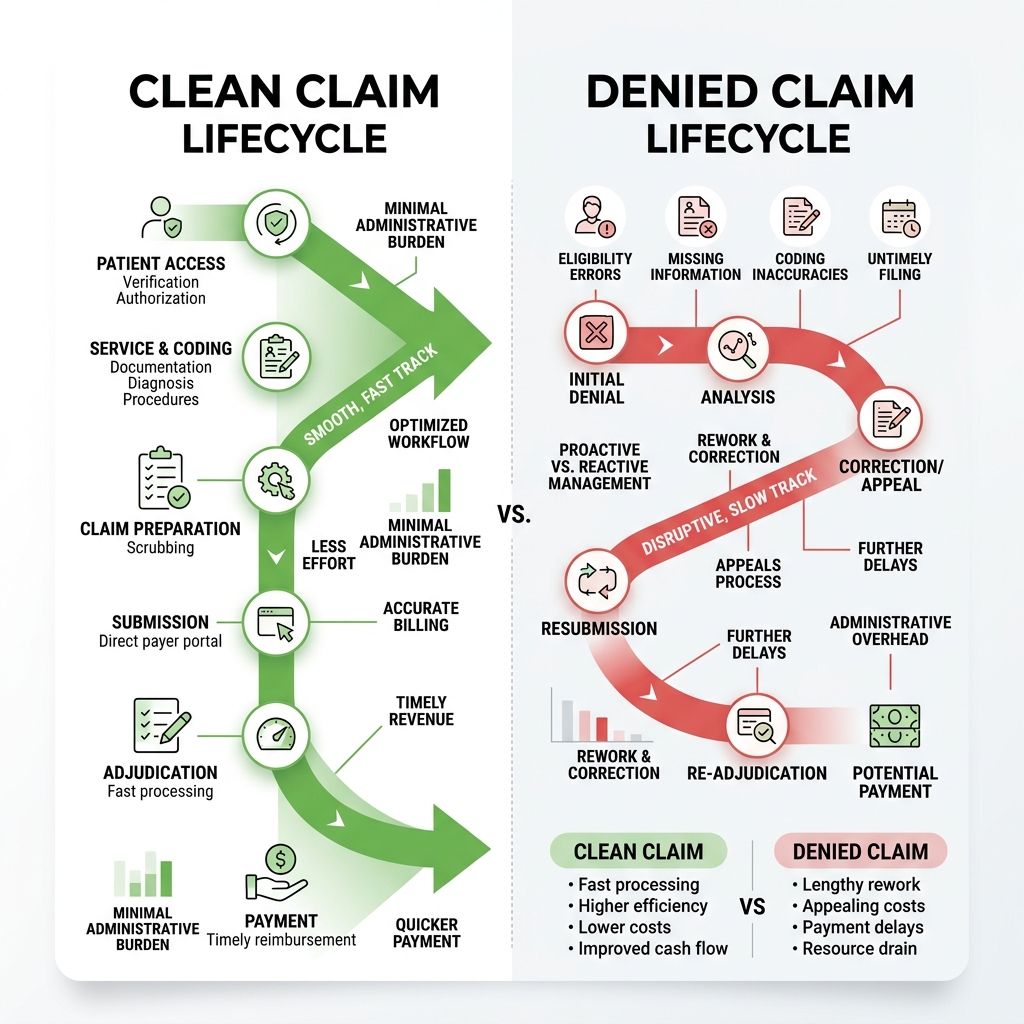
Managing this lifecycle effectively requires a deep understanding of Medical Billing fundamentals. Let’s break down each stage to see where the magic—and the mistakes—happen.
Front-End Intake and Verification
The journey begins long before the provider ever sees the patient. Front-end intake is the foundation of the entire claims process. During this stage, our administrative staff must perform comprehensive eligibility checks, register patient demographics with 100% accuracy, and secure any necessary prior authorizations.
Many practices treat this step as a quick administrative formality, but the data tells a different story. In fact, 55% of providers spend more than 10 minutes re-running eligibility checks because of incomplete or flat-out incorrect initial results. If we don't leverage the full Features of EHR systems to automate and verify this data in real-time, we are essentially building our claims on a foundation of sand.
Mid-Cycle Coding and Submission
Once clinical care is delivered, the mid-cycle phase begins. This is where clinical documentation is translated into highly specific medical codes. Accurate RCM Medical Coding requires a masterly grasp of ICD-10 diagnostic codes and CPT procedure codes.
After coding is complete, the claim is formatted into an electronic file (typically an 837 transaction) and sent via Electronic Medical Billing channels to a clearinghouse. The clearinghouse acts as an intermediary, "scrubbing" the claim for basic errors before passing it along to the insurance payer.
Back-End Adjudication and Denial Management
Once the payer receives the claim, they begin the adjudication process. They evaluate the claim against the patient's benefits plan, check for coding accuracy, and determine their financial responsibility. The payer then issues an Electronic Remittance Advice (ERA) detailing what they paid and why.
If the payer denies the claim, we enter the critical phase of Denials and Appeals Management. We must immediately investigate the denial, correct the underlying errors, and submit a formal appeal. Simultaneously, we post the approved payments and route any remaining balances to patient collections. If claims are left unpaid or unappealed, our team must deploy aggressive AR Follow Up Services to ensure we chase down every single dollar owed to the practice.
Common Causes of Claim Denials and How to Prevent Them
Denials are the single greatest threat to a practice's financial health. To fight them, we must first understand what causes them.
Denial Cause Why It Happens Proactive Prevention Strategy Eligibility Mismatches Patient's coverage has changed, expired, or was entered incorrectly. Implement real-time, automated eligibility verification at check-in. Prior Authorization Missing The service required pre-approval from the payer, but none was obtained. Integrate prior auth rules directly into the scheduling workflow. Coding Inaccuracies Outdated codes, incorrect modifiers, or unbundled codes were used. Conduct regular coding audits and continuous staff education. Missing Information Social Security numbers, date of birth, or accident details are blank. Utilize mandatory-field validation in your intake software. Timely Filing Limit Exceeded The claim was submitted past the payer's strict deadline. Establish daily submission queues and automate age-alerts.
Understanding Medical Billing Denials is only half the battle; we must implement rigorous Denial Prevention protocols to stop errors before they leave our office. This means our billing team must be intimately familiar with common Medical Billing Denial Codes so they can spot trends and fix systemic issues.
Furthermore, we must navigate complex federal regulations. The No Surprises Act, designed to protect patients from unexpected out-of-network bills, has added an entirely new layer of complexity to claims adjudication. Ensuring complete Medical Billing HIPAA Compliance while maintaining compliance with these newer consumer protection laws requires constant vigilance and robust administrative workflows.
Proactive Denial Prevention Strategies
The most expensive way to handle a denial is to wait for it to happen and then try to fix it. True financial health comes from investing in Denial Reduction Services. By implementing advanced claim scrubbing technology, we can automatically flag claims for inaccurate coding or missing documentation prior to payer submission.
Additionally, we must keep a incredibly close eye on our filing calendars. Untimely Filing in Medical Billing is one of the most frustrating ways to lose money, as payers will flatly refuse to pay claims submitted outside their designated window, leaving you with zero recourse for appeal.
How Technology and AI are Transforming Medical Claims Management
The days of manually typing claims into clunky software and crossing your fingers are officially over. Technology is completely rewriting the rules of the game.
By integrating AI in Healthcare Claims Processing and adopting Automated Revenue Management platforms, modern practices can transition from a reactive "chase" model to a highly proactive, automated system. These advanced claims management solutions connect directly with your EHR via real-time APIs, pulling clinical documentation and translating it into clean claims instantly. However, this seamless integration is only possible if you are utilizing fully Certified EHR Systems that support modern interoperability standards.
The Rise of Autonomous AI in Medical Claims Management
The cutting edge of billing technology is "Agentic AI." Unlike simple rule-based automation, autonomous AI agents can analyze historic payer behavior, predict denials before they occur, and automatically generate appeal letters with a single click.
By deploying specialized Claims Processing Software Healthcare, we can automate up to 21% of our straight-through claims processing, allowing our human billing experts to focus their energy on resolving the most complex, high-value appeals.
Key Metrics and Best Practices for Claims Success
If you don't measure your billing performance, you can't improve it. To achieve the Lowest Error Rates Billing, your practice must track these three critical Key Performance Indicators (KPIs):
Clean Claim Rate (CCR): The percentage of claims that are accepted by the payer on the first submission. Your target should be 95% or higher.
Days in Accounts Receivable (A/R): The average number of days it takes for a claim to be paid. Top-quartile practices keep this between 27 and 37 days.
First-Pass Acceptance Rate (FPAR): The percentage of claims that clear clearinghouse edits and are successfully received by the payer's system.
To keep these metrics in the green, continuous staff training is non-negotiable. Payer rules change daily, and your team needs to be equipped with real-time performance dashboards so they can see exactly where claims are getting stuck and adjust workflows accordingly.
In-House vs. Outsourced Claims Management
As a practice grows, leadership inevitably faces a critical choice: do we keep our billing team in-house, or do we outsource?
For many practices, managing a billing department is an administrative nightmare. Recruiting, training, and retaining certified coders in a highly competitive job market is incredibly expensive. Additionally, you have to purchase and maintain your own billing software, which quickly drains capital.
By partnering with Outsourced Medical Billing Services in USA, you instantly eliminate these overhead costs. You gain access to a highly scalable, dedicated team of experts who do nothing but eat, sleep, and breathe claims management.
When evaluating USA Medical Billing Services, it is vital to look for partners who keep their operations entirely onshore. Offshoring your billing can lead to massive communication gaps and severe compliance risks. Choosing the Best Medical Billing Services USA ensures that your patient data remains secure, compliance is guaranteed, and your practice benefits from a team that understands the nuances of the American healthcare system.
Frequently Asked Questions about Medical Claims Management
What is the difference between a claim rejection and a claim denial?
Understanding this distinction is fundamental to What is Denial Management in Medical Billing.
A claim rejection occurs before the claim is actually processed by the payer. It is typically flagged by the clearinghouse or the payer's front-end system due to formatting errors, typos, or basic eligibility mismatches. Rejections do not enter the payer's adjudication system and can usually be corrected and resubmitted immediately.
A claim denial occurs after the payer has fully adjudicated the claim. The payer has determined that, for some clinical or administrative reason (such as lack of medical necessity or missing prior authorization), they are not obligated to pay. Denials require a formal appeal process to overturn.
How does the No Surprises Act affect medical claims management?
The No Surprises Act has placed a massive emphasis on strict Billing Compliance. It outlaws "balance billing" for emergency out-of-network services and certain non-emergency services provided at in-network facilities.
For claims management, this means billing teams must be incredibly precise when handling out-of-network claims, utilizing specific state and federal Independent Dispute Resolution (IDR) processes to negotiate payments with insurers rather than billing the patient for the difference.
What is a good clean claim rate for healthcare organizations?
While the industry average clean claim rate hovers around 75% to 80%, top-performing organizations aim for a clean claim rate of 95% or higher.
Achieving this level of precision requires a highly disciplined approach to RCM Denial Management, utilizing advanced software edits and proactive front-end data validation to ensure that errors are caught and corrected before they ever reach the payer.
Conclusion
At the end of the day, your practice deserves to be paid fully and promptly for the vital care you provide. You shouldn't have to spend your evenings fighting with insurance portals or worrying if a wave of unexpected denials is going to compromise your cash flow.
At National Billing Institute, we take the headache out of the revenue cycle. Our 100% USA-based team, operating directly out of our headquarters in Boca Raton, FL, brings over 30 years of specialized medical billing experience to your practice. By combining state-of-the-art AI-automated claims processing with a highly dedicated, human-centric team, we consistently deliver the industry's lowest denial rates and help our clients achieve a 15% to 30% increase in overall revenue.
Let us handle the complexities of the billing machine so you can focus on what you do best: caring for your patients.
Ready to transform your practice’s financial health? Partner with National Billing Institute today and let's build a stronger, more profitable future together.
