
Common Medical Billing Denial Codes and How to Fix Them
Why Medical Billing Denial Codes Cost Your Practice More Than You Think
medical billing denial codes are standardized alphanumeric codes that insurance payers send back to explain why a claim was not paid — or was paid at a reduced amount.
Here is a quick reference to the most common denial codes you will encounter:
Denial Code Meaning Responsibility CO-45 Charge exceeds fee schedule Contractual (write-off) CO-16 Missing or incomplete information Resubmit corrected claim CO-50 Not medically necessary Appeal with documentation CO-18 Duplicate claim Verify and resubmit CO-29 Timely filing limit exceeded Appeal with proof of original submission CO-97 Service bundled into another payment Add modifier or appeal CO-11 Diagnosis/procedure mismatch Correct codes and resubmit CO-15 No prior authorization Obtain auth or appeal retroactively PR-1 Patient deductible not met Bill the patient PR-27 Coverage terminated Verify eligibility and appeal
These codes appear on your Explanation of Benefits (EOB) or Electronic Remittance Advice (ERA) after a claim is adjudicated. They are grouped under prefixes like CO (Contractual Obligation), PR (Patient Responsibility), OA (Other Adjustment), and PI (Payer Initiated Reductions).
The problem is not just understanding what the code means. It is what happens after. With over 70 million claims denied annually and administrative costs topping $20 billion per year, denials are one of the single biggest threats to your practice's financial health — and nearly 90% of them are preventable.
I'm Olivia Harper, Founder and Denial Management Specialist at National Billing Institute, and with over 30 years of hands-on experience managing medical billing denial codes for hundreds of practices nationwide, I have seen how the right systems can dramatically cut denial rates and recover lost revenue. In this guide, I will walk you through exactly what each major denial code means and how to fix it.
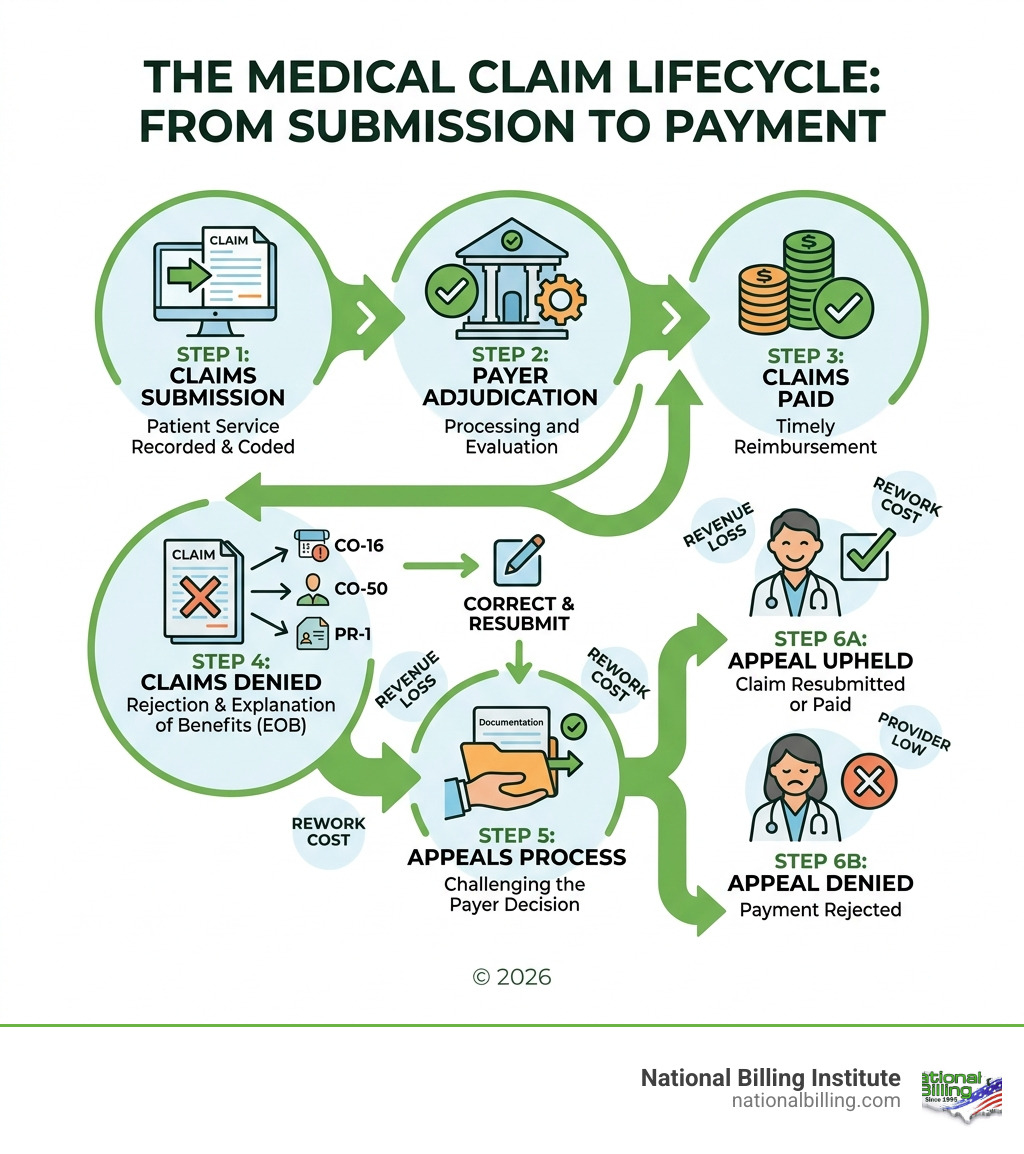
Understanding the Impact of Medical Billing Denial Codes on Revenue
In the world of healthcare, a denied claim is more than just a minor administrative hiccup; it is a direct hit to your bottom line. As we move through May 2026, the financial landscape for healthcare providers remains challenging. Statistics show that the percentage of initially denied claims rose from 10.25% in 2020 to nearly 12% in 2023. For a typical hospital or practice, this translates to millions in "parked" revenue.
The real sting comes from the cost of rework. On average, it costs a practice $43.84 just to investigate and resubmit a single denied claim. If your team is chasing hundreds of these every month, you aren't just losing the original reimbursement; you are paying a premium to get what was already yours.
To manage this effectively, we must distinguish between two types of denials:
Feature Hard Denials Soft Denials Definition A permanent refusal to pay that cannot be corrected with a simple resubmission. A temporary denial that can be fixed and paid after correction. Common Causes Services not covered by the plan, timely filing limits exceeded. Missing modifiers, incorrect member ID, missing documentation. Action Needed Formal appeal or write-off. Correction and resubmission. Prevention Strict Billing Compliance and eligibility checks. Claim scrubbing and staff training.
When we talk about What is Denial Management in Medical Billing, we are talking about the strategic process of identifying the root causes of these codes. Since 70% of RCM leaders report that denial management is more critical today than it was pre-pandemic, ignoring these trends is no longer an option. Revenue leakage occurs when claims are denied and never resubmitted—a fate that befalls nearly 60% of all denied claims.
Decoding the Main Categories of Claim Adjustment Reason Codes
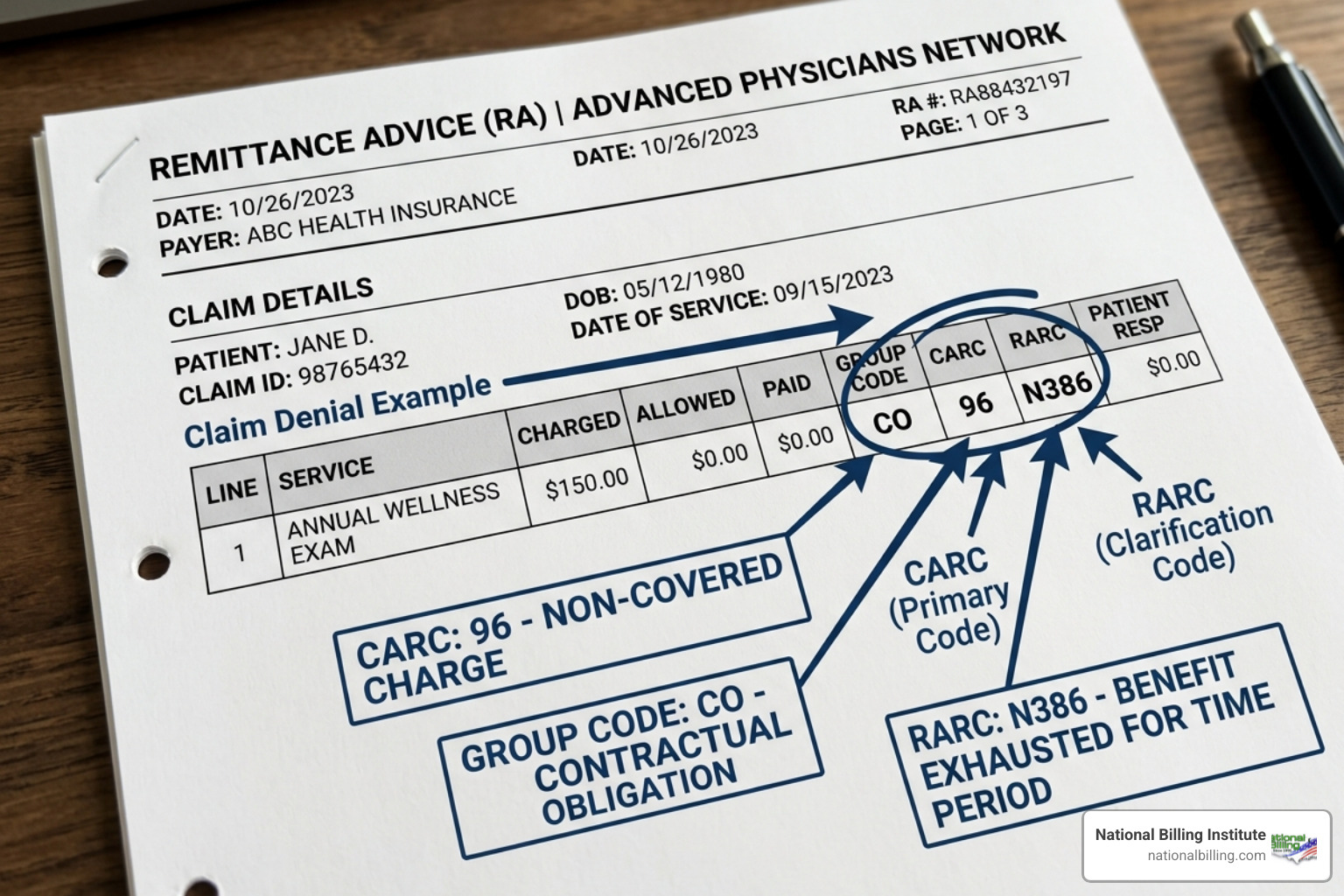
When you receive a remittance advice, the medical billing denial codes you see are technically known as Claim Adjustment Reason Codes (CARC). These codes provide the "why" behind a payment discrepancy. However, a CARC rarely travels alone; it is usually paired with a Group Code and a Remittance Advice Remark Code (RARC).
The Group Codes (The "Who" and "How")
Group codes tell us who is financially responsible for the unpaid portion of the claim.
CO (Contractual Obligation): This is the most common prefix. It indicates that the adjustment is based on a contract between the provider and the payer. These are typically write-offs.
PR (Patient Responsibility): This code means the amount should be billed to the patient (e.g., deductibles, copays).
OA (Other Adjustment): A "catch-all" category used when no other group code applies.
PI (Payer Initiated Reductions): Used when the payer believes the adjustment is not a contractual obligation or patient responsibility.
CR (Corrections and Reversals): Used when a previous adjudication is being corrected.
CARC vs. RARC
Think of the CARC as the primary headline and the RARC as the sub-headline. For example, a CARC might say "Claim lacks information" (Code 16), while the RARC specifies exactly what is missing, such as "Missing NPI" or "Invalid Modifier." For a deep dive into the technical standards, you can refer to the official Claim Adjustment Reason Codes - X12 database.
Resolving the Most Frequent Claim Denials
To stop the bleeding, we have to look at the data. Most practices find that a small handful of codes—roughly 2 or 3 specific reasons—account for 60% to 70% of their total denials. By performing a root cause analysis, we can identify whether the error happened at the front desk (eligibility), in the exam room (documentation), or at the biller's desk (coding).
Common triggers include a lack of medical necessity, coordination of benefits (COB) errors where the wrong insurance was billed first, and credentialing issues where a provider is not yet fully "loaded" into the payer's system.
10 Most Common Medical Billing Denial Codes and Recovery Actions
Let’s get into the "fix-it" manual for the most frequent offenders:
CO-45 (Charge Exceeds Fee Schedule):
What it means: The amount billed is higher than the payer's allowed amount.
The Fix: This is usually a standard contractual write-off. However, if the allowed amount is lower than your actual contract, it flags an underpayment that needs to be disputed.
CO-97 (Bundled Services):
What it means: The payer believes the service is included in the payment of another procedure performed on the same day.
The Fix: Review NCCI edits. If the service was truly distinct, resubmit with an appropriate modifier (like -25 or -59).
CO-50 (Medical Necessity):
What it means: The payer doesn't believe the procedure was required for the diagnosis provided.
The Fix: Check the payer’s Local Coverage Determinations (LCDs). Appeal with clinical notes that prove why the service was vital for the patient's care.
CO-16 (Missing Information):
What it means: You forgot a field on the claim form—maybe an NPI, a date, or a modifier.
The Fix: Identify the missing element via the RARC, add it, and resubmit. This is a classic "soft denial."
CO-15 (Prior Authorization):
What it means: You performed a service that required a "hall pass" from the insurance company, but you didn't get one.
The Fix: These are tough. Try to request a "retroactive authorization," though many payers are strict. Prevention is the only true cure here.
CO-18 (Duplicate Claim):
What it means: The payer thinks they’ve already seen this claim.
The Fix: Often happens when a biller resubmits too quickly without checking status. Verify if the first claim was paid; if not, ensure the second submission is marked as a "Corrected Claim" in Box 22.
CO-11 (Diagnosis Mismatch):
What it means: The ICD-10 code doesn't support the CPT code (e.g., billing a pregnancy test for a male patient).
The Fix: Review the medical record and correct the coding error.
CO-29 (Timely Filing):
What it means: You sent the claim too late. Limits vary from 90 days to one year.
The Fix: Unless you can prove the claim was sent earlier (using a clearinghouse log), this is usually a write-off.
PR-1 (Deductible):
What it means: The patient owes this money before insurance kicks in.
The Fix: Move the balance to patient responsibility and send a statement.
PR-27 (Terminated Coverage):
What it means: The patient’s insurance was not active on the date of service.
The Fix: Contact the patient to see if they have new coverage and bill the correct payer.
Strategies to Reduce Medical Billing Denial Codes
The best way to handle a denial is to never receive it in the first place. This is where Denial Prevention becomes your practice's best friend.
Real-Time Eligibility Verification: 25% of denials are eligibility-related. Verifying coverage before the patient sees the doctor eliminates PR-27 and PR-1 surprises.
Automated Claim Scrubbing: Use software to check for missing modifiers (like the tricky Modifier 25) or NPIs before the claim ever leaves your office.
Standard Operating Procedures (SOPs): Create a clear "playbook" for your staff. If everyone follows the same steps for prior authorization tracking, fewer things fall through the cracks.
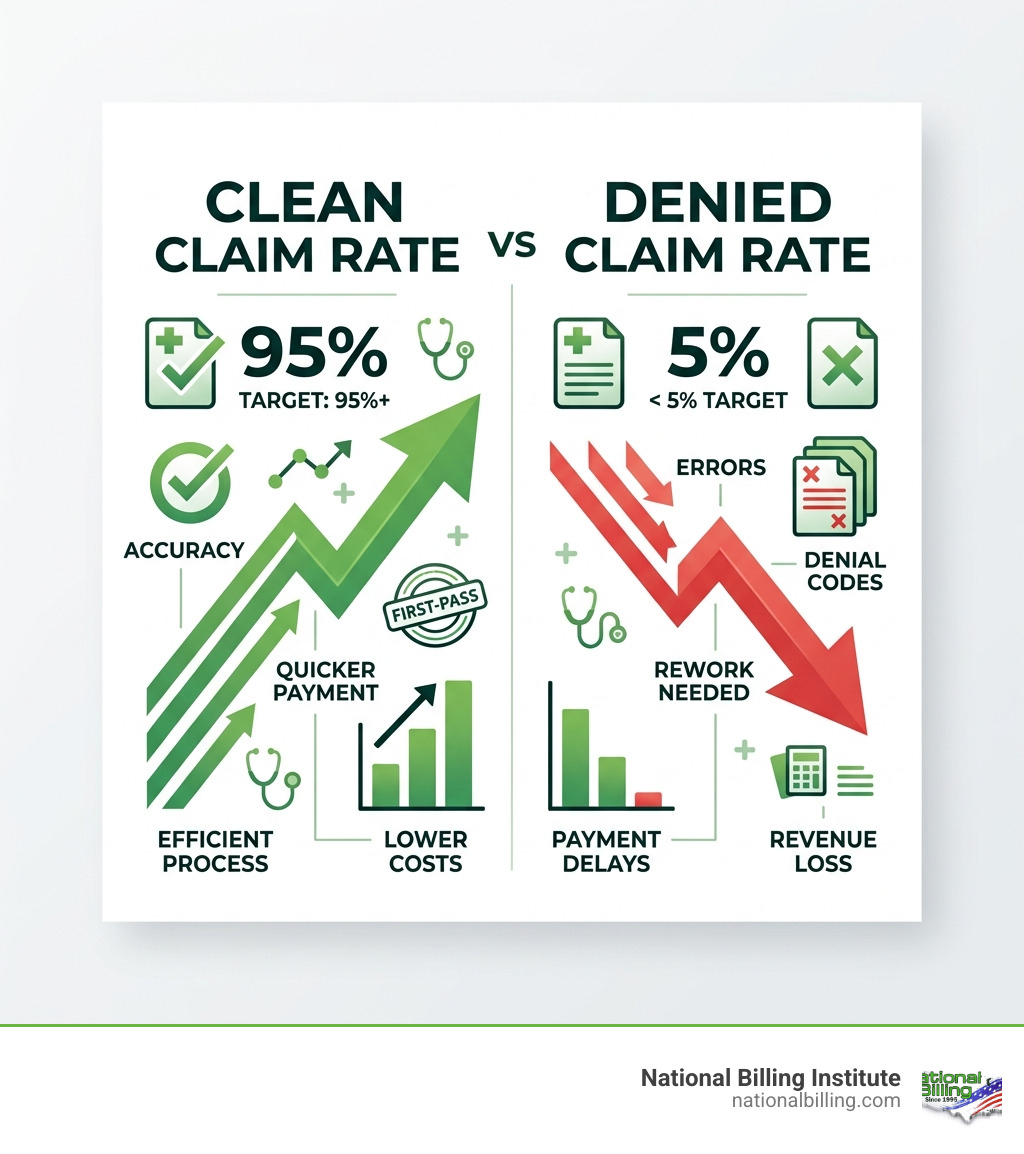
KPI Monitoring: Track your "Clean Claim Rate." If it’s below 95%, you have a process problem that needs addressing.

How to Effectively Appeal and Correct Denied Claims
When a resubmission isn't enough, you must enter the appeal phase. This is a formal request for the payer to reconsider their decision.
The Golden Rules of Appeals:
Watch the Clock: Medicare redetermination requests usually have a 120-day window, but some commercial payers give you as little as 60 days.
Be Specific: Don't just say "Please pay us." Use an appeal letter that cites specific clinical notes, peer-reviewed guidelines, or the payer's own policy manual.
Use the Portal: Most major payers prefer appeals through their online portals rather than snail mail. It’s faster and provides a digital paper trail.
Level Up: If the first appeal is denied, don't stop. Most systems have multiple levels of appeal, including an external review by an independent third party. These external decisions are often legally binding on the insurance company.
Frequently Asked Questions about Medical Billing Denial Codes
What is the difference between a claim denial and a claim rejection?
A rejection happens at the clearinghouse or payer "front door" due to data errors (like a misspelled name). It never enters the payer's adjudication system. A denial happens after the payer has processed the claim and decided not to pay for a specific reason. Rejections are usually easier and faster to fix.
How can I identify the root cause of recurring denial codes?
Use data analytics! Pull a report of your top 10 medical billing denial codes. If CO-15 (Authorization) is high, the issue is in your front-office workflow. If CO-11 (Coding) is high, your coding team needs more training on ICD-10/CPT compatibility.
Can all medical billing denial codes be appealed?
Technically, yes, but practically, no. For example, if a service is explicitly listed as a "non-covered benefit" in the patient's contract, an appeal is unlikely to succeed. Similarly, timely filing denials are nearly impossible to overturn without proof of a payer system error.
Conclusion
Navigating the labyrinth of medical billing denial codes requires a mix of technical knowledge, persistent follow-up, and the right technology. At National Billing Institute, we’ve spent over 30 years perfecting this process. Our 100% USA-based team in Boca Raton, FL, uses AI-automated processing to catch errors before they become denials.
By identifying trends, automating scrubs, and fighting for every dollar through expert appeals, we typically help our clients see a 15-30% increase in revenue. You don't have to let $43.84-per-claim rework costs eat your profits. Maximize your revenue with National Billing and let our experts turn your denials into deposits.
