
Smart Strategies for Proactive Denial Management and Solutions
Why Denial Prevention Should Be at the Core of Your Revenue Cycle
Denial prevention is the practice of stopping claim rejections before they happen — rather than chasing reimbursements after the fact. Here's a quick overview of what works:
Top denial prevention strategies:
Verify patient eligibility before every visit
Obtain prior authorizations on time
Use accurate ICD-10 coding and complete documentation
Scrub claims for errors before submission
Track denial patterns and fix root causes
Automate workflows with AI and RCM technology
Train staff regularly on payer-specific rules
Nearly three-quarters of healthcare administrators say claim denials are getting worse — and the numbers back that up. Denial rates have quadrupled since 2018. The average appeal costs $181 per claim. And up to 90% of those denials were entirely avoidable in the first place.
That's not a billing problem. That's a strategy problem.
When claims get denied, your team spends hours reworking submissions, writing appeal letters, and tracking down documentation — time that could go toward patient care. And for every dollar you fight to recover, you've already spent more than you should have just trying to get paid.
The good news? Most denials follow predictable patterns. That means they can be stopped before they reach the payer.
I'm Olivia Harper, Founder and Denial Management & Reimbursement Specialist at National Billing Institute, and with over 30 years of hands-on experience in revenue cycle management, denial prevention is one of the most impactful — and most neglected — levers available to healthcare practices. In the strategies below, I'll walk you through exactly how to fix that.
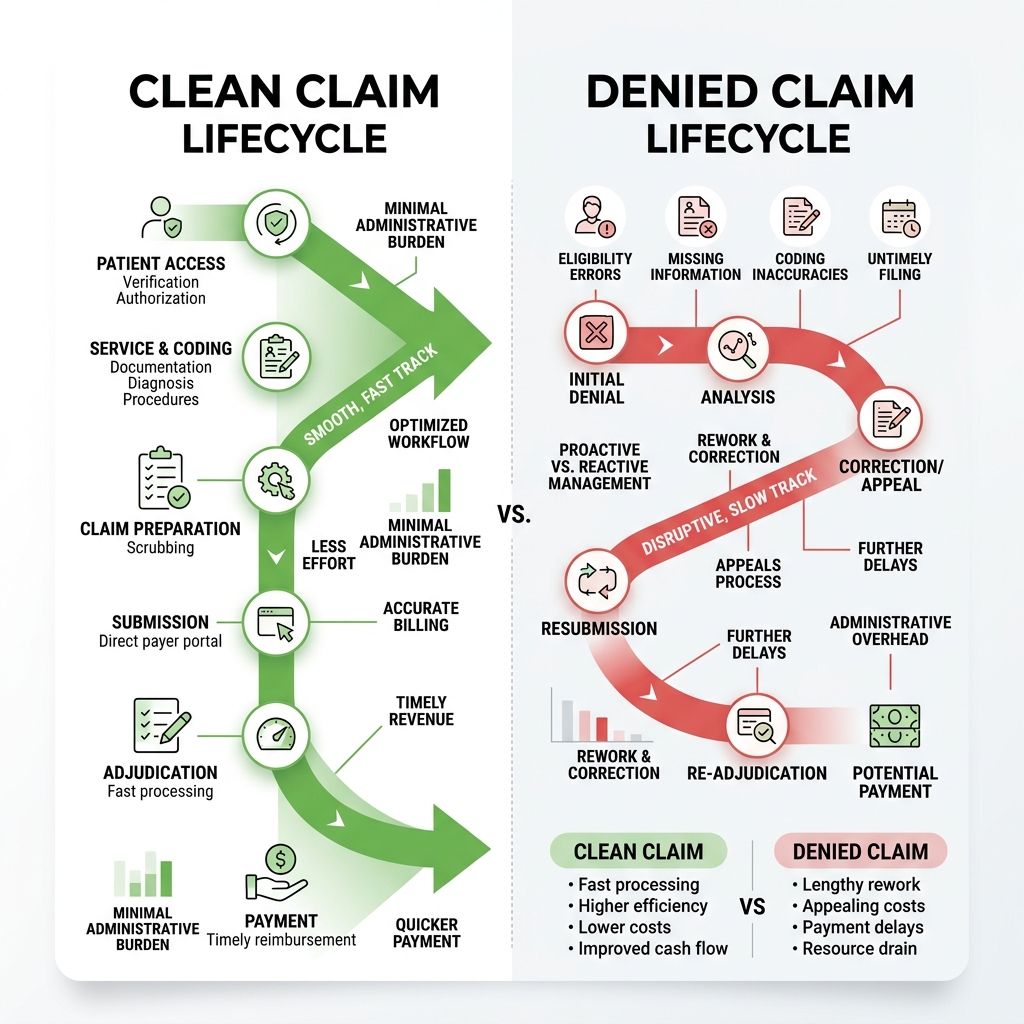
The High Cost of Reactive Denial Management
In medical billing, there is a massive difference between being "reactive" and "proactive." Reactive denial management is like trying to catch water from a leaky pipe with a tiny thimble. You might catch some of it, but the floor is still getting soaked, and you’re exhausted from the effort.
The statistics are sobering. It costs an average of $181 to appeal a single claim. When you consider that 7% to 11% of all claims are underpaid and a significant portion of submitted claims are denied on the first pass, the financial drain is staggering. This "revenue leakage" isn't just a line item; it's the lifeblood of your practice escaping through administrative cracks.
Research shows that 63% of denials are technically recoverable, yet a shocking number of them are never even reworked because the administrative burden is too high. This leads to massive operational inefficiency. Your staff ends up stuck in a "hamster wheel" of re-filing and chasing, rather than moving the practice forward. As highlighted in The Shift from Denial Management to Denial Prevention in Healthcare, the industry is moving away from simply managing the mess and toward stopping the mess from happening in the first place.
Financial and Operational Benefits of Efficiency
When we implement a successful denial prevention strategy, the benefits ripple through the entire organization. First and foremost, cash flow stabilizes. Instead of waiting months for an appealed claim to pay out, you receive the correct reimbursement within the standard 14-to-30-day window.
Beyond the checkbook, efficiency reduces audit risks. Payers often flag practices with high denial rates for closer scrutiny. By submitting "clean" claims the first time, you stay off the radar of aggressive payer audits. Perhaps most importantly, it reduces staff burnout. No one likes doing the same job twice, especially when that job involves arguing with insurance companies. When your team isn't bogged down by reworks, they can focus on patient trust and care quality. 82% of denials are eventually overturned on appeal—which proves that the care was necessary and the claim was valid, but the paperwork was the only thing standing in the way of your payment.

Transitioning to a Denial Prevention Strategy
To move from a reactive state to a proactive one, we have to look at the "why" behind the "no." This is called root cause analysis. Industry data suggests that up to 90% of denied claims are easily avoidable. They aren't denied because the doctor did something wrong; they are denied because a box wasn't checked, a number was transposed, or an authorization was missed.
The core difference between prevention and recovery is timing. Recovery happens after the "Explanation of Benefits" (EOB) says $0.00. Prevention happens at the front desk, in the exam room, and during the coding process. By shifting our focus, we treat the cause of the illness rather than just the symptoms. For a deeper dive into these frameworks, you can review the Best Practices for Denials Prevention and Management.
Implementing a Denial Prevention Framework
Building a prevention framework requires a three-pronged approach: people, process, and technology. We start by optimizing the workflow—ensuring that every person in the chain knows their role in protecting the claim. We must stay updated on ever-changing payer policies, as insurance companies frequently move the goalposts on what they require for a "clean" submission.
At National Billing, we help practices design these strategic plans from the ground up. Whether it's through our 100% USA-based team or our advanced tech stack, we ensure your billing cycle is built for speed and accuracy. You can find More info about National Billing services to see how we bridge the gap between clinical care and financial stability.
Top Strategies for Reducing Claim Denials
If you want to slash your denial rates, you have to target the "Big Three": Eligibility, Authorization, and Coding.
Eligibility Verification: This is the #1 reason for denials. Insurance plans change constantly. A patient might have lost coverage yesterday, or their "COB" (Coordination of Benefits) might list a different primary insurer. Verifying this before the patient sees the provider is non-negotiable.
Prior Authorizations: Authorization issues account for up to 18.2% of all denials. Even if a procedure is medically necessary, if the "Mother May I" step wasn't completed with the payer, they will deny the claim automatically.
Claim Scrubbing: Think of this as a digital proofreader. Before a claim is sent to the payer, it should pass through a "scrubber" that checks for missing modifiers, invalid codes, or mismatched gender/age demographics.
Enhancing Data Accuracy and Documentation
Denial prevention starts at the moment of patient registration. If the front desk enters "Jon" instead of "John" as it appears on the insurance card, that claim is likely headed for a rejection. We also need to look at the clinical notes. If the ICD-10 codes don't match the level of service described in the documentation, payers will flag it for "lack of medical necessity."
Continuous staff training is the only way to keep up. Coding rules change every October and January. If your team is using last year's codes, you are essentially asking the payer to deny your claims. We recommend regular huddles to discuss new payer-specific rules and common errors found in recent internal audits.
The Role of Predictive Analytics in Denial Prevention
We live in the age of big data, and we should use it. Predictive analytics can assign a "risk score" to claims before they are even sent. By looking at historical payer behavior, we can predict which claims are likely to be denied and fix them in real-time.
For example, if we know that "Payer A" always denies a specific code combination unless a specific modifier is attached, our system can flag that claim for manual review. This data-driven decision-making takes the guesswork out of billing and ensures that our team is focusing their energy where it matters most.
Leveraging AI and Automation in Denial Prevention
Artificial Intelligence (AI) and Robotic Process Automation (RPA) are changing the game. At National Billing, we use AI-automated claims processing to handle the repetitive, detail-oriented tasks that often lead to human error.
Machine learning algorithms can scan thousands of claims in seconds, identifying patterns that a human eye might miss. RPA can handle the "grunt work" of checking claim statuses on payer websites, freeing up our expert staff to handle complex appeals and high-level strategy. This isn't about replacing humans; it's about giving humans "superpowers" to ensure no revenue is left on the table.
How AI and Automation Prioritize Denials
Not all denials are created equal. Some are simple "missing info" fixes that can be resolved in minutes, while others require extensive clinical documentation. AI helps us prioritize these by predictive modeling. We can identify "high-value" claims or those with the highest probability of being overturned and move them to the front of the line.
This exception-based processing means our team doesn't waste time looking at "clean" claims. Instead, they only see the "exceptions"—the claims that actually need a human touch. This leads to massive efficiency gains and a significant increase in the first-pass payment rate.
Measuring Success with Key Performance Indicators
You cannot manage what you do not measure. To see if your denial prevention efforts are working, you need to track specific Key Performance Indicators (KPIs).
KPI Industry Average Top Performing Practices Clean Claim Rate 75% - 85% > 95% Initial Denial Rate 5% - 10% < 4% Days in A/R 40 - 50 Days < 30 Days
Tracking KPIs for Continuous Improvement
We don't just look at the numbers once a year. We recommend monthly RCM reviews to dive into root cause reporting. If your denial rate for "Eligibility" spikes, you know you need to retrain the front desk. If "Timely Filing" is an issue, you may have a bottleneck in your coding department.
Tracking the "Collection Ratio" (how much you collected vs. how much you were legally owed) gives you the true picture of your practice's financial health. By constantly monitoring these metrics, we can implement "booster doses" of training and process improvements to keep the revenue cycle healthy.
Frequently Asked Questions about Denial Prevention
What are the most common causes of medical billing denials?
The "usual suspects" include incorrect patient information, lack of prior authorization, services not covered by the plan, and coding errors (like unbundling or incorrect modifiers). Missing documentation to support medical necessity is also a frequent culprit.
How much revenue is typically lost due to denials?
Most practices see a revenue leakage of 5% to 10% due to denials. Considering that 90% of these are avoidable and 67% are recoverable, a practice doing $1 million in billings could be leaving $50,000 to $100,000 on the table every single year.
How can outsourcing RCM help with denial prevention?
Outsourcing to a specialist like National Billing provides you with immediate access to 30+ years of expertise and advanced AI technology without the overhead of hiring and training. We offer scalability—meaning as your practice grows, your billing department grows with you—and a 100% USA-based team that understands the nuances of Florida-specific payers. Check out Why Choose National to see the difference professional management makes.
Conclusion
At National Billing Institute, we believe that healthcare providers should be able to focus on what they do best: healing patients. You shouldn't have to spend your weekends worrying about "denial codes" or "payer tactics."
With over 30 years of experience and a 100% USA-based team in Boca Raton, FL, we’ve mastered the art and science of denial prevention. Our AI-automated processing and proactive strategies typically result in a 15-30% revenue increase for our clients. We don't just manage your denials; we work to eliminate them.
If you're tired of seeing your hard-earned revenue disappear into the "denial black hole," it's time for a change. Let's build a denial-resistant revenue cycle together.
Schedule a Billing Review today and let us show you how we can protect your practice's financial future.
