
The No-Nonsense Guide to Medical Billing Compliance
The Regulatory Framework Governing Healthcare Reimbursement
Navigating healthcare reimbursement often feels like walking through a legal minefield. At the federal level, several heavy-hitting laws ensure that the trillions of dollars flowing through our healthcare system are handled with integrity. With U.S. national healthcare spending reaching $4.87 trillion in 2023 (about 17.6% of the GDP), the government has a massive vested interest in preventing waste.
The "Big Three" laws we always watch are:
The False Claims Act (FCA): This is the government's primary weapon against fraud. It prohibits submitting "false or fraudulent" claims for payment to Medicare or Medicaid. Interestingly, you don't even need "specific intent" to defraud to be liable; "deliberate ignorance" or "reckless disregard" for the truth is enough to trigger massive penalties—up to three times the claim amount plus additional fines per claim.
The Anti-Kickback Statute (AKS): This criminal law prohibits exchanging anything of value (remuneration) to induce or reward patient referrals for services covered by federal healthcare programs.
The Stark Law: Also known as the Physician Self-Referral Law, this prevents doctors from referring patients to entities for "designated health services" if the doctor (or an immediate family member) has a financial relationship with that entity.
Beyond these, the Truth-In-Billing Policy | Federal Communications Commission highlights that even non-medical agencies regulate how we communicate costs. While the FCC focuses on telecommunications, the principle of "clear, non-misleading plain language" in billing is a universal standard for billing compliance.
Regulating Agencies and Enforcement
Who is actually knocking on the door? The Centers for Medicare & Medicaid Services (CMS) sets the rules for the millions of people enrolled in federal programs (including the 77.75 million people in Medicaid and CHIP as of June 2025). Meanwhile, the Office of Inspector General (OIG) acts as the watchdog, performing audits and investigations.
If these agencies find a pattern of non-compliance, the consequences are severe:
Civil Monetary Penalties (CMPs): Fines that can reach hundreds of thousands of dollars.
Corporate Integrity Agreements (CIAs): Forced, high-level monitoring that lasts for years.
Exclusion: The "death penalty" for a practice—being banned from participating in all federal healthcare programs.
The Seven Elements of an Effective Compliance Program

How do we stay out of the crosshairs? The OIG has provided a roadmap. Since 1991, they have endorsed seven core elements that form the foundation of any modern billing compliance program. We use these as our "North Star" at National Billing:
Written Policies and Procedures: You need a "playbook" that everyone can read.
Designated Compliance Officer: Someone needs to be "the buck stops here" person for integrity.
Effective Training and Education: You can't follow rules you don't know.
Effective Lines of Communication: This includes a hotline for anonymous reporting of potential issues.
Internal Monitoring and Auditing: You have to check your own work before someone else does.
Enforcement through Disciplinary Standards: Rules only matter if there are consequences for breaking them.
Prompt Response to Detected Offenses: If you find a mistake, you must fix it and, in many cases, report and return overpayments.
To help you get started, we recommend you Schedule Billing Review with us to see where your current program stands.
Best Practices for Maintaining Billing Compliance
Compliance is not a "one-and-done" checklist; it is a journey of constant diligence. We recommend conducting quarterly internal reviews and at least one annual external audit. External eyes are often better at catching "blind spots" that your internal team might miss.
Internal Audits External Audits Faster and less expensive Provides total objectivity Good for monthly "pulse checks" Identifies complex systemic risks Helps train staff in real-time Essential for legal protection and credibility
By integrating these reviews, you protect your practice from the 20% claim denial rate currently plaguing the industry. For more details on how we handle this, check out More info about our services.
Common Billing Compliance Challenges and Coding Errors
Most billing compliance issues aren't the result of a "secret room" full of people trying to steal from the government. Usually, they are the result of poor training or outdated processes.

The most common "red flags" include:
Upcoding: Billing for a higher-level service than what was actually performed (e.g., billing a complex 99214 visit when the notes only support a 99212).
Unbundling: Breaking a single "package" code into multiple smaller codes to get a higher total payment.
Duplicate Billing: Submitting the same claim twice, often by accident during a re-submission.
Modifier 25 Misuse: This is a huge one. This modifier is for a "significant, separately identifiable" service on the same day as a procedure. If the documentation doesn't show that the service was truly separate, it’s a compliance violation.
MPPR (Multiple Procedure Payment Reduction): In states like Florida, insurers often reduce payment for additional services on the same day. Under Florida PIP laws, these reductions must be explicitly stated in the policy, or they may be unlawful.
The Payments and Billing | Federal Trade Commission also reminds us that unauthorized charges—like billing for "negative options" without express consent—are illegal and fall under the umbrella of consumer protection.
Impact of Coding Standards on Compliance
Coding is the "language" of healthcare. We use CPT (procedures), ICD-10-CM (diagnoses), and HCPCS Level II (supplies/services). If the "translation" is wrong, the bill is wrong.
Accurate coding ensures that the "medical necessity" is clear. If you code a high-level procedure but the diagnosis code suggests a minor scratch, the payer will deny the claim. This is why Why Choose National is so important—our 100% USA-based team understands these nuances better than any automated bot ever could.
Navigating Specialized Regulations: HIPAA, Research, and Patient Protections
Compliance also extends to how we treat patients and their data. The No Surprises Act, for instance, protects patients from "balance billing" for emergency services and requires us to provide "good faith estimates" to uninsured patients. If a final bill is $400 or more above the estimate, the patient has the right to dispute it.
In clinical trials, billing compliance gets even more complex. We use a Billing Coverage Analysis (BCA) to determine exactly what can be billed to insurance (routine care) versus what must be paid for by the study sponsor. "Double-dipping" by billing both is a major federal offense.
HIPAA Requirements in the Billing Workflow
You can't talk about billing compliance without talking about HIPAA. The HIPAA Billing Compliance Guide: Requirements, Enforcement, and Corrective Action Steps explains that compliance sits at the intersection of privacy, security, and "Administrative Simplification."
Key requirements include:
Administrative Simplification: Using standard transactions and identifiers like the NPI (National Provider Identifier).
Encryption: Protecting ePHI (electronic Protected Health Information) both "at rest" and "in transit."
Business Associate Agreements (BAAs): You must have these legal contracts with any vendor (like a billing company) that handles your data.
Access Controls: Ensuring only the people who need to see the data can see it.
Financial Integrity and the Role of Technology in Billing Compliance
The way we recognize revenue is also a matter of compliance. Standards like ASC 606 and IFRS 15 require a five-step process to identify contracts and performance obligations before recognizing income. This prevents "cooking the books" and ensures financial transparency.
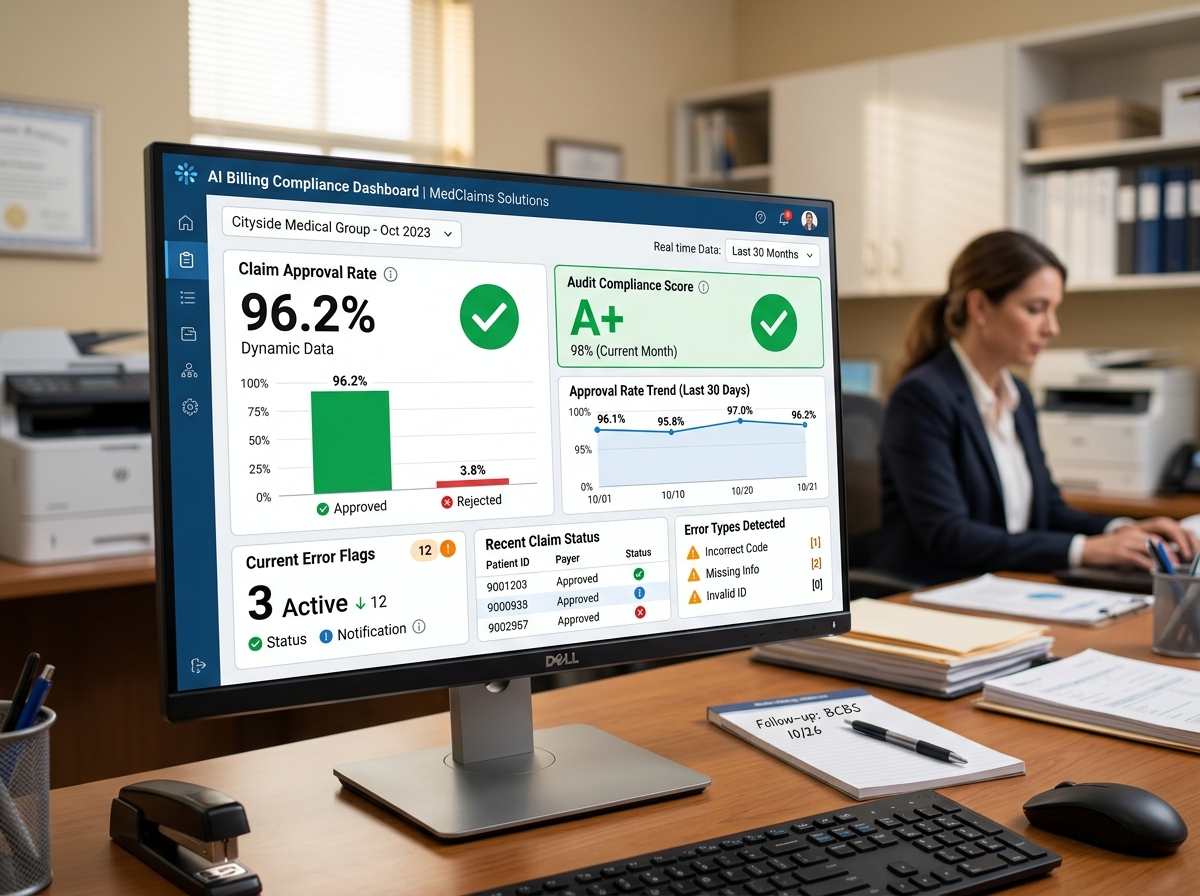
Technology is our greatest ally here. Automation tools can perform "real-time" audits, flagging a claim for a missing modifier before it ever leaves the office. These tools also help with PCI DSS (securing credit card data) and CCPA (California Consumer Privacy Act), which carries penalties up to $7,500 for intentional violations.
Future-Proofing Through Billing Automation
At National Billing, we use AI-automated claims processing to slash denial rates. Automation provides a digital "audit trail" that proves your compliance if an auditor ever comes calling. It handles data normalization for usage-based billing and manages electronic payment gateways securely.
If you are still doing everything manually, you are inviting human error into your revenue cycle. We recommend you Schedule Billing Review to see how automation can protect you.
Frequently Asked Questions about Billing Compliance
What are the most common causes of billing compliance issues?
The "usual suspects" include inaccurate coding (upcoding/undercoding), missing clinical documentation to support medical necessity, and failing to stay updated on payer-specific contract terms. Late claim submissions and unbundling are also frequent triggers for audits.
How does the No Surprises Act affect provider obligations?
Providers must provide a "Good Faith Estimate" of costs before treatment for uninsured or self-pay patients. It also prohibits out-of-network providers from sending "surprise" balance bills for emergency care or for certain services at in-network facilities.
What is a Billing Coverage Analysis (BCA)?
A BCA is a specialized review used in clinical research. It maps out every service in a study protocol to decide if it is "routine care" (billable to insurance) or "research-only" (must be paid by the sponsor). This prevents the illegal practice of billing two different parties for the same service.
Conclusion
Billing compliance is the heartbeat of a healthy practice. It isn't just about avoiding fines; it’s about ensuring the financial and operational integrity of your life’s work. When you get compliance right, you protect your patients, your reputation, and your bottom line.
At National Billing Institute, we take the guesswork out of the process. Our 100% USA-based team in Boca Raton, Florida, brings over 30 years of experience to the table. By combining AI-automated processing with human expertise, we consistently help our clients see a 15-30% increase in revenue while maintaining full HIPAA compliance and the industry's lowest denial rates.
Ready to secure your practice's future? Explore our Services today and let's build a compliant, profitable revenue cycle together.
