
The Robot Revolution in Revenue Management
When Revenue Slips Through the Cracks, Automation Closes the Gap
Automated revenue management is the use of software and rules-based systems to automatically handle pricing, billing, revenue recognition, and reporting — replacing slow, error-prone manual processes with fast, accurate, end-to-end automation.
Here's what you need to know at a glance:
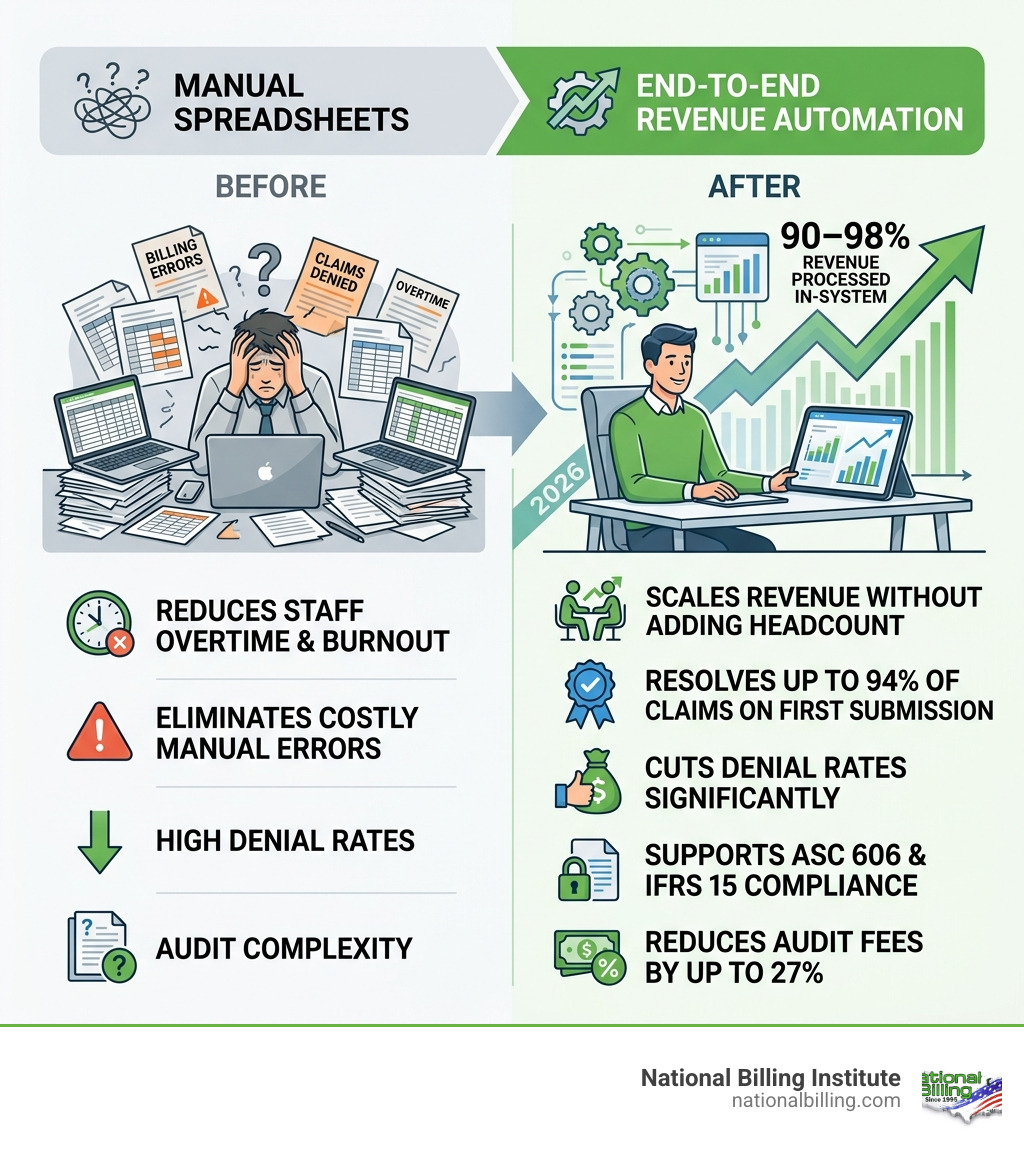
What It Does Why It Matters Automates billing, pricing, and revenue recognition Eliminates costly manual errors Processes 90–98% of revenue in-system Reduces staff overtime and burnout Resolves up to 94% of claims on first submission Cuts denial rates significantly Supports ASC 606 and IFRS 15 compliance Keeps auditors satisfied and reduces audit fees by up to 27% Scales revenue without adding headcount Grows profit without growing costs
Every day, healthcare practices across the US lose money they've already earned. Claims get denied. Billing cycles drag on. Staff burn hours chasing paperwork instead of focusing on patients.
The problem isn't effort — it's the system.
Most practices still rely on spreadsheets, manual data entry, and fragmented processes. And as your patient volume grows, the cracks get wider. A single billing error can trigger a denial. A missed follow-up can mean lost revenue. Multiply that across hundreds of claims per week, and the financial damage adds up fast.
The shift to automation isn't just about saving time. It's about protecting revenue you've already worked hard to earn.
Industry research shows that leaders in revenue automation process 90–98% of all revenue entirely within their systems, with minimal manual intervention. Meanwhile, practices still running manual cycles stay up past midnight reconciling accounts — and still fall behind.
As Andrew Dailey of MGI Research put it:
"What differentiates leaders is that they are able to automate 90%, 95%+ percent of all their revenue, while the others are still staying up past midnight."
That gap between leaders and laggards is growing — and it's measurable in dollars.
I'm Olivia Harper, Founder of National Billing Institute and a denial management specialist with over 30 years of hands-on experience in medical revenue cycle management, including the implementation of automated revenue management systems for healthcare practices nationwide. In this guide, I'll walk you through exactly how automation works, what to look for in a solution, and how to stop leaving money on the table.
Defining Automated Revenue Management in 2026

As we navigate 2026, the definition of automated revenue management (ARM) has moved far beyond simple "billing software." It is now an end-to-end ecosystem. In the past, "automation" might have meant a spreadsheet with a few complex macros. Today, true automation means that 90% to 98% of your revenue flows through the system without a human ever having to touch a keyboard.
The Death of the Spreadsheet
Traditional methods relied heavily on manual data entry into tools like Excel. However, spreadsheets have a practical limit of about 1 million rows. Once you hit that wall, you face the "spinning wheel of death," data corruption, and human error. More importantly, spreadsheets are reactive. They tell you what happened last month, not what is happening right now.
End-to-End Automation
True automated revenue management captures the entire "quote-to-cash" cycle. This includes:
Quotation and Pricing: Dynamically adjusting rates based on demand.
Order Management: Seamlessly moving a sale into the billing system.
Revenue Recognition: Automatically applying complex accounting rules.
Reporting: Real-time dashboards that show exactly where your money is.
When you Why Choose National, you are choosing a partner that understands that "partial automation" is often just a fancy way of saying "I still use spreadsheets." We aim for a system where manual intervention is the exception, not the rule.
Why Modern Businesses Must Automate Revenue Cycles
The business landscape of April 2026 is faster and more regulated than ever before. For many organizations, automation is no longer a luxury—it is "table stakes" for survival.
Compliance and Standards
Accounting standards like ASC 606 and IFRS 15 have made revenue recognition incredibly complex. These standards require businesses to identify specific performance obligations in contracts and allocate revenue accordingly. Doing this manually for thousands of transactions is an invitation for an audit nightmare.
Audit Readiness and M&A
Automating your internal controls can decrease audit fees by as much as 27%, according to Gartner. Why? Because auditors no longer have to spend weeks verifying manual entries; they simply audit the system's logic. Furthermore, many M&A deals fail because the target company cannot prove its revenue recognition is compliant. Automation provides the "get out of jail free" card that keeps investors and buyers confident.
To see how we can take these regulatory burdens off your plate, explore our National Billing Institute Services.
The Role of AI in Automated Revenue Management
Artificial Intelligence is the engine under the hood of 2026 revenue systems. We use AI-native tools rather than "AI add-ons."
Predictive Analytics: AI analyzes hundreds of forecasting models to predict future demand with extraordinary accuracy.
Pacing Anomalies: The system can detect when revenue is coming in slower than usual for a specific period and alert management before it becomes a crisis.
Machine Learning: These systems learn from past denials. If a specific payer changes a rule, the AI identifies the pattern and adjusts the billing logic automatically.
Industry-Specific Applications for Automated Revenue Management
While every business needs to get paid, the way they get paid varies:
Healthcare: Focuses on claims processing and reducing denials. Advanced systems use rules engines to resolve up to 94% of claims on the first try, ensuring steady cash flow.
Hospitality: Uses Infor or Duetto Advance for dynamic pricing, adjusting room rates by the minute based on local events and occupancy.
SaaS and B2B: Focuses on subscription management and usage-based billing, ensuring that as a customer uses more data or seats, the bill adjusts automatically.
Manufacturing: Uses Revenue Analytics to manage complex price exceptions and protect margins against fluctuating raw material costs.
Key Benefits of Implementing an ARM System

The move to automated revenue management isn't just a technical upgrade; it's a financial transformation. The benefits are measurable and immediate.
Metric Manual Process Automated Revenue Management Monthly Work Hours High (100+ hours) Low (Saves 50+ hours) Audit Fees Standard 27% Lower (Gartner) Claim Success Rate ~75% (Industry Avg) 94% (Top-tier ARM) Revenue Visibility Delayed/Monthly Real-time/Instant Error Rate High (Human Factor) Minimal (Rules-based)
Maximizing Profitability with Automated Revenue Management
Automation allows you to scale without adding headcount. We've seen companies increase their contract volume by 100% without hiring a single new billing clerk.
By using Revenue Analytics, businesses often see a 3-10% revenue uplift and a 10x average ROI. This happens through:
Dynamic Pricing: Never leaving money on the table during high-demand periods.
Inventory Optimization: Ensuring the right "product" (whether a hospital bed or a hotel room) is sold to the right customer at the optimal price.
DSO Improvement: Reducing the Days Sales Outstanding (DSO) by getting invoices out faster and following up on payments automatically.
If you're wondering how much revenue you're currently losing, you can Schedule Billing Review with us to find the leaks in your current system.
Essential Features of a Comprehensive ARM Ecosystem
When shopping for an ARM solution in 2026, don't be fooled by "pseudo-automation." Look for these specific features:
CPQ Integration: Your "Configure, Price, Quote" system must talk to your billing system. This ensures that the price promised to the customer is exactly what is recognized by finance.
Billing Rules Engine: For healthcare, this is critical. A robust engine should have tens of thousands of rules (like the 23,000+ rules found in top systems) to "scrub" claims before they are sent.
Real-Time Reporting: You shouldn't have to wait for the "month-end close." You should see your TCV (Total Contract Value) and churn rates in real-time.
Omnichannel Capabilities: Whether you sell via a website, a sales rep, or a third-party partner, all revenue should flow into a single source of truth.
Cloud-Native Architecture: Legacy on-premise systems can't handle the data velocity required today. Cloud-based tools like RevMax allow for agile adjustments from anywhere.
To learn more about how our infrastructure supports these features, visit our Company Info page.
Frequently Asked Questions about Revenue Automation
How does ARM help with financial compliance?
Automated revenue management systems are built with ASC 606 and IFRS 15 at their core. Instead of an accountant trying to remember how to split a $12,000 annual contract into monthly buckets while accounting for a one-time setup fee, the system does it automatically. It creates a permanent, unchangeable audit trail that shows exactly why every penny was recognized when it was.
Which industries benefit most from revenue automation?
While any business with complex billing benefits, the biggest winners are:
Healthcare: Where specialized AI-driven platforms manage the high-velocity world of medical claims and complex payer rules.
Hospitality and Travel: Where Revenue Analytics manages "perishable" inventory like hotel rooms or train seats.
Subscription SaaS: Where recurring billing and "freemium" models make manual billing impossible at scale.
What are the risks of not adopting automated revenue management?
The risks are existential. Beyond just "losing money," manual systems lead to:
Revenue Leakage: Services provided but never billed.
High Denial Rates: In healthcare, this can be the difference between profit and bankruptcy.
Employee Burnout: Your best finance people will leave if they are forced to work until midnight on manual reconciliations.
Audit Failure: Inaccurate books can prevent you from getting loans or selling your business.
Conclusion
The "Robot Revolution" isn't coming; it's already here. In April 2026, the businesses that thrive are those that have stopped "counting beans" and started analyzing data.
At National Billing Institute, we specialize in making this transition painless for healthcare providers. Our AI-automated claims processing and 100% USA-based team (located right here in Boca Raton, FL) consistently deliver a 15-30% revenue increase for our clients. We combine 30+ years of expertise with the latest in automated revenue management to ensure you have the lowest denial rates in the industry while remaining fully HIPAA compliant.
Don't let your hard-earned revenue slip through the cracks of an outdated system. Explore Our Services today and see how we can turn your billing department from a cost center into a growth engine.
