
Winning the race against medical billing filing deadlines
The Clock Is Already Ticking on Your Medical Claims
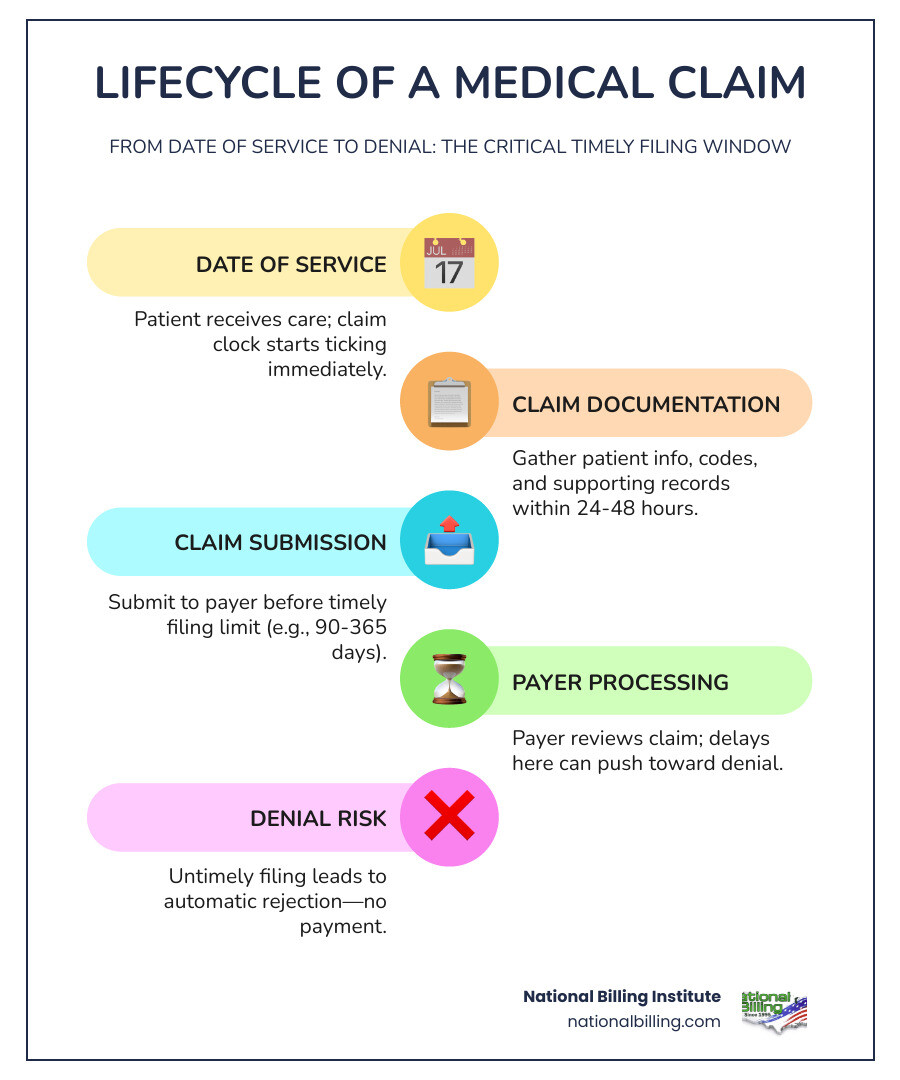
Untimely filing in medical billing happens when a provider submits a claim after the payer's deadline — and the result is almost always a permanent denial with no payment.
Here is a quick breakdown of what that means in practice:
What It Is A claim submitted past the payer's required filing window Common denial code CO-29 (filing limit expired) Who sets the deadline Each payer — Medicare, Medicaid, or commercial insurer Typical windows 90 days to 12 months from date of service Can it be appealed? Rarely — only with documented exceptions Can you bill the patient? Generally no — most payer contracts prohibit it How to prevent it Daily submissions, eligibility verification, automated tracking
These denials are not just frustrating. They are permanent revenue loss.
Unlike coding errors or authorization issues, a timely filing denial usually cannot be fixed after the fact. Once that window closes, the money is gone — and your practice absorbs the cost.
The numbers make this painfully clear. Hospitals lose over $262 billion annually from denied claims. Timely filing consistently ranks among the top five denial reasons. And reworking even one denied claim costs up to $118 — before you factor in the claims that never get resubmitted at all.
The good news? Nearly all untimely filing denials are completely preventable with the right workflows, tools, and habits in place.
I'm Olivia Harper, Founder and Denial Management & Reimbursement Specialist at National Billing Institute, and I've spent over 30 years helping practices across the United States eliminate untimely filing in medical billing through proven, US-based revenue cycle management. In this guide, I'll walk you through exactly how to stop these denials before they happen — and what to do when they do.
Understanding Timely Filing Limits by Payer
Navigating medical billing deadlines feels a bit like trying to solve a puzzle where the pieces keep changing shape. Every payer has their own "ticking clock," and if you don't know the specific rules for each, you're essentially leaving your revenue to chance.
The "timely filing limit" is the window of time a healthcare provider has to submit a claim to an insurance company after the date of service. If the claim arrives one day late, it’s often rejected automatically.
The Major Player Deadlines
To manage your revenue cycle effectively, you must maintain a master matrix of these deadlines. Here is how the landscape looks for major payers in 2025:
Payer Type Standard Filing Deadline Medicare (Part A & B) 12 months (1 calendar year) from the date of service Medicaid (Florida) 12 months (365 days) from the date of service Aetna 120 days to 365 days (varies by contract) UnitedHealthcare 90 days for most commercial plans; up to 1 year for Medicare Advantage Cigna 90 to 180 days Humana 90 days
Anchor Dates: When Does the Clock Start?
It isn't just about the number of days; it’s about when you start counting. Most payers use the Date of Service (DOS) as the anchor. However, there are nuances:
Medicare Part A (Institutional): The clock usually starts from the "Through" date (the last day of the service period).
Medicare Part B (Professional): The clock starts from the "From" date (the specific day the service was rendered).
Secondary Claims: This is a common pitfall. The timely filing window for a secondary payer often starts from the date on the Primary Payer’s Explanation of Benefits (EOB), not the original date of service. If you wait too long to process that primary EOB, you’ll miss the window for the secondary payment.
Common Causes of Untimely Filing in Medical Billing
If everyone knows the deadlines, why do so many claims still get denied? In our 30 years of experience at National Billing, we’ve found that untimely filing in medical billing is rarely caused by a single person "forgetting" to hit send. Instead, it’s usually a breakdown in the workflow.
The Dreaded CO-29 Denial
When you see the code CO-29 on an electronic remittance advice (ERA), it means the filing limit has expired. This is the insurance company saying, "You did the work, but you told us too late, so we aren't paying."
Why Claims Get Stuck
Registration and Eligibility Errors: If a patient provides the wrong insurance card and you don't catch it at the front desk, you might spend 60 days billing the wrong company. By the time you get the rejection and try to bill the correct company, their 90-day window might have closed.
Credentialing Delays: If a new provider starts seeing patients before their credentialing is finalized, claims may sit in "hold" status. If that hold lasts longer than the payer's filing limit, those claims become unbillable.
Clearinghouse Rejections: A claim might leave your billing software but get "stuck" at the clearinghouse due to a formatting error. If your team isn't checking rejection reports daily, that claim sits in limbo while the clock keeps ticking.
Batching Backlogs: Some practices only submit claims once a week. This "batching" creates a dangerous buffer. If a claim is rejected on a Friday but you only bill on Thursdays, you’ve already lost seven valuable days of your filing window.

The Financial Impact of Untimely Filing in Medical Billing
The financial consequences are staggering. Research shows that nearly 7% of net patient revenue is lost annually due to administrative inefficiencies, much of it tied to missed deadlines.
Administrative Waste: The U.S. healthcare system loses over $265 billion a year to administrative waste.
Rework Costs: Reworking a single denied claim costs between $25 and $118.
Lost Revenue: Since 60% of denied claims are never resubmitted, untimely filing in medical billing represents a direct hit to your bottom line that you can never recover.
If you are worried about your current denial rates, we recommend you Schedule Billing Review with us to identify where your revenue is leaking.
Best Practices to Eliminate Submission Delays
At National Billing, we believe the best way to handle an untimely filing denial is to ensure it never happens in the first place. This requires a "front-to-back" approach to the revenue cycle.
1. Daily Claim Submission
The most effective habit a practice can adopt is daily submission. Practices that submit claims every 24–72 hours reduce their denial rates by nearly 20% compared to those that submit weekly. This ensures that even if a claim is rejected, you have plenty of time to fix and resubmit it within the window.
2. Rigorous Front-End Validation
Prevention starts at the front desk. You must verify insurance eligibility before the patient sees the provider.
Confirm the payer ID.
Check for coordination of benefits (COB).
Ensure demographics (name, DOB, ID number) match the card exactly.
3. Prompt Documentation and Signatures
A claim cannot be coded or billed until the provider signs the note. We often see "billing backlogs" that are actually "documentation backlogs." Implementing a policy where charts must be closed within 24 hours is vital for maintaining a healthy filing pace.
To see how our team handles these complexities for you, check out Why Choose National.
Leveraging Technology to Prevent Untimely Filing in Medical Billing
Technology is your greatest ally in the race against the clock. Modern RCM tools, like the AI-automated systems we use at National Billing, provide layers of protection:
Claim Scrubbing: Automatically checking for errors before the claim ever reaches the payer.
Automated Aging Reports: Using reports that flag claims approaching the 30, 60, or 90-day mark allows you to prioritize the oldest claims first.
Real-Time Alerts: Getting an instant notification when a clearinghouse rejects a claim so it can be fixed the same day.
Using automated aging reports alone can cut timely filing denials by up to 30%. If you want to see how your current processes stack up, take our Quiz to evaluate your billing health.
Navigating the Appeals Process for Late Claims
Is a CO-29 denial always the end of the road? Not necessarily, but the burden of proof is high. You cannot simply say, "We were busy." You must provide "Good Cause."
Medicare's "Good Cause" Exceptions
CMS allows for late filing under very specific circumstances. According to the Medicare Appeals Good Cause for Late Filing | CMS guidelines, these include:
Administrative Error: If a representative of the government or a Medicare contractor gave you incorrect information that caused the delay.
Retroactive Eligibility: If a patient was granted Medicaid or Medicare coverage retroactively back to the date of service.
Natural Disasters: Fires, floods, or other major emergencies that destroyed records or prevented access to billing systems.
System Faults: Documented payer system outages that prevented submission.
Proving You Were on Time
If you believe the payer denied a claim in error, you must provide documentation. This is where your record-keeping pays off. You will need:
Clearinghouse Acceptance Reports: This is the "receipt" that proves the claim was sent and accepted by the payer's gateway before the deadline.
Screen Captures: Proof from the payer's portal showing the claim status.
Proof of Primary Payment: If the delay was caused by waiting for a primary payer, include the primary EOB to show you acted as soon as that payment was received.
For more information on how we handle these complex appeals for our clients, visit our Services page.
Legal and Contractual Implications of Late Filing
Your relationship with insurance payers is governed by a contract, and that contract is the final word on timely filing.
Payer Contracts and Patient Billing
A common question we get is: "Can I just bill the patient if the insurance won't pay because we were late?" The answer is almost always no. Most commercial and government payer contracts include a "hold harmless" clause. This means that if the provider fails to meet the contractual obligation of timely filing, they must write off the balance. You cannot penalize the patient for an administrative error on the provider's part. Billing a patient for a timely filing denial is often a violation of your contract and could lead to audits or termination from the network.
Secondary and Tertiary Claims
The legal "clock" for secondary insurance is often misunderstood. For secondary claims, the filing limit typically triggers from the adjudication date of the primary claim.
Example: If Medicare pays a claim on January 1st, and the secondary payer has a 90-day window, you have 90 days from January 1st to get that secondary claim in.
If you are unsure about the specific language in your payer agreements, you can learn more about how we help manage these relationships in our Company Info section.
Frequently Asked Questions about Filing Deadlines
Can I bill a patient for a claim denied due to untimely filing?
As mentioned above, typically no. Most provider agreements with insurance companies state that the provider is responsible for submitting claims within the agreed-upon timeframe. If the provider misses that window, the amount is considered a provider write-off. The patient is only responsible for their standard co-pays, deductibles, or non-covered services as outlined in their EOB.
How do 2025-2026 updates affect timely filing?
The trend in 2025 and 2026 is toward standardization. Many payers are moving toward a 365-day standard to align with Medicare, but some commercial payers are doing the opposite—shortening windows to 60 or 90 days to reduce their long-term liability. Additionally, some states are passing "clean claim" laws that require payers to accept claims within specific timeframes, but these vary wildly by geography.
Does a corrected claim reset the timely filing clock?
No. This is a dangerous misconception. A corrected claim must still be submitted within the payer's specific "correction window," which is often much shorter than the original filing limit (sometimes only 30-60 days from the initial denial). Submitting a corrected claim does not give you a fresh 365 days. If the original claim was filed late, the corrected claim will also be denied for untimely filing.
Conclusion
Winning the race against medical billing deadlines requires more than just speed; it requires a disciplined system. Untimely filing in medical billing is a silent revenue killer that can drain the lifeblood of a practice if left unchecked. By implementing daily submissions, leveraging AI-driven technology, and maintaining rigorous front-end verification, you can ensure that you are paid for every service you provide.
At National Billing Institute, we’ve spent three decades perfecting this process. Our 100% USA-based team in Boca Raton, FL, uses AI-automated claims processing and 30+ years of expertise to maintain the lowest denial rates in the industry. We don't just "process" bills; we optimize your entire revenue cycle to increase your revenue by 15-30%.
Don't let the clock run out on your hard-earned revenue. Explore our full range of Services today and let us help you build a denial-resistant practice.
