
Why Your Claims Get Rejected and How to Fix Them
Why Medical Billing Denials Are Costing Your Practice More Than You Think
Medical billing denials are one of the biggest threats to a healthy revenue cycle — and in 2026, they're getting worse.
Here's a quick overview of the most common reasons claims get denied:
Denial Reason CARC Code Quick Fix Missing or incomplete information CO-16 Verify all fields before submission No prior authorization CO-197 Confirm auth before service is rendered Coordination of benefits error CO-22 Identify primary payer at registration Timely filing exceeded CO-29 Track deadlines per payer Eligibility issues CO-109 Run real-time eligibility checks Duplicate claim CO-18 Use claim scrubbing tools Medical necessity not supported CO-50 Ensure documentation matches diagnosis Diagnosis code issues CO-167 Use current ICD-10 codes with full specificity Non-covered service PR-96 Verify coverage before scheduling Procedure code issues CO-181 Audit CPT codes against documentation
Initial denial rates hit 11.8% in 2024, up from 10.2% in 2020. U.S. hospitals now lose an estimated $262 billion every year to denied claims. And perhaps most alarming: 65% of denied claims are never reworked or resubmitted — meaning that revenue is simply gone.
Every denial is a signal. It points to a breakdown somewhere in your process — at registration, during coding, or in authorization tracking. The good news is that more than 83% of denials are avoidable with the right systems in place.
I'm Olivia Harper, Founder and Denial Management & Reimbursement Specialist at National Billing Institute, where I've spent over 30 years helping practices reduce medical billing denials and recover revenue they didn't know they were losing. In this guide, I'll walk you through exactly why claims get denied, what they're costing you, and how to fix the underlying problems.
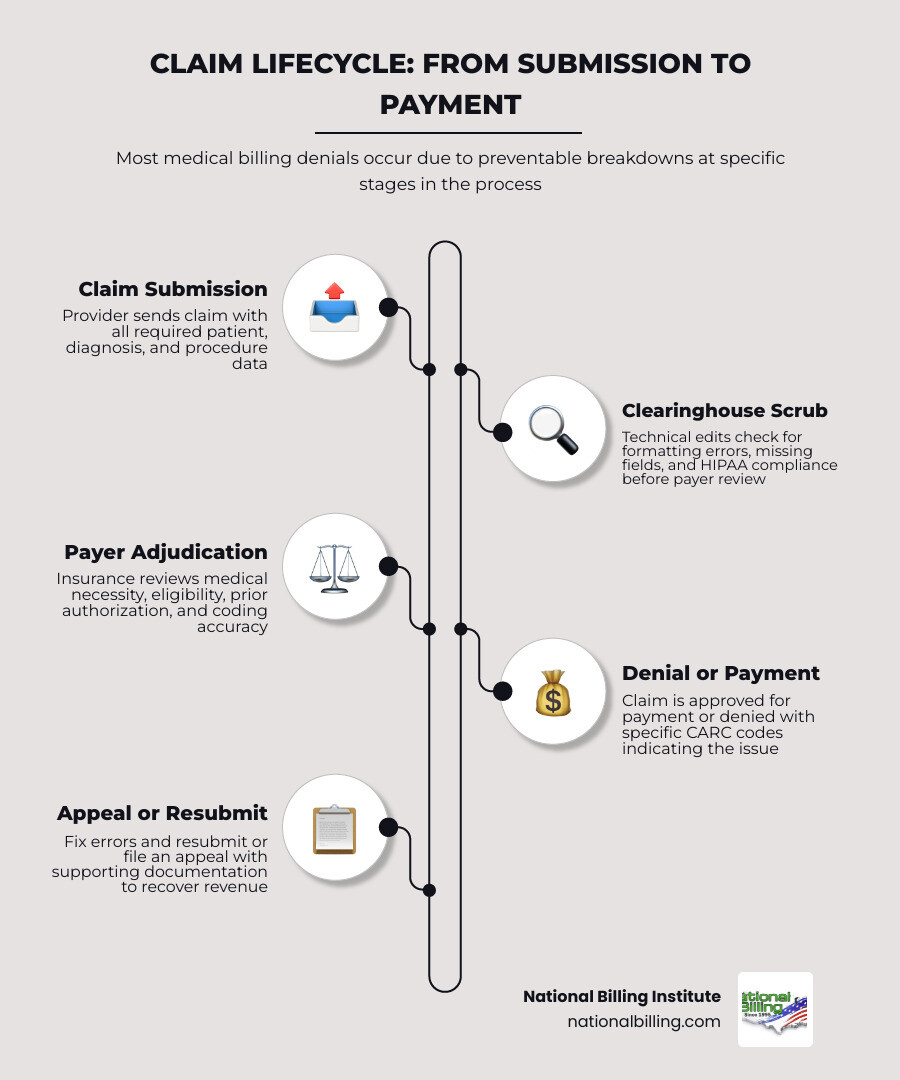
Claim Rejection vs. Medical Billing Denials: Understanding the Difference
In our three decades of experience at National Billing, we’ve found that many providers use the terms "rejection" and "denial" interchangeably. However, from a revenue cycle perspective, they are two very different beasts. Understanding the difference is the first step in What is Denial Management in Medical Billing.
A claim rejection occurs before the claim even enters the payer’s adjudication system. Think of it like a letter returned to the sender by the post office because the zip code was wrong. These are typically technical or formatting errors — like a missing NPI number or a typo in a patient’s date of birth. Because they never "reached" the payer's system, they don't count toward your denial rate, and they can often be fixed and resubmitted immediately.
On the other hand, medical billing denials occur after the payer has received and processed the claim. The payer has looked at the services provided and decided, for a specific reason, not to pay. This is a much more serious issue that requires a formal resolution path.

Feature Claim Rejection Claim Denial When it happens Before processing (at Clearinghouse or Payer Front-end) After processing/adjudication Primary Cause Technical/Formatting errors (e.g., invalid ID) Policy/Clinical/Administrative issues Status Not "on file" with the payer "On file" but unpaid Action Needed Correct and resubmit Appeal or corrected claim with reference number
For a deeper dive into how clinical leaders can help bridge these gaps, see this A Guide to Understanding Common Denial Issues.
Soft Denials vs. Hard Denials
Within medical billing denials, we further categorize them by their "recoverability."
Soft Denials: These are essentially "pends." The payer isn't saying "no" forever; they are saying "not yet." This usually happens when they need more information, such as medical records or a coordination of benefits (COB) update from the patient. These have a high recovery rate if you act quickly.
Hard Denials: These are much tougher. They involve fundamental issues like "non-covered services" or "untimely filing." Appealing a hard denial is an uphill battle and often results in a write-off if the initial error was legitimate. Effective Denials and Appeals Management focuses on turning soft denials into cash and preventing hard denials entirely.
The Role of the Clearinghouse
We like to think of the clearinghouse as the "security guard" of your revenue cycle. Its job is to perform front-end scrubbing—checking for "HIPAA loops" and formatting errors—before the claim ever reaches the payer. A high-performing clearinghouse can prevent nearly all rejections by catching missing modifiers or invalid procedure-to-diagnosis mappings. However, even the best clearinghouse can't catch a clinical denial for "medical necessity" because that requires a human review of the patient's chart.
Top 10 Most Common Reasons for Denied Claims in 2026
As we move through May 2026, the landscape of medical billing denials has shifted. Payers are using more sophisticated AI to find reasons to withhold payment, making Denial Prevention more critical than ever.
Top 10 Medical Billing Denials and Their CARC Codes
To fix a denial, you first have to speak the language of the payer. This language is written in Claim Adjustment Reason Codes (CARC). According to the Top 20 Medical Billing Denial Codes in the USA (2026 Guide), these are the heavy hitters:
CO-16 (Missing/Incomplete Info): This is the "oops" of medical billing. It could be a missing NPI, a missing referring provider, or even a blank field for the "date of onset."
CO-197 (Pre-authorization): This is a rising star in 2026. Payers have increased authorization requirements by 30% over the last three years. If you don't have the number on the claim, you don't get paid.
CO-22 (Coordination of Benefits): This happens when a patient has dual coverage and the wrong payer was billed as primary.
CO-29 (Timely Filing): This is the most painful denial because it is often unrecoverable. Most commercial payers give you 90 to 180 days, but some are even shorter. For Medicare, the window is 12 months, as detailed in our guide on Medicare Appeal Timely Filing.
CO-109 (Eligibility): The patient's coverage was terminated or wasn't active on the date of service.
CO-18 (Duplicate Claim): Often caused by resubmitting a claim before the first one finished processing.
CO-50 (Medical Necessity): The payer doesn't believe the procedure was required for the diagnosis provided.
CO-167 (Diagnosis Code specificity): Using a "generic" code when a more specific one (like laterality—left vs. right) exists.
PR-96 (Non-covered Service): The service is explicitly excluded from the patient's plan.
CO-181 (Procedure/Modifier Error): Using the wrong modifier or an invalid code combination.
Understanding Untimely Filing in Medical Billing is particularly important for back-office teams to ensure claims are prioritized correctly.
Coding Accuracy and Documentation Gaps
Coding isn't just about picking a number; it's about telling a story. In 2026, the story must be highly specific. The 2026 CPT updates brought 288 new codes and 84 deletions, while the October 2025 ICD-10-CM update added 614 new codes.
If your clinical documentation doesn't support the level of service billed (e.g., billing a Level 4 E&M when the notes only support a Level 3), you're inviting a "downcoding" denial. Maintaining Billing Compliance requires a tight loop between what the doctor does in the exam room and what the coder puts on the claim form.
The Financial Impact of Rising Denial Rates on Healthcare Providers
The numbers are staggering. When we look at the industry as a whole, medical billing denials are no longer just an administrative nuisance; they are a financial crisis.
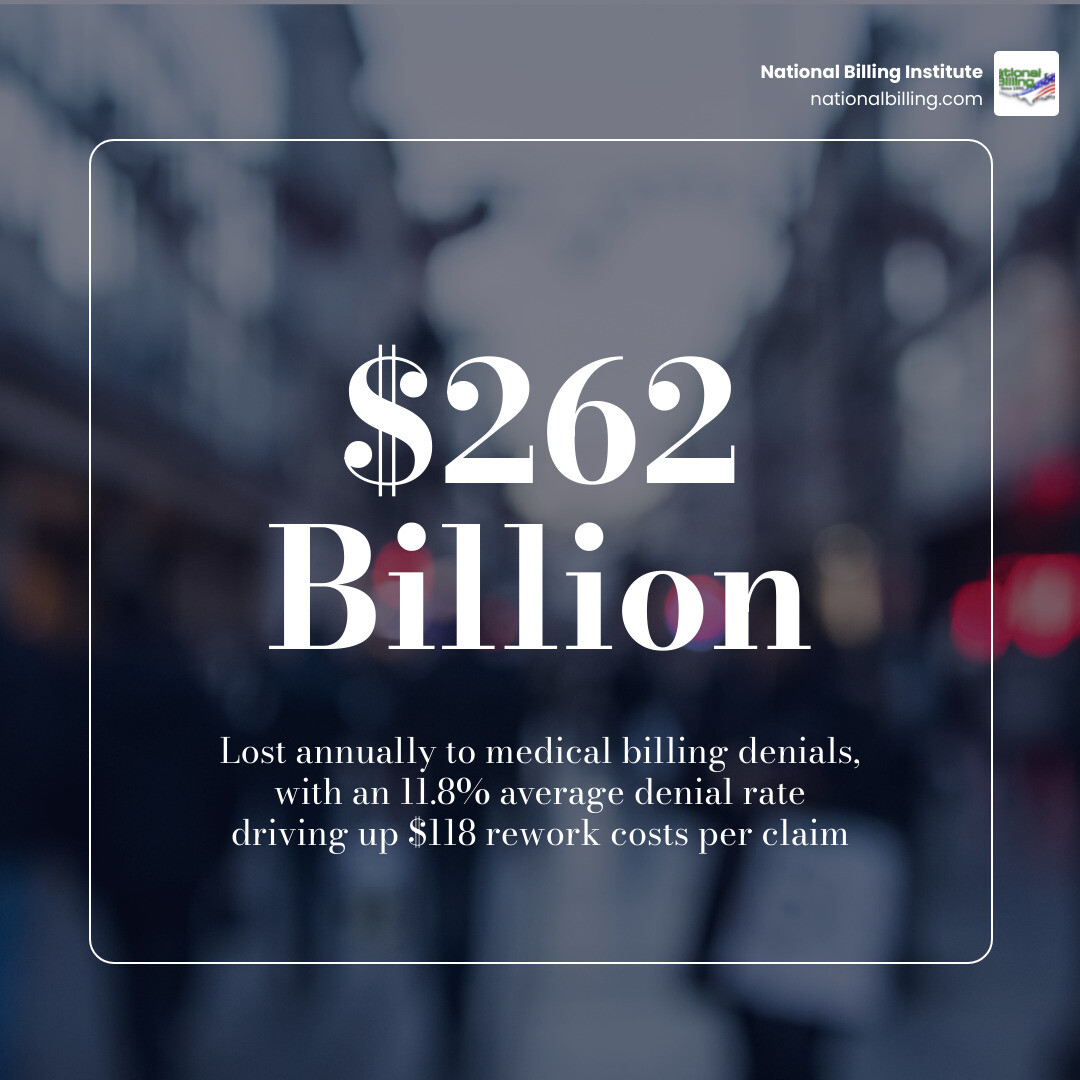
The average cost to rework a single denied claim ranges from $25 for ambulatory practices to $118 for hospitals. If your practice sees 50 denials a week, you could be spending nearly $6,000 a month just on the labor to fix mistakes that shouldn't have happened in the first place. This is why many organizations are turning to professional Revenue Cycle Management Solutions.
The Hidden Cost of Unworked Claims
Perhaps the most heartbreaking statistic in our industry is the 65% abandonment rate. Because rework is so expensive and time-consuming, over half of all denied claims are simply written off. This creates massive cash flow volatility. If you have a 10% denial rate and you only work half of them, you are effectively giving away 5% of your total revenue. Our Denial Reduction Services are designed to stop this "revenue leakage" by ensuring every recoverable dollar is pursued.
Payer Behavior and Automation in 2026
Why are denials rising? It’s an arms race. Payers are now using AI-driven review systems that can scan thousands of claims in seconds, looking for any technicality to trigger a denial. We’ve seen a 30% increase in prior authorization requirements and a significant spike in "technical denials" — rejections based on tiny data mismatches that a human might have overlooked in the past. As the AAPC notes on Denials Management, staying ahead requires a proactive, not reactive, approach.
Best Practices for Effective Denial Management and Prevention
At National Billing, we believe that denial management is an all-hands-on-deck endeavor. It shouldn't just be the billing department's problem.
Leveraging Automation to Prevent Medical Billing Denials
The most effective way to handle medical billing denials is to prevent them before they happen. We recommend a "front-end first" strategy:
Real-Time Eligibility (RTE): Don't wait for the claim to bounce. Check eligibility at the time of scheduling, 48 hours before the visit, and again at check-in.
Automated Claim Scrubbing: Use software that is updated weekly with payer-specific rules and NCCI edits.
Predictive Analytics: Our Revenue Cycle Management Solutions use AI to flag claims that have a high probability of denial based on historical patterns.
RPA for Appeals: Robotic Process Automation can handle the "busy work" of checking claim statuses and even auto-populating appeal forms, allowing your skilled staff to focus on complex clinical appeals.
Closing the Loop: Training and Feedback
The biggest mistake a practice can make is fixing a denial and then moving on. You have to "close the loop." If you see a trend of denials for "missing modifiers" in the Orthopedics department, you need to provide targeted Billing Compliance training to those specific coders or providers.
Monthly trend reporting is your best friend. By categorizing denials by department, payer, and reason, you can identify the root causes. Is it a front-desk registration error? A provider documentation gap? Or a payer-specific policy change? Once you know the "why," you can implement the "how" of Denial Prevention.
Frequently Asked Questions about Medical Billing Denials
What is the difference between a claim denial and a claim rejection?
A rejection is a technical error caught before the claim is processed (like a wrong ID number). A denial is a decision made by the payer after processing the claim not to pay for clinical, administrative, or policy reasons. Rejections can be fixed and resubmitted; denials usually require an appeal.
How long do providers have to appeal a denied claim in 2026?
It varies wildly by payer. Most commercial payers allow between 60 and 180 days from the date of the denial. Medicare generally allows 120 days for a redetermination request. Always check your specific payer contracts, as missing a deadline is a "hard denial" that you cannot win.
When should a practice consider outsourcing denial management?
If your denial rate is above 5%, or if your staff is unable to work at least 90% of your denied claims, it’s time to look for help. Outsourcing to a specialist like National Billing can often pay for itself by increasing your "first-pass" pay rate and recovering the 65% of claims that usually go unworked.
Conclusion
Managing medical billing denials in 2026 requires a mix of expert human knowledge and cutting-edge technology. The days of "submit and hope" are over. Payers are more aggressive than ever, and the financial health of your practice depends on your ability to submit clean claims the first time.
At National Billing Institute, we’ve spent over 30 years perfecting this process. Based in Boca Raton, FL, our 100% USA-based team combines 30+ years of experience with AI-automated processing to help healthcare providers see a 15-30% increase in revenue. We don't just work denials; we engineer them out of your system.
Ready to stop the revenue leak? More info about National Billing services can help you get started on the path to a 98% first-pass clean claim rate.
