
Stop the Rejection with These Denial Reduction Strategies
Why Claim Denials Are Draining Your Practice's Revenue Right Now
denial reduction services are specialized solutions that help healthcare providers prevent, manage, and overturn insurance claim denials — protecting cash flow and recovering lost revenue.
Here's a quick breakdown of what they do and why they matter:
Prevent denials before submission through eligibility checks, coding audits, and prior authorization tracking
Identify and categorize denied claims using CARC/RARC codes and payer-specific rules
Resolve and appeal denials with clinical documentation, appeal letters, and peer-to-peer reviews
Analyze denial trends to fix root causes and reduce repeat denials over time
Recover lost revenue faster through automated workflows and expert follow-up
If you run a medical practice, you've felt this pain: a claim gets denied, your staff spends hours trying to fix it, and meanwhile your cash flow takes a hit. Now multiply that by hundreds of claims per month.
The numbers are staggering. $262 billion in claims are denied every year in the US. Reworking just one denied claim costs an average of $118. And here's the part that stings most — 90% of those denials are completely preventable.
Denials aren't just a billing problem. They're a financial stability problem. And for smaller or mid-sized practices, a high denial rate can quietly erode revenue month after month before anyone notices how bad it's gotten.
I'm Olivia Harper, Founder and Denial Management & Reimbursement Specialist at National Billing Institute, and I've spent over 30 years helping practices across the US implement effective denial reduction services that consistently achieve some of the lowest denial rates in the industry. In this guide, I'll walk you through exactly what's causing your denials and what you can do — step by step — to stop them.
Understanding the Financial Impact of Healthcare Denials
When we look at the landscape of American healthcare finance, the numbers are enough to give any administrator a headache. Nationwide, roughly $262 billion in claims are denied annually, according to industry data from the American Hospital Association. For an individual hospital or clinic, this isn't just a "cost of doing business"—it is a direct drain on the net patient revenue. In fact, preventable denials account for approximately 3% of net patient revenue for the average provider.
The true cost of a denial isn't just the money you didn't get; it's the money you spend trying to get it back. Research shows that reworking a single denied claim costs $118. When you consider that over 33% of hospitals face denial rates exceeding 10%, those $118 increments add up to a massive administrative burden.
Perhaps the most frustrating statistic we share with our clients in Boca Raton and across the US is that 90% of all denials are preventable. This means the vast majority of lost revenue is staying in the pockets of payers simply because of process gaps, missing data, or avoidable coding errors. Without robust denial reduction services, many practices fall into a cycle of "revenue leakage," where they work harder for less money.

Common Root Causes and the Need for Denial Reduction Services
To fix the leak, we first have to find the holes. In our 30+ years of experience, we've found that denials usually stem from a handful of recurring issues. While every payer has their own "flavor" of rejection, the underlying reasons remain remarkably consistent.
The "Heavy Hitters" of Claim Denials
Prior Authorization: This is the leading cause of "hard" denials. If the payer required a "hall pass" before the service and you didn't get it, they often won't pay—period.
Eligibility Errors: The patient’s coverage may have lapsed, or they may have switched plans. If your front desk isn't verifying insurance at every single visit, you're asking for a denial.
Medical Necessity: Payers often argue that a service wasn't "medically necessary" based on their specific (and often shifting) guidelines.
Coding Inaccuracies: Using an outdated CPT code or failing to link it to the correct ICD-10 diagnosis code is a surefire way to trigger an automated denial.
Timely Filing Limits: Every payer has a clock. If you miss the window (sometimes as short as 90 days), the claim is dead on arrival.
Coordination of Benefits (COB): When a patient has two insurances, payers love to point fingers at each other, leaving you unpaid in the middle.
Decoding the Payer Language: CARC and RARC
When a claim comes back denied, it includes Claim Adjustment Reason Codes (CARC) and Remittance Advice Remark Codes (RARC). These are the "why" behind the denial. Effective denial reduction services use these codes to categorize denials so we can spot trends. For example, if you see a spike in "CARC 197" (Precertification/authorization/notification absent), you know your front-end authorization process is broken.
Soft Denials vs. Hard Denials
Understanding the difference between these two is vital for your recovery strategy:
Feature Soft Denial Hard Denial Definition A temporary denial that can be corrected and resubmitted. A permanent denial that usually requires a formal appeal. Common Causes Missing data, incorrect patient ID, or simple coding errors. Lack of authorization, medical necessity disputes, or timely filing. Action Needed Correction and resubmission (often automated). Complex appeal, clinical documentation, or peer-to-peer review. Success Rate Very high with basic denial reduction services. Requires expert clinical and legal intervention.
A Step-by-Step Guide to Overturning Denied Claims
If you’re handling denials in-house, you need a repeatable, disciplined workflow. At National Billing Institute, we’ve refined this into a science to ensure no dollar is left on the table.
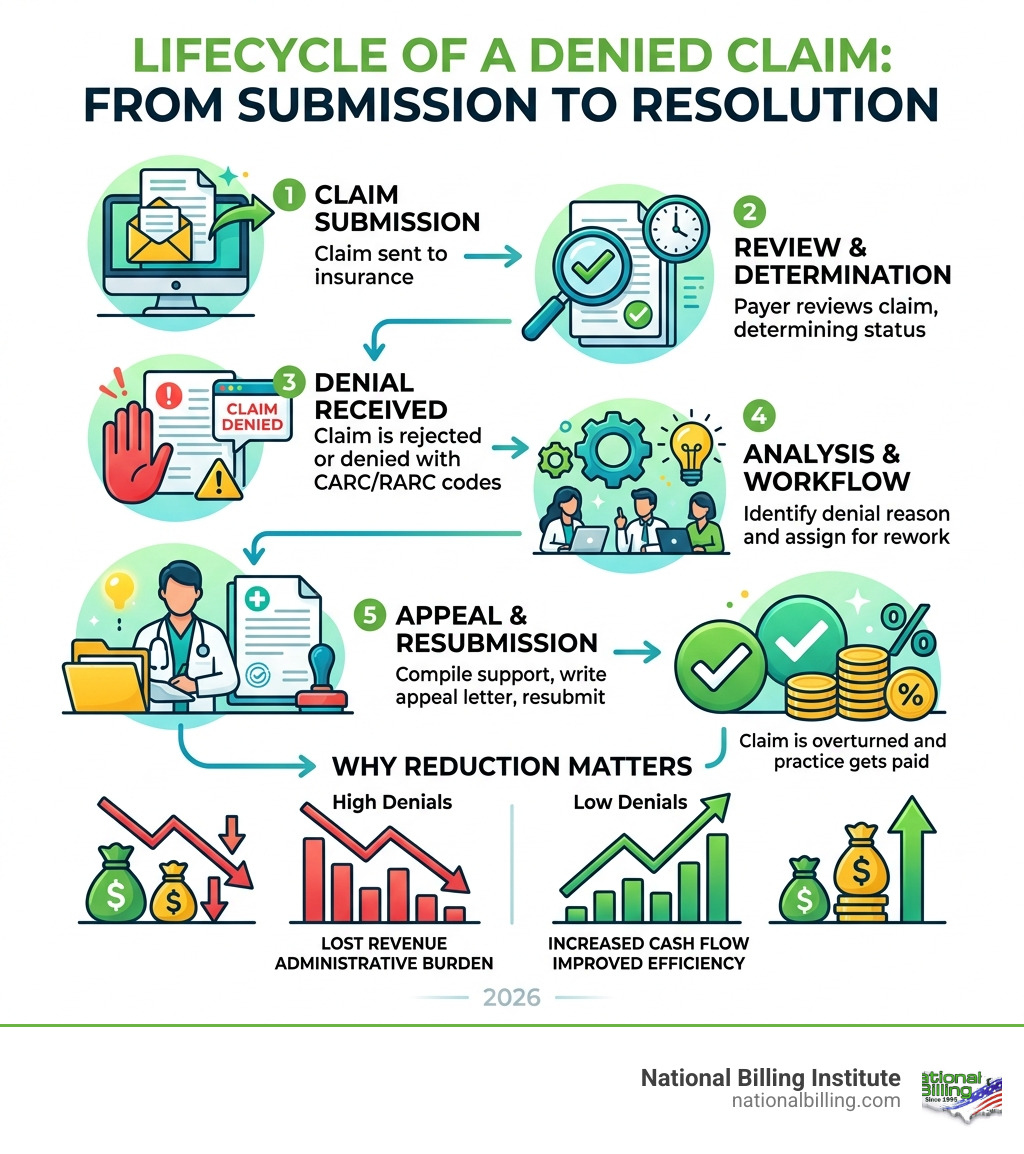
Step 1: Denial Identification & Categorization You can't fix what you don't track. Every denial should be logged and categorized by reason (using those CARC/RARC codes). This allows you to prioritize high-value claims and identify systemic issues.
Step 2: Root Cause Analysis Don't just fix the claim; fix the problem. Was the denial caused by the front desk, the coder, or the physician's documentation? We look for patterns to ensure the same error doesn't happen next month.
Step 3: Clinical Documentation Improvement (CDI) For medical necessity denials, the "fix" is often in the charts. Our team works with providers to ensure clinical notes clearly support the level of care provided. If the documentation is weak, the appeal will fail.
Step 4: The Appeal Process Drafting a winning appeal letter isn't about asking nicely; it's about proving the payer is wrong using their own policies, LCDs (Local Coverage Determinations), and NCDs (National Coverage Determinations).
Step 5: Payer Peer-to-Peer Review When a standard appeal fails, a "Peer-to-Peer" review—where your doctor speaks directly to the insurance company's medical director—can be a game-changer. We've seen hospital clients achieve an ROI in excess of 4x just by utilizing these reconsiderations effectively.
If this sounds like a lot of work, it is. That's why many providers choose to Schedule Billing Review to see how our experts can take this off their plate.
Leveraging AI and Automation in Denial Reduction Services
The "old way" of managing denials was a room full of people with highlighters and spreadsheets. That doesn't work anymore. Modern denial reduction services rely on a "smarter blend" of technology and human expertise.
Claim Scrubbing: We use automated tools to "scrub" claims before they leave the building. This checks for NCCI edits, modifier errors, and missing data points, ensuring a 98% Clean Claim Rate.
Real-Time Eligibility Verification: Our systems integrate with your EHR to verify a patient's coverage before they even see the doctor.
Predictive Analytics: AI can actually predict which claims are likely to be denied based on historical payer behavior, allowing us to fix them proactively.
Robotic Process Automation (RPA): We use "bots" to handle the tedious tasks, like checking claim status on payer portals or transcribing data, which speeds up the resolution process by up to 3x.
By integrating these tools into our Services, we help practices recover revenue that would otherwise be lost to "administrative fatigue."
Proactive Prevention Strategies for Long-Term Success
The best denial is the one that never happens. While recovery is important, prevention is the ultimate goal of any high-quality denial reduction services program.
Continuous Provider Education: We provide feedback loops to your clinical team. If a specific procedure is constantly being denied for "lack of medical necessity," we train the providers on what specific wording the insurance company is looking for.
Front-End Data Capture: Most denials (up to 30-40%) start at the registration desk. We implement checklists to ensure every piece of patient data is captured accurately the first time.
Payer Policy Monitoring: Insurance companies change their rules constantly. Part of our job is to stay on top of these updates so your billing team isn't using last year's rules for this year's claims.
Quality Over Quantity: We don't just "churn" claims. We focus on "quality denials"—those with high clinical merit and high dollar value—to ensure the best possible ROI for your practice.
We are always looking for talented professionals to join our mission of protecting provider revenue; check out our Jobs page if you're a billing expert in the Boca Raton area!
Tracking KPIs for Denial Reduction Services Success
You can't manage what you don't measure. To know if your denial reduction services are actually working, you need to track specific Key Performance Indicators (KPIs).
Essential Metrics for Denial Reduction Services Performance
Denial Rate: This is the percentage of claims denied. A "healthy" rate is below 5%. If yours is over 10%, you are in the danger zone.
Clean Claim Rate: The percentage of claims that pass through the payer's system and get paid on the first try. Our target is always 98% or higher.
Days in A/R (Accounts Receivable): How long does it take for you to get paid? With effective automation, we aim for 3x faster payments than the industry average.
Appeal Success Rate: If you are appealing claims but only winning 10% of them, your strategy is flawed. A high-performing team should see an appeal success rate of 70% or more.
Cost to Collect: This measures how much you're spending to get paid. By outsourcing to a specialized team, you can often reduce administrative costs by up to 30%.
Frequently Asked Questions about Denial Management
What is the difference between a claim rejection and a denial?
It’s a common mix-up! A rejection happens before the claim is even processed. It’s usually due to a simple data error (like a misspelled name or a missing ID number). You can fix these and resubmit them almost immediately. A denial, however, happens after the payer has processed the claim and decided not to pay it based on their rules. Denials are much more complex and often require a formal appeal.
Why are 90% of healthcare denials considered preventable?
Because most denials aren't about the care provided; they're about the paperwork. Errors in insurance verification, failing to get a prior authorization, or simple coding mistakes are all things that could have been caught before the claim was sent. denial reduction services focus on these "front-end" issues to stop the denial before it starts.
How does outsourcing denial management compare to in-house handling?
In-house teams are often overwhelmed by daily billing and patient questions. They rarely have the time to perform deep-dive root cause analysis or fight complex appeals. Outsourcing to a specialized team like National Billing Institute gives you access to:
Advanced AI and Automation that most small practices can't afford on their own.
Dedicated Specialists who do nothing but fight denials all day.
Lower Costs, as you don't have to worry about the overhead of hiring, training, and providing benefits for additional billing staff.
Conclusion
At the end of the day, your focus should be on your patients, not on fighting with insurance companies. But in the modern healthcare environment, ignoring your denials is a recipe for financial disaster.
At National Billing Institute, we take pride in being a 100% USA-based team located right here in Boca Raton, FL. With over 30 years of experience and a deep understanding of the US healthcare system, we provide denial reduction services that don't just "manage" denials—we eliminate them. Our clients typically see a 15-30% increase in revenue and enjoy the peace of mind that comes with full HIPAA compliance and the lowest denial rates in the business.
Don't let the insurance companies keep the money you've earned. Contact Us today to learn how we can transform your revenue cycle and help you get paid what you deserve.
