
The Best Medical Billing Services to Boost Your Practice Revenue Today
Why Getting Medical Billing Right Can Make or Break Your Practice
Medical billing is the process healthcare providers use to submit claims to insurance payers — and follow up on them — to get paid for the services they deliver.
If you're comparing medical billing service providers, here's a quick snapshot of what separates a strong partner from a costly one:
What to Look For Industry Average Top Performer Benchmark First-Pass Acceptance Rate 91.2% 98.4% Net Collection Rate (NCR) 95.1% 98.7% Average AR Cycle Time 34 days 17 days Denial Overturn Rate 45% 78%
The stakes are real. The average provider loses around $180,000 per year from underpaid claims, algorithmic downcoding, and untracked payer variances — often without even knowing it.
And it's getting harder. Payers like UHC have tightened documentation standards, with denials rising 22% nationally in 2026. Medicare Advantage plans now average 5.5% hidden revenue leakage through algorithmic downcoding — even on clean claims.
That means submitting error-free claims is no longer enough. You need a billing partner who can out-maneuver payer systems, recover written-off revenue, and protect your practice's financial health.
I'm Olivia Harper, Founder and Denial Management & Reimbursement Specialist at National Billing Institute, and I've spent over 30 years in medical billing helping practices across the U.S. recover revenue they didn't know they were losing. In this guide, I'll walk you through what separates the best medical billing services — so you can make a confident, informed decision for your practice.
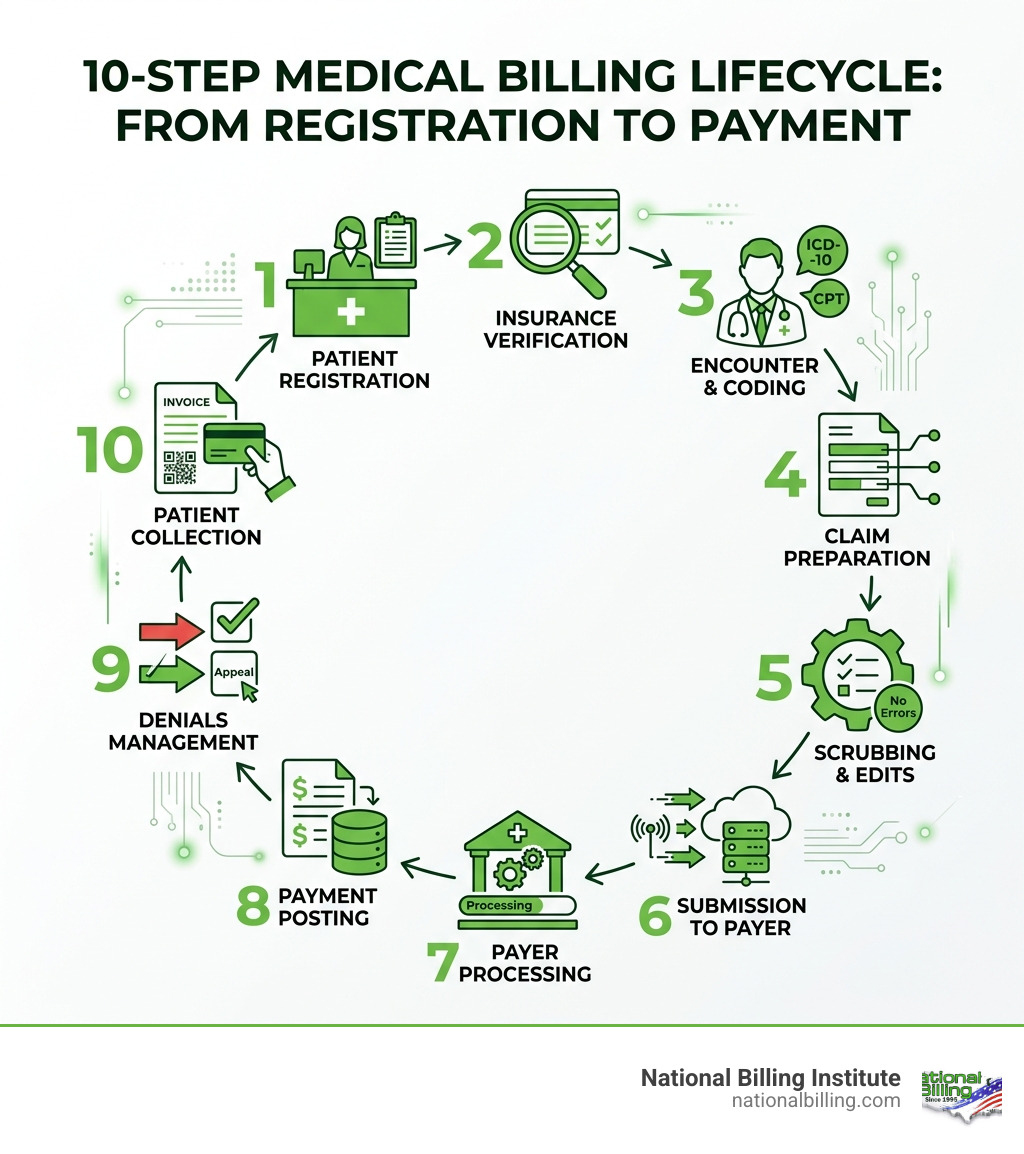
Understanding Medical Billing and the Modern Revenue Cycle
In the U.S. healthcare system, medical billing is the essential bridge between providing care and getting paid for it. It operates within a complex three-party system involving the patient (the first party), the healthcare provider (the second party), and the insurance company or payer (the third party).
While it might seem like a simple invoice-and-check exchange, modern medical billing is actually a high-stakes game of data precision. According to AAPC, it is the process of translating healthcare services into billing claims, following up on those claims, and appealing any denials to ensure the practice remains financially viable.
Without a robust revenue cycle management (RCM) strategy, even the most successful clinical practice can struggle with cash flow. The cycle begins the moment a patient calls to schedule an appointment and only ends when the full balance—from both the insurance and the patient—is settled.

Medical Billing vs. Medical Coding: Knowing the Difference
We often hear these two terms used interchangeably, but they are distinct roles that require different skill sets. Think of it this way: medical coding is the "translation," while medical billing is the "transaction."
Medical Coding: A coder reviews clinical documentation (like doctor’s notes and lab results) and translates them into a universal language of alphanumeric codes. Their job is to tell the story of the patient's visit using standardized sets.
Medical Billing: A biller takes those codes, creates a claim, and navigates the administrative workflow to ensure the payer reimburses the provider. This includes claims submission, payment follow-up, and patient collections.
While a coder ensures the data is accurate according to the medical record, the biller ensures that data actually turns into a deposit in the practice's bank account.
The Role of ICD-10, CPT, and HCPCS Codes
To get paid, we have to speak the payers' language. This involves three primary code sets:
ICD-10-CM (International Classification of Diseases): These are diagnosis codes. With approximately 70,000 codes available, they explain why the patient received care. They establish medical necessity.
CPT (Current Procedural Terminology): These are procedure codes. There are over 10,000 codes that describe what service was performed (e.g., an office visit, a surgery, or an X-ray).
HCPCS Level II: These codes cover products and services not included in CPT, such as durable medical equipment (wheelchairs), ambulance services, and certain medications.
It is important to note that the industry is currently preparing for the ICD-11 transition, which is scheduled to bring even more specificity to the diagnostic process in 2025 and beyond.
The 8-Step Process for Clean Claims and Revenue Integrity
Achieving "revenue integrity" means ensuring that every dollar earned is actually collected. This requires a disciplined 8-step process:
Patient Registration: Collecting accurate demographic and insurance information.
Insurance Verification: Confirming eligibility and benefits before the service is rendered.
Charge Entry: Assigning the appropriate dollar amounts to the codes.
Claim Scrubbing: Using software to check for errors before submission.
Claims Submission: Sending the claim electronically to the payer or clearinghouse.
Adjudication: The payer evaluates the claim to decide how much to pay.
Payment Posting: Recording the payments and adjustments into the practice management system.
Denial Management: Investigating and appealing any claims that weren't paid.
To understand how these steps impact your bottom line, look at the differences between these three claim statuses:
Claim Type Definition Action Required Clean Claim Submitted without errors; accepted on the first pass. None; results in fastest payment. Rejected Claim Contains "fatal errors" (wrong ID number, typos) and was never processed. Correct the error and resubmit immediately. Denied Claim Processed by the payer but deemed "not payable" due to policy or medical necessity rules. Requires a formal appeal process and documentation.
From Superbills to Explanation of Benefits (EOB)
The journey of a claim often starts with a superbill—an itemized form used by healthcare providers to reflect the services provided during a visit. This document is the source material for the biller to create the official claim.
Once the payer processes the claim, they issue an Explanation of Benefits (EOB) to the patient and an Electronic Remittance Advice (ERA) to the provider. These documents break down:
The Charged Amount: What the doctor billed.
The Allowed Amount: The maximum amount the insurance will pay based on their contract.
Contractual Adjustments: The "write-off" difference between the billed and allowed amounts.
Patient Responsibility: What the patient owes in the form of copays, deductibles, or coinsurance.
Managing Denied vs. Rejected Claims in Medical Billing
Understanding the difference between a denial and a rejection is critical for your staff's productivity. A rejected claim is like a letter returned to the sender because the address was wrong; it never made it into the payer's system. These should be fixed and sent back within 24 hours.
A denied claim, however, is more complex. It means the payer received the claim but refused to pay it. Common reasons include "lack of medical necessity" or "prior authorization not obtained." These require a deep understanding of payer requirements and strict adherence to resubmission timelines. At National Billing, we focus on high-level appeal strategies to overturn these denials, as many practices simply leave this money on the table.
The Evolution of Billing: AI, Automation, and HIPAA Compliance
The history of medical billing is a fascinating journey from the 18th-century "honorarium" system—where physicians in England weren't even allowed to sue for payment—to today's high-tech landscape. In the U.S., the 19th century saw a shift toward contract-based fees, but the real revolution happened in 1996 with the passage of HIPAA.
HIPAA mandated the electronic submission of most claims, leading to the development of standardized X12 transactions (like the 837 for claims and the 835 for payments). More recently, the No Surprises Act has added new layers of protection for patients, requiring providers to give "good faith estimates" to uninsured or self-pay patients, ensuring they aren't hit with unexpected bills.
You can explore our full range of Services to see how we navigate these complex regulations for our clients.
Overcoming Modern Challenges with Technology
In 2026, the biggest threat to practice revenue isn't just human error—it's algorithmic downcoding. Payers are now using sophisticated AI to automatically lower the level of service billed, resulting in a hidden leakage of about 5.5% per claim.
To fight back, we use AI-automated claims processing. Our software identifies potential errors and "payer variances" before the claim is even submitted. This technology allows our team to focus on high-level strategy rather than manual data entry.
Why Outsourcing to a Professional Service is Essential in 2026
Many practices wonder if they should keep their billing in-house. While it offers a sense of control, the reality is that in-house billing often leads to higher overhead and lower collection rates. Between salaries, benefits, software costs, and the need for constant training on new codes, the costs add up quickly.
When you partner with National Billing Institute, you gain access to a 100% USA-based team in Boca Raton, FL, with over 30 years of experience. Our clients typically see a 15-30% increase in revenue simply because we have the payer intelligence to out-compute the insurance algorithms.
We don't just "process" claims; we manage your entire revenue cycle to ensure you are paid every cent you are owed. You can learn more about our philosophy on Why Choose National.
Maximizing Revenue and Reducing Provider Burnout
The average annual loss per provider from untracked payer variance is $180,000. That is a staggering amount of money that could be used to expand your practice, hire more staff, or invest in new equipment.
By focusing on the Net Collection Rate (NCR)—which measures how much you actually collect versus what you are legally entitled to collect—we move beyond "vanity metrics" like the clean claim rate. Our goal is to reduce your AR cycle time (the time it takes to get paid) from the industry average of 34 days down to 17 days.
This efficiency doesn't just help your bank account; it helps your mental health. When you aren't worried about whether the lights will stay on, you can focus on what you went to medical school for: caring for patients.
Career Outlook: Salary Expectations and Professional Certifications
For those looking to enter the field, the future is bright. Employment for medical insurance billers and health information technicians is projected to grow 16% from 2022 to 2032, which is much faster than the national average for all occupations.
Median Salary: The median pay for insurance specialists in medical billing was $58,250 in 2022.
Certifications: While not always legally required, certifications are highly recommended. The Certified Medical Reimbursement Specialist (CMRS) from the American Medical Billing Association (AMBA) and the Certified Professional Biller (CPB) from AAPC are the gold standards.
Earning these credentials demonstrates a mastery of the complex rules governing reimbursement. You can find more details on Understanding Billing & Coding | American Medical Billing Association.
Frequently Asked Questions about Medical Billing
What is the difference between a denied and a rejected claim?
A rejected claim has technical errors (like a misspelled name or wrong ID number) and is sent back by the clearinghouse or payer before it is even processed. A denied claim has been processed but the payer has decided not to pay it based on coverage rules or medical necessity. Rejections are fixed; denials are appealed.
How has the No Surprises Act impacted patient billing?
The No Surprises Act protects patients from unexpected "balance billing" when they receive emergency care or are treated by an out-of-network provider at an in-network facility. It also requires providers to give "good faith estimates" to uninsured patients, increasing transparency in the billing process.
Why is the clean claim rate considered a "vanity metric" in 2026?
A "clean claim" simply means the claim was submitted without technical errors. However, a claim can be "clean" and still be downcoded by a payer algorithm, resulting in you getting paid less than you deserve. In 2026, we focus on the Net Collection Rate (NCR) to ensure you are receiving the full contracted amount, not just an "accepted" claim.
Conclusion
At the end of the day, your practice is a business, and its financial health depends on the precision of your medical billing process. With payer denials on the rise and complex algorithms working against you, "good enough" billing is no longer an option.
We invite you to Schedule a Billing Review with our team. We’ll perform a free revenue integrity audit to show you exactly where your practice might be leaking revenue. Let us handle the complexities of the revenue cycle so you can get back to the heart of healthcare.
Ready to see how much more your practice could be earning? Explore our full Services and take the first step toward total financial optimization today.
