
The Ultimate Guide to Revenue Cycle Management for Healthcare Providers
Why Revenue Cycle Management Healthcare Determines Your Practice's Financial Future
Revenue cycle management healthcare is the end-to-end process of tracking and collecting payment for patient care — from the moment a patient schedules an appointment to the moment their final balance is paid.
Here's a quick breakdown of what it covers:
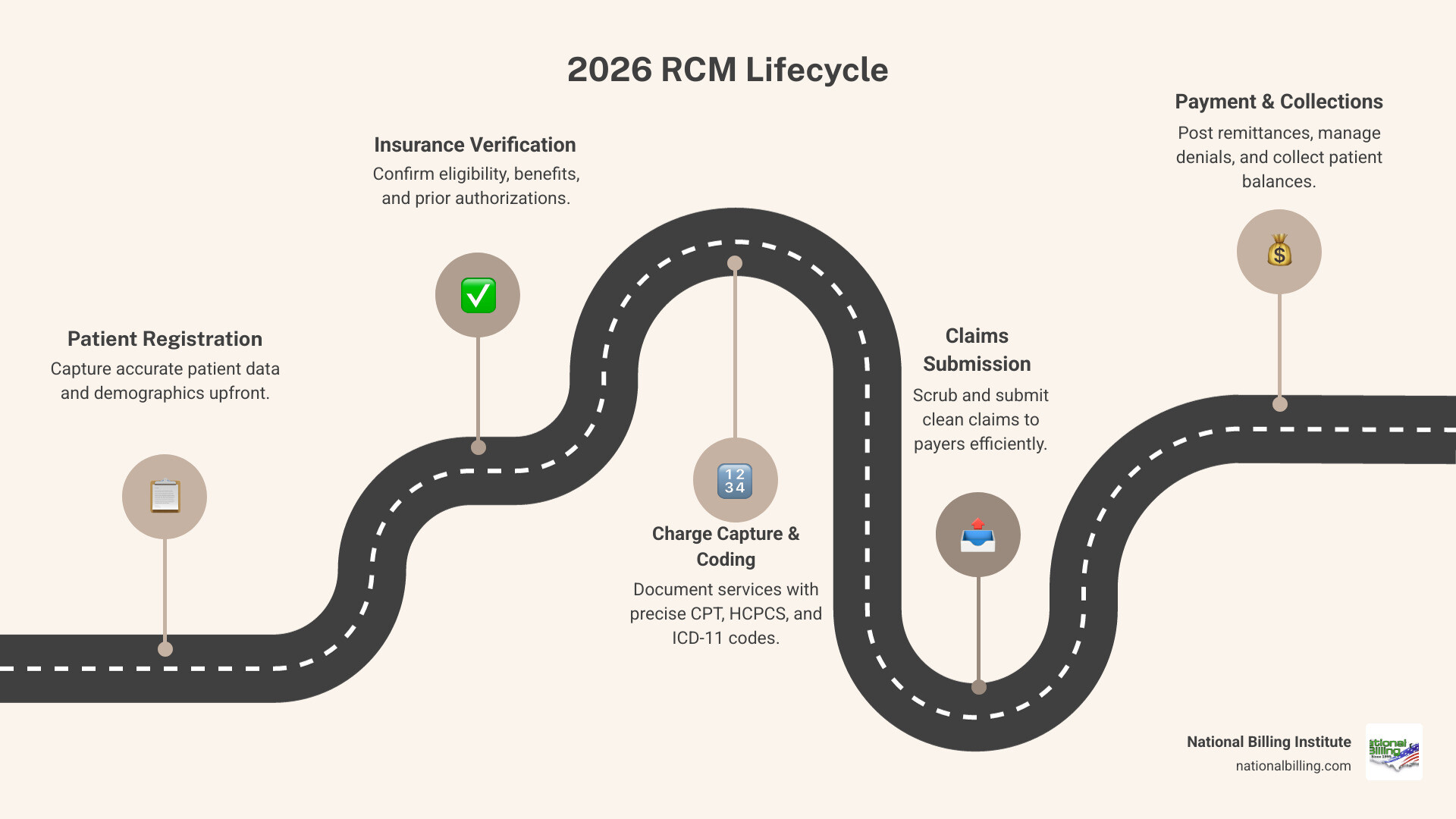
Stage What Happens Front-End Patient registration, insurance verification, prior authorizations Mid-Cycle Medical coding, charge capture, clinical documentation Back-End Claims submission, payment posting, denial management, patient collections
The bottom line: A well-run revenue cycle means your practice gets paid accurately and on time. A poorly run one means lost revenue, rising denial rates, and cash flow problems.
The numbers make the stakes clear:
Hospitals lose roughly $262 billion per year from denied claims
Providers fail to collect 2%–5% of net patient revenue due to inefficient RCM
Denial rates typically run between 5% and 10% — but many of those denials are preventable
For most healthcare providers, RCM isn't just a billing function. It's the financial backbone of the entire practice. And in 2026, with rising administrative complexity, tighter payer rules, and growing patient payment burdens, getting it right matters more than ever.
I'm Olivia Harper, Founder of National Billing Institute and a denial management and reimbursement specialist with over 30 years of hands-on experience in revenue cycle management healthcare. In this guide, I'll walk you through everything you need to know to protect your revenue, reduce denials, and keep your practice financially healthy.
What is Revenue Cycle Management Healthcare?
In its simplest form, Revenue cycle management is the "central nervous system" of a healthcare organization’s financial health. It encompasses every administrative and clinical function that contributes to the capture, management, and collection of patient service revenue.
Think of it as the entire journey a dollar takes from the time a patient calls to book an appointment until that dollar is safely deposited in your practice's bank account. This isn't just about "sending out bills." It involves complex interactions between patients, providers, and insurance companies (payers).
Effective revenue cycle management healthcare ensures that:
Services provided are accurately documented and coded.
Insurance eligibility is confirmed before care is delivered.
Claims are submitted without errors.
Payments are posted correctly.
Denials are appealed and resolved promptly.
Without a structured RCM process, even the busiest medical practice can struggle to survive. When you consider that the global RCM market is estimated at $344 billion as of 2024 and projected to grow significantly by 2030, it’s clear that this is a massive, essential part of the modern healthcare ecosystem.
The Evolution of RCM in 2026
As we navigate through April 2026, the landscape of revenue cycle management healthcare has shifted dramatically from the paper-heavy days of the past. We are now firmly in the era of digital transformation.
Several key trends are defining RCM today:
Value-Based Care: We are moving away from traditional fee-for-service models toward payments based on patient outcomes and quality of care. This requires more sophisticated data tracking and reporting.
Price Transparency: Patients are now savvy consumers. New regulations require providers to give clear, upfront cost estimates. Our teams at National Billing Institute prioritize this transparency to help build trust between you and your patients.
Regulatory Compliance: With the full implementation of ICD-11 and stricter HIPAA enforcement, staying compliant is a moving target that requires constant vigilance.
AI Integration: Automation is no longer a luxury; it’s a necessity to handle the "brutal" scale of modern claims processing without burning out your staff.
The Core Stages of the Healthcare Revenue Cycle

The revenue cycle is often divided into three distinct phases: front-end, mid-cycle, and back-end. Each stage is a link in a chain; if one link breaks, the whole process fails.
Front-End: Patient Access and Eligibility
The front-end is where the foundation for a clean claim is laid. Mistakes made here—like misspelling a name or missing a digit in a policy number—account for a massive portion of downstream denials.
Preregistration and Scheduling: Collecting accurate demographic data right at the start.
Insurance Eligibility: This is critical. In 2026, we use real-time eligibility checks to confirm coverage, deductibles, and co-pays before the patient even walks through the door.
Prior Authorizations: Failing to get the "green light" from a payer for a specific procedure is a leading cause of non-payment.
Cost Estimates: Providing patients with their out-of-pocket responsibility upfront improves collection rates and satisfaction.
At National Billing, we emphasize that a strong preregistration process sets the financial tone for the entire encounter. You can learn more about how we optimize these early touchpoints by visiting our page on Why Choose National.
Mid-Cycle: Documentation and Coding Integrity
Once the patient is seen, the "mid-cycle" begins. This is where clinical care is translated into data.
Clinical Documentation: If it isn't documented, it didn't happen (and you can't bill for it).
Medical Coding: Using standardized systems like CPT, HCPCS, and ICD-11 to describe the diagnosis and the services rendered. According to AAPC, accurate coding is the bridge between the provider's work and the payer's reimbursement.
Charge Capture: Ensuring every supply used and every minute of service is accounted for. Many practices "leave money on the table" simply by forgetting to bill for ancillary services.
Back-End: Claims Management and Collections
The final phase is where the money actually moves.
Claim Scrubbing: This is the process of checking claims for errors before they are sent to the insurance company. Our goal is a "clean claim rate" of 95% or higher.
Remittance Processing: When the insurance company pays, we reconcile that payment against the original claim to ensure you were paid the full contracted rate.
Denial Management: If a claim is rejected, we don't just "post and go." We perform a root-cause analysis and appeal the decision.
Patient Billing: For the portion the patient owes, we provide clear statements and flexible payment options.
If you feel your back-end processes are lagging, you can Schedule Billing Review with us to identify where the "leaks" in your revenue are occurring.
Maximizing Financial Stability through KPI Monitoring
You cannot manage what you do not measure. In revenue cycle management healthcare, Key Performance Indicators (KPIs) are the vitals of your practice's financial health.
Benchmarks for Success in 2026
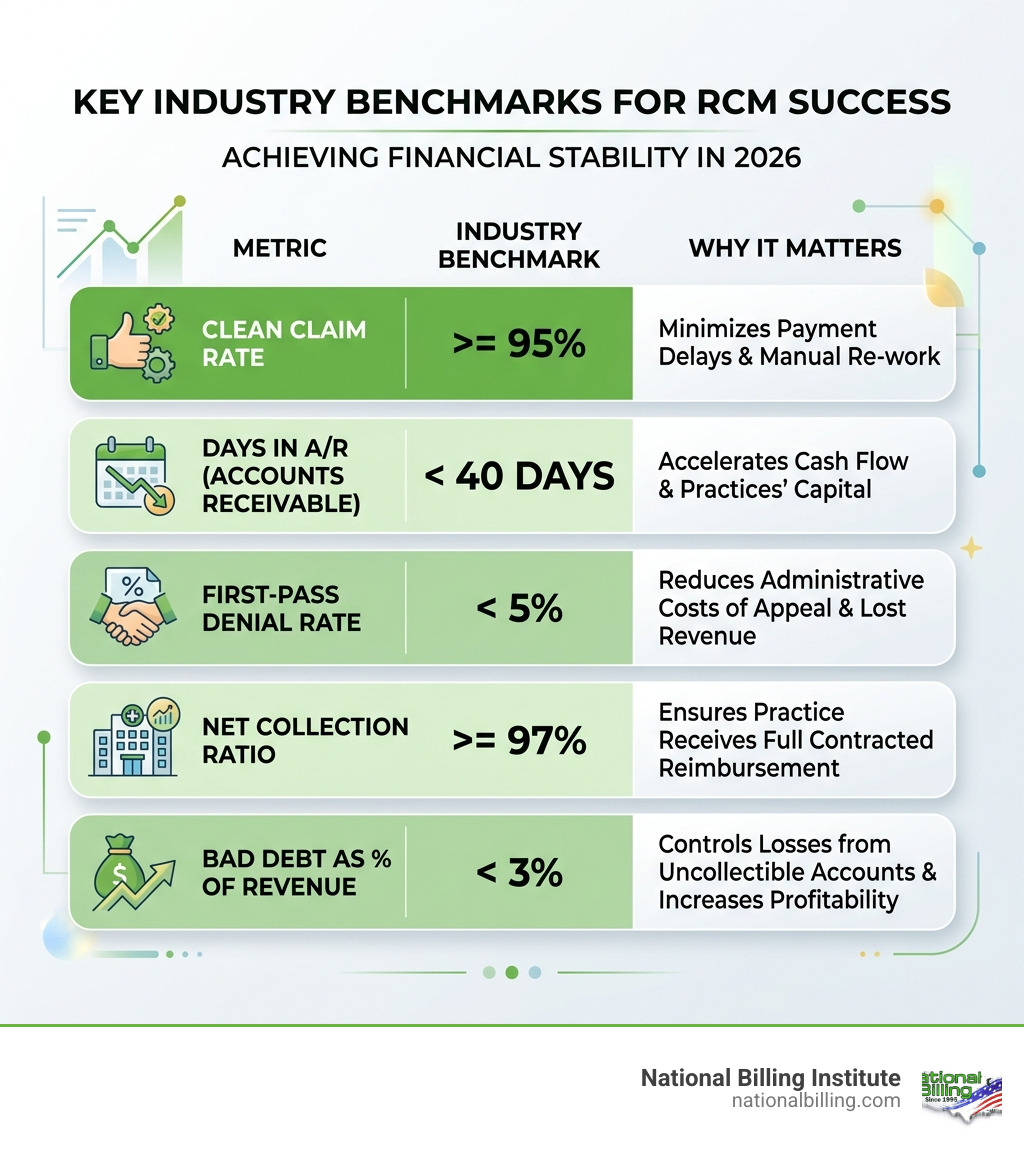
To stay competitive and profitable in 2026, healthcare providers should aim for these industry-standard benchmarks:
Metric Industry Benchmark Why It Matters Clean Claim Rate 95% or higher Indicates how many claims are accepted on the first pass. Days in A/R 30–40 days or less Measures how long it takes, on average, to get paid. Net Collection Rate 95% or higher Shows the percentage of "legally owed" money you actually collect. A/R > 90 Days Less than 15% High numbers here indicate serious problems with follow-up or denials.
Monitoring these metrics monthly allows us to catch bottlenecks before they become financial crises. According to HFMA, using "MAP Keys" or standardized KPIs is the best way to track performance across the care continuum.
Overcoming Challenges and Denials
The reality of healthcare today is that payers often maximize their cash flow by delaying or denying yours. With $262 billion lost annually to denials, a "passive" approach to billing is no longer an option. Common hurdles include staffing shortages, constantly changing payer rules, and the sheer volume of manual data entry required by legacy systems.

Optimizing Revenue Cycle Management Healthcare with AI
The most significant breakthrough in 2026 is the use of Artificial Intelligence (AI) and automation to solve these challenges. At National Billing Institute, we leverage technology to work smarter, not just harder.
Predictive Analytics: Our systems can predict which claims are likely to be denied before they are even submitted, allowing us to fix errors proactively.
OCR Technology: Optical Character Recognition allows us to scan insurance cards and documents with near-perfect accuracy, reducing human data-entry errors.
Real-Time Error Detection: Automated "scrubbers" check claims against over 30,000 billing rules in real-time.
Automated Insurance Selection: AI helps select the correct payer plan, which research shows can reduce insurance-related denials by nearly 13%.
These National Billing Institute Technology Solutions are designed to take the administrative burden off your clinical staff so they can focus on patients.
Managing Denials and Appeals
When a denial does occur, it requires a structured response. Many practices simply write off small denials as the "cost of doing business," but those small amounts add up to a 2%–5% loss in net revenue.
Our process involves:
Root Cause Analysis: Did the denial happen because of a coding error, a lack of medical necessity, or a simple registration mistake?
Timely Filing: Most payers have a strict window (often 21 to 90 days) for appeals. If you miss the window, the money is gone forever.
Underpayment Recovery: We cross-check every payment against your specific payer contracts to ensure you aren't being "short-changed" by a few dollars on every claim.
Frequently Asked Questions about Revenue Cycle Management Healthcare
What are the most common causes of claim denials?
The majority of denials are caused by preventable administrative issues. These include:
Incomplete or Inaccurate Patient Data: Missing middle initials, wrong birthdates, or misspelled addresses.
Coding Errors: Using outdated codes or failing to link a diagnosis code to a procedure code.
Lack of Medical Necessity: The payer doesn't believe the service was required for the patient's condition.
Missed Filing Deadlines: Submitting the claim too late.
Prior Authorization Issues: Performing a service before getting the required approval.
How does RCM impact the patient experience?
Believe it or not, the revenue cycle is often the first and last touchpoint a patient has with your practice. If the billing is confusing, or if they receive an unexpected "surprise bill" months later, it can ruin their perception of the high-quality clinical care you provided.
By offering billing transparency, flexible payment plans, and digital payment options, we reduce financial friction and improve overall patient satisfaction. A satisfied patient is much more likely to return and recommend your practice to others.
What are the benefits of outsourcing RCM versus in-house management?
This is a common debate for practice owners. While in-house management offers a sense of direct control, it often comes with high overhead costs, staffing headaches, and a lack of specialized expertise.
The benefits of outsourcing to a partner like National Billing include:
Scalability: We can grow with you as you add providers or locations without you needing to hire and train new office staff.
Specialized Expertise: Our team lives and breathes billing rules, which change almost daily.
Reduced Administrative Burden: Your staff can focus on patient care instead of fighting with insurance companies.
Lower Overhead: You save on salaries, benefits, office space, and expensive billing software.
Higher Revenue: Most of our clients see a 15-30% increase in revenue simply by tightening up the cycle and reducing denials.
To see if outsourcing is the right move for your specific situation, check out our Why Choose National page.
Conclusion
At the National Billing Institute, we believe that you shouldn't have to choose between providing excellent care and maintaining a profitable practice. Revenue cycle management healthcare is a complex, ever-changing field, but you don't have to navigate it alone.
Based in Boca Raton, FL, our 100% USA-based team brings over 30 years of experience to the table. We pride ourselves on having the lowest denial rates in the industry and maintaining full HIPAA compliance. Whether you are looking for AI-automated claims processing or specialized telemedicine billing, we have the tools and the expertise to help your practice thrive in 2026 and beyond.
Ready to see how much revenue you might be leaving on the table? Explore our full range of Services and let us help you turn your revenue cycle into a growth engine.
