
Winning the War Against Denials in Your Revenue Cycle
Why RCM Denial Management Is the Difference Between a Thriving Practice and a Leaking One
RCM denial management is the process of identifying, resolving, and preventing insurance claim denials to protect your practice's revenue. Here's what you need to know at a glance:
Question Quick Answer What is it? The systematic process of finding, fixing, and preventing denied insurance claims Why does it matter? 65% of denied claims are never reworked, costing providers ~3% of net revenue Biggest causes? Coding errors, missing prior authorization, eligibility issues, late filing First step? Identify denials using CARC/RARC codes on your ERA/EOB reports Best long-term fix? Shift from reactive correction to proactive front-end prevention
If you bill insurance, you deal with denials. And the numbers are brutal.
Nearly 59% of healthcare providers say claim denials are their single biggest financial challenge. Payers denied roughly 17% of in-network claims filed through HealthCare.gov plans in 2021. For Medicare, denial rates can climb as high as 23%. And in 2023, providers spent approximately $19.7 billion just fighting denied claims through the adjudication process.
The real gut punch? Most of those denials were preventable.
Yet two out of three denied claims never get worked at all. That's not just lost revenue — it's a slow leak draining your practice every single month, while your billing team drowns in rework, your cash flow becomes unpredictable, and your days in accounts receivable keep climbing.
A denied claim isn't just a billing problem. It's a signal that something upstream broke down — in registration, coding, authorization, or documentation. The practices that understand this shift from constantly chasing payments to stopping denials before they happen.
This guide walks you through exactly how to do that.
I'm Olivia Harper, Founder and Denial Management & Reimbursement Specialist at National Billing Institute, where I've spent over 30 years helping practices across the country master RCM denial management and consistently achieve some of the lowest denial rates in the industry. Everything in this guide reflects the real-world strategies my team applies daily from our Boca Raton office to help practices recover 15–30% more in collections.
Understanding RCM Denial Management and Its Financial Impact
To understand why effective RCM denial management is critical, we have to look beyond the immediate headache of a single unpaid claim. When we talk about What Is Denial Management In Medical Billing, we are talking about the financial life support system of your practice.
Every denial introduces immediate friction into your Revenue Cycle Management Healthcare operations. When a payer refuses to pay a claim, it triggers a chain reaction:
Delayed Cash Flow: Money that should have cleared within 14 to 30 days is locked up for months while your team appeals.
Bloated Days in AR: As unpaid claims sit in your accounts receivable, your average Days in AR rises, signaling financial instability to lenders and stakeholders.
Excessive Administrative Costs: Industry data shows the average cost to manually correct and resubmit a single denied claim is over $25—and for complex clinical appeals, that cost can easily exceed $100.
Eroded Profitability: When 65% of denials are never worked, that translates to a direct 3% net revenue loss. If your practice operates on a 10% profit margin, losing 3% of your gross revenue to unworked denials wipes out nearly a third of your actual profit.
By building a high-performing denial management strategy, you transform your billing department from a reactive cleanup crew into a proactive revenue recovery engine.
Categorizing Claim Denials: Types and Root Causes
Not all denials are created equal. To tackle them strategically, we must categorize them. Broadly, denials fall into two major cross-sections: Soft vs. Hard and Clinical vs. Preventable.
Understanding these distinctions helps your team perform a targeted root cause analysis rather than treating every rejection with a generic, template-based appeal. You can learn more about navigating these specific codes in our guide on Medical Billing Denial Codes.
Denial Category Definition Core Characteristics How to Resolve Soft Denial A temporary rejection due to administrative or minor procedural errors. Missing patient middle initial, incorrect coordination of benefits (COB), or missing attachments. Correct the data error and resubmit the claim without a formal appeal. Hard Denial A permanent rejection of payment based on policy or contractual terms. Services not covered, missed timely filing deadlines, or unauthorized out-of-network care. Requires a formal, structured appeal process; often difficult to overturn. Clinical Denial A rejection based on medical necessity or level-of-care decisions. Payer disputes the necessity of an MRI or argues an inpatient stay should have been observation. Requires clinical documentation, physician notes, and references to guidelines like InterQual. Preventable Denial An administrative error that should have been caught before submission. Expired prior authorization, duplicate billing, or active coverage eligibility errors. Implement front-end software, real-time eligibility checks, and cleaner workflows.
For government claims, staying aligned with official guidelines is crucial. We always recommend reviewing the CMS Guide to Medicare Billing and Denials to ensure your administrative processes match Medicare's strict submission and appeal standards.
The Most Common Reasons for Claim Denials in Healthcare Billing
In our three decades of managing revenue cycles, we have noticed that while payers change their rules constantly, the underlying reasons they deny claims remain remarkably consistent.

The most common culprits behind modern revenue leakage include:
Lack of Prior Authorization: Physicians lose an estimated $80,000 annually simply because their teams fail to obtain or document prior authorizations before services are rendered.
Medical Coding Errors: Using outdated ICD-10 or CPT codes, omitting necessary modifiers, or mismatching diagnostic codes with procedural codes.
Incomplete or Inaccurate Patient Information: Typographical errors in the patient's name, policy number, or date of birth.
Duplicate Billing: Submitting the same claim multiple times, often because a previous submission wasn't tracked properly.
Non-Covered Services: Billing for treatments or procedures that are explicitly excluded from the patient's specific benefit plan.
Missing Filing Deadlines: Failing to submit the claim within the payer's timely filing window, which can range from 90 days to one year from the date of service.
Coordination of Benefits (COB) Issues: Confusion over which insurance plan is primary and which is secondary, especially common with patients covered by both Medicare and commercial plans.
Understanding these common pitfalls is the first step toward securing your revenue cycle and establishing a more resilient billing workflow.
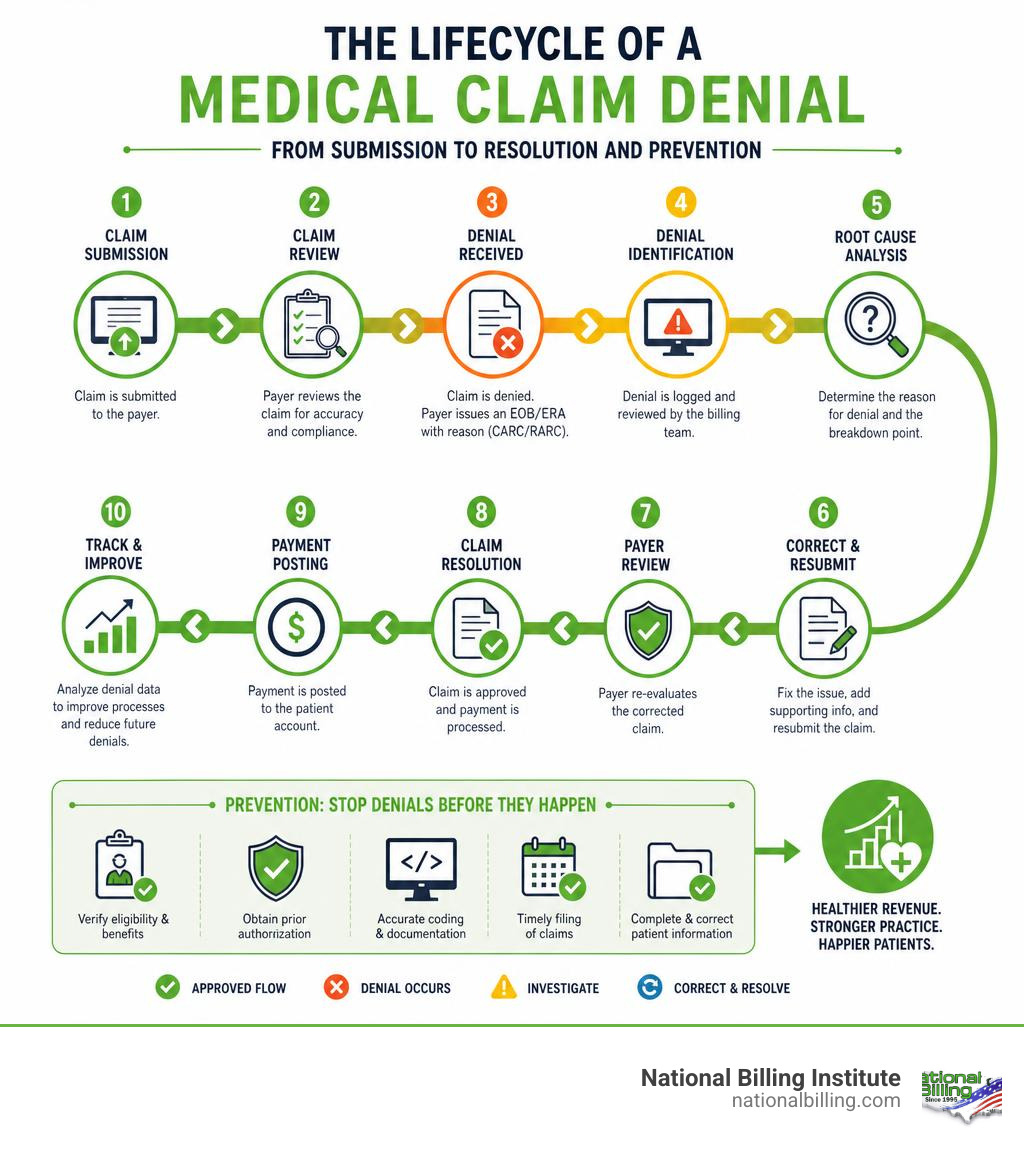
A Step-by-Step Guide to Effective RCM Denial Management
If you want to stop the rework cycle, you need a highly structured, repeatable process. You cannot treat denial management as an "as-time-permits" task. It requires workflow optimization, cross-team collaboration, and a deep understanding of payer rules.
Step 1: Identification and Tracking in RCM Denial Management
You cannot fix what you do not track. The moment a claim is adjudicated, your billing team must actively monitor the response. Look closely at your Electronic Remittance Advice (ERA) and Explanation of Benefits (EOB) documents. Payers communicate rejections using Claim Adjustment Reason Codes (CARCs) and Remittance Advice Remark Codes (RARCs).
By logging these codes immediately into your tracking system, you can separate partial payments from complete rejections. For a deeper look at how to structure this initial tracking phase, read our breakdown on Denials And Appeals Management.
Step 2: Categorization and Prioritization
Not all denials should be worked in the order they arrive. If your team starts at the top of a random stack, they are leaving money on the table.
We recommend prioritizing your workflow using three key vectors:
Timely Filing Limits: Work claims closest to their appeal deadlines first.
Dollar Value: Prioritize high-value claims to restore cash flow quickly.
Payer Rules: Group denials by payer so a single billing specialist can resolve multiple claims under the same guidelines in a single session.

Step 3: Root Cause Analysis and Resolution
Every denial is a symptom of an upstream issue. When a claim is denied, don't just patch the error and send it back. Ask why it happened. Was it a front-desk eligibility oversight? Did a coder miss a clinical modifier?
Once you identify the workflow gap, correct the underlying issue in your system, update the claim, and resubmit it. If you need help structuring this analytical workflow, our team at National Billing Institute offers comprehensive Denial Management Services to handle the heavy lifting for you.
Step 4: Appeal Preparation and Submission
When a hard or clinical denial occurs, you must build a bulletproof appeal package. Generic template letters are rarely successful. Instead, construct your appeal with:
A clear, concise cover letter outlining why the service was appropriate.
Comprehensive clinical documentation, including physician progress notes and lab results.
Direct references to established clinical criteria, such as InterQual or MCG guidelines.
For advanced strategies on structuring winning appeals, check out our resource on Effective Appeals Management Strategies.
Step 5: Prevention Strategies for Long-Term RCM Denial Management
The ultimate goal of RCM denial management is to make the resolution process obsolete. By shifting your focus to front-end prevention, you save time, administrative costs, and stress. This involves real-time eligibility checks at registration, pre-submission claim scrubbing, and ongoing staff education.
To transition your practice from reactive appeals to proactive prevention, explore our specialized guides on Denial Prevention and Denial Reduction Services.
Leveraging Technology, AI, and Analytics for Denial Prevention
We are living in an era where payers are using increasingly complex, automated algorithms to deny claims. To level the playing field, healthcare providers must fight technology with technology.
Integrating artificial intelligence and predictive analytics into your billing workflow is no longer optional—it is a baseline requirement for financial resilience. By utilizing Automated Revenue Cycle Management, you can automate repetitive, low-value tasks like checking claim statuses and verifying real-time eligibility.
Modern Revenue Cycle Management Solutions use machine learning to analyze years of historical denial data. These tools can flag high-risk claims before they are submitted, pointing out missing modifiers or authorization gaps so your team can correct them pre-flight. Real-time analytics dashboards also give your leadership team instant visibility into which payers are denying claims at the highest rates, allowing you to renegotiate contracts with hard data in hand.
Key Performance Indicators (KPIs) for Measuring Success
To ensure your RCM denial management program is actually working, you must track key performance metrics. Without continuous monitoring of your Revenue Cycle Operations, you are essentially flying blind.
Here are the four essential KPIs your practice should monitor monthly:
Clean Claim Rate (Target: >98%): The percentage of claims that are accepted and paid on their very first submission.
Denial Rate (Target: <5%): The percentage of your total submitted claims that are denied by payers. A rate above 10% indicates severe systemic issues.
Appeal Success Rate (Target: >60%): The percentage of your submitted appeals that result in overturned decisions and recovered revenue.
Average Days to Resolve (Target: <30 days): The average amount of time it takes your team to identify, correct, appeal, and resolve a denied claim.
Frequently Asked Questions about RCM Denial Management
What is the difference between a soft denial and a hard denial?
A soft denial is a temporary rejection caused by minor administrative or formatting errors (like a typo in a patient's policy number). These can be corrected and resubmitted without a formal appeal. A hard denial is a permanent rejection based on policy terms (such as a service not being covered). Hard denials require a formal, structured appeal process to overturn and are much more difficult to resolve.
How much does it cost a healthcare provider to rework a denied claim?
According to the Medical Group Management Association (MGMA), the average administrative cost to manually rework a single denied claim is at least $25. However, when you factor in clinical staff time, specialized appeal writing, and the potential for lost revenue, the true cost of complex clinical appeals can easily exceed $100 per claim.
When should a healthcare organization outsource its denial management?
You should consider outsourcing when your internal team is struggling to keep up with timely filing limits, when your denial rate climbs above 5%, or when you lack the specialized coding and clinical expertise to fight complex payer rejections. Outsourcing to dedicated specialists immediately eliminates staffing challenges and improves your clean claim rates.
Conclusion
Winning the war against denials requires a shift in mindset. You cannot afford to treat denials as an unavoidable cost of doing business. Every rejected claim is a valuable piece of data showing you exactly where your revenue cycle is breaking down.
At National Billing Institute, we have spent more than 30 years helping healthcare providers build denial-resistant revenue cycles. Operating entirely out of our Boca Raton, FL office, our 100% USA-based team combines decades of clinical billing expertise with advanced, HIPAA-compliant automation to deliver some of the lowest denial rates in the industry.
Our clients typically experience a 15% to 30% increase in overall revenue simply by letting us clean up their front-end workflows and aggressively pursue their outstanding appeals.
If you are ready to stop chasing payers, stop the rework cycle, and secure the revenue your practice has rightfully earned, we are here to help.
Partner with National Billing Institute today to schedule your comprehensive, hassle-free revenue cycle assessment. Let's turn those denials back into dollars.
