
Why You Should Switch to Automated Revenue Cycle Management Today
Why Automated Revenue Cycle Management Is the Future of Healthcare Billing
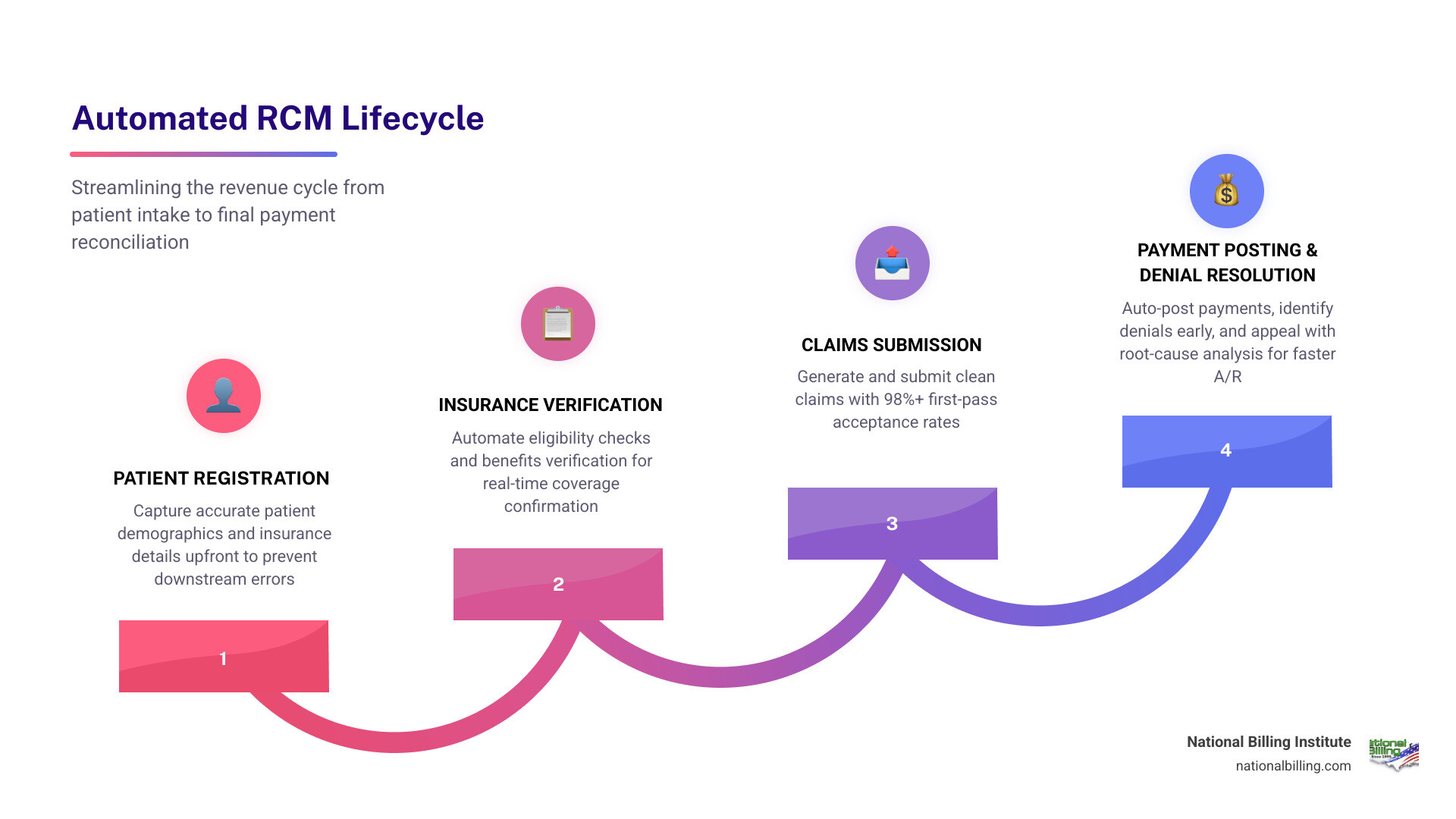
Automated revenue cycle management is the use of AI, machine learning, and robotic process automation (RPA) to handle the full billing lifecycle — from patient registration and insurance verification to claims submission, payment posting, and denial resolution — with minimal manual effort.
Here's what it does for your practice:
Reduces claim denial rates by up to 40%
Cuts days in accounts receivable (A/R) to under 30 days
Lowers cost to collect by 20–70%
Boosts clean claim rates above 98%
Frees up staff time for higher-value work
Keeps you audit-ready and HIPAA compliant
Healthcare billing has never been more complex. Payer rules keep changing. Denial rates keep climbing. And the administrative burden on your team keeps growing — often without a proportional increase in revenue. In fact, labor shortages now affect 83% of healthcare revenue cycle leaders, and over half of CFOs say their legacy systems simply can't keep up.
The result? Revenue leakage, delayed reimbursements, and a billing team stuck fixing errors instead of capturing revenue.
Automation changes that equation entirely. It doesn't just speed things up — it makes your entire revenue cycle more accurate, scalable, and resilient.
I'm Olivia Harper, Founder and Denial Management & Reimbursement Specialist at National Billing Institute, with over 30 years of hands-on experience in automated revenue cycle management and medical billing from our 100% US-based office in Boca Raton, Florida. In this guide, I'll walk you through exactly why switching to automation today is one of the smartest financial decisions your practice can make.
Understanding the Shift to Automated Revenue Cycle Management
The healthcare industry is currently navigating a perfect storm of rising costs, complex payer requirements, and a shift toward high-deductible health plans. In the past, "managing the revenue cycle" meant hiring more people to type data into spreadsheets. Today, that manual approach is a recipe for financial instability.
The shift toward automated revenue cycle management is driven by the need for absolute financial transparency and scalability. Traditional systems are often "siloed," meaning the front desk doesn't know what the billing office is doing, and neither knows why a claim was actually denied until weeks later.
Automation bridges these gaps. By integrating AI into the workflow, we can achieve real-time payer compliance. Instead of waiting for a rejection letter, an automated system checks the claim against thousands of payer-specific rules before it ever leaves your office. This proactive approach ensures that your revenue cycle isn't just a series of tasks, but a strategic engine for growth. As Gartner predicts, by 2027, 90% of finance analytics will be fully automated. If your practice isn't moving in that direction, you're essentially leaving your financial health to chance.
Overcoming the Limitations of Traditional Manual Billing
Let’s be honest: manual billing is exhausting. It’s prone to human error, creates massive revenue leakage, and puts an incredible administrative burden on your staff. When a human has to manually verify insurance for every single patient, mistakes happen. A typo in a policy number or a missed prior authorization can lead to a denial that takes hours of labor to fix.
We often see practices struggling with labor shortages—in fact, 83% of healthcare leaders report that staffing issues are actively hurting their revenue cycle. When you rely on manual processes, your ability to grow is capped by how many people you can hire and train.
Feature Manual RCM Automated RCM Clean Claim Rate 75% - 85% 98% + Posting Efficiency 7-10 minutes per remit < 1 minute per remit A/R Days 45 - 60+ days Sub-30 days Cost to Collect High (Labor intensive) 20% - 70% Lower Error Rate High (Human factor) Near Zero
By moving away from these manual gaps, you stop "burning" money on administrative rework. To see how we handle these complexities for our clients, you can explore our Medical Billing Services.
How AI and RPA Transform Revenue Cycle Workflows
You might hear terms like "AI" and "Machine Learning" and think they belong in a sci-fi movie, but in automated revenue cycle management, they are very real tools that solve very boring (but expensive) problems.
Machine Learning (ML) is excellent at pattern recognition. It looks at millions of past claims to predict which ones are likely to be denied. It learns that "Payer X always denies Code Y if Modifier Z isn't present," and it flags that for you instantly.
Natural Language Processing (NLP) is another game-changer. It can "read" unstructured clinical notes and translate them into accurate billing codes. This improves coding productivity by up to 170% and ensures you aren't missing out on HCC (Hierarchical Condition Category) captures that could increase your revenue by 24%.
These technologies ensure data integrity across your entire organization, allowing your team to transition from "data entry clerks" to "revenue strategists."
The Role of RPA in Automated Revenue Cycle Management
Robotic Process Automation (RPA) is the "muscle" of the operation. Think of RPA as a 24/7 digital workforce that never gets tired, never takes a lunch break, and never makes a typo. RPA bots are perfect for repetitive, rules-based tasks such as:
Insurance Verification: Automatically checking eligibility 24 hours before an appointment.
Data Entry: Moving patient information from your registration portal into your billing software without manual typing.
Claim Status Checks: Logging into payer portals overnight to see if a claim has been processed.
HIPAA Compliance: Ensuring every data transfer follows strict HIPAA compliance protocols with 100% accurate audit trails.
At National Billing, we use these digital workers to handle the heavy lifting, which is one of the many reasons why providers Choose National Billing to manage their complex financial needs.
AI-Driven Predictive Analytics for Denial Prevention
The best way to manage a denial is to make sure it never happens. AI-driven predictive analytics analyze payer rules in real-time. If a payer changes a policy on a Tuesday, the AI learns it by Wednesday.
By performing a root-cause analysis on every rejection, the system identifies trends. Is a specific provider consistently under-documenting? Is a specific front-desk person missing a secondary insurance field? By catching these patterns early, we can maintain clean claim rates above 98%, ensuring that your cash flow remains steady and predictable.
Measurable Benefits of Automating Your Financial Operations
The impact of automated revenue cycle management isn't just theoretical—the numbers are staggering. When you remove the friction of manual labor, your financial health improves across every KPI.
Based on industry data and our own experience at National Billing, here is the measurable impact you can expect:
86% Increase in Posting Efficiency: What used to take 7 minutes to post manually now takes less than 60 seconds.
65% Reduction in Labor Costs: By automating tasks, you can reduce the need for full-time employees (FTEs) from 1.9 down to just 0.2 per 100,000 claims.
15-30% Revenue Lift: By eliminating "lost" claims and under-coding, most practices see a significant jump in their net collections.
Faster A/R Cycles: We typically see A/R days drop to between 27 and 37 days, compared to the industry average of 50+.
Enhancing the Patient Experience through Automated Revenue Cycle Management
We often forget that the revenue cycle involves the patient, too. Nothing ruins a patient's experience faster than a confusing, unexpected bill three months after their visit.
Automation allows for price transparency. We can provide accurate, real-time cost estimates before service is rendered. Automated systems also offer:
Self-service tools: Patients can pay bills, set up payment plans, and update insurance info via a portal.
Clear Statements: No more "medical jargon" bills; patients get clear, easy-to-read summaries.
Personalized Payment Plans: AI can predict a patient's "propensity to pay" and offer a tailored installment plan that fits their budget, doubling the likelihood of collection.
Strategic Steps for Successful Automation Implementation
Switching to an automated system doesn't happen overnight, but with the right partner, it’s a smooth transition. Here is the roadmap we recommend:
Data Governance: Ensure your existing data is clean. Automation is powerful, but "garbage in, garbage out" still applies.
Staff Training: Your team needs to understand how to work with the AI. They aren't being replaced; they are being upgraded.
Pilot Programs: Start by automating one high-impact area, like insurance eligibility or payment posting, before rolling it out to the entire cycle.
Change Management: Clear communication from leadership is essential to overcome any "tech-phobia" within the office.
If you're ready to see how these steps apply to your specific practice, you should Schedule a Billing Review with our team in Boca Raton. We can analyze your current workflows and show you exactly where automation will have the biggest impact.
Frequently Asked Questions about RCM Automation
How does automation reduce claim denials?
Automation reduces denials by using "scrubbing" engines and AI to validate every claim against current payer rules before submission. It catches missing modifiers, incorrect ICD-10 codes, and eligibility issues in real-time. This results in a much higher "first-pass" clean claim rate, meaning you get paid the first time you ask.
Is automated RCM HIPAA compliant?
Absolutely. In fact, it's often more secure than manual billing. Automated systems use encrypted data transfers, role-based access controls, and generate 100% accurate audit logs. At National Billing, our systems are fully HIPAA-aligned and SOC 2 certified, ensuring that patient data is protected at every step.
What is the typical ROI for RCM automation?
Most practices see a return on investment within the first three to six months. Between the 20-70% reduction in "cost to collect" and the 15-30% increase in overall revenue, the technology effectively pays for itself by capturing money that was previously being lost to denials and administrative inefficiencies.
Conclusion
The era of "guessing" at your practice's financial health is over. Automated revenue cycle management is no longer a luxury for large hospital systems; it is a necessity for any provider who wants to remain profitable in today’s healthcare landscape.
At National Billing Institute, we combine 30+ years of expertise with cutting-edge AI and RPA technology to ensure you get paid every dollar you’re owed. Our 100% USA-based team in Boca Raton, FL, understands the nuances of the American payer system and is dedicated to helping you achieve the lowest denial rates in the industry.
Stop letting manual errors and slow A/R cycles hold your practice back. It’s time to move toward a faster, smarter, and more reliable financial future.
Ready to transform your practice? Transform Your Revenue Cycle with National Billing Services
