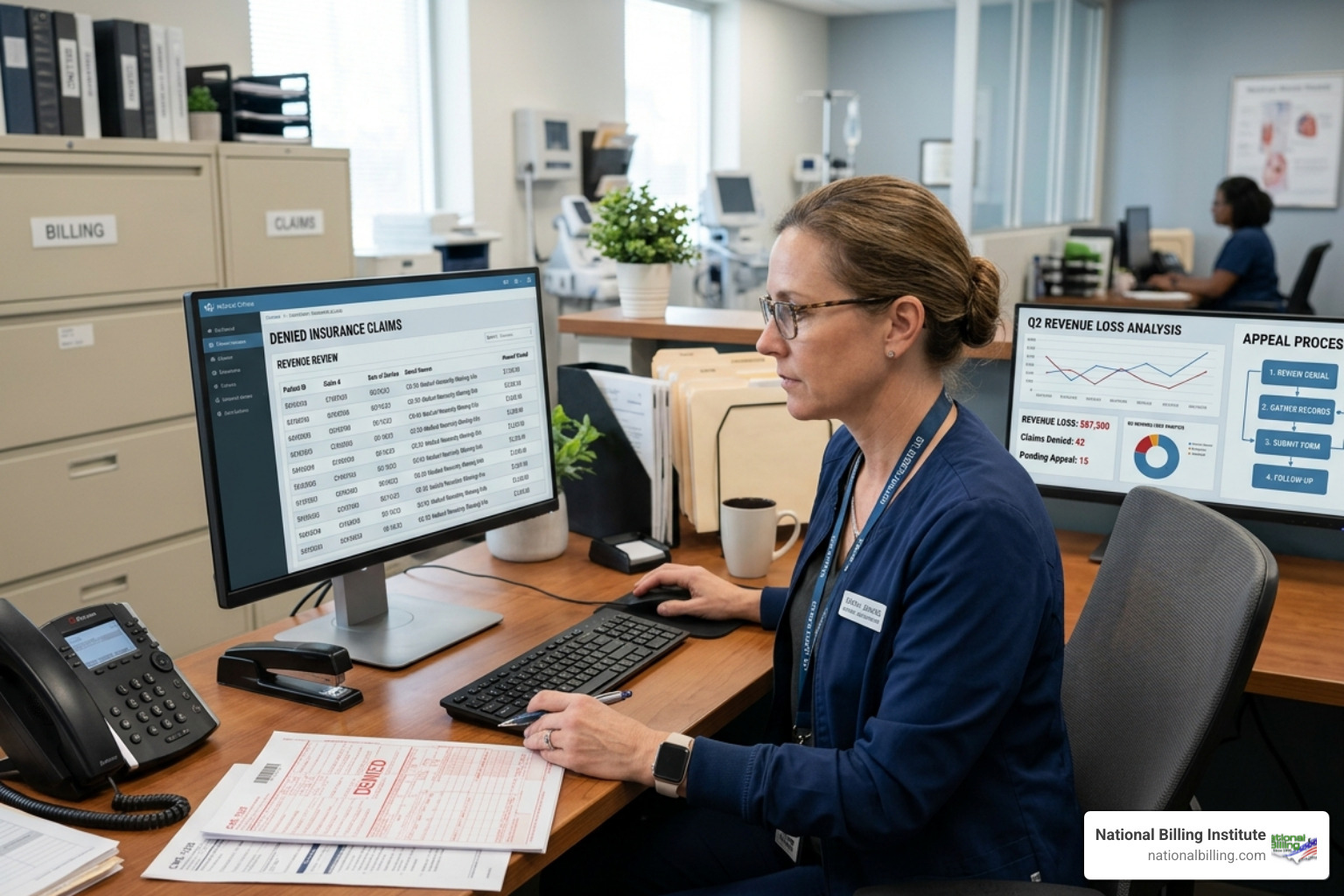
Why You Need a Denial Management Specialist on Your Side
Why Claim Denials Are Quietly Draining Your Practice's Revenue
Denial management services are the systems, processes, and specialists that identify, appeal, and prevent rejected insurance claims — so healthcare providers get paid for the work they've already done.
If you're evaluating your options right now, here's what you need to know:
What You Need What to Look For Recover denied claims fast Specialists with >60% appeal success rate Prevent future denials Clean claim rate target of >98% Reduce admin burden US-based, certified billing team Stay HIPAA compliant In-office processing, no offshore risk Improve cash flow Target denial rate of <5%, resolved in <30 days
Here's the hard truth: 90% of all claim denials are preventable. Yet across the United States in May 2026, denied claims are still costing the healthcare industry an estimated $265.6 billion in lost and delayed revenue. For individual practices, that translates to cash flow gaps, overworked billing staff, and revenue that simply never gets collected.
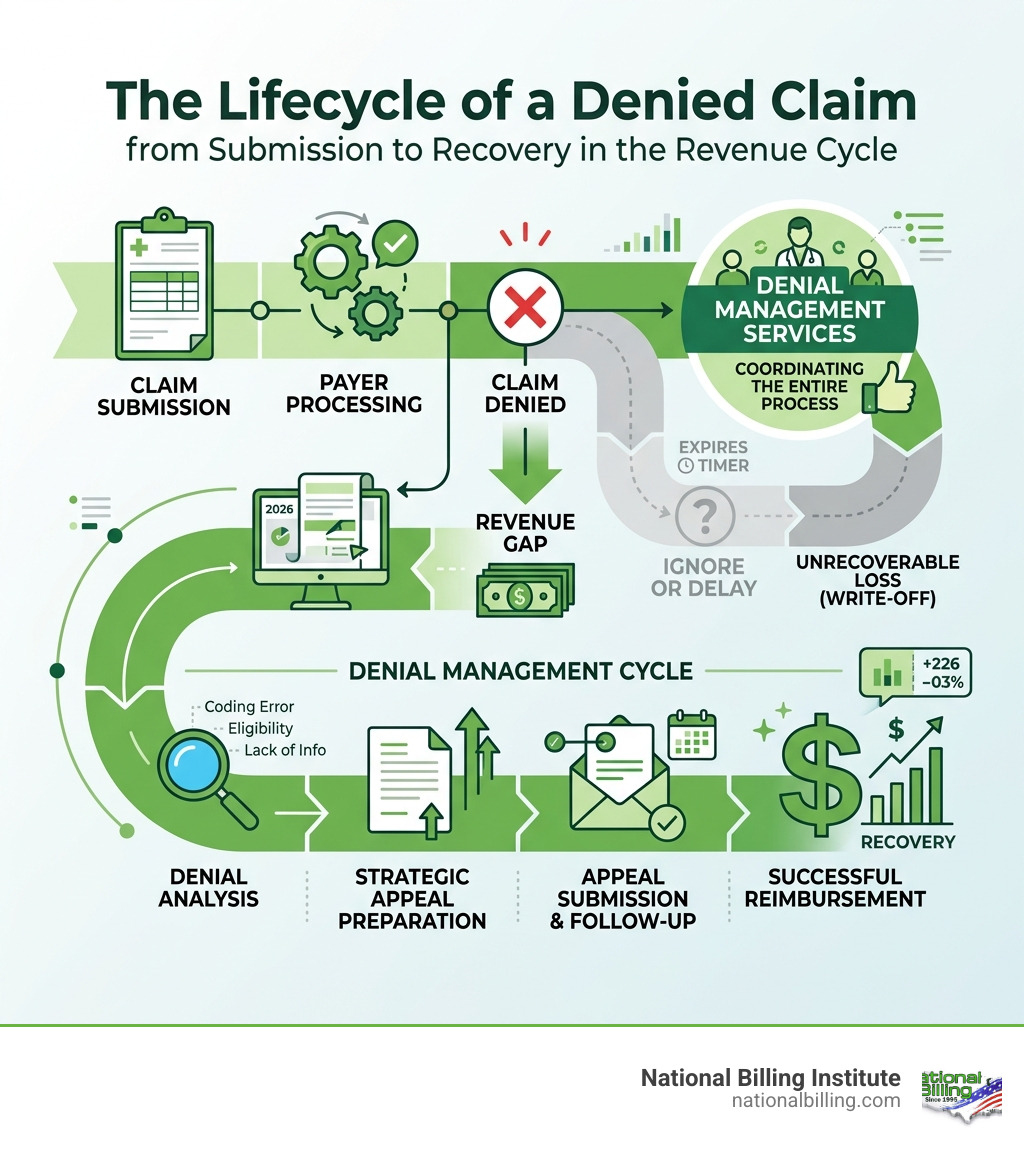
Denied claims don't just hurt your bottom line. They pull clinical staff away from patient care, create compliance risks, and — when left unresolved — expire entirely. In fact, delayed follow-ups cause 30 to 40% of denials to reach their expiration date before anyone acts on them, making that revenue unrecoverable.
This isn't a small administrative inconvenience. It's a systemic problem that requires a specialist's approach.
I'm Olivia Harper, Founder and Denial Management & Reimbursement Specialist at National Billing Institute, with over 30 years of hands-on experience delivering denial management services from our 100% in-office team in Boca Raton, Florida. In this guide, I'll walk you through exactly what to look for — and what to avoid — when evaluating denial management solutions for your practice.
The $265 Billion Crisis: Why Claim Denials Are a Major Challenge
In the current landscape of May 2026, the financial health of a healthcare practice is often determined by its ability to navigate the increasingly complex maze of payer rules. What Is Denial Management In Medical Billing involves more than just resubmitting a claim; it is a strategic effort to reclaim revenue that is rightfully yours.
The industry is currently grappling with a $265.6 billion crisis. This staggering figure represents the cost of denial complexities, including the labor required to rework claims and the revenue lost to write-offs. When we look at the data, the tragedy is that the vast majority of this loss is unnecessary.
Category Impact Prevention Potential Preventable Denials 90% of all denials High (Workflow & Coding) Administrative Burden $565 per inpatient claim High (Automation) Revenue Leakage 3% to 5% of net revenue High (Root Cause Analysis)
The administrative burden is heavy. Traditional billing playbooks are often broken because they are reactive. Many practices find themselves in a "denial loop" where they fix the same errors over and over without addressing the source. This creates a massive drain on cash flow. Furthermore, Denial resolution research shows that payers are becoming more aggressive, using their own algorithms to identify reasons to withhold payment. Without a specialist to advocate for you, your practice is essentially fighting a high-tech battle with outdated tools.
Key Strategies for Effective denial management services
To turn the tide on revenue loss, we must shift from a reactive "rework" mindset to a proactive "prevention" strategy. Effective denial management services rely on a foundation of data analysis and clinical integrity. We don't just want to get the claim paid; we want to ensure it never gets denied in the first place.
At National Billing Institute, we focus on achieving the Lowest Error Rates Billing by integrating several core strategies:
Root Cause Analysis: We don't just fix a claim; we ask why it failed. Is it a specific payer changing their rules? Is it a documentation gap in the clinical team? By identifying patterns, we can eliminate repeat issues.
Workflow Optimization: From the front desk to the back office, every step must be synchronized. This includes real-time eligibility checks and "tollgates" that prevent a claim from moving forward if data is missing.
Clinical Documentation Improvement (CDI): Clinical documentation was originally meant to record patient care, but today it carries the full weight of financial reimbursement. We work to align clinical and financial teams so that the records support the codes.
Payer-Specific Intelligence: Payer rules change by more than 25% annually. Maintaining a database of these shifts is essential for Industry standards for denial resolution.
Common Reasons for Claim Denials
Understanding why claims fail is the first step toward fixing them. While there are hundreds of reason codes, most fall into a few high-impact buckets:
Coding Errors and Missing Modifiers: Up to 20% of claims are denied due to simple coding inaccuracies or missing modifiers.
Eligibility and Coverage Issues: This is the most common point of failure. If a patient’s insurance has changed or a service isn't covered, the claim is doomed before it's even sent.
Lack of Medical Necessity: Payers often question whether a procedure was required. Overcoming this requires strong clinical justification and sometimes peer-to-peer reviews.
Authorization Failures: Forgetting to secure prior authorization is a "technical" denial that is notoriously difficult to overturn after the fact.
Timely Filing: If you miss the payer's window, the revenue is often gone forever.
Key Performance Indicators (KPIs) for denial management services
You cannot manage what you do not measure. To evaluate the success of your billing department or partner, you should track these specific KPIs. We aim for these high-performance benchmarks for all our clients:
Denial Rate: Target < 5%. (The industry average often hovers between 10% and 15%).
Clean Claim Rate: Target > 98%. This measures the percentage of claims that pass through the payer's system on the first attempt without errors.
Appeal Success Rate: Target > 60%. When a denial does happen, you need a team that knows how to win the argument.
Average Days to Resolve: Target < 30 days. Stagnant claims are the enemy of cash flow.
The Role of AI and Automation in Modern Denial Prevention
In May 2026, technology is the great equalizer. Payers are using AI to reject claims faster than human teams can process them. To stay competitive, providers must use "AI to fight AI."
Modern Denial Prevention uses predictive modeling to identify "risky claims" before they are submitted. By analyzing millions of previous transactions, our systems can flag a claim that has a high probability of denial based on current payer trends.

Automation plays a crucial role in:
Claim Scrubbing: Automatically detecting misspelled names, incorrect dates of birth, or mismatched ICD-10 codes.
Real-time Eligibility: Verifying insurance coverage at every single visit, not just the first one.
Automated Appeals: Generating evidence-based appeal letters that pull clinical data directly from the EHR to match payer requirements. This has been shown to be 2.2x faster than manual drafting.
While technology is powerful, it is most effective when paired with human expertise. Advanced denial management insights suggest that a "smarter blend" of automation and certified specialists is the only way to keep pace with modern billing complexities.
Benefits of Hiring a Denial Management Specialist
Choosing to partner with a specialist like National Billing Institute can be a game-changer for your practice’s financial outlook. Our 100% USA-based team in Boca Raton, FL, brings over 30 years of experience to the table. We don't just manage your billing; we act as a revenue recovery engine.
Practices that switch to professional Denial Reduction Services typically see a 15-30% increase in revenue. This isn't magic—it's the result of recovering the 3 out of every 4 dollars that usually get lost to unresolved denials.

The benefits of our specialized approach include:
100% USA-Based Security: All our work is done in-office in Florida. This eliminates the HIPAA risks associated with offshore billing and ensures that our team understands the nuances of the American payer landscape.
Expert Appeals: We utilize clinical merit and legal standards to challenge denials. For complex cases, we can even facilitate payer peer-to-peer reconsiderations, which often yield a 4x ROI.
Billing Compliance: We maintain strict Billing Compliance standards, ensuring that your practice is protected during audits.
Reduced Days in A/R: By reworking denials to completion rather than letting them sit in "hold buckets," we move revenue into your bank account faster.
Evaluating Modern denial management services
When you are looking to hire, consider these factors to ensure you are getting a true partner:
Contingency Models: Look for a partner who only gets paid when you get paid. This aligns incentives and ensures the team is motivated to recover every dollar.
Technical and Clinical Expertise: Does the service have AAPC or AHIMA certified coders? Do they have clinicians who can argue medical necessity?
System Integration: The solution should integrate directly with your existing EHR to avoid workflow disruption.
Reporting Transparency: You should have access to real-time dashboards that show exactly where your claims stand and what the recovery trends look like.
Frequently Asked Questions
What is the difference between a rejection and a denial?
A rejection happens at the clearinghouse or payer "front door" due to technical errors like a misspelled name or invalid ID number. These claims never enter the payer's system. A denial is a claim that was received and processed but the payer decided not to pay it for reasons like medical necessity, lack of authorization, or coding errors. Rejections are usually easy to fix; denials require a strategic appeal.
How much revenue can be recovered through professional denial management?
Most practices can recover up to 75% of previously denied claims (recovering $3 out of every $4). By implementing systematic resolution, we have seen practices increase their overall collections by up to 40% and their net income by 15-30% within the first year.
Why is root cause analysis important for long-term financial stability?
If you only fix the individual claim, you are treating the symptom, not the disease. Root cause analysis identifies why the error happened (e.g., a specific front-desk staff member needs more training on eligibility, or a doctor is missing a specific documentation field). Fixing the root cause stops the "revenue leak" permanently, leading to a higher clean claim rate and more predictable cash flow.
Conclusion
In May 2026, you shouldn't have to choose between providing excellent patient care and maintaining a profitable practice. Claim denials are a massive challenge, but they are not an unsolvable one. By moving from a reactive approach to a proactive, specialist-led strategy, you can protect your revenue, improve your operational efficiency, and build long-term financial resilience.
At National Billing Institute, we take the burden of the revenue cycle off your shoulders so you can focus on what matters most: your patients. With our 30+ years of experience and our dedicated team in Boca Raton, we are ready to help you reclaim the revenue you've earned.
