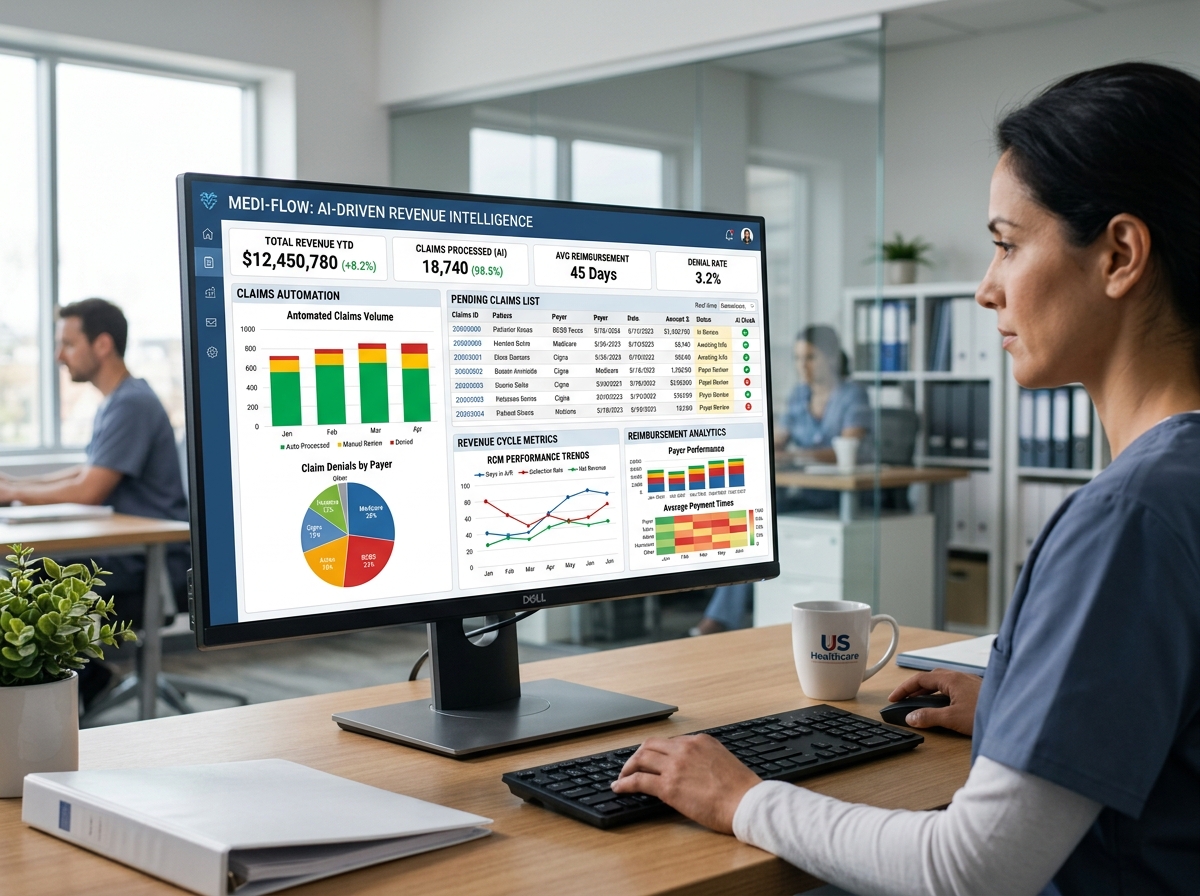
Leveraging Artificial Intelligence for Smarter Claims Management
Why AI in Healthcare Claims Processing Is Changing How Practices Get Paid
AI in healthcare claims processing is transforming how medical practices submit, track, and collect on claims — reducing errors, cutting denial rates, and speeding up reimbursements significantly.
Here is a quick overview of how AI automates medical claims processing:
Intake & Classification - AI captures and sorts incoming claims from multiple sources automatically
Data Extraction - OCR and NLP pull structured data from forms, notes, and records
Eligibility Verification - AI checks patient coverage in real time before submission
Coding Assistance - Machine learning suggests accurate ICD-10 and CPT codes from clinical documentation
Claim Scrubbing - AI validates claims against payer rules and flags errors before submission
Adjudication & Routing - Clean claims are routed to payers automatically
Denial Prediction & Management - Predictive analytics flag high-risk claims and prioritize appeals
Payment Reconciliation - AI matches payments to claims and identifies discrepancies
The financial stakes are real. U.S. providers spent an estimated $25.7 billion on claim denials in 2023. Meanwhile, 46% of those denials stem from something entirely preventable — missing or incorrect patient information. And with 77% of providers worried that changing payer policies will hurt their reimbursements, the pressure to do more with less has never been higher.
Manual claims workflows simply cannot keep up. The average claim touches four to six staff members before it is resolved. Denial rates across the industry average 12%, and in some specialties exceed 25%. That is not just an administrative headache — it is a direct hit to your bottom line.
AI is not a futuristic promise anymore. It is already helping practices process claims faster, catch errors earlier, and recover revenue that used to slip through the cracks.
I'm Olivia Harper, Founder and Denial Management & Reimbursement Specialist at National Billing Institute, and over my 30+ years in revenue cycle management I have watched AI in healthcare claims processing evolve from experimental technology into an essential tool for practices that want to stay financially healthy. In the sections below, I will walk you through exactly how it works — and how to put it to work for your practice.
The Role of AI in Healthcare Claims Processing: A Technical Overview
When we talk about "AI," we aren't talking about a single magic button. It is a symphony of different technologies working together to handle the massive volume of data generated in a modern medical practice. In the past, claims processing was a "detect and repair" game—you sent a claim, waited for it to break, and then tried to fix it. Today, AI is moving us toward a "predict and prevent" model.
At its core, AI uses Machine Learning (ML) to analyze historical data and recognize patterns that humans might miss. For example, if a specific payer suddenly changes how they view a certain procedure code, ML can spot the trend after just a few denials and alert our team before the next batch goes out.
Natural Language Processing (NLP) acts as the "translator." It reads unstructured data—like the handwritten notes a doctor might scribble or the detailed clinical narratives in an EHR—and turns them into structured data that billing systems can understand. This is supported by AI-Powered Data Integration in Healthcare Claims Processing: Enhancing Workflow Efficiency and Reducing Processing Errors | Journal of Artificial Intelligence Research, which highlights how integrating these disparate data sources is the key to reducing the manual "grunt work" that leads to burnout.
Enhancing Accuracy with AI in Healthcare Claims Processing
The biggest enemy of your cash flow isn't the payer; it's the "dirty claim." A dirty claim is any submission with missing info, mismatched codes, or simple typos. Research shows that 46% of claim denials are caused by missing or incorrect information.
By using ai in healthcare claims processing, we implement "claim scrubbing" that happens in real-time. Instead of a human checking every box, the AI validates the claim against thousands of payer-specific rules in milliseconds. It identifies inconsistencies—like a procedure code that doesn't match the patient's gender or age—and flags it for correction before it ever leaves our office. This proactive approach is a cornerstone of our medical billing services, ensuring that we maintain the lowest denial rates in the industry.
Specific AI Technologies Used in Medical Billing
To get technical for a moment, several specific layers of technology make this possible:
Optical Character Recognition (OCR): This isn't your grandma's scanner. Modern OCR uses layout-aware extraction to understand where data sits on a page, even if the form is slightly skewed or wrinkled.
Domain-Specific NLP: Unlike general AI, this is trained specifically on medical terminology, understanding the difference between "cold" (the temperature) and "cold" (the upper respiratory infection).
Predictive Analytics: This forecasts which claims are most likely to be denied based on historical payer behavior.
Agentic AI: These are "smart agents" that can autonomously plan and execute tasks, such as navigating a payer portal to check a claim's status without a human having to log in manually.
Automating the Traditional Claims Workflow: A Step-by-Step Guide
The traditional workflow is slow. It involves intake, manual data entry, manual coding, and a lot of "waiting and seeing." AI compresses this timeline. While a manual process might take 4–6 weeks for a full cycle, AI-driven systems can reduce processing time by up to 80%.
Feature Traditional Workflow AI-Automated Workflow Data Entry Manual typing (high error risk) Automated OCR/NLP extraction Coding Manual lookup of ICD/CPT codes AI-suggested codes with confidence scores Verification Staff calling payers or checking portals Real-time automated eligibility API checks Speed 10–15 claims per hour 150+ claims per minute Denial Handling Reactive (fixing after rejection) Proactive (predicting and preventing)
Integrating AI in Healthcare Claims Processing with Existing EHR Systems
One of the biggest fears we hear from providers in Boca Raton is: "Will this break my current system?" The answer is no. Modern AI is designed for interoperability. It sits on top of your existing Electronic Health Records (EHR) and Practice Management (PM) software, acting as an intelligent layer that synchronizes data without disrupting your daily routine. This ensures that patient demographics and clinical notes flow seamlessly into the billing engine, maintaining full HIPAA compliance through encrypted data tunnels.

Automating Eligibility Verification and Prior Authorization
Prior authorization is a major pain point. According to the AMA, 94% of physicians report negative patient impacts from prior auth delays. Some insurers use AI to issue "batch denials," which has many physicians concerned about AI prior authorization denials.
However, when used on the provider side, AI is a shield. We use it to automate the "handshake" between your office and the payer. It verifies coverage, checks for required authorizations, and ensures all patient demographics are 100% accurate before the patient even walks through your door. This prevents the "missing info" denials that plague so many practices.
Real-World Applications and Benefits of Intelligent Claims Management
The benefits of ai in healthcare claims processing aren't just theoretical; they are measurable in dollars and cents. For example, one healthcare organization used AI to reduce denials by 50%, adding $100 million to their bottom line in just six months. Another medical center saw a 4.6% average monthly decrease in denials simply by using predictive software.
Future Trends for AI in Healthcare Claims Processing
We are moving toward a world of "straight-through processing" (STP). Currently, many payers only process about 7% of claims without human intervention because their systems can't handle unstructured data. As AI improves, we expect STP rates to climb to 60-80%.
We are also seeing the rise of Generative AI to draft appeal letters and Blockchain to create immutable records of patient consent and billing history. For a deeper look at where the industry is headed, check out AI for Healthcare Claims: The Ultimate Payer's Guide.
Improving Revenue Cycle Management with Predictive Analytics
Predictive analytics is like having a weather forecast for your bank account. It allows us to:
Forecast Reimbursement Timelines: Know exactly when cash will hit your account.
Identify Audit Risks: Flag claims that might trigger an OIG audit before they are sent.
Prioritize High-Value Claims: AI can sort your "To-Do" list so that the claims most likely to pay the most are handled first.
Navigating Challenges: Compliance, Ethics, and Human Oversight
While we love technology, we aren't robots. AI has limitations. It can suffer from "algorithmic bias" if it's trained on poor data, and it lacks the human context needed for complex medical cases. That’s why we believe in Augmented Intelligence—AI that helps humans do their jobs better, rather than replacing them.
The Impact of AI on Medical Billing and Coding Professionals
Will AI take your job? Not if you're a National Billing professional. We view AI as a "force multiplier." It handles the boring, repetitive tasks—like checking if a zip code matches—so our expert coders can focus on high-level strategy and complex appeals. Human judgment is irreplaceable for ethical decisions and nuanced clinical documentation.
Ensuring HIPAA Compliance in Automated Systems
In medical billing, security is everything. Any AI tool we use must be "HITRUST-certified" and fully HIPAA compliant. This means:
End-to-End Encryption: Data is scrambled while sitting still and while moving.
Audit Trails: We can see exactly who (or what AI) touched a record and when.
Role-Based Access: Only the people who need to see patient data can see it.
How to Implement AI-Powered Claims Automation in Your Practice
Implementation doesn't have to be a "big bang" event. We recommend a phased rollout. Start by automating a single, high-friction workflow—like eligibility verification—and measure the results. Once you see the "Clean Claim Rate" go up, you can expand to coding and denial management.
Selecting the Right AI Claims Processing Partner
Choosing a partner is about more than just software; it's about experience. You want someone who understands the Florida payer landscape and has a proven track record. At National Billing, our 30+ years of experience and 100% USA-based team in Boca Raton give us a unique edge. We don't just give you a tool; we give you a team that knows how to use it.
Measuring Success: Key Performance Indicators for Automation
How do you know if it's working? Watch these three numbers:
Clean Claim Rate: The percentage of claims that pay on the first submission (aim for 95%+).
Days in A/R: How long it takes to get paid (AI can drop this by 18+ days).
Denial Rate: This should drop significantly—often by 20% or more within the first year.
Frequently Asked Questions about AI in Claims Processing
Will AI replace human medical billing and coding professionals?
No. AI is a tool that enhances human roles. While it automates repetitive tasks, human expertise is required for complex clinical decisions, ethical oversight, and managing payer relationships.
Is AI-powered claims processing HIPAA compliant?
Yes, provided it is implemented correctly. At National Billing, we ensure all AI integrations use encryption, secure audit trails, and role-based access controls to meet or exceed HIPAA standards.
How much can AI reduce healthcare claims processing costs?
On average, AI-driven automation can lower processing costs by up to 30% by reducing manual labor, minimizing errors, and eliminating the need for costly rework on denied claims.
Conclusion
The transition to ai in healthcare claims processing is no longer optional for practices that want to thrive in a complex regulatory environment. By automating the routine and predicting the problematic, you can reclaim your time and your revenue.
At National Billing Institute, we combine 30+ years of industry expertise with cutting-edge AI technology to help our clients see a 15-30% increase in revenue. Based right here in Boca Raton, FL, our team is dedicated to providing the highest level of service with the lowest denial rates in the business.
Ready to see how we can transform your revenue cycle? Check out our Company-Info to learn about our history, or explore our full suite of Services to find the right fit for your practice. Let’s get you paid what you deserve.
