
Why Claim Edits Are Your Best Friend in Billing
Why Claim Edits Are the First Line of Defense in Medical Billing
Claim edits in medical billing are automated validation checks that review a claim for errors before it reaches the insurance payer. They catch problems like incorrect codes, missing patient information, duplicate charges, and billing rule violations — so the claim can be corrected before it gets denied.
Here is a quick breakdown of what claim edits do:
What Claim Edits Check Why It Matters Patient demographics and eligibility Prevents rejections from basic data errors CPT and ICD-10 code accuracy Ensures codes match the documented service Duplicate billing Stops the same service from being billed twice Medical necessity Confirms the diagnosis supports the procedure Payer-specific rules Aligns claims with each insurer's requirements Modifier usage Prevents unbundling and improper code combinations
As many as 80% of all medical bills contain at least one error. For a busy practice, that is not just an administrative headache — it is a direct threat to your revenue. Healthcare organizations lose an average of 5 to 10% of net revenue every year from preventable claim rejections alone.
Think of claim edits as a quality filter built into your billing workflow. Without them, flawed claims flow straight to payers, triggering denials, delays, and costly rework. With them, most errors get caught and fixed in seconds — before anyone outside your practice ever sees the claim.
I'm Olivia Harper, Founder and Denial Management & Reimbursement Specialist at National Billing Institute, and over my 30+ years managing revenue cycles for practices nationwide, I have seen how a strong claim edits strategy is the single most effective tool for reducing denials and accelerating cash flow. In the sections below, I'll walk you through everything you need to know to make claim edits in medical billing work for your practice.
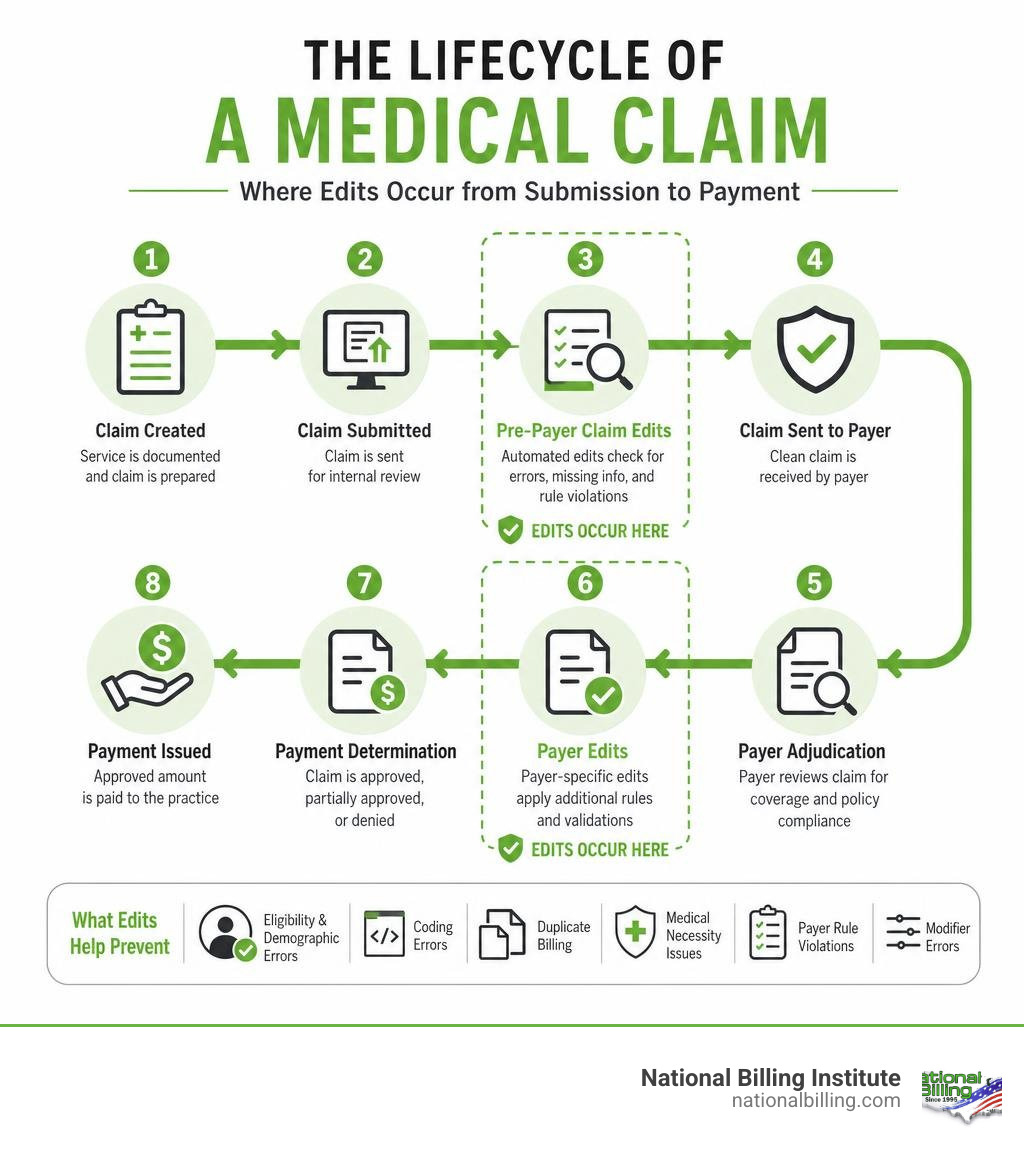
What Are Claim Edits in Medical Billing and How Do They Work?
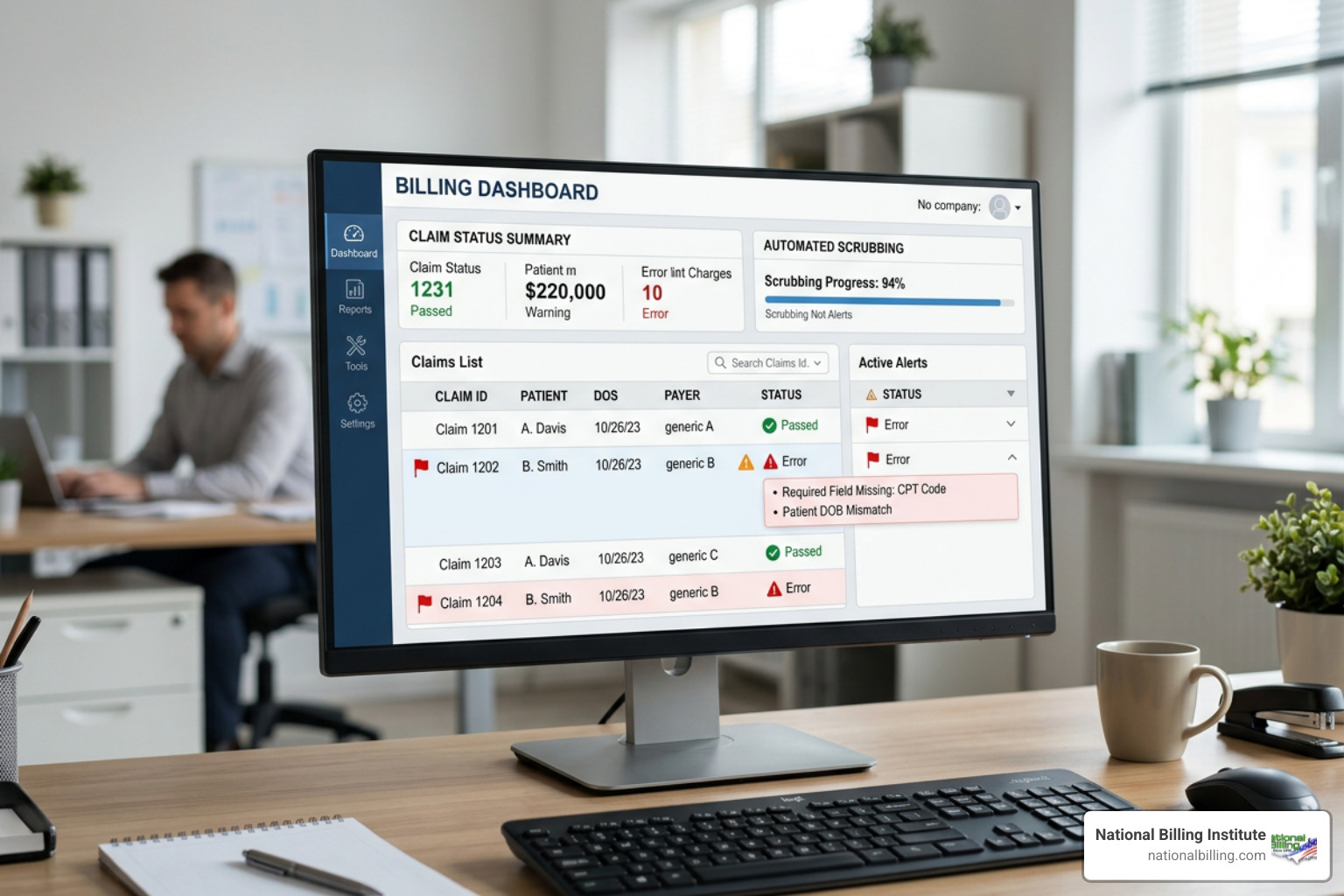
To understand how claim edits in medical billing work, it helps to think of them as a digital safety net. When a clinical provider documents a patient encounter, that encounter is translated into a complex web of medical codes. Before those codes are packaged and sent to an insurance company, they must pass through a series of automated checkpoints.
These checkpoints are what we call claim edits. They are rules-based algorithms that scan every line item of a claim to verify its clinical, administrative, and financial accuracy. If a claim passes all the checks, it is designated as a "clean claim" and sent on its way. If it fails even a single check, the system flags the error and halts the claim so a biller can correct it.
This process is a vital phase of the overall health insurance claim process. By validating data completeness and coding accuracy at the very beginning, we ensure that payers do not receive flawed files that they will immediately reject.
Understanding the role of claim edits in medical billing and RCM success comes down to one goal: maximizing your first-pass acceptance rate. When claims are clean on their first submission, they get processed faster, which keeps your cash flow steady and predictable.
The Role of Claim Edits in Medical Billing Workflows
In a modern healthcare practice, claim edits are integrated directly into the daily workflow. This integration typically happens across two distinct stages:
Front-End Validation: When a patient checks in, front-desk staff collect demographic and insurance details. Internal systems run immediate validation rules to ensure the name, date of birth, and policy ID match the payer's database.
Clearinghouse Filters: Once the clinical documentation is complete and the codes are entered, the claim goes through a clearinghouse. The clearinghouse applies thousands of industry-standard and payer-specific rules to catch errors before final submission.
This multi-layered approach ensures that claim submission in medical billing is highly optimized. By catching errors before the claim is officially submitted to the payer, we protect the practice from the administrative burden of reworking denied claims.
Transitioning from manual workflows to modern electronic medical billing allows these edits to run in real time. Instead of waiting weeks for a paper denial to arrive in the mail, billing teams see instant notifications of missing modifiers or incorrect code pairings, allowing them to resolve issues in minutes.
Why Billing Errors Are So Common in Healthcare
It is no secret that medical billing is incredibly complex. With tens of thousands of active ICD-10 diagnosis codes and thousands of CPT procedure codes, the margin for error is razor-thin. Simple clerical oversights, such as transposing two digits in an insurance policy number or misspelling a patient's last name, account for a massive percentage of front-end rejections.
Furthermore, practices often struggle with "upcoding" (billing for a more expensive service than what was performed) or "unbundling" (billing component parts of a procedure separately). Whether these errors are accidental or due to outdated coding knowledge, they lead to immediate rejections.
Claim edits act as an essential layer of patient protection. By catching duplicate charges, mismatched diagnosis codes, and inflated billing lines before a claim is finalized, edits prevent overpayment issues. This keeps the billing process fair, compliant, and transparent for both the provider and the patient.
The Main Types of Claim Edits and How They Prevent Denials

To build a highly resilient billing department, you must understand the different types of validation rules. Different errors trigger different edits, and knowing how to categorize them is key to preventing medical billing denials.
When we look at how edits function, we can group them into distinct categories. For a deeper look at how these rules interact with clinical documentation, you can read the Understanding Coding Edits & Modifiers: Complete Guide — AMBCI. Let’s explore the primary types of claim edits that keep your revenue cycle running smoothly.
Coding and Modifier Edits
Coding edits ensure that CPT (procedure) and ICD-10 (diagnosis) codes are used correctly and match the clinical scenario. These edits check for:
Age and Gender Discrepancies: Flagging a pregnancy-related code billed for a male patient, or a pediatric code billed for a senior citizen.
Deleted or Invalid Codes: Ensuring that outdated codes that have been retired by the AMA or CMS are not submitted.
Modifier Misuse: Ensuring that modifiers (such as -25 or -59) are only appended when the documentation proves they are clinically justified.
When modifiers are used incorrectly, or when codes are unbundled to artificially inflate reimbursement, payers issue specific medical billing denial codes. Coding edits catch these formatting and logical mismatches before submission, saving your team from compliance audits.
Medicare NCCI Edits and Compliance
The Centers for Medicare & Medicaid Services (CMS) developed the National Correct Coding Initiative (NCCI) to promote national correct coding methodologies and prevent improper payments. These edits are updated quarterly and serve as the baseline for both government and commercial payers. NCCI edits primarily focus on:
Procedure-to-Procedure (PTP) Edits: These identify pairs of CPT codes that should not be billed together because one service is considered an inherent part of the other.
Medically Unlikely Edits (MUE): These define the maximum units of service that a provider can report for a single beneficiary on the same date of service, based on anatomical realities or clinical guidelines.
Maintaining strict billing compliance requires your software to be continuously updated with these quarterly files. For state-specific rules, the 2026 Medicaid NCCI Technical Guidance Manual outlines how Medicaid agencies must apply these methodologies to prevent unbundling and overpayments.
Duplicate and Medical Necessity Edits
Duplicate edits prevent the same service, lab test, or procedure from being billed multiple times for the same patient on the same day. This is a common issue when multiple clinicians coordinate care, or when a lab test is run twice to confirm a result.
Medical necessity edits, on the other hand, verify that the billed procedure is supported by a valid diagnosis code. Insurance payers establish Local Coverage Determinations (LCDs) and National Coverage Determinations (NCDs) that dictate which diagnoses justify specific treatments. If a cardiologist bills for an advanced cardiac MRI but lists a routine chest pain code that does not meet the payer's medical necessity criteria, the edit will flag the claim.
Integrating these rules into your daily medical claims management workflow prevents your practice from submitting claims that are destined to be denied for lack of clinical justification.
Claim Edits vs. Claim Audits: Understanding the Difference
Many healthcare professionals use the terms "claim edits" and "claim audits" interchangeably, but they serve completely different purposes in the revenue cycle.
Edits are proactive and automated. They occur in real time before the claim is submitted to the payer, acting as a gatekeeper to prevent errors. Audits are typically reactive and retrospective. They are detailed reviews of claims that have already been processed or paid, often involving manual reviews of the patient's actual medical records to ensure clinical documentation matches the billed codes.
Here is a direct comparison to help you understand the differences:
Feature Claim Edits Claim Audits Timing Pre-submission (before the payer receives the claim) Post-submission or Post-payment (after processing) Methodology Automated, rules-based software algorithms Manual or hybrid review of clinical records and codes Primary Goal Prevent rejections and denials; ensure clean claims Verify compliance, detect fraud, and recover overpayments Speed Instantaneous (takes seconds) Time-consuming (can take weeks or months) Action Taken Claim is paused for correction before submission Claim is adjusted, paid, denied, or clawed back
By implementing robust pre-submission edits, you drastically reduce the risk of failing a post-payment audit. Catching errors early is the foundation of proactive denial management in medical billing.
How to Optimize Your Revenue Cycle with Smart Edits
Optimizing your revenue cycle requires moving away from manual, spreadsheet-based billing reviews. Relying solely on human eyes to catch coding errors across hundreds of claims a day is a recipe for high denial rates and administrative burnout.
Instead, modern practices utilize advanced claims processing software healthcare platforms that feature built-in, real-time edit engines. This technology automatically scrubs every claim against standard coding databases and payer-specific rules.
For maximum accuracy, many successful practices partner with specialists for us-based claims scrubbing. This combines the speed of automated software with the clinical expertise of certified coders who can resolve complex coding conflicts before submission.
Implementing Smart Claim Edits in Medical Billing
To get the most out of your claim edits, your system needs to be integrated and dynamic. Here is how a highly efficient, automated edit workflow functions:
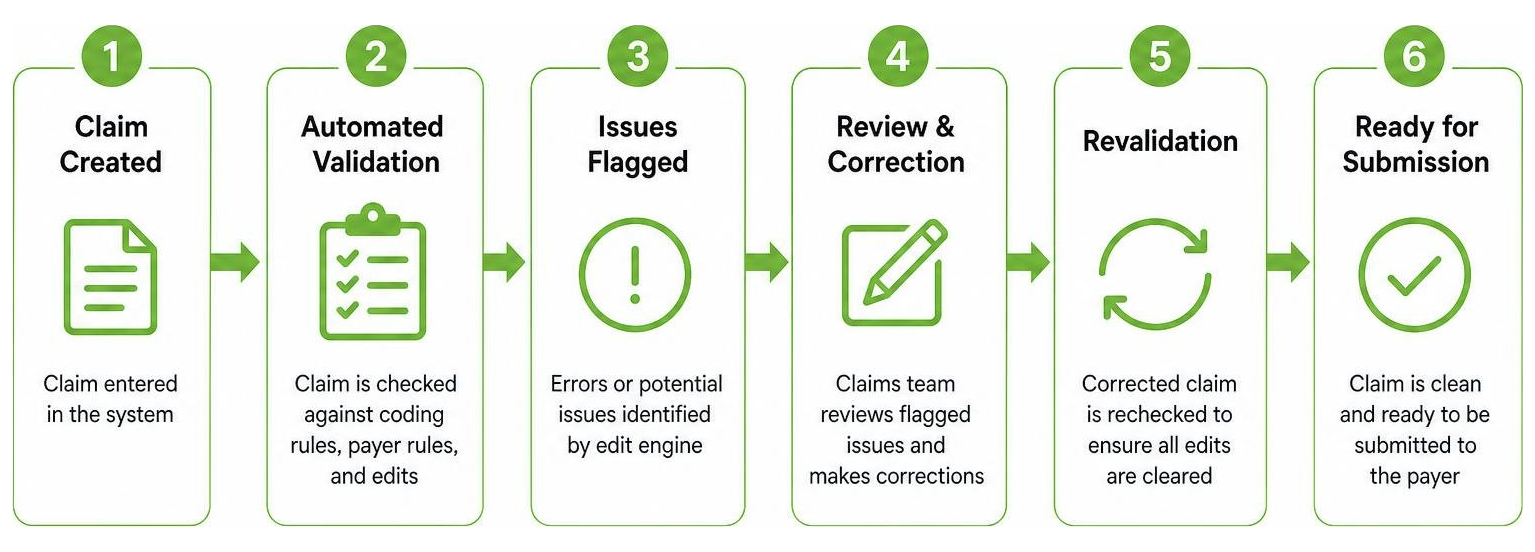
By utilizing ai in healthcare claims processing, your billing system can go beyond basic rule-checking. AI engines analyze historical remittance data to predict which claims are likely to be denied, allowing you to create custom, proactive edit rules.
Accessing these tools through a modern web-based medical billing portal ensures your team can review, correct, and clear flagged edits from any location, keeping your billing cycle moving without delays.
Correcting and Resubmitting Claims
Even with excellent edits, there are times when a claim must be corrected and resubmitted after a payer issues an adjustment. When this happens, it is critical to understand the technical requirements of electronic corrections to avoid triggering duplicate denials.
When resubmitting, you must choose the correct frequency code on your electronic claim form:
Replacement Claim (Frequency Code 7): This completely overwrites the original claim. You must include the original Payer Control Number (ICN/DCN) to link the two. A replacement is a full swap, so you must include all billing lines from the original claim, not just the corrected ones.
Void Claim (Frequency Code 8): This completely retracts the original claim. This is necessary if you billed under the wrong patient ID, the wrong Tax ID, or the wrong payer, as these core fields cannot be "replaced."
For a step-by-step breakdown of how to map these fields in your EDI files, refer to How to Submit a Corrected Claim Electronically: Void vs. Replace - LegalClarity. Managing these corrections within a centralized electronic claims management system ensures you meet timely filing deadlines and maintain a clean claim history.
Frequently Asked Questions about Claim Edits
What is the difference between a claim rejection and a claim denial?
A claim rejection happens on the front end, usually before the payer even processes the claim. Rejections are caused by simple data errors, such as a misspelled name or an invalid policy ID, which fail basic validation rules. Rejections can be corrected and resubmitted immediately without an appeal.
A claim denial occurs after the payer has processed the claim and determined it cannot be paid due to coverage limits, lack of medical necessity, or coding errors. Denials require a formal appeal process. Implementing a strong pre-submission edit strategy is the core of effective what is denial management in medical billing, as it stops rejections from turning into costly, time-consuming denials.
How do automated claim edits protect patients from overpaying?
Automated claim edits verify that patients are only billed for services they actually received and that those services are coded accurately. By catching duplicate charges (such as billing twice for a routine vitals check or a single dose of medication) and preventing unbundled charges, edits ensure that the itemized bills sent to patients are clean, compliant, and accurate. This prevents patients from paying unnecessary out-of-pocket costs.
How quickly can a practice see results after improving their claim edits?
Most practices see a dramatic improvement almost immediately. On average, implementing automated, smart claim edits results in a 40% to 60% reduction in claim rejections within the first 30 days. This immediate drop in errors accelerates your cash flow, reduces the time claims spend in Accounts Receivable (A/R), and frees up your billing staff to focus on complex clinical cases rather than repetitive data entry.
Secure Your Revenue with Smart Claim Edits
In today's complex healthcare landscape, managing your revenue cycle manually is no longer sustainable. With payer rules constantly changing and billing errors costing practices up to 10% of their net revenue every year, you need a proactive partner to protect your financial health.
At National Billing, we combine over 30 years of industry expertise with state-of-the-art, AI-automated claims processing to deliver the cleanest claims in the industry. Based entirely in our Boca Raton, FL headquarters, our 100% US-based team of certified billing specialists ensures full HIPAA compliance while driving down your denial rates to the absolute minimum.
Our clients experience an average revenue increase of 15% to 30% by eliminating preventable rejections and accelerating their reimbursement cycles. Let us turn your billing department into a streamlined revenue engine.
