
Stop Hitting Send Too Early: A Claim Submission Masterclass
Why Getting Claim Submission Right the First Time Matters
Claim submission in medical billing is the formal process of sending a completed healthcare claim — including patient details, diagnosis codes, procedure codes, and charges — to an insurance payer to request reimbursement for services rendered.
Here's what you need to know at a glance:
What it is: A structured request from a provider to a payer, typically filed on a CMS-1500 (professional) or UB-04 (institutional) form, or transmitted electronically via the 837P/837I format.
Why it matters: Errors, missing data, or late submissions result in denials, delayed payments, and revenue leakage.
Key deadline: Medicare claims must be filed within 12 months of the date of service — no exceptions.
Gold standard: A clean claim rate of 95% or higher is considered excellent. Anything below that signals a process problem.
The cost: Each claim costs between $3 and $10 to process. Rework multiplies that cost fast.
Most denied claims aren't denied because the service wasn't covered. They're denied because of preventable errors — wrong codes, missing authorizations, or outdated patient information. That means the fix is almost always upstream, before you ever hit submit.
For overworked practice managers and billing teams, those errors quietly drain revenue month after month. And when billing is handled offshore or without proper oversight, the risks compound: HIPAA exposure, slower turnarounds, and no real accountability.
I'm Olivia Harper, Founder and Denial Management & Reimbursement Specialist at National Billing Institute, and with over 30 years of hands-on experience in claim submission in medical billing and revenue cycle management, I've seen how a disciplined, clean-claim-first approach can increase collections by 15–30% for practices of all sizes. In the sections below, I'll walk you through exactly how to build that process — from documentation and coding to clearinghouse workflows and compliance.
What is Claim Submission in Medical Billing?
At its core, claim submission in medical billing is the bridge between the clinical encounter and the provider’s bank account. When a patient receives care, the clinical documentation must be translated into a highly structured billing format. This claim contains the patient’s demographic information, insurance policy details, the clinical diagnoses (ICD-10-CM codes), the procedures performed (CPT/HCPCS codes), and the provider's financial charges.
Submitting this information is not a simple "send and forget" administrative task. It is the defining moment in your revenue cycle. If done correctly, it triggers a smooth adjudication process, leading to a prompt payment. If done incorrectly, it triggers a cascade of rejections, denials, and administrative rework that drains your staff's time and stalls your cash flow.
The financial stakes of this process are incredibly high:
The Cost of Processing: Industry benchmarks indicate that the administrative cost per claim typically ranges from $3 to $10. This cost accounts for staff time, clearinghouse fees, and software usage. However, when a claim is rejected or denied, the cost of manual rework, appeals, and resubmissions can easily double or triple that figure.
The Danger of Timely Filing Limits: Every insurance payer has strict rules regarding how quickly a claim must be submitted after the date of service. For instance, according to the official guidelines for Filing a claim | Medicare, Original Medicare claims must be filed no later than 12 months (or one full calendar year) after the date when the services were provided. Commercial payers often have even tighter windows—sometimes as short as 90 or 180 days. Missing these deadlines means forfeiting your right to reimbursement entirely.
The Broader Revenue Cycle Impact: A bottleneck at the submission stage ripples through your entire practice. It delays payment posting, skews your accounts receivable (A/R) metrics, and complicates patient billing.
Implementing a robust strategy for Medical Claims Management is the only way to safeguard your cash flow and ensure that your clinical team is fairly compensated for their hard work.
The Anatomy of a Medical Claim: Types and Requirements
To master the submission process, you must first understand the structural differences between the types of claims you submit. Not all medical claims are created equal. Depending on the setting where care was delivered and the type of provider who delivered it, your claim will fall into one of two primary categories: professional or institutional.

Professional vs. Institutional Claims
Professional claims are used by physicians, non-physician practitioners, and independent suppliers for outpatient services, clinic visits, and professional consultations. These are billed using the standard CMS-1500 paper form or its electronic equivalent, the 837 Professional (837P) transaction.
Institutional claims, on the other hand, are utilized by hospitals, skilled nursing facilities, rehabilitation centers, and home health agencies to bill for facility charges, room and board, and outpatient hospital services. These are billed using the UB-04 paper form (also known as the CMS-1450) or the electronic 837 Institutional (837I) transaction.
To help visualize these differences, let's look at how they compare across key operational variables:
Feature / Metric Professional Claims Institutional Claims Standard Paper Form CMS-1500 UB-04 (CMS-1450) Electronic Format ASC X12 837P (5010A1) ASC X12 837I (5010A1) Primary Billing Entity Individual doctors, clinics, therapists Hospitals, nursing facilities, ASCs Key Code Sets Used CPT, HCPCS Level II, ICD-10-CM ICD-10-CM, ICD-10-PCS, Revenue Codes Governing Body National Uniform Claim Committee (NUCC) National Uniform Billing Committee (NUBC) Typical Cost to Process Lower ($3 - $5 per claim) Higher ($7 - $10+ per claim due to complexity)
Understanding these distinctions is vital because submitting a professional service on an institutional form—or vice versa—will result in an immediate, automated rejection. For detailed guidelines on standard transaction formats, providers should consult the Medicare Claims Processing Manual.
Required Documentation for Claim Submission in Medical Billing
Creating a claim that passes payer scrutiny requires a meticulous gathering of clinical and administrative documentation. If even one piece of this puzzle is missing, the claim is incomplete. The foundational documents and data points required for every submission include:
Patient Demographics: The patient's legal name (spelled exactly as it appears on their insurance card, using commas to separate last name, first name, and middle initials without unnecessary periods), date of birth, gender, and complete address (including a 5- or 9-digit ZIP code without hyphens).
Insurance Verification & Policy Details: The active insurance carrier’s name, payer ID, policy group number, and the primary insured's unique identification number (which can accommodate up to 29 characters on standard forms).
Comprehensive Medical Records: Detailed clinical notes, intake forms, and physician signatures that support the medical necessity of the services rendered.
ICD-10-CM Diagnosis Codes: Standardized codes that describe the patient's condition or reason for the visit. If a claim requires multiple pages, the diagnosis codes reported on the first page must be repeated on subsequent pages; if more than 12 diagnoses are required, the claim must be split.
CPT/HCPCS Codes & Modifiers: CPT codes describe the specific professional procedures performed, while HCPCS Level II codes describe medical equipment, supplies, and injectable drugs. Modifiers must be appended when necessary to provide additional context (e.g., distinguishing bilateral procedures).
Prior Authorization Approval: For specialty services, advanced imaging, or specific surgeries, you must secure and document a valid prior authorization number from the payer prior to treatment, entering it directly into the designated field on the claim form.
Electronic vs. Paper Formats in Modern Billing
In June 2026, paper claims are a relic of the past for the vast majority of healthcare organizations. The Administrative Simplification Compliance Act (ASCA) mandates that all claims submitted to Medicare must be sent electronically, except under very rare circumstances (such as extremely small practices with fewer than 10 full-time equivalent employees).
Electronic claims are structured using standard HIPAA-compliant transactions. For professional billing, this is the ASC X12 837P format, and for institutional billing, it is the ASC X12 837I format. Transitioning away from paper forms to Electronic Medical Billing is highly beneficial: it eliminates physical mailing costs, bypasses manual mailroom delays, and allows for rapid electronic validation.
For a complete breakdown of electronic standards and the legal mandates governing them, you can review the official resources on Electronic Health Care Claims - CMS. If a provider is permitted to submit paper claims, they must use the exact red-ink drop-out forms specified by the National Uniform Claim Committee CMS-1500 Claim guidelines to ensure they can be read by optical character recognition (OCR) scanners.
Step-by-Step: The Claim Submission Process
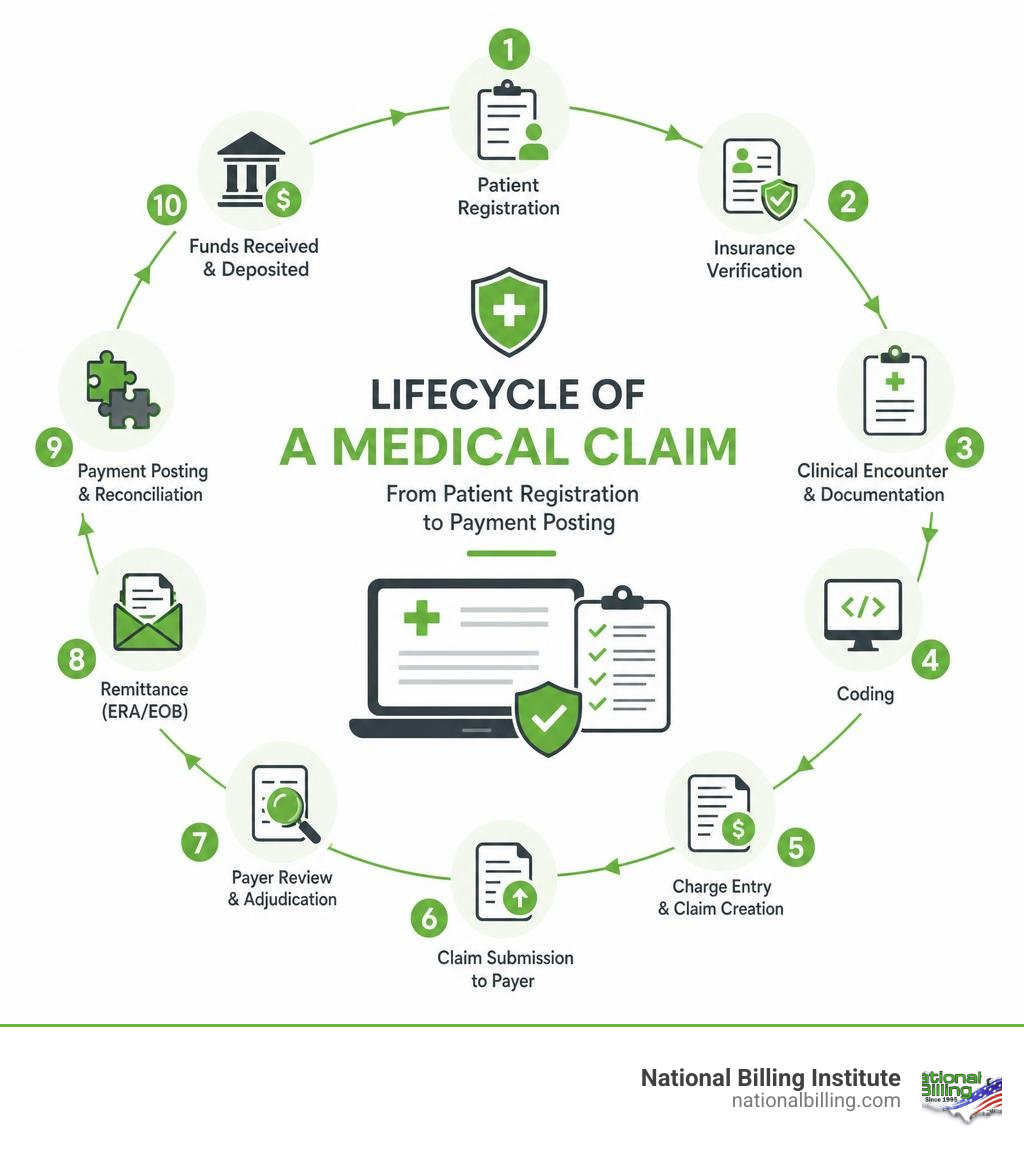
To achieve a highly efficient billing operation, your practice must treat claim submission as a continuous, structured pipeline rather than a batch of paperwork compiled at the end of the week. Let’s break down the optimal step-by-step workflow:
Patient Registration: The workflow begins the moment a patient schedules an appointment. Front-desk staff must collect accurate demographic information and scan physical insurance cards.
Insurance Eligibility Verification: Before the patient even sees the provider, billing staff must verify active insurance coverage, copay requirements, deductible status, and whether the planned services require a prior authorization.
Medical Coding: Following the clinical encounter, the provider documents the visit. Certified medical coders translate this clinical narrative into the appropriate ICD-10-CM, CPT, and HCPCS codes.
Claim Generation: The billing software compiles the verified patient demographics, insurance details, and medical codes into a standard electronic file (the 837 transaction) or a paper form.
Claim Scrubbing: Before the claim leaves your system, it must pass through a specialized "scrubber." This software automatically analyzes the claim against thousands of industry rules, payer policies, and CCI (Correct Coding Initiative) edits to catch errors like mismatched codes, missing modifiers, or invalid policy numbers. Using advanced Claims Processing Software Healthcare is critical at this stage to prevent dirty claims from reaching the clearinghouse.
The Role of Clearinghouses and EDI in Claim Submission in Medical Billing
Once a claim is generated and scrubbed internally, it is rarely sent directly to the insurance company. Instead, it travels through an intermediary known as a medical billing clearinghouse using Electronic Data Interchange (EDI).
EDI is the secure, standardized computer-to-computer exchange of healthcare data using Accredited Standards Committee (ASC) X12 formats. Think of the clearinghouse as an automated digital post office. It receives a large batch of claims from your practice, translates them into the precise format required by each individual insurance carrier, and transmits them securely.
During this transmission, claims undergo a layered validation process:
Front-End HIPAA Edits: The clearinghouse first checks the files to ensure they meet basic HIPAA transaction standards. If a batch fails these initial structural edits, the entire batch is rejected and returned to the sender.
Implementation Guide Edits: Next, the system checks if the clinical and demographic data fields conform to standard implementation guidelines.
Payer-Specific Edits: Finally, the claims are evaluated against the specific coverage and payment policies of the receiving insurer. At this stage, errors will result in the rejection of individual claims rather than the whole batch.
By catching these errors at the clearinghouse level, providers can review detailed electronic reports, correct mistakes instantly, and resubmit claims before they ever reach the payer's desk. This system drastically reduces administrative costs and speeds up payments. For a deeper look at these electronic transmission channels, refer to the [PDF] Claim Submission Methods - Medical Bill Processing Portal documentation.
Clean Claims, Compliance, and Error Prevention
In medical billing, your primary operational metric is the clean claim rate (CCR). A clean claim is a claim that is submitted to an insurance company containing all the necessary, accurate, and compliant information required for immediate processing. It has no missing data, no coding errors, and perfectly conforms to all payer-specific rules on its very first submission.
Conversely, a dirty claim is one that contains errors, omissions, or structural defects. When a payer receives a dirty claim, they will either reject it (send it back immediately without processing) or deny it (refuse payment after adjudication).
Maintaining a high clean claim rate is essential for healthy cash flow. A CCR of 95% or higher is considered the gold standard in healthcare billing. If your rate drops below 90%, your practice is spending excessive time and money on manual rework, which directly delays your revenue.
To manage your claims pipeline effectively, your billing team must also understand these key claim classifications:
Pending Claims: Claims that are placed on hold by the payer during adjudication, usually because they require additional supporting documentation, medical records, or manual review.
Void Claims: Claims that are submitted to completely cancel a previously processed claim, typically used to correct major clerical errors or duplicate submissions before a final payment decision is locked in.
Crossover Claims: Claims that are automatically forwarded from a primary payer (like Medicare) to a secondary payer (like Medicaid) without requiring the billing team to file a separate, secondary claim.
To prevent dirty claims, providers must also strictly adhere to HIPAA regulations, ensuring that all electronic transmissions protect Protected Health Information (PHI) through secure EDI channels. For detailed payer-specific rules and guidelines on clean claims, check out Claims, billing and payments | UHCprovider.com. Transitioning to an Automated Revenue Cycle Management system can help automate these compliance checks and keep your clean claim rate well above the industry benchmark.
Common Errors in Claim Submissions and How to Avoid Them
Even seasoned billing teams can fall victim to repetitive errors if they rely on manual workflows. Here are the most common errors in claim submission in medical billing and the practical steps you can take to prevent them:
Incorrect Patient or Insured Information: Simple typos in a patient's name, mismatched dates of birth, or incorrect policy numbers are the leading causes of claim rejections.
How to avoid: Implement real-time digital insurance verification during check-in, and use optical character readers to scan insurance cards directly into your practice management system.
Coding Errors (Mismatched ICD-10 and CPT Codes): Submitting a procedure code that does not logically align with the diagnosis code (e.g., billing a cardiac procedure with a diagnosis code for a sprained ankle) flags the claim for lack of medical necessity.
How to avoid: Ensure your billing software has robust CCI edit checks, and provide continuous education to your coding staff on annual code updates.
Missing Prior Authorizations: Submitting a claim for an advanced service (like an MRI or outpatient surgery) without the required prior authorization number leads to an immediate, hard denial.
How to avoid: Create hard stops in your scheduling system that prevent patients from being seen for specific procedures unless an active authorization number is documented in their file.
Failing Timely Filing Limits: Submitting claims outside of the payer's designated filing window (such as the 12-month Medicare limit or 90-day commercial limits) results in an unappealable denial.
How to avoid: Establish a daily billing routine. Never allow claims to sit in your "unsubmitted" queue for more than 24 to 48 hours.
Duplicate Billing: Accidentally submitting the same claim twice for a single date of service. This often happens when a billing team resubmits a claim without checking if the original is still pending.
How to avoid: Always check the status of a claim in your clearinghouse portal before sending a corrected or replacement claim.
Return to Provider (RTP) Issues: On paper claims, leaving mandatory fields blank or failing to format the carrier block correctly (which requires a clean 3- or 4-line address format with no punctuation) will cause the mailroom to physically return the form.
How to avoid: Transition fully to electronic billing, and verify all required paper fields are complete before printing.
Frequently Asked Questions About Claim Submissions
What is an excellent clean claim rate for a medical practice?
An excellent clean claim rate is 95% or higher. This means that 95 out of every 100 claims you submit are processed and paid on the first pass without being rejected, denied, or delayed for corrections. Maintaining a high first-pass ratio is the single best indicator of an efficient, highly optimized revenue cycle.
How long do providers have to submit a Medicare claim?
Under federal law, Medicare claims must be filed no later than 12 months (or 1 full calendar year) after the date on which the services were provided. If a service was performed on June 15, 2025, the claim must be successfully received by Medicare no later than June 15, 2026. Failing to meet this deadline results in a permanent loss of reimbursement for that service.
What are the processing timelines for fresh bills and adjustments?
For standard medical bill processing portals, fresh, clean electronic bills are typically processed within 28 calendar days from the date of receipt. If a claim requires an adjustment or correction, those adjustments are usually processed within 8 business days from the date the corrected claim is received. Paper submissions, however, may take an additional 24 to 48 hours just to be scanned into the payer's digital system.
Conclusion: Partner with National Billing Institute
Mastering claim submission in medical billing is not about working harder; it’s about building a highly disciplined, compliant, and automated workflow. When you eliminate manual errors, leverage real-time clearinghouse edits, and strictly monitor your timely filing limits, you protect your practice from costly denials and secure the revenue you’ve rightfully earned.
But managing this complex pipeline internally can be an administrative nightmare. Between keeping up with shifting payer rules, managing prior authorizations, and chasing down rejections, your staff can easily become overwhelmed—leaving money on the table.
That is where we come in. At National Billing Institute, we provide comprehensive Medical Billing and AI-automated claims processing solutions tailored to your practice's unique needs.
Our competitive advantages include:
30+ Years of Experience: Led by industry experts, we know how to navigate the most complex billing regulations.
100% USA-Based Team: Operating directly out of our headquarters in Boca Raton, FL, we offer unmatched transparency, security, and communication.
The Lowest Denial Rates in the Industry: Our proactive scrubbing and dedicated denial management ensure your claims are paid on the first pass.
Full HIPAA Compliance: We utilize state-of-the-art encryption and secure EDI channels to protect your patient data.
15–30% Revenue Increase: By streamlining your submission workflow and eliminating leakage, we consistently boost our clients' bottom lines.
Stop hitting send too early and leaving your revenue to chance. Partner with National Billing Institute today to secure your practice's financial future with a personalized, high-performing billing solution.
