
Top Features of a Modern Electronic Claims Management System
Why an Electronic Claims Management System Is Critical for Your Practice's Financial Health
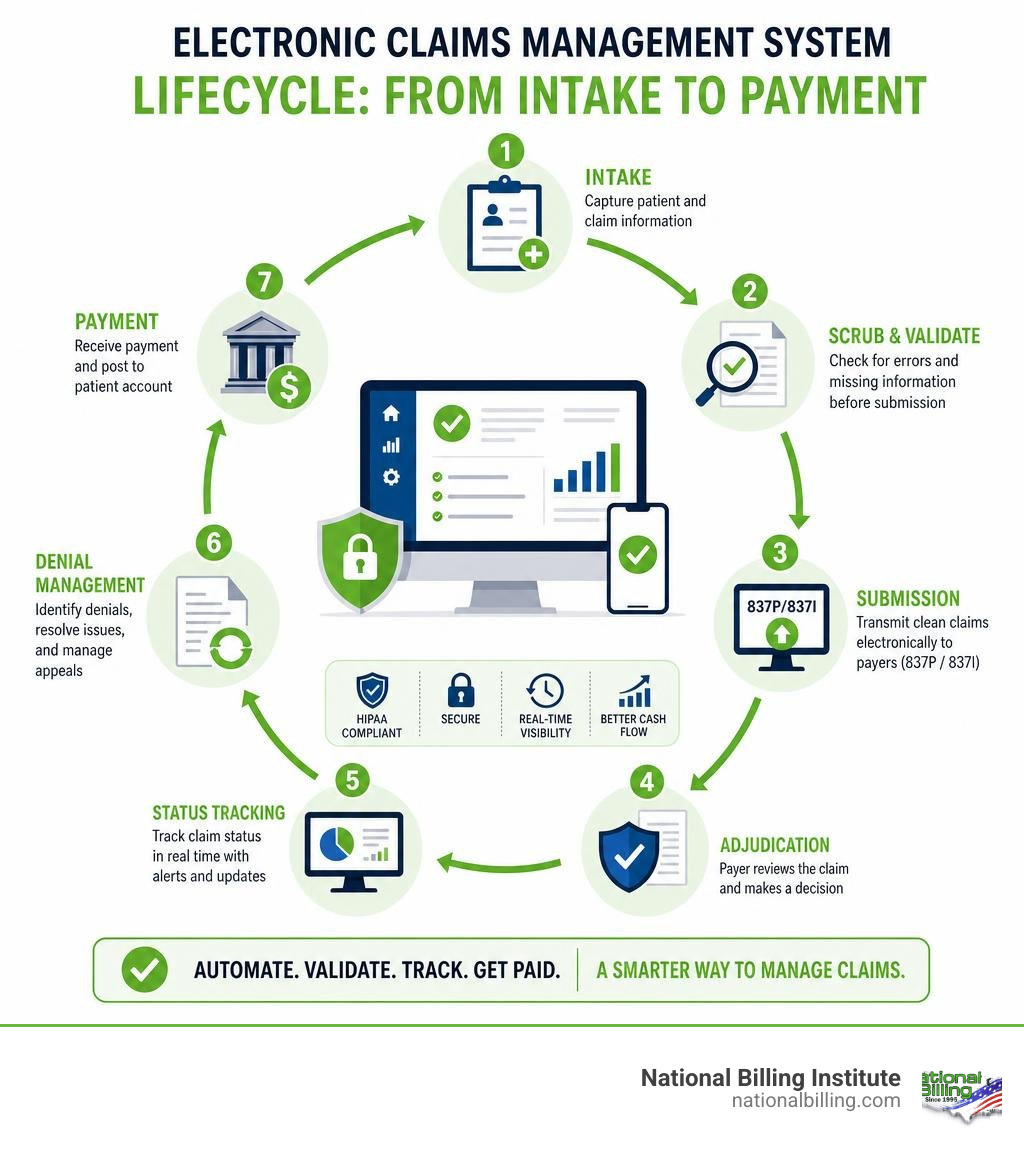
An electronic claims management system is software that automates the full lifecycle of a healthcare claim — from intake and scrubbing to submission, adjudication, and payment. If you're trying to decide whether your practice needs one (or which one to choose), here's the short answer:
What an electronic claims management system does:
Submits claims electronically to payers using standard formats like 837P and 837I
Scrubs claims for errors before submission to prevent denials
Tracks claim status in real-time from submission to payment
Flags potential fraud and compliance issues automatically
Manages denials and automates the appeals process
Integrates with your EHR, billing platform, and payer networks
Why it matters:
Without ECMS With ECMS 10%+ average denial rate As low as 1–4% denial rate Manual claim entry and follow-up Automated workflows and alerts Slow A/R cycles (60–90+ days) A/R cycles as low as 27–37 days High risk of billing errors Real-time validation before submission Limited visibility into claim status Full dashboard tracking at every stage
The stakes are high. Claim denials cost healthcare practices millions in lost and delayed revenue every year. Manual processes make the problem worse — they're slow, error-prone, and hard to scale. As claim volumes grow and payer rules get more complex, practices that rely on paper-based or fragmented billing workflows fall further behind.
The shift to electronic claims processing isn't just about convenience. It's about protecting your revenue, staying HIPAA-compliant, and giving your team the tools to work smarter.
I'm Olivia Harper, Founder and Denial Management & Reimbursement Specialist at National Billing Institute, and over my 30+ years running a US-based medical billing operation, I've seen how the right electronic claims management system can transform a practice's financial performance. In this guide, I'll walk you through the features that matter most so you can evaluate your options with confidence.
Evolution of the Electronic Claims Management System
To appreciate what a modern electronic claims management system (ECMS) can do today in 2026, it helps to look back at how we got here. Decades ago, medical billing was a sluggish, paper-bound process. Billers manually typed out claim details on red-and-white paper forms, stuffed them into envelopes, and sent them via postal mail to commercial insurers and government payers.
This paper-heavy approach was incredibly slow. A single claim could take weeks just to arrive at the payer's mailroom, let alone undergo manual review and adjudication. If there was a single typo, the paper claim was mailed back to the provider, starting the entire cycle over again.
The digital transition began to take shape with the passage of the Health Insurance Portability and Accountability Act (HIPAA) of 1996. This landmark legislation established the first national standards for electronic healthcare transactions. Over the years, federal initiatives pushed the industry away from paper toward standardized electronic data interchange (EDI) formats.
For example, government agencies developed specialized platforms like the Historical context on electronic claims engines to process pharmacy transactions in compliant, real-time formats. These early systems proved that moving data electronically could slash turnaround times from weeks to seconds.
Today, modern Electronic Medical Billing has evolved into a fully automated, cloud-based practice. We no longer just transmit data; we manage the entire financial relationship between providers, patients, and insurance payers through intelligent software. This evolution has turned medical billing from a reactive administrative chore into a proactive, data-driven strategy for practice growth.
Core Features of Modern Claims Software
A modern electronic claims management system is far more than a simple digital post office. It is an intelligent hub that coordinates complex data exchanges across multiple networks.

To understand how these platforms work, we must look at the standard EDI transaction sets that power them:
837P (Professional Claims): Used by individual physicians, clinics, and outpatient providers to bill for clinical services.
837I (Institutional Claims): Used by hospitals, skilled nursing facilities, and medical centers to bill for inpatient and outpatient facility services.
835 (Electronic Remittance Advice - ERA): The electronic equivalent of an Explanation of Benefits (EOB), which payers send back to explain payment decisions, adjustments, and denials.
An advanced ECMS also includes real-time eligibility verification. Instead of calling payers or logging into multiple portals, billers can verify a patient's benefits instantly before care is delivered.
To see how these capabilities change daily operations, let's compare a manual workflow with an automated, electronic one:
Workflow Step Manual Claims Processing Automated Electronic Claims Data Entry Manual typing into legacy billing screens Automated import from EHR and scheduling software Eligibility Check Staff calls payers or checks individual websites Real-time verification at check-in via API Error Detection Visual review of paper forms (high risk of human error) Instant automated scrubbing against millions of rules Submission Mailed or uploaded via basic, unvalidated portals Secure batch submission in standard 837 formats Tracking Manual follow-up calls to payers after 30+ days Real-time digital dashboard tracking Remittance Paper checks and manual posting of EOBs Automated posting of electronic 835 ERA files
By standardizing these steps, modern platforms help providers transition to a highly organized digital environment, maximizing efficiency and reducing administrative burdens.
Automated Claim Scrubbing and Validation
The secret to a healthy revenue cycle is getting claims right the first time. This is where automated claim scrubbing comes in. Before a claim ever leaves your system, the software automatically reviews it for missing information, mismatched coding (such as CPT and ICD-10 combinations), and payer-specific guidelines.
A key part of this process is SNIP (Strategic National Implementation Process) validation. SNIP validation checks claims across seven levels of compliance — from basic formatting and mathematical integrity to complex clinical logic and specialty-specific rules.
By implementing robust Claims Processing Software Healthcare systems, practices can catch errors before they lead to costly rejections. This ensures your claims remain fully aligned with established CMS Billing Standards from day one.
AI-Driven Denial Management in an Electronic Claims Management System
Even with excellent scrubbing tools, payers occasionally deny claims. When this happens, a modern ECMS uses artificial intelligence and machine learning to turn a setback into an automated recovery process.
AI-driven systems use predictive analytics to analyze historical claims data and recognize patterns in payer behavior. If a claim is denied, the system doesn't just flag it; it automatically triages the denial, determines the root cause, and recommends the exact steps needed to correct it.
Some advanced systems even feature "agentic AI" workflows. With a single click, the software can pull patient records, generate a customized appeal letter, attach the necessary clinical documentation, and submit it directly to the payer.
To explore how these cutting-edge tools are transforming the industry, read our detailed guide on AI in Healthcare Claims Processing and see how AI-powered claims optimization is helping practices recover lost revenue faster than ever.
Key Benefits of Upgrading Your Claims Infrastructure
Upgrading to a modern, automated claims infrastructure is one of the most impactful financial decisions a healthcare organization can make. The benefits extend far beyond simply going paperless; it fundamentally changes the speed at which your practice is compensated for care.

When you eliminate manual touchpoints, you instantly reduce operational costs. Staff members who once spent hours on hold with insurance companies or manually typing data can focus on patient care and higher-value tasks.
Furthermore, the dramatic drop in denial rates has a compounding effect on your cash flow. Moving from the industry average denial rate of 10% or higher down to an optimized rate of under 4% means you keep more of the money you earn, without the administrative overhead of constant re-billing.
To maximize these financial gains, practices must align their technology with overall Revenue Cycle Operations to ensure no revenue is left on the table.
Streamlining Workflows with an Electronic Claims Management System
A primary operational benefit of an ECMS is the dramatic acceleration of the claim lifecycle. High-performance, federal-ready platforms can adjudicate claims in just 2 to 3 seconds. For commercial practices, this speed translates to near-instant feedback on whether a claim has been accepted or rejected by the payer's gateway.
This high-speed processing is made possible by auto-adjudication, where clean claims are processed and approved for payment entirely by software, requiring manual review only for complex exceptions.
To achieve this level of efficiency, many organizations are shifting toward Automated Revenue Cycle Management platforms. Implementing Cloud-native claims management solutions ensures your team can securely access, track, and manage claims from any device, anywhere.
Enhancing Financial Performance and Transparency
Without clear data, managing a practice's financial health is like driving in the dark. A modern ECMS shines a light on your revenue cycle through real-time dashboards and actionable analytics.
These platforms track critical key performance indicators (KPIs) such as:
Days in Accounts Receivable (A/R): The average number of days it takes to get paid. Top-performing practices using advanced systems can lower their A/R days to between 27 and 37 days.
First-Pass Clean Claim Rate: The percentage of claims accepted on the very first submission.
Denial Trends: Detailed insights into which payers are denying claims and why.
By leveraging Healthcare Revenue Cycle Analytics, you can identify bottlenecks, address recurring billing errors, and implement targeted Revenue Cycle Management Solutions to keep your cash flow steady and predictable.
Integration and Compliance Standards
A claims management system cannot exist on an island. To be truly effective, it must integrate seamlessly with your existing technology stack, including your Electronic Health Records (EHR) and Practice Management (PM) systems.
Modern platforms achieve this through robust API (Application Programming Interface) ecosystems. Instead of relying on slow batch file uploads at the end of the day, APIs allow your EHR and billing systems to talk to each other in real-time. When a provider signs off on a clinical note, the billing codes can flow instantly into your claims engine.
At the same time, security and compliance are non-negotiable. Because these platforms handle highly sensitive Protected Health Information (PHI), they must maintain strict security standards. This includes full HIPAA compliance for secure data exchange, SOC 2 certification for data security, and end-to-end data encryption.
For platforms serving government programs, meeting FedRAMP (Federal Risk and Authorization Management Program) standards and obtaining an Authority to Operate (ATO) in secure cloud environments is essential.
Implementing an integrated, secure Automated Revenue Management platform ensures your practice complies with the latest federal rules, including CMS Clearinghouse Guidelines and prompt-payment laws, protecting your organization from compliance risks and ensuring seamless data exchange.
Frequently Asked Questions about Claims Processing
What is the difference between clearinghouses and claims management systems?
While they work together, they serve different purposes. A clearinghouse is primarily a transmission hub; it takes your billing data, translates it into the standard EDI format required by the payer, and securely transmits it.
A claims management system, on the other hand, is an end-to-end workflow platform. It manages the entire lifecycle of the claim within your practice. It includes the user interface your team works in, custom rules engines, AI denial triage tools, A/R tracking, and direct integration with your EHR. Many modern claims management systems feature built-in clearinghouse capabilities, giving you a single platform for the entire process.
How does AI improve clean claim rates?
AI improves clean claim rates by moving beyond simple, rigid "if-then" rules. Traditional claim scrubbers look for basic errors (like a missing zip code). AI-driven systems use machine learning to analyze millions of historical claims and recognize subtle, evolving patterns in how specific payers adjudicate claims.
For instance, if a commercial payer quietly changes its documentation requirements for a specific procedure, the AI can detect the sudden spike in denials across the network and automatically create a new custom edit rule in minutes. This proactive approach prevents future denials before they can happen.
What security standards must these platforms meet?
At a minimum, any platform handling medical billing data in the United States must be fully compliant with the HIPAA Security Rule. This requires robust administrative, physical, and technical safeguards, including:
Multi-factor authentication (MFA) and strict user access controls
End-to-end encryption for data both in transit and at rest
Detailed audit logs that record every time PHI is accessed or modified
Regular third-party security audits, such as SOC 2 Type II certifications
These rigorous standards ensure that sensitive patient data remains protected at every stage of the transmission and adjudication process.
Conclusion
Upgrading to a modern electronic claims management system is no longer optional for healthcare practices that want to thrive. In an era of shrinking reimbursements and increasingly complex payer rules, having the right technology to protect your revenue is a necessity.
At National Billing Institute, we combine cutting-edge, AI-automated claims processing with the invaluable expertise of a 100% USA-based team. Headquartered in Boca Raton, FL, our specialists bring over 30 years of hands-on experience to your revenue cycle. We are fully HIPAA-compliant, proud to maintain some of the lowest denial rates in the industry, and consistently help our clients achieve a 15% to 30% increase in revenue.
If you are ready to eliminate billing headaches, lower your denial rates, and accelerate your cash flow, we are here to help. Partner with National Billing Institute for expert services today, and let us take the complexity out of your claims management.
