
The Power of Data in Modern Healthcare Revenue Cycle Analytics
Why Healthcare Revenue Cycle Analytics Is the Financial Lifeline Providers Need Right Now
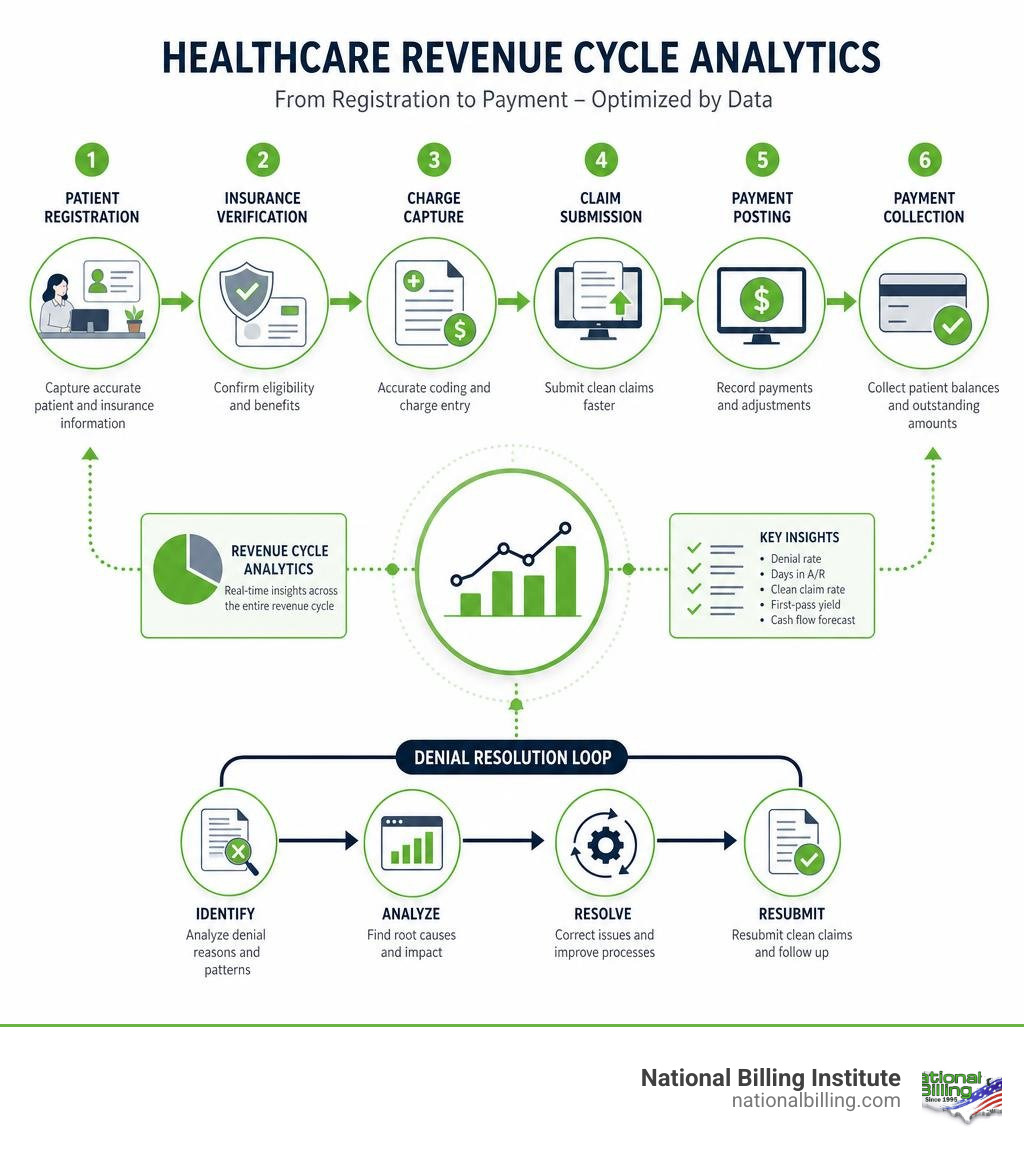
Healthcare revenue cycle analytics is the use of data analysis to track, measure, and improve every step of the financial process — from patient registration to final payment.
Here's what it does in plain terms:
Identifies why claims get denied — and fixes the root cause before the next submission
Tracks key metrics like Days in A/R, clean claim rate, denial rate, and first-pass yield
Forecasts cash flow over 30/60/90-day windows so you can plan staffing and operations
Flags revenue leakage across payers, service lines, and billing workflows
Turns fragmented billing data from multiple systems into one clear financial picture
In short: it tells you exactly where your money is going — and how to stop losing it.
The financial pressure on healthcare providers right now is real. The median hospital operating margin sits at just 2.3% nationwide as of 2025. At the same time, hospitals spend nearly $20 billion every year fighting denied claims — most of which are entirely avoidable.
Up to 25% of all U.S. healthcare spending — close to $1 trillion annually — is lost to administrative waste and inefficiency. For a hospital with $3 billion in net revenue, a 10% denial rate alone puts $300 million in revenue at risk.
That's not a billing problem. That's a data problem.
Without visibility into why denials happen, which payers are slow-paying, and where charges are leaking, providers are left reacting instead of preventing. Analytics changes that equation entirely.
I'm Olivia Harper, Founder of National Billing Institute and a denial management and reimbursement specialist with over 30 years of hands-on experience in healthcare revenue cycle analytics and medical billing. In that time, I've seen how the right data — captured, organized, and acted on — can transform a practice's financial performance from reactive and unpredictable to consistent and growth-oriented.
What is Healthcare Revenue Cycle Analytics and Why is it Crucial in 2026?
Let's face it: healthcare billing has never been simple. But in 2026, the complexity has reached an all-time high. Between shifting payer rules, rising patient deductibles, and increasingly strict regulatory requirements, providers are working harder than ever just to get paid for the care they deliver.
At its core, healthcare revenue cycle analytics is the engine that transforms raw billing and clinical data into actionable financial strategies. Instead of waiting for month-end reports to tell you what went wrong thirty days ago, modern analytics gives you a real-time, high-definition view of your entire financial operation.
When we look at the broader picture of Revenue Cycle Management Healthcare, the goal is no longer just "getting claims out the door." The goal is establishing a continuous loop of financial intelligence. Every claim submitted, every denial received, and every payment posted contains valuable clues. Analytics helps us decode those clues to make smarter, data-driven decisions that protect our operating margins.
According to the HFMA Revenue Cycle Best Practices, top-performing organizations don't treat billing as an isolated administrative task. They treat it as a core component of their clinical and operational strategy. By automating administrative transactions and analyzing the resulting data, health systems and private practices can curb the massive administrative waste that drains our industry.
The Core Pillars of Healthcare Revenue Cycle Analytics
To get the most out of your financial data, it helps to understand the four distinct levels of analytics. Think of these as a ladder—each step takes you from simply understanding the past to actively shaping your financial future:
Descriptive Analytics ("What happened?"): This is your traditional reporting. It gathers historical data to show you your current baseline—such as your total outstanding Accounts Receivable (A/R), last month's denial rate, or your average charge lag. It's the foundation, but it only tells you where you've been, not where you're going.
Diagnostic Analytics ("Why did it happen?"): This is where we start digging deeper. If your denial rate spiked by 5% last quarter, diagnostic analytics helps you isolate the cause. Was it a specific payer? A new coding guideline? A front-desk registration error? By grouping data by payer, CPT code, or department, you can uncover the exact root causes of revenue leakage.
Predictive Analytics ("What is likely to happen?"): Now we're looking forward. By analyzing historical payment behaviors and payer trends, predictive models can forecast future cash flow, identify which claims are at a high risk of denial before they are even submitted, and estimate patient payment likelihood.
Prescriptive Analytics ("What should we do about it?"): The peak of the ladder. Prescriptive analytics doesn't just predict a problem; it suggests the optimal solution. For example, if a claim has a 90% likelihood of being denied due to a prior authorization mismatch, prescriptive tools will flag the claim and guide your billing staff on how to correct it before submission.
By mastering these four pillars, we move our clients from a defensive posture of fighting denials to an offensive strategy of preventing them entirely. This structured approach is highlighted by leading industry guides, such as Revenue Cycle Analytics | Experian Health , which emphasize how advanced data modeling can turn historical pain points into predictable financial wins.
Key Metrics and KPIs for Monitoring Revenue Cycle Performance
If you don't measure it, you can't manage it. But in a sea of financial data, which metrics actually deserve your attention?

To run a highly efficient billing operation, we focus on a mix of traditional operational metrics and modern, predictive indicators. Traditional KPIs tell us how well our billing team and software are performing historically, while predictive KPIs help us anticipate and prevent future bottlenecks in our Revenue Cycle Operations.
Here is a breakdown of the essential metrics every healthcare leader should monitor:
Days in Accounts Receivable (Days in A/R): This measures the average number of days it takes to collect payments after a service is rendered. The lower this number, the faster your cash flow. High-performing organizations aim to keep this below 35 days.
Clean Claim Rate (CCR): The percentage of claims that are successfully submitted on the first attempt without errors or rejections. A high CCR is the ultimate indicator of front-end billing health.
First-Pass Yield (FPY): Often confused with CCR, first-pass yield measures the percentage of claims that are not just submitted cleanly, but actually paid on the first submission.
Net Collection Rate (NCR): This is the ultimate test of your billing efficiency. It represents the percentage of collectable revenue (total charges minus contractual adjustments) that you actually bring through the door. If your NCR is below 95%, you are leaving money on the table.
To help you visualize how the landscape of financial tracking is evolving, let's compare traditional metrics with the emerging predictive KPIs that modern analytics platforms provide:
Traditional RCM Metric Emerging Predictive KPI Why the Shift Matters Days in A/R Payment Behavior Forecasting Instead of measuring how long collections used to take, we predict exactly when a specific payer will settle a specific claim category. Standard Denial Rate Claim Approval Likelihood Index Rather than counting rejections after they occur, we assign a pre-submission success score to prevent the denial from happening. Gross Collections Patient Financial Responsibility Index Moves beyond total outstanding balances to predict a patient's actual capacity and likelihood to pay, allowing for customized billing plans. Manual Touch Counting Zero-Touch Rate (Automation Efficiency) Tracks how many claims are processed from intake to payment without a single human intervention, highlighting automation success.
Leveraging Healthcare Revenue Cycle Analytics for Cash Flow Forecasting
One of the greatest headaches for healthcare CFOs and practice administrators is unpredictable cash flow. When you are waiting on commercial payers who constantly shift their payment cycles, budgeting can feel like guesswork.
This is where advanced analytics steps in to save the day. By analyzing historical payment lag times down to the specific payer, plan, and service line, we can build highly accurate 30/60/90-day cash flow forecasts.
This deep visibility is also a powerful weapon during payer contract negotiations. When you sit down at the negotiating table, you shouldn't rely on vague estimates. You need hard data. With robust analytics, you can walk into negotiations armed with exact figures showing a payer's average denial rate, their average time to pay, and their exact conversion factor compared to your other commercial contracts.
As outlined in Healthcare RCM Analytics: Transform Financial Performance , having this level of contract modeling and scenario planning allows providers to evaluate the true financial impact of proposed contract changes before signing them. By aligning your billing workflows with the MGMA Financial Performance Standards, you ensure that your practice remains financially resilient no matter how payers try to shift the goalposts.
Reducing Claim Denials and Improving First-Pass Yield
The "denials tax" is real, and it is costing healthcare providers billions of dollars every year. When a claim is denied, it doesn't just delay your payment—it actively drains your resources. It is estimated that hospitals and health systems spend nearly $20 billion annually simply appealing and fighting denied claims.
Even worse, up to 85% of all claim denials are completely avoidable. They are caused by simple, upstream errors like eligibility mismatches, missing prior authorizations, or minor coding discrepancies.
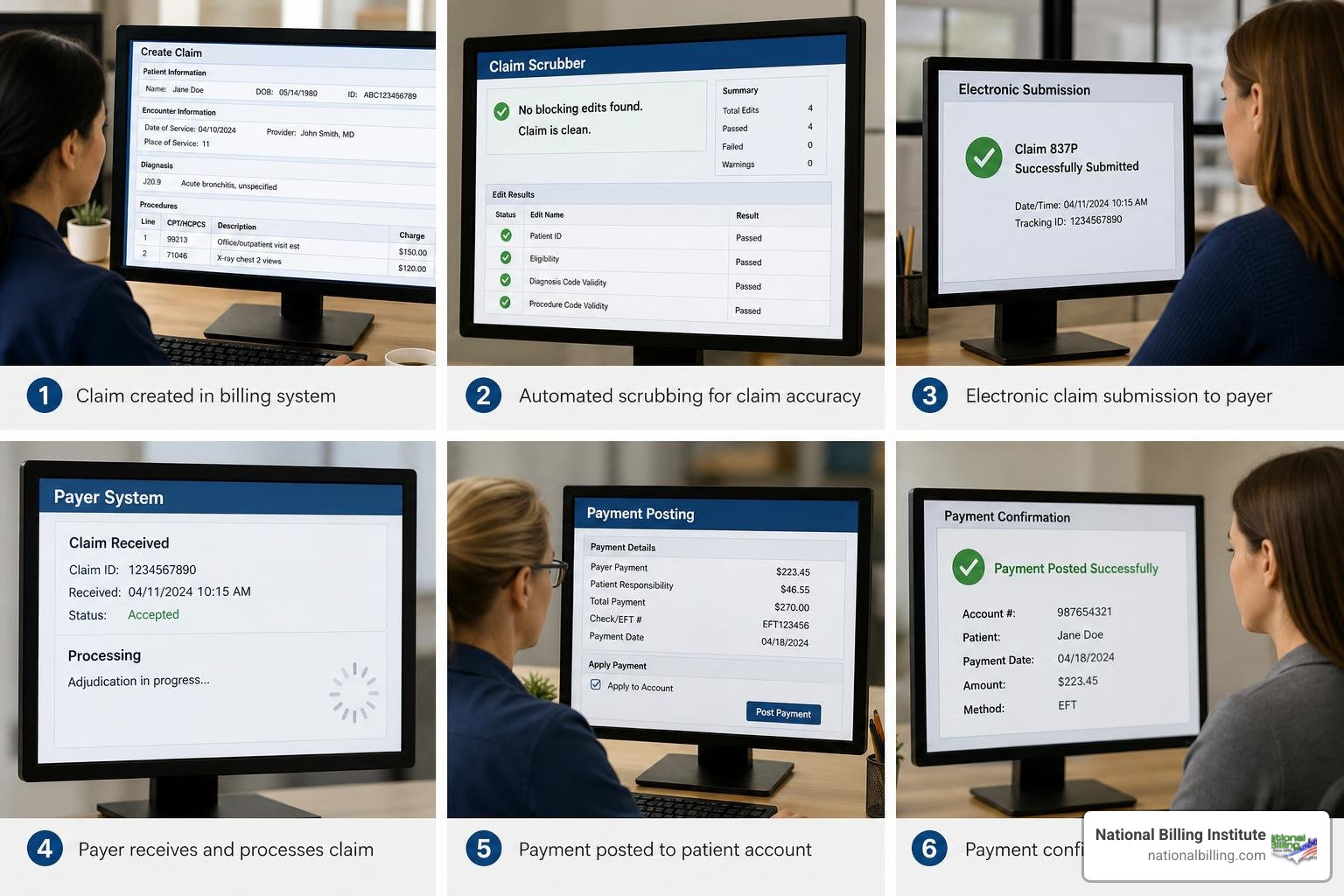
This is where healthcare revenue cycle analytics becomes your ultimate shield. Instead of dealing with denials on a case-by-case basis (which is like trying to empty a leaking boat with a teacup), analytics allows you to perform comprehensive root cause analysis.
By aggregating denial data, we can spot patterns. For example, we might find that 40% of your prior authorization denials are coming from a single payer for a specific imaging procedure. Armed with this insight, we can adjust our front-end workflows, implement targeted claim-scrubbing rules in our Claims Processing Software Healthcare, and resolve the issue upstream before the claim ever leaves our system.
According to the HIMSS Revenue Cycle Optimization Guidelines, organizations that successfully transition from reactive denial management to proactive denial prevention consistently see their first-pass yield climb. In fact, when providers implement structured analytics solutions, they routinely achieve an average denial reduction of 40% and push their first-pass yield to 93% or higher.
Enhancing Patient Engagement and Financial Outcomes
It is easy to forget that the revenue cycle doesn't just involve payers and providers—it also heavily involves patients. With the rise of high-deductible health plans, patient financial responsibility has skyrocketed.
If your billing process is confusing, clinical, or unexpected, patients are far less likely to pay. This is why modern revenue cycle analytics must extend to the very beginning of the patient journey: patient access.
By utilizing analytics-driven Revenue Cycle Management Solutions, we can streamline the patient experience in several key ways:
Real-Time Eligibility Verification: Confirming active coverage and exact benefits before the patient even walks through the door, reducing front-end registration errors by up to 60%.
Upfront Cost Estimation: Giving patients clear, transparent estimates of their out-of-pocket costs before service, which dramatically improves point-of-service collections.
Customized Payment Paths: Using predictive analytics to identify patients who may need financial assistance or flexible payment plans, matching their specific financial profiles.
When billing is clear and predictable, the patient experience thrives. For a deeper look at how streamlining these front-end processes directly impacts clinical satisfaction and cash flow, take a look at the insights provided in Medical Revenue Cycle Management Services & RCM Software .
The Role of AI and Automation in Modern Healthcare Revenue Cycle Analytics
We are living in the golden age of artificial intelligence, and the revenue cycle is one of the most natural fits for this technology. Traditional RCM systems relied on static, rule-based engines. If a rule was broken, the claim stopped. But those systems couldn't adapt to the rapid, daily changes in payer policies.
Today, AI and machine learning are completely rewriting the playbook. Modern billing systems utilize agentic AI—autonomous software agents that can handle complex, multi-step tasks without constant human oversight.
By integrating AI in Healthcare Claims Processing, we can automate the most tedious parts of the billing workflow. For example, AI can analyze clinical documentation (Progress Notes) using Natural Language Processing (NLP) to recommend the most precise CPT and ICD-10 codes, reducing human coding errors.
Furthermore, when a denial does occur, AI agents can automatically generate comprehensive appeal packets—complete with payer-specific forms, clinical documentation, and cover letters—with a single click. This level of Automated Revenue Cycle Management dramatically reduces the administrative burden on your staff.
In fact, industry data shows that health plans and providers stand to save almost $25 billion a year simply by increasing the automation of administrative transactions. By letting AI handle the routine, repetitive tasks, your billing team can focus their energy on resolving the most complex, high-value appeals.
For organizations looking to scale their operations without adding massive administrative overhead, platforms like Revenue Cycle Analytics | WhiteSpace Health show how automated data integration can uncover hidden margin gains in real time.
EHR-Embedded Tools vs. Third-Party Analytics Solutions
When it comes to implementing revenue cycle analytics, healthcare leaders face a classic dilemma: Should we use the built-in reporting tools in our existing Electronic Health Record (EHR) system, or should we invest in a dedicated third-party analytics solution?
While EHR-embedded tools are convenient, they often fall short in complex billing environments. EHRs were primarily designed to store clinical records, not to act as financial engines. Their reporting is frequently slow, rigid, and restricted to their own ecosystem.
Here is how the two approaches compare:
Data Aggregation: If your organization operates on multiple disparate EHRs or practice management systems (which is common after mergers or expansions), EHR-embedded tools cannot easily bridge the gap. Third-party solutions are designed to ingest and unify data from multiple legacy systems into a single "golden record."
Customization and Visualizations: Dedicated analytics platforms offer highly customizable, interactive dashboards. Instead of static spreadsheets, you get real-time, visual data that allows you to drill down from high-level executive summaries to individual claim-level details in seconds.
Proactive Intelligence: EHR reporting is typically reactive—it shows you what has already happened. Third-party tools often feature predictive modeling and machine learning engines that highlight issues before they impact your cash flow.
If you are looking for a deep dive into how dedicated analytics platforms solve these integration challenges, the capabilities outlined in Acuity Revenue Cycle Analytics | Optum Business demonstrate how bridging clinical and financial data silos is essential for enterprise-scale success. To ensure seamless clinical data flow across systems, these solutions must align with the EHR Association Interoperability Standards.
Overcoming Implementation Challenges and Measuring ROI
Transitioning to a highly analytical, data-driven revenue cycle is incredibly rewarding, but it isn't without its hurdles. The most common challenges we see include:
Data Silos: Financial, clinical, and administrative data often live in completely separate software systems that don't talk to each other.
Staff Resistance: Billing teams are often comfortable with their existing manual workflows and may be skeptical of new dashboards or automated work queues.
Leadership Skepticism: Executives want to see a clear, guaranteed return on investment (ROI) before approving the budget for advanced analytics tools.
To overcome these barriers, you need a structured implementation plan. Start by securing executive buy-in through clear, data-driven case studies. Next, involve your billing and clinical staff early in the process, providing thorough training to show them how analytics will actually make their daily jobs easier (e.g., reducing manual data gathering by 20% and manual reporting by 90%).
When evaluating partners, look for Healthcare Revenue Cycle Companies that hold high KLAS performance ratings and offer dedicated, ongoing support rather than just handing over a piece of software. A successful implementation can yield massive financial improvements, as detailed in the Guide to Healthcare Revenue Cycle Analytics Success 2026 .
How We Measure ROI at National Billing Institute
We don't believe in vague promises of "better efficiency." We believe in concrete, measurable financial outcomes. When we partner with a healthcare provider, we track several key areas to calculate the exact ROI of our services:
Direct Revenue Increase: Our clients typically experience a 15% to 30% increase in overall revenue due to recovered denials, reduced charge leakage, and optimized payer contracts.
Labor Cost Savings: By automating manual reporting and optimizing workflows, we help organizations realize massive labor savings—such as one behavioral health group that saved $700,000 annually in administrative labor.
Reduced Write-Offs: By catching prior authorization and timely filing errors early, we routinely help clients reduce avoidable write-offs by up to 75%.
Ready to see how we can transform your financial performance? Explore our full suite of services on our National Billing Institute RCM Services page.
Frequently Asked Questions about Healthcare Revenue Cycle Analytics
How does healthcare revenue cycle analytics help reduce claim denials?
Analytics tools track and aggregate denial patterns across your entire billing history. Instead of treating every denial as an isolated incident, the software performs a root cause analysis to identify the exact reasons behind the rejections (e.g., specific codes, payers, or front-desk workflows). This allows you to make upstream corrections—such as updating clinical documentation rules or verifying insurance eligibility in real time—to prevent the denial from happening in the first place.
What is the difference between EHR-embedded analytics and third-party RCM tools?
EHR-embedded tools are built directly into your clinical software. While convenient, they often lack advanced customization, cannot easily aggregate data from multiple different EHR systems, and offer limited predictive capabilities. Third-party RCM analytics tools are specialized software platforms designed to integrate data from all of your clinical and financial systems, offering highly customizable dashboards, real-time tracking, and predictive AI models.
How can organizations measure the ROI of an RCM analytics platform?
You can measure ROI by tracking key financial improvements before and after implementation. Key indicators include a reduction in Days in A/R, an increase in your Clean Claim Rate and Net Collection Rate, a drop in total claim denials, and direct administrative labor savings achieved through automated reporting and streamlined workflows.
Conclusion
In the modern healthcare landscape of 2026, relying on gut feelings and outdated spreadsheets to manage your financial health is no longer an option. The providers who thrive will be those who harness the power of their data to build highly efficient, proactive, and automated billing operations.
At National Billing Institute, we combine our 30+ years of industry expertise with cutting-edge, AI-automated claims processing to deliver the lowest denial rates in the industry. Based entirely in Boca Raton, FL, our 100% USA-based team is fully HIPAA compliant and dedicated to helping you achieve a 15% to 30% increase in revenue.
Let us handle the complexities of the revenue cycle so you can focus on what matters most: delivering exceptional care to your patients.
Ready to unlock the true financial potential of your practice?
Partner with National Billing Institute for Expert RCM Services today, and let's start a conversation about how we can secure your financial future.
