
The Best Healthcare RCM Companies for Small and Large Practices
The Best Healthcare Revenue Cycle Companies for Small and Large Practices in 2026
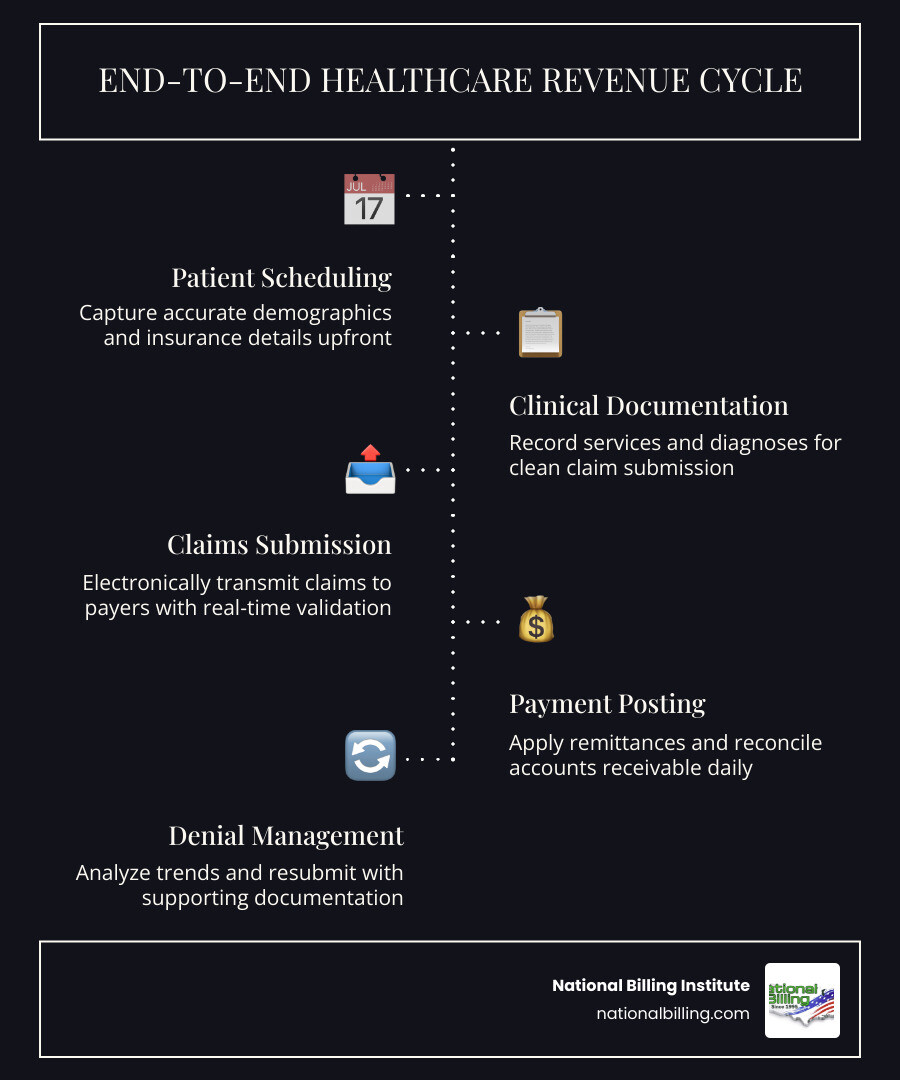
Healthcare revenue cycle companies help providers capture, manage, and collect every dollar they've earned — from the moment a patient schedules an appointment to the day the final payment clears. According to the Centers for Medicare & Medicaid Services (CMS), maintaining rigorous billing standards and compliance is vital for the financial health of the US healthcare system.
Here are the key attributes that define top-tier RCM partners in 2026:
100% US-Based Operations: Ensures high accountability, clear communication, and superior collection rates.
AI-Powered Automation: Utilizing real-time intelligence to manage high-volume accounts receivable and predict denials.
End-to-End Integration: Full-service outsourcing that handles the entire lifecycle from patient registration to final payment.
Scalable Technology: Platforms that support both independent practices and large, multi-setting health systems.
Proven Performance: Partners that consistently deliver a 15-30% revenue increase through optimized workflows.
Running a medical practice today is harder than it should be. Claim denial rates are climbing — 41% of providers now report denial rates above 10% — and administrative costs eat up roughly a quarter of total healthcare spending. Meanwhile, staff are stretched thin, payer rules keep shifting, and one compliance misstep can cost tens of thousands of dollars.
The right RCM partner changes that equation. The wrong one makes it worse.
That's why picking from the crowded field of healthcare revenue cycle companies takes more than a quick Google search. You need to know who actually delivers — and who just promises results.
I'm Olivia Harper, founder of National Billing Institute and a denial management and reimbursement specialist with over 30 years of hands-on experience helping practices across the U.S. navigate the full landscape of healthcare revenue cycle companies — from boutique billing firms to enterprise platforms. In the breakdown below, I'll walk you through the strategies that consistently deliver results, and what to look for before you sign any contract.
Why Choosing the Right Healthcare Revenue Cycle Companies Matters in 2026
In 2026, the financial health of a medical practice isn't just about how many patients you see; it's about how many claims you actually get paid for. The landscape has shifted dramatically. Payer rules are more complex, and the "human-only" approach to billing is no longer sufficient to keep up with the volume of data. Insights from the Healthcare Financial Management Association (HFMA) suggest that proactive revenue cycle management is essential for mitigating the impact of rising administrative costs.
When we evaluate healthcare revenue cycle companies, we look at three critical pillars: claim denial prevention, cash flow acceleration, and the patient financial experience.
Claim Denials and Cash Flow
The industry is currently seeing a surge in sophisticated denial tactics from payers. Some of the leading RCM firms report that they now manage tens of billions in accounts receivable (AR) specifically to combat these trends. For instance, top-tier partners can reduce a practice's AR days to between 27 and 37 days, a significant improvement over the industry average which often hovers above 50. By streamlining Revenue Cycle Operations, these companies ensure that cash flow remains steady, allowing providers to reinvest in clinical care rather than chasing old debt.
The Patient Experience
Modern RCM is no longer just "back-office." It starts at the front desk. Patients in 2026 expect transparency. They want to know their out-of-pocket costs before they sit in the exam room. Companies that provide digital engagement tools have seen patient collection rates jump by as much as 42%, with the vast majority of those payments happening through user-friendly digital portals.
Value-Based Care and Regulatory Compliance
As the industry moves toward value-based care models, your RCM strategy must adapt. This means managing risk-based contracts and ensuring that clinical documentation is precise enough to support higher-acuity coding. Furthermore, with the constant threat of audits and changing CMS guidelines, regulatory compliance is non-negotiable. The best healthcare revenue cycle companies act as a shield, providing CMS-compliant auditing and HIPAA-secure workflows to minimize risk.
Overcoming Modern Challenges with AI-Driven RCM Solutions

The biggest challenge facing healthcare organizations today is the labor shortage. There simply aren't enough expert billers and coders to keep up with the demand. This is where Automated Revenue Cycle Management steps in to bridge the gap.
AI isn't just a buzzword anymore; it's the engine driving modern Healthcare Billing Services. By using machine learning to predict denials before they happen, some RCM providers are identifying over $1.1 million in unbilled revenue per client annually.
The Role of AI in Leading Healthcare Revenue Cycle Companies
Top-tier healthcare revenue cycle companies are deploying "Agentic AI" and generative models to handle the heavy lifting.
Predictive Modeling: AI can scan a claim and predict the likelihood of a denial based on millions of previous payer interactions.
Coding Accuracy: Automated coding solutions can reduce manual coding labor by up to 70%, while simultaneously dropping coding-related denials by 60%.
Prior Authorization: This has traditionally been the "black hole" of the revenue cycle. AI now automates the evidence-building process, packaging records for payers in seconds rather than hours.
Technology Platforms vs. Full-Service Outsourcing
One of the most frequent questions we hear is whether a practice should buy a software platform (SaaS) or hire a full-service firm.
SaaS Solutions: Best for practices with a strong internal billing team that just needs better tools for Revenue Cycle Management Solutions.
Full-Service Outsourcing: This is a "hands-off" approach where the vendor handles everything from patient registration to final collections. Large health systems often prefer this model to standardize operations across multiple states.
Hybrid/Staff Augmentation: This is becoming the "sweet spot" in 2026. You keep your core team but use an external partner to handle high-volume tasks or complex denials. It allows for a 40-50% reduction in labor costs without losing control over your data.
Evaluating Performance: Metrics for Healthcare Revenue Cycle Companies
You can't manage what you don't measure. When you partner with an RCM Billing Company, you should expect real-time access to a KPI dashboard.
Essential KPIs for Top Healthcare Revenue Cycle Companies
To truly understand if your RCM partner is performing, look at these specific benchmarks:
Metric Small Practice Target Large Health System Target Net Collection Rate >96% >98% Days in AR <35 Days <45 Days Clean Claim Rate >95% >90% Denial Rate <5% <10% Cost to Collect <4% of Revenue <3% of Revenue
One of the most impressive statistics from the 2026 market is that organizations using advanced denial prevention edits have avoided costs of approximately $4.3 million per year. Additionally, identifying unbilled revenue—revenue that would have otherwise been lost—has become a hallmark of a top-tier partner.
Payer Transparency and Interoperability in 2026
The No Surprises Act and new CMS interoperability rules have forced a level of transparency that was previously non-existent. Leading healthcare revenue cycle companies now use real-time data exchange to verify insurance eligibility instantly. This prevents the "eligibility denial" which remains one of the most common (and preventable) reasons for payment delays.
Furthermore, advanced contract modeling allows us to see when a payer is underpaying based on your specific contract terms. Some firms have recovered over $6 billion in client recoveries simply by identifying these discrepancies.
Frequently Asked Questions about RCM Partners
What is the average revenue lift when switching to a top RCM company?
While results vary by specialty, many providers see a 15% to 30% increase in revenue within the first six to twelve months. This comes from a combination of higher clean claim rates, lower denial rates, and the identification of "missing" charges that were never captured by legacy systems. For example, some specialized solutions have helped drive a $55 million increase in net patient revenue for large health systems over a multi-year engagement.
How does AI-automated claims processing reduce administrative burden?
AI-automated processing acts as a 24/7 "super-biller." It performs "record scrubs" to ensure every claim is perfect before it hits the payer's system. By automating routine tasks like payment posting and claim status checks, your staff can focus on high-value tasks like patient care and complex clinical appeals. In some cases, conversational AI has reduced data analysis time by 93%, allowing managers to ask questions like "Which payer has the highest denial rate this month?" and get an answer instantly.
What are the key differences between onshore and offshore RCM models?
Offshore models are often cheaper but can come with communication barriers, time zone delays, and potential security concerns. Onshore (US-based) teams, like our team at National Billing Institute in Boca Raton, FL, offer higher levels of accountability, easier communication, and a deeper understanding of the nuances of the U.S. healthcare system and local payer behaviors. Many providers find that the slightly higher cost of a US-based team is more than offset by the higher collection rates and lower denial rates they achieve.
Conclusion
The search for the right healthcare revenue cycle companies doesn't have to be overwhelming. Whether you are a solo practitioner or a large hospital system, the goal remains the same: financial sustainability so you can focus on what matters most—your patients.
At National Billing Institute, we take pride in being a 100% USA-based team with over 30 years of experience. We don't just provide software; we provide a partnership. By combining AI-automated claims processing with the expertise of seasoned billing professionals, we help our clients achieve some of the lowest denial rates in the industry and a typical revenue increase of 15-30%.
