
Web Based Medical Billing vs. The World
Why Web Based Medical Billing Is Changing How Practices Get Paid
Web based medical billing is a cloud-hosted approach to submitting, tracking, and managing healthcare claims — accessible from any browser, on any device, with no software to install or servers to maintain.
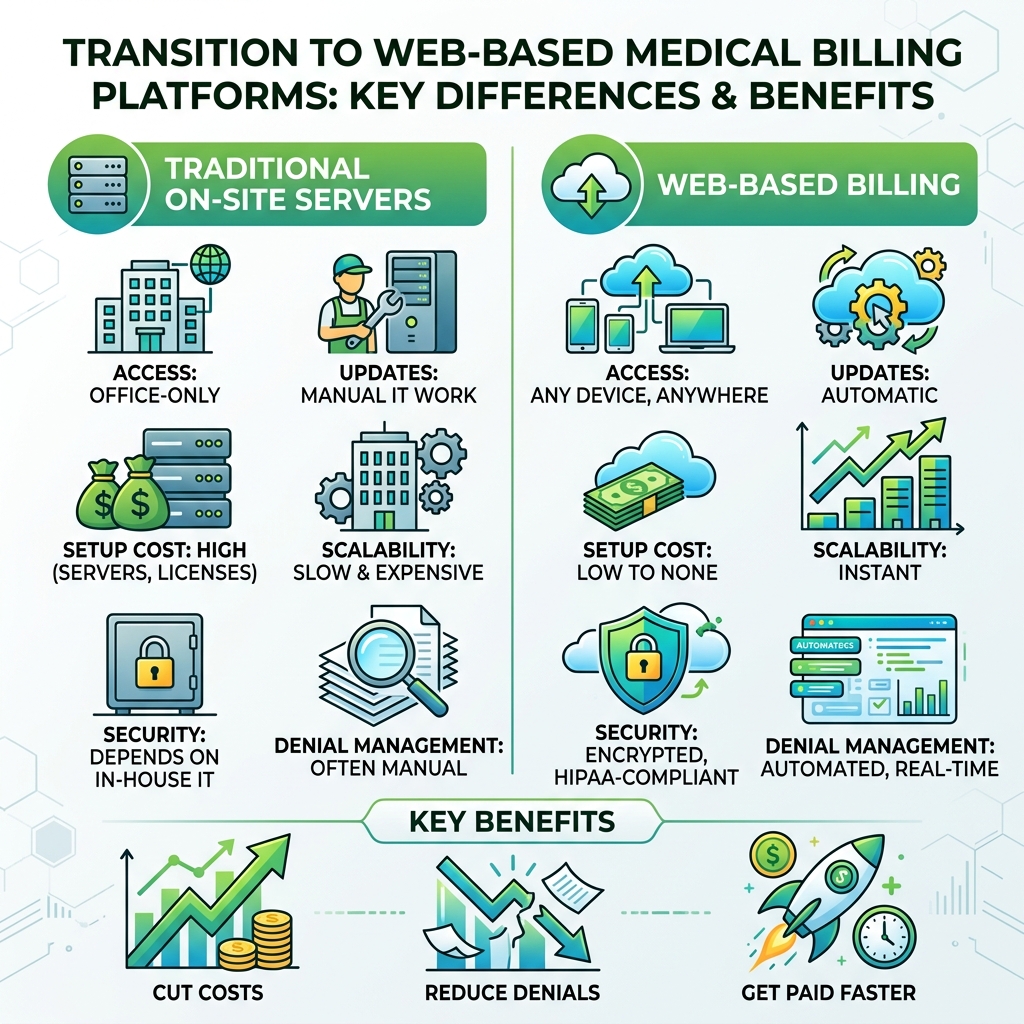
Here is a quick breakdown of what it means and why it matters:
Feature Web-Based Billing Traditional On-Site Billing Access Any device, anywhere Office only Updates Automatic Manual IT work Setup cost Low to none High (servers, licenses) Scalability Instant Slow and expensive Security Encrypted, HIPAA-compliant Depends on in-house IT Denial management Automated, real-time Often manual
The shift is happening fast. Practices that once relied on local servers and desktop software are moving to web-based platforms to cut costs, reduce denials, and get paid faster. Some platforms report clean claim rates as high as 96%, while others have helped practices reduce end-to-end revenue cycle costs by up to 75%.
But web-based billing is not a magic fix. Choosing the wrong platform — or the wrong billing partner — can still leave your practice exposed to HIPAA risks, revenue leakage, and administrative chaos.
I'm Olivia Harper, founder of National Billing Institute and a denial management and reimbursement specialist with over 30 years of hands-on experience in web based medical billing and revenue cycle management. In this guide, I'll walk you through everything you need to know to make a confident, informed decision for your practice.
The Evolution of Web Based Medical Billing

To understand where we are, we have to look at where we started. For decades, medical billing was a "tethered" experience. You had a dark room in the back of the clinic filled with humming servers. If that server crashed or the office lost power, your billing stopped. Software installation was a grueling process of CDs and manual license keys, and if you wanted to check a claim from home? Forget about it.
The evolution to web based medical billing has effectively "cut the cord." By moving the infrastructure to the cloud, practices have traded heavy hardware for high-speed accessibility. This shift isn't just about convenience; it's about survival in a modern healthcare landscape. Traditional on-site systems require constant manual updates and expensive IT maintenance. In contrast, cloud platforms offer automatic updates—ensuring you are always using the latest ICD-10 codes and payer rules without lifting a finger.
For those curious about how we’ve helped navigate this transition for over three decades, you can find more info about our company and our 30+ years of experience in the Florida healthcare market. We’ve seen the industry move from paper ledgers to 256-bit encryption, and the results for our clients speak for themselves.
AI-Powered Efficiency in Web Based Medical Billing
One of the most exciting leaps in this evolution is the integration of Artificial Intelligence. We aren't just talking about basic "if-then" logic; we are talking about machine learning that predicts denials before they happen. Modern web based medical billing platforms use AI for "claims scrubbing," which checks every line item against millions of payer-specific rules in milliseconds.
The efficiency gains are staggering. Research shows that AI-powered clinical note processing can save providers up to 20% of their time per day on documentation. This directly reduces the administrative burden on your staff. Instead of manually chasing down a missing modifier, the system flags it instantly. This level of automation is why some of our clients have seen a 400% increase in staff output. When the software handles the "grunt work," your team can focus on complex appeals and patient care.
Accessibility and Device Compatibility in Web Based Medical Billing
The "anywhere, anytime" promise of the cloud is perhaps its greatest selling point. Modern platforms offer full browser compatibility across Chrome, Safari, Firefox, and Edge. Whether you are using a Mac at home, a PC at the front desk, or an iPad in the exam room, your data looks and acts the same.
This 24/7 availability is a game-changer for remote workflows. If a billing manager needs to work from home, they have the same tools they’d have in the office. Furthermore, mobile EHR and billing integrations allow for seamless telehealth sessions. You can conduct a virtual visit and trigger the billing process simultaneously, ensuring no revenue falls through the cracks. In an era where 150,000+ providers are leaning into digital health, being "stuck" to a desktop is no longer an option.
Key Benefits of Cloud-Based Revenue Management
When we talk about the bottom line, the benefits of web based medical billing become undeniable. The most significant impact is on the cost of operations. By eliminating the need for on-site servers, IT staff, and expensive software licenses, practices can decrease the cost of end-to-end revenue cycle operations by up to 75%.
But it’s not just about saving money; it’s about making more of it. Our goal at National Billing is to help practices achieve a 15-30% revenue increase through optimized workflows and lower denial rates. Real-time reporting allows you to see exactly where your money is at any given second. You can track cash flow, monitor A/R days, and identify which payers are dragging their feet—all from a single dashboard. If you're wondering if your current setup is holding you back, it might be time to learn why choose a professional billing partner to handle these complexities for you.
Seamless Integration with EHR and Patient Portals
A siloed billing system is a recipe for errors. The best web based medical billing solutions offer deep interoperability with Electronic Health Records (EHR) and patient portals. This means data synchronization is automatic. When a patient completes their digital intake form, that data flows directly into the billing record.
This unified workflow extends to:
Secure Messaging: Discussing balances with patients via HIPAA-compliant portals.
e-Prescribing: Ensuring pharmacy data is linked to the clinical encounter.
Patient Engagement: Sending automated appointment reminders to reduce no-shows.
When your clinical and financial tools "talk" to each other, you eliminate the double-entry of data that leads to so many human errors.
Advanced Claims Submission and Denial Management
The "clean claim rate" is the heartbeat of your practice's financial health. Top-tier web-based platforms often boast clean claim rates as high as 96%. This is achieved through automated Electronic Remittance Advice (ERA) and real-time eligibility verification.
Before a patient even sees the doctor, the system can verify their insurance coverage, reducing the chance of a "coverage terminated" denial later. Once the claim is sent, automated remittance tools download and post payments instantly. If a claim is denied, the system doesn't just tell you it failed; it provides AI-generated advice on how to fix it, allowing for 80% faster reporting and auditing. This level of A/R tracking ensures that no claim is ever truly "lost."
Security and HIPAA Compliance in the Cloud
A common myth is that on-site servers are "safer" because you can see them. In reality, a server sitting in a closet in Boca Raton is far more vulnerable to fire, theft, or a simple coffee spill than a professional data center. Web based medical billing platforms utilize military-grade security that most small practices could never afford on their own.
We utilize 256-bit SSL encryption—the same standard used by major financial institutions—to protect data in transit. Furthermore, cloud providers implement multi-factor authentication (MFA) and rigorous disaster recovery protocols. If your office computer dies, your data isn't gone; it’s safely stored in the cloud, ready for you to log in from a new device.
Security Feature Manual/On-Site Automated Cloud Encryption Often absent or basic 256-bit SSL (Standard) Backups Manual (Easy to forget) Automatic & Redundant HIPAA Updates Requires manual patching Instant & Global Physical Security Office lock and key Biometric Data Centers Disaster Recovery High risk of data loss Near-instant recovery
Whether it's adhering to HIPAA in the States or PHIPA/PIPEDA standards for our neighbors, security is baked into the architecture, not added as an afterthought.
Implementation and Future Trends
Transitioning to a new system can feel daunting, but the onboarding process for web based medical billing is surprisingly streamlined. Because there is no hardware to install, most of the "heavy lifting" involves data migration and staff training. Modern providers offer hands-on support to ensure your historical data is moved accurately and your team is comfortable with the new interface.
Looking ahead, the future of billing is even more automated. We are seeing the rise of "ambient listening" AI that can draft clinical notes just by listening to the doctor-patient conversation. These notes then auto-populate the billing codes. We are also seeing "AI-native" RCM that acts as a virtual assistant, autonomously handling low-level appeals and scheduling. To stay ahead of these trends, you might want to schedule a billing review with our team to see how these innovations can fit into your specific specialty.
Frequently Asked Questions about Web-Based Billing
What are the typical pricing models for web-based platforms?
Most web based medical billing software operates on a subscription-based model. You might pay a monthly per-provider fee (some starting as low as $199/month) or a percentage of your collections. Many offer free trials or demos so you can test the "feel" of the software before committing. At National Billing, we believe in transparent pricing—no hidden fees for clearinghouse access or support.
How does web-based billing handle high-volume complex claims?
Cloud architecture is built to scale. Whether you are a solo practitioner or a nationwide enterprise processing millions of transactions, web-based systems use rules-based workflows to handle complexity. Specialty-specific coding (like the unique requirements for anesthesia or oncology) is programmed into the system, ensuring that even the most complex claims meet payer compliance.
Is web-based software suitable for small practices?
Absolutely. In fact, small practices often benefit the most. It provides them with the same enterprise-grade tools used by large hospitals but at a fraction of the cost. With reduced IT overhead and low upfront investment, independent clinics can compete on a level playing field, enjoying high clean claim rates and robust security without needing a dedicated IT department.
Conclusion
The world of medical reimbursement is getting more complex, not less. Relying on outdated, on-site systems is like trying to win a race with an anchor tied to your ankle. Web based medical billing offers the speed, security, and intelligence needed to thrive in today’s environment.
At National Billing Institute, we combine this cutting-edge technology with our 30+ years of USA-based expertise. Operating out of Boca Raton, FL, our team provides AI-automated processing and full-service RCM that consistently delivers the lowest denial rates in the industry. We don't just provide software; we provide a partnership dedicated to your practice's growth.
Ready to see what a 15-30% revenue increase looks like for your practice? Explore our full-service medical billing solutions and let’s get you paid what you deserve.
