
Stop the Bleeding with Better Medical Billing Denial Management
The $262 Billion Problem: Why Denial Management in Medical Billing Can't Be Ignored
Denial management in medical billing is the process of identifying, appealing, and preventing insurance claim denials so healthcare providers get paid for the care they deliver.
Here's a quick breakdown:
What it covers: Reviewing denied claims, finding root causes, correcting errors, resubmitting claims, and fixing upstream processes to stop denials from repeating
Why it matters: Denied claims delay or eliminate revenue your practice has already earned
Who it affects: Every provider — from solo physicians to large health systems
The goal: Keep your denial rate below 5% and recover the maximum revenue possible
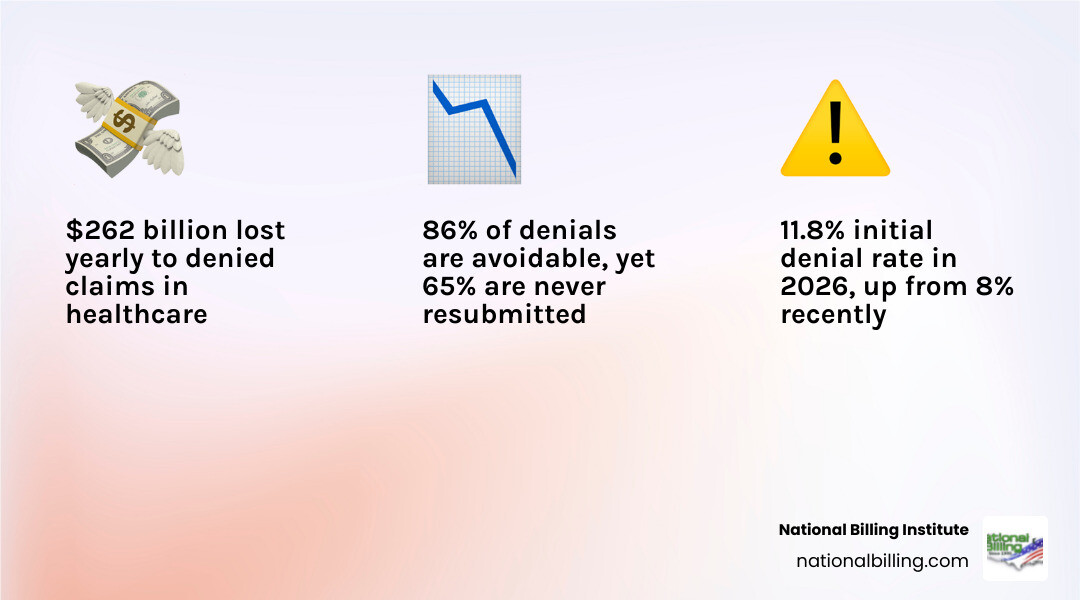
The numbers are hard to ignore. Healthcare claim denials cost the industry $262 billion every year — and 86% of those denials are entirely avoidable. As of 2026, the initial denial rate has climbed to 11.8%, up from 8% just a few years ago. Forty-one percent of providers now report that more than 1 in 10 of their claims are denied.
Every one of those denials costs money to fix — up to $25 per claim for smaller practices, and up to $118 per claim for hospitals. And here's the part that stings most: 65% of denied claims are never resubmitted at all, meaning that revenue is simply gone.
This isn't a back-office nuisance. It's a direct threat to your practice's financial health.
I'm Olivia Harper, Founder and Denial Management & Reimbursement Specialist at National Billing Institute, with over 30 years of hands-on experience helping practices across the US reduce denials and reclaim lost revenue through expert denial management in medical billing. In this guide, I'll walk you through exactly how denials happen, how to fight them, and how to stop them before they start.
Understanding Denial Management in Medical Billing

When we talk about denial management in medical billing, we aren't just talking about fixing a mistake on a form. We are talking about the strategic heartbeat of your practice’s financial stability. At its core, denials management is the systematic approach to identifying why a payer refused to pay a claim, resolving that specific issue, and—most importantly—using that data to ensure it never happens again.
In the current landscape of May 2026, payer volatility is at an all-time high. Insurance companies are increasingly using sophisticated algorithms to flag and deny claims for the smallest technicalities. This has created a massive administrative burden for providers who just want to focus on patient care. If your revenue cycle operations aren't optimized to handle these roadblocks, your cash flow will suffer.
Effective denial management acts as a safety net. It ensures that the services you’ve already provided actually turn into the revenue you’ve earned. Without it, you are essentially providing free healthcare and footing the bill for the administrative overhead yourself.
Common Reasons and Types of Healthcare Claim Denials
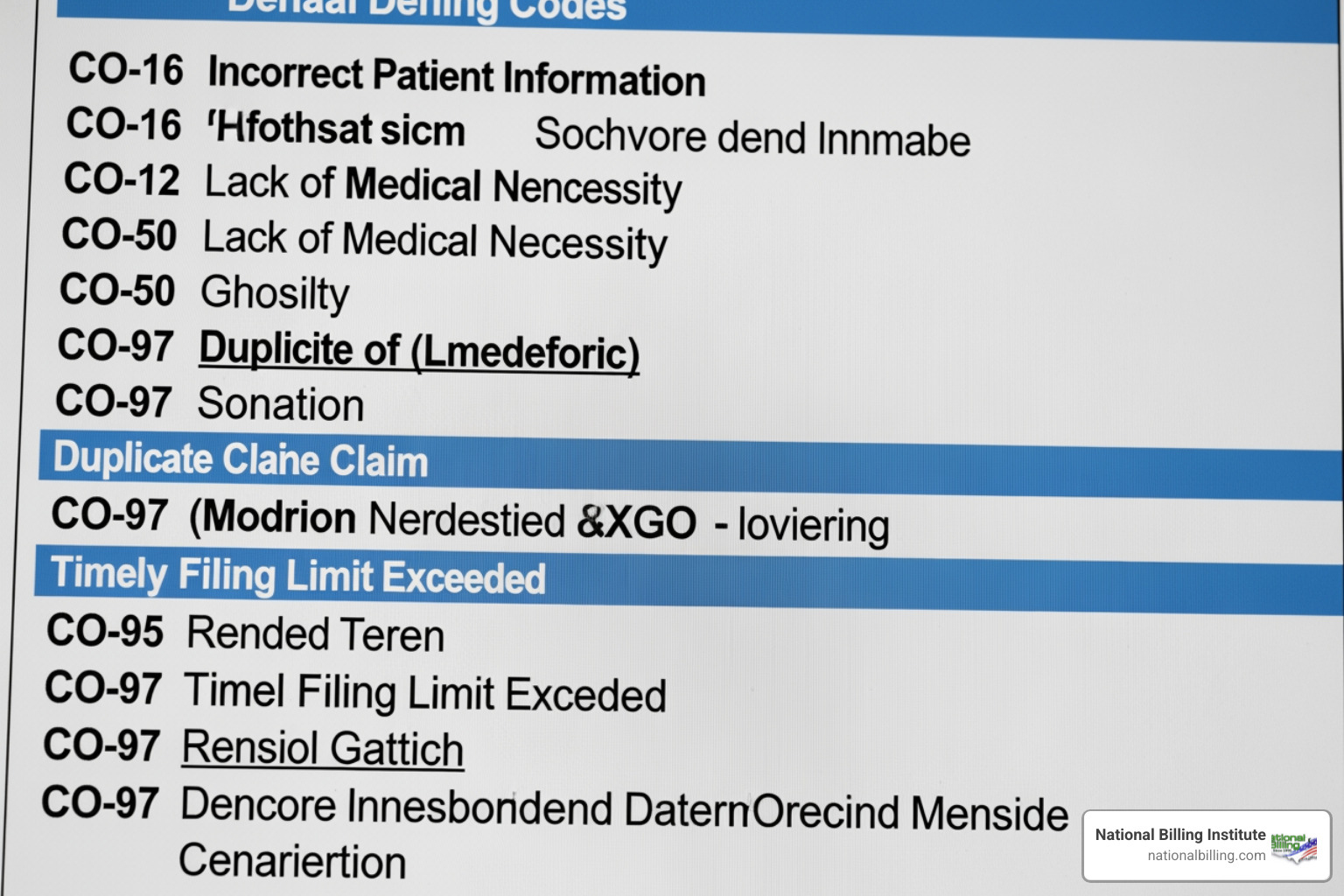
Not all denials are created equal. To manage them effectively, we first have to speak the "payer language." Understanding the nuances of insurance denials and rejections is the first step toward recovery.
Broadly, denials fall into two main buckets:
Hard Denials: These are the "final" answers. A hard denial often involves a service that is explicitly excluded from a patient's plan or a failure to meet a mandatory deadline. These are difficult to overturn and often result in lost revenue.
Soft Denials: Think of these as a "maybe." The payer needs more information, such as medical records or a corrected modifier. These are recoverable if you act quickly.
We also distinguish between Clinical Denials (related to medical necessity or level of care) and Administrative Denials (related to paperwork, billing compliance, or eligibility).
Claim Rejections vs. Claim Denials: Know the Difference
It is a common mistake to use these terms interchangeably, but they require very different responses.
Feature Claim Rejection Claim Denial When it happens Before the claim is processed (at the "front door") After the claim is adjudicated (processed) Reason Data errors (wrong ID number, missing field) Coverage issues, coding errors, medical necessity Resolution Fix the data and resubmit immediately Requires investigation, correction, and often an appeal Impact on A/R Does not hit A/R; it's like the claim never existed Increases Days in A/R and requires labor to rework
Root Causes of Denial Management in Medical Billing
Why do claims fail? In 2026, the data shows that 50% of denials stem from missing or inaccurate claim data.
Eligibility Errors: This is the #1 culprit. A patient switches from Medicare to a Medicare Advantage plan, or their employer changes insurance carriers, and the front desk doesn't catch it.
Missing Patient Data: Simple things like a misspelled name or a missing birthdate can trigger a CO-16 code—the catch-all code for claims lacking information.
Credentialing Gaps: If a new provider starts seeing patients before their enrollment with a specific payer is finalized, every single one of those claims will be denied.
Security Failures: Maintaining medical billing HIPAA compliance is not just a legal requirement; it's a financial one. If data is handled insecurely or incorrectly, it can lead to systematic rejections.
Prior Authorization and Medical Necessity in Denial Management in Medical Billing
The 2026 landscape has been heavily shaped by CMS-0057-F regulations. While these rules were intended to streamline the process, many providers still face "authorization bottlenecks."
Payers are requiring prior auth for more services than ever—from imaging to specialty medications. Even when you have an authorization number, claims are often denied because the clinical documentation doesn't perfectly mirror the "medical necessity" criteria the payer expects. This is where denial reduction services become vital. Our team often utilizes peer-to-peer reviews, where a physician speaks directly to the insurance company's medical director to overturn these clinical denials.
The 4-Step IMMP Framework for Success
At National Billing Institute, we don't believe in "whack-a-mole" billing. We use a systematic framework called IMMP to handle denials and appeals management.
Identify: We look at the CARC (Claim Adjustment Reason Codes) and RARC (Remittance Advice Remark Codes) to understand exactly why the payer said no.
Manage: We route the denial to the right person. A coding error goes to a certified coder; an eligibility issue goes to the registration team. We aim for a 48-72 hour response protocol because speed is everything in appeals.
Monitor: We track the "disposition" of every denial. Is it pending? Overturned? Written off? You can't manage what you don't measure.
Prevent: This is the most important step. We perform a root cause analysis to find the "leak" upstream. If 20% of your denials are for "No Authorization," we fix the authorization workflow.
Focusing on these 10 key focus areas helps move a practice from reactive "firefighting" to proactive revenue protection.
Strategies for Effective Denial Management in Medical Billing
Building a denial prevention culture requires more than just better software. It requires people.
Staff Training: Your front-end staff are your first line of defense. They need to understand insurance basics and the high cost of a "simple" data entry error.
Cross-Departmental Collaboration: Denials are rarely just a "billing problem." They are often a "registration problem" or a "documentation problem." Breaking down these silos is essential.
Standardized Workflows: Every type of denial should have a "playbook." If X happens, we do Y. This removes the guesswork and speeds up our AR follow up services.
Leveraging AI and Technology for Revenue Optimization
In 2026, if you are still managing denials with spreadsheets and sticky notes, you are losing money. The technology asymmetry between payers (who use AI to deny claims) and providers is a major reason why denial rates are climbing.
To level the playing field, we utilize automated revenue cycle management tools. Here is how modern tech is changing the game:
Predictive Analytics: We can now predict the likelihood of a denial before the claim is even sent. If a claim has a high "denial risk score," it gets flagged for human review.
AI Claim Scrubbing: Standard scrubbers look for formatting errors. AI scrubbers look for denial trends based on real-time payer behavior "drift."
Robotic Process Automation (RPA): RPA can handle the "grunt work" of checking claim statuses on payer portals, freeing up our human experts to handle complex appeals.
Real-Time Eligibility: Verifying insurance at the time of scheduling, 48 hours before the visit, and again at check-in virtually eliminates the #1 cause of denials.
Measuring Success: Key Performance Indicators (KPIs)
How do you know if your denial management in medical billing is actually working? You have to track the numbers. At National Billing Institute, we focus on these revenue cycle management solutions and metrics:
Denial Rate: The industry benchmark is under 5%. If you are at 10% or higher, you are in the danger zone.
Clean Claim Rate: You should aim for over 98%. This measures how many claims are accepted on the first pass without any manual intervention.
Days in A/R: Ideally, this should be under 35-40 days. The longer a claim sits, the less likely you are to collect it.
Appeal Success Rate: You should be overturning at least 60% of your denied claims.
Cost to Collect: This tracks how much you are spending to get the money you're owed. Automation helps keep this number low.
Frequently Asked Questions about Denial Management
What is the difference between a hard denial and a soft denial?
A hard denial is a permanent rejection (like a service not covered by the plan) that usually results in a write-off. A soft denial is temporary (like a request for medical records) and can be turned into a payment if you provide the requested info quickly.
How much does it cost a practice to ignore denied claims?
Ignoring denials is incredibly expensive. Beyond the lost revenue of the claim itself, you're losing the $25 to $118 in labor costs spent trying to process it. Furthermore, 65% of ignored claims are never recovered, leading to a permanent 5-10% dip in annual net revenue for many practices.
Why are denial rates increasing in 2026?
Several factors are at play: payers are using AI to find reasons to deny claims, prior authorization requirements have expanded to almost every specialty, and frequent policy changes mean that "the rules" change every few months. Additionally, staffing shortages in billing departments lead to more manual errors.
Conclusion
The "bleeding" caused by denied claims doesn't have to be a permanent condition for your practice. By shifting from a reactive approach to a proactive, AI-driven strategy, you can protect your revenue and ensure your staff spends their time on patients, not paperwork.
At National Billing Institute, we bring 30 years of expertise and a 100% USA-based team in Boca Raton, FL, to the table. Our mission is simple: to provide the lowest denial rates in the industry and help our clients see a 15-30% increase in revenue. We don't just "process" claims; we manage your entire revenue cycle with the precision and care your practice deserves.
Ready to stop the revenue leakage? Get started with professional billing services today and let us help you reclaim what you've earned.
