
US-Based Claims Scrubbing: The Secret to Fewer Denials
How US-Based Claims Scrubbing Optimizes Your Revenue Cycle
US-based claims scrubbing is the process of reviewing and correcting medical claims before they reach a payer — using US-based billing teams, software, or both — to catch errors, ensure compliance, and maximize first-pass acceptance rates.
Quick answer: What to look for in US-based claims scrubbing
Factor What it means for your practice First-pass clean claim rate Should be 95%+ to minimize rework US-based team Ensures HIPAA compliance, time zone alignment, and payer expertise AI + human review Catches coding errors, missing data, and payer-specific rule violations EHR/PMS integration Scrubbing happens inside your existing workflow, not outside it Edit library updates Rules should update every few weeks, not quarterly
The numbers tell a hard story. About 10% of claims are denied across all payers, and industry-average denial rates can climb as high as 15–20% depending on your specialty and payer mix. For hospitals, unresolved denials can eat up to 5% of net patient revenue. And with 68% of providers saying clean claim submission is harder than it was a year ago, the pressure to get it right the first time has never been greater.
The cost of getting it wrong adds up fast. At roughly $25 to rework a single denied claim, a practice submitting 10,000 claims a year at a 10% denial rate is burning through $25,000 annually just on rework — before accounting for delayed cash flow or claims that never get resubmitted at all. In fact, fewer than half of all denied claims are ever resubmitted.
This is exactly the problem that effective claims scrubbing solves — and why where that scrubbing happens, and who does it, matters more than most practices realize.
I'm Olivia Harper, Founder and Denial Management & Reimbursement Specialist at National Billing Institute, and I've spent over 30 years refining US-based claims scrubbing processes from our Boca Raton, Florida office for hundreds of practices nationwide. In this guide, I'll walk you through exactly how to evaluate and implement a scrubbing process that reduces denials, protects your revenue, and keeps your patient data secure.

When we talk about optimizing the revenue cycle, we are really talking about "clean claims." A clean claim is one that is submitted without errors and is processed by the payer on the first attempt. In May 2026, achieving this is more complex than ever because payer rules are evolving almost weekly.
This is where us-based claims scrubbing acts as your financial gatekeeper. By implementing a proactive Denial Prevention strategy, we stop the "denial spiral" before it starts. Think of it as a spell-checker for your billing; it scans every line item for accuracy before the insurance company ever sees it.
The impact on your bottom line is immediate. Research shows that 82% of healthcare organizations now prioritize preventing denials as their top financial goal. Why? Because the cost of rework is a silent profit killer. If your team is spending hours chasing $25 reworks, they aren't focusing on high-value tasks. By using advanced Revenue Cycle Management Solutions, we can shorten the revenue cycle from several months to as little as two weeks.
Furthermore, US-based scrubbing ensures that your practice stays aligned with payer-specific rules. National payers like Medicare have different requirements than regional commercial plans. A robust scrubber identifies these nuances, ensuring Claim Scrubbing in Medical Billing: Process and Clean Claim Benefits are fully realized through accelerated cash flow and a massive reduction in administrative overhead.
The Step-by-Step Process of Effective Claim Scrubbing

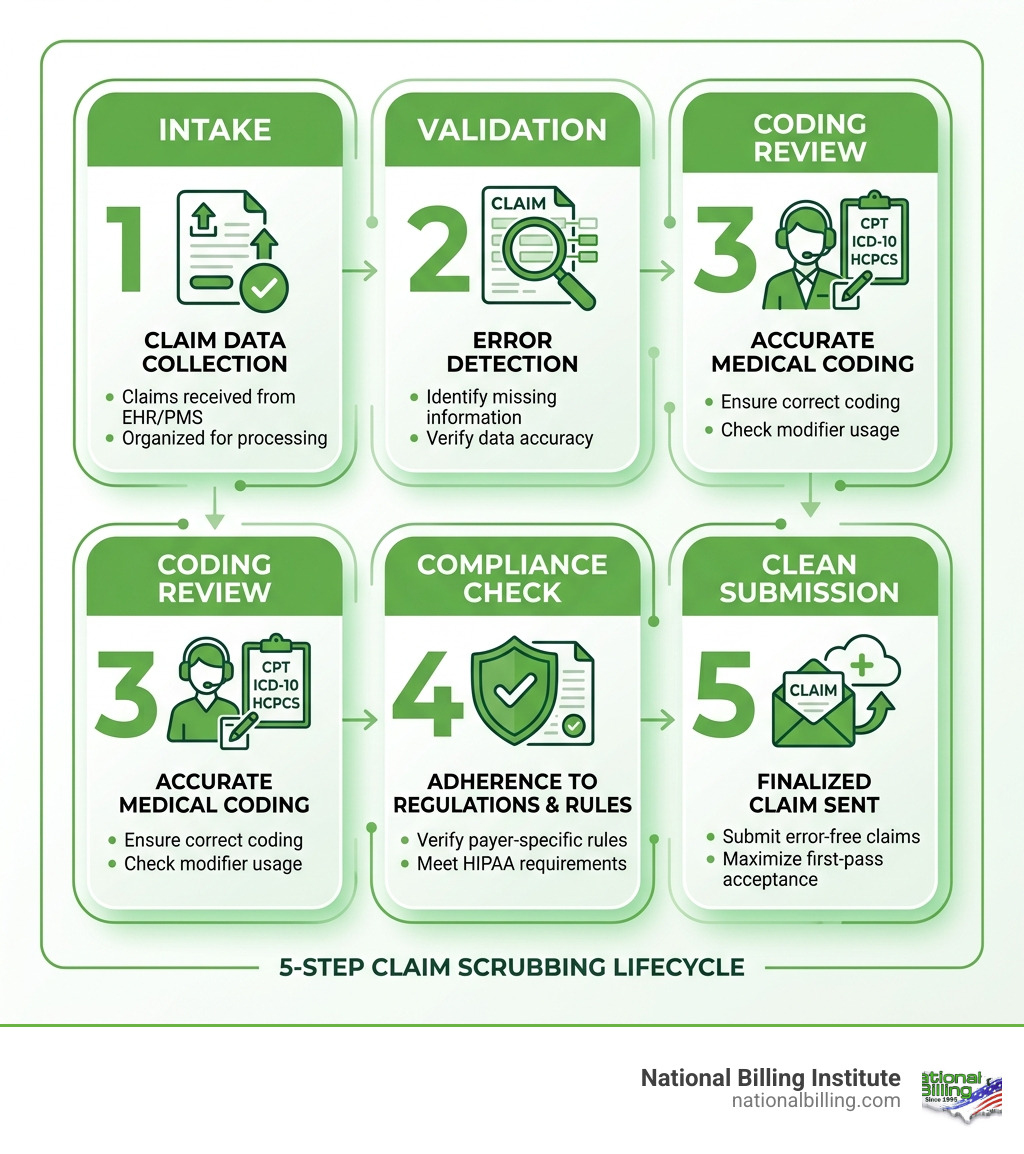
How does the magic actually happen? Effective scrubbing isn't just a single click; it’s a comprehensive 5-step lifecycle that integrates seamlessly into your daily operations.
Patient Data Collection & Intake: Believe it or not, more than a quarter of all denials result from inaccurate or incomplete data collected at the very beginning. Our HIPAA Compliant USA Team ensures that patient demographics, insurance IDs, and eligibility are verified upfront.
Coding Validation: This is the core of the process. The system checks ICD-10, CPT, and HCPCS codes for accuracy. We look for "unbundling" errors, incorrect modifiers, and mismatched diagnosis codes. We aim for the Lowest Error Rates Billing by cross-referencing over 119 million industry edits.
Compliance Checking: We apply National Correct Coding Initiative (NCCI) edits, as well as Local Coverage Determinations (LCD) and National Coverage Determinations (NCD). This ensures your claims meet the strict medical necessity requirements of Medicare and Medicaid.
Payer-Specific Rule Application: Every payer has their own "secret sauce" for what they want to see on a claim. Our Medical Billing Claim Scrubbing For Private Practice - AdvancedMD tools allow us to customize rules for specific insurance carriers, catching errors that generic scrubbers might miss.
Final Review and Batch Submission: Once the "flags" are cleared, claims are batched and sent to the clearinghouse. Because the scrubbing happens in 2.7 to 3.0 seconds per claim, this doesn't slow down your workflow—it speeds up your payments.
Key Features and Metrics for US-Based Claims Scrubbing
Choosing the right partner or software requires looking under the hood. Not all scrubbers are created equal, especially when comparing manual processes to modern AI-driven systems.
Feature Manual Review AI-Automated Scrubbing Speed Minutes per claim 2.7 - 3.0 seconds Error Detection Human-dependent (prone to fatigue) 119M+ automated edits Rule Updates Manual research Real-time / Every 3-4 weeks Scalability Requires more staff Handles unlimited volume Integration Often siloed Fully embedded in EHR/PMS
Modern us-based claims scrubbing must offer real-time feedback. If a coder makes a mistake, the system should flag it immediately, allowing for instant correction. This is a vital part of efficient Revenue Cycle Operations. Additionally, for US providers, data residency is non-negotiable. Using a US-based team ensures your data stays within the country, maintaining strict Billing Compliance and HIPAA standards.
Essential Technology for US-Based Claims Scrubbing
The "secret sauce" in 2026 is the integration of Artificial Intelligence. AI in Healthcare Claims Processing has moved beyond simple "if/then" rules. Today, machine learning algorithms analyze historical denial patterns to predict which claims are likely to be rejected, even if they seem technically correct.
These predictive analytics tools are backed by an Expert Billing Team that can interpret complex flags. While AI handles the bulk of the 119 million edits, human experts handle the nuances of specialty-specific billing, such as complex surgical modifiers or behavioral health authorization requirements.
Critical Metrics for US-Based Claims Scrubbing
To know if your scrubbing is working, you must track the right numbers. We recommend focusing on these four:
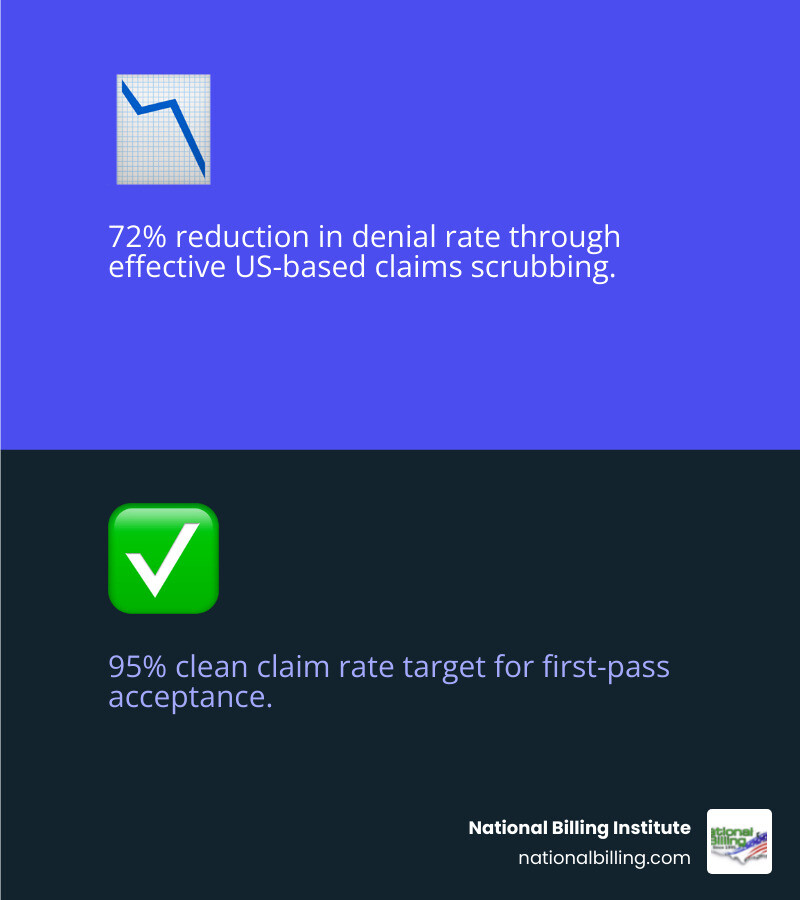
First-Pass Clean Claim Rate: This is the percentage of claims paid on the first submission. You should aim for a minimum of 95%.
Days in A/R (Accounts Receivable): Effective scrubbing can reduce A/R days from over 100 to under 30. Some systems even achieve next-day submissions.
Denial Rate: If your denial rate is above 10%, your scrubbing process needs an overhaul. Understanding What is Denial Management in Medical Billing helps you realize that preventing the denial is always cheaper than managing it after the fact.
ROI (Return on Investment): Calculate the cost of the scrubbing service versus the $25-per-claim rework savings and the 15-30% increase in total revenue.
Frequently Asked Questions about Claim Scrubbing
What is the difference between claim scrubbing and denial management?
This is a common point of confusion. Think of claim scrubbing as "preventative medicine" and denial management as "surgery."
Claim Scrubbing happens before the claim is submitted. It is a proactive process designed to catch errors so the claim is accepted and paid immediately.
Denial Management happens after the payer has already rejected the claim. It involves investigating why the claim was denied, correcting it, and resubmitting it.
While both are necessary, a heavy reliance on denial management usually means your scrubbing process is failing.
How does AI enhance the claim scrubbing process?
AI brings three main superpowers to the table: pattern recognition, speed, and continuous learning. Unlike static rules that only check if a box is filled, AI can look at the relationship between codes. For example, it can recognize that a specific combination of a procedure code and a diagnosis code often leads to a denial with a specific payer, even if both codes are technically valid. It processes thousands of charts per minute, providing a level of scrutiny that no human team could match.
Why is a US-based team better for claim scrubbing?
While offshore options exist, us-based claims scrubbing offers three distinct advantages:
Security and HIPAA: Managing sensitive patient data within the US ensures full compliance with federal laws and reduces the risk of international data breaches.
Payer Knowledge: US-based teams have a deep, "boots-on-the-ground" understanding of American insurance companies and their ever-changing policies.
Communication: Being in the same time zone means that if a high-dollar claim is flagged, your billing team can pick up the phone and resolve it with your clinical staff immediately, rather than waiting for a 12-hour time difference.
Conclusion
At National Billing Institute, we’ve seen how us-based claims scrubbing can transform a struggling practice into a thriving one. With over 30 years of experience and a 100% USA-based team in Boca Raton, FL, we specialize in helping providers achieve the Best Medical Billing Services USA standards.
By catching administrative errors—which account for more than a third of all denials—we help our clients see a 15-30% increase in revenue. Whether you are a small private practice or a large healthcare organization, our Healthcare Billing Services are designed to give you your time back so you can focus on what matters most: your patients.
Ready to stop the "denial spiral" and secure your practice's financial future? Explore Our Full-Service Solutions today and see how our expert team can help you get paid faster and more accurately.
