
How to Master the Medical Billing Claims Process Without Losing Your Mind
What You Need to Know About the Health Insurance Claim Process Right Now
The health insurance claim process is the series of steps that turns a medical visit into a paid bill — involving your provider, your insurer, and sometimes you.
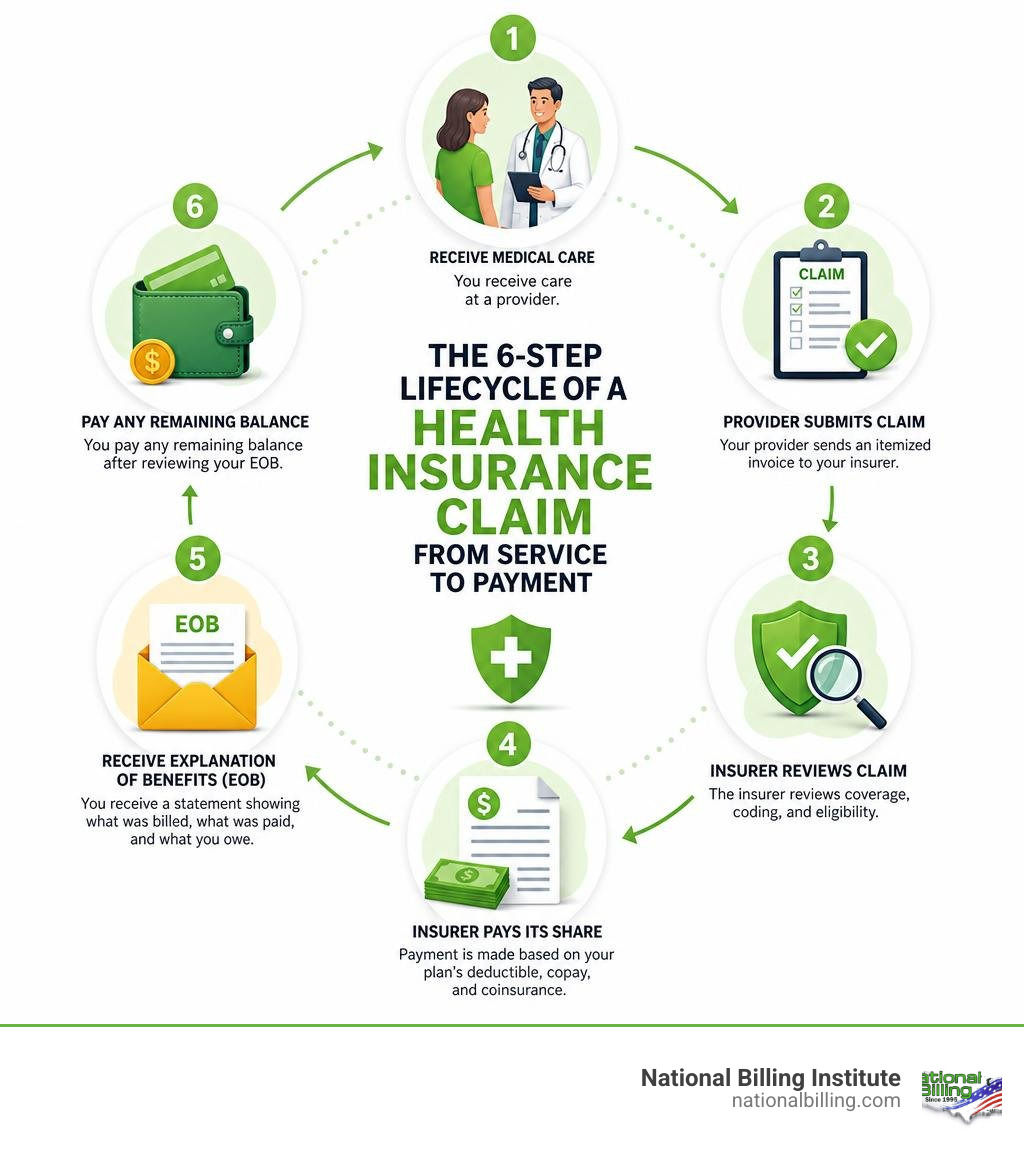
Here is a quick overview of how it works:
You receive medical care — at a doctor's office, hospital, or pharmacy
Your provider submits a claim — an itemized invoice with standardized medical codes sent to your insurer (in-network providers do this automatically)
The insurer reviews the claim — checking coverage, coding accuracy, and eligibility
The insurer pays its share — based on your plan's deductible, copay, and coinsurance rules
You receive an Explanation of Benefits (EOB) — a document showing what was billed, what insurance paid, and what you owe
You pay any remaining balance — after reviewing the EOB against your provider's bill
Most patients never need to file a claim themselves. But when errors occur — wrong codes, missed deadlines, out-of-network visits — the costs fall directly on your practice or your wallet.
And those errors are more common than you might think. Research suggests roughly 80% of medical bills contain some kind of billing error. For healthcare providers, that means revenue leaking out with every denied or underpaid claim.
I'm Olivia Harper, Founder and Denial Management & Reimbursement Specialist at National Billing Institute, and over my 30+ years optimizing the health insurance claim process for practices across the United States, I've seen how small missteps in claim submission can cost providers tens of thousands of dollars annually. In this guide, I'll walk you through every stage of the claims lifecycle — so you can protect your revenue and stop leaving money on the table.
What is a Health Insurance Claim and Why Does It Matter?
At its core, a health insurance claim is a formal, itemized invoice submitted by a healthcare provider (or occasionally a patient) to an insurance company. This document requests payment for the medical services, procedures, tests, or medications provided during a patient encounter.
Without this invoice, the insurance company has no record of the care provided, meaning no reimbursement can occur. To make this process uniform across thousands of different insurers and millions of providers, the healthcare industry relies on standardized medical codes. These codes—such as CPT (Current Procedural Terminology) and ICD-10-CM (International Classification of Diseases)—translate complex medical diagnoses and clinical treatments into a universal alphanumeric language that computers can quickly interpret.

For medical practices, claims are the foundation of Healthcare Revenue Cycle Management (RCM). The health of your practice’s cash flow depends entirely on how quickly and accurately these claims are generated, submitted, and paid. When claims are delayed, coded incorrectly, or rejected, the financial impact is immediate. By understanding the claim as the critical bridge between clinical care and financial sustainability, practices can transition from a reactive approach to a highly optimized, proactive billing strategy.
The Different Types of Claims: Medical, Dental, and Pharmacy
Not all medical services are billed in the same way. Depending on the nature of the treatment, a claim will fall into one of several distinct categories:
Medical Claims: These are the most common claims, covering standard physician visits, hospitalizations, surgeries, diagnostic imaging (like X-rays and MRIs), and laboratory tests. They are typically submitted on a standard CMS-1500 form or its electronic equivalent.
Dental Claims: Dental insurance is usually separate from medical insurance and operates under its own set of rules, deductibles, and annual maximums. Dental claims utilize CDT (Current Dental Terminology) codes and are submitted directly to dental insurers.
Pharmacy Claims: When a patient fills a prescription, the pharmacy processes a pharmacy claim. Unlike medical claims, which can take weeks to resolve, pharmacy claims are processed in real-time at the point of sale. The pharmacist enters the drug's National Drug Code (NDC), and the system instantly calculates the patient’s copay and the insurer's liability.
Consumer-Directed Health Plan (CDHP) Claims: These claims involve reimbursement from tax-advantaged accounts like Health Savings Accounts (HSAs) or Flexible Spending Accounts (FSAs). They often require the submission of itemized receipts or a detailed "superbill" to prove that the funds were used for IRS-qualified medical expenses.
Demystifying the Health Insurance Claim Process: A Step-by-Step Guide
To master the claims process, we must look at it as a continuous lifecycle. While it may seem like a chaotic journey, the claim lifecycle actually follows a highly structured path from the moment a patient schedules an appointment to the day the final balance is settled.
Here is how the end-to-end medical billing workflow operates:
Patient Registration & Scheduling: The lifecycle begins before the patient even sees a provider. Staff collect demographic details and insurance card information.
Insurance Verification & Eligibility: Before care is delivered, we verify that the patient’s policy is active, confirm what benefits are covered, and determine if prior authorization is required.
Clinical Documentation & Coding: After the visit, the provider documents the clinical encounter. Certified medical coders translate this documentation into ICD-10-CM diagnosis codes and CPT/HCPCS procedure codes.
Charge Entry & Claim Generation: The codes are entered into the billing system alongside practice fees, provider information, and patient details to create the official claim.
Claim Scrubbing & Submission: The claim is "scrubbed" by billing software to detect formatting errors, missing fields, or coding mismatches before being sent electronically to a clearinghouse.
Claim Adjudication: The insurance payer reviews the claim to decide how much it will pay based on the patient's specific benefit plan.
Payment Posting & Reconciliation: Once adjudicated, the payer sends an Electronic Remittance Advice (ERA) and payment. The biller posts these payments and reconciles the accounts.
Patient Billing & Collections: If there is any remaining patient responsibility (such as a deductible or coinsurance), a clear statement is generated and sent to the patient.
Implementing efficient, modern Revenue Cycle Management Solutions is the best way to automate these steps, eliminate human error, and accelerate your cash flow.

How In-Network vs. Out-of-Network Providers Affect the Health Insurance Claim Process
Whether a provider is in-network or out-of-network heavily influences how the health insurance claim process unfolds.
An in-network provider has a signed contract with the insurance company. Under this agreement, the provider agrees to accept a pre-negotiated, discounted rate for services. Because of this contract, in-network providers are legally obligated to file claims on behalf of the patient. Furthermore, they cannot engage in "balance billing"—meaning they cannot bill the patient for the difference between their standard fee and the insurer's negotiated rate.
An out-of-network provider has no contract with the insurance company. Consequently, they are not bound by negotiated rates and can charge their full fees. In many cases, out-of-network providers do not file claims for patients. Instead, the patient must pay the full bill upfront and request a detailed receipt called a superbill. The patient then submits this superbill to their insurance company to seek reimbursement.
For employer-sponsored plans, the federal Employee Retirement Income Security Act (ERISA) establishes strict rules regarding how these claims must be handled. You can learn more about these protections in the Filing a Claim for Your Health Benefits - EBSA Guide. Navigating these rules is critical, as state-specific consumer protections—such as those outlined by state insurance commissioners—frequently regulate how out-of-network billing and emergency care disputes are resolved. For a deeper dive into state-level claims regulations, refer to How your health insurance claims process works.
Essential Information and Documents Required to File
For a claim to pass through the clearinghouse and be accepted by an insurer on the first attempt, it must be complete and error-free. The standard paper form used by non-institutional providers across the United States is the CMS-1500 form, maintained by the National Uniform Claim Committee.
To ensure compliance with national standards, billers must reference the official National Uniform Claim Committee CMS-1500 Claim manual. At a minimum, every claim must contain the following essential data points:
Patient Demographics: Full legal name (formatted exactly as it appears on the insurance card), date of birth, gender, and complete address.
Subscriber Information: The policyholder’s name, group number, and unique insurance ID number.
Provider Information: The billing provider's National Provider Identifier (NPI), Tax Identification Number (TIN), and physical service facility location.
Clinical Coding: Accurate ICD-10-CM codes representing the patient's diagnoses, linked directly to the corresponding CPT/HCPCS codes that describe the services rendered.
Financial Details: The date of service, Place of Service (POS) code, number of units provided, and the specific billed charges for each line item.
Understanding Your Explanation of Benefits (EOB) and Claim Timelines
Once an insurance company processes a claim, they issue an Explanation of Benefits (EOB) to the policyholder. It is vital to emphasize that an EOB is not a bill. Rather, it is an informational statement detailing how the insurance company applied the patient's benefits to the medical claim.
The EOB is a crucial document for both patients and providers because it breaks down the exact financial transition of the claim. To help demystify this document, let us look at how EOB fields correspond to the provider's actual billing ledger:
EOB Field Name What It Means Impact on the Patient & Provider Amount Billed The standard fee the provider charged for the service. This is the initial starting price before any insurance contracts are applied. Allowed Amount The maximum amount the insurer will pay for a covered service. If the provider is in-network, they must write off the difference between the Billed and Allowed amounts. Member Savings The discount negotiated between the insurer and an in-network provider. Also known as the contractual write-off; the patient is never responsible for this amount. Deductible Applied The portion of the allowed amount credited toward the patient's annual deductible. The patient must pay this amount directly to the provider. Copay / Coinsurance The fixed fee (copay) or percentage of the cost (coinsurance) the patient owes. Collected by the provider, usually at the time of service or billed after adjudication. Plan Paid The actual dollar amount paid by the insurance company to the provider. This completes the insurance company's liability for this specific claim. Patient Responsibility The total remaining amount the patient legally owes to the provider. Calculated as: (Deductible + Copay + Coinsurance).
How Long Does It Take to Process and Pay a Claim?
The time it takes for a claim to go from submission to payment varies based on the submission method and the insurer's processing guidelines.
Generally, standard electronic claims are processed and paid within 14 to 30 days. Paper claims, which require manual data entry and physical mailing, take significantly longer—often 30 to 45 business days.
Under ERISA regulations for employer-sponsored plans, insurers must adhere to strict federal timelines. For post-service claims (care that has already been received), the insurer must notify the member of an approval or denial within 30 business days. For pre-service claims (prior authorization), they have 15 days. Urgent care claims require the fastest turnaround, demanding a decision within 72 hours under the Affordable Care Act (ACA).
Tracking Your Claim Status Online
In 2026, manual claim tracking is a thing of the soul-crushing past. Both patients and providers can easily monitor claims in real-time. Patients can log into their insurer's member portal or mobile app, where they can search by their unique claim number to see if a claim is "Pending," "Approved," "Partially Paid," or "Denied."
For healthcare practices, tracking claims manually is highly inefficient. Leveraging Healthcare Revenue Cycle Analytics allows billing teams to monitor thousands of claims simultaneously. These advanced analytics platforms flag aging claims that have been sitting unpaid for more than 30 days, allowing your team to intervene before the timely filing window closes.
Navigating Claim Denials, Rejections, and the Appeals Process
To effectively manage your revenue cycle, you must understand the critical difference between a claim rejection and a claim denial:
Claim Rejection: A rejection occurs before the claim is even processed by the insurer. It is usually stopped at the clearinghouse level due to formatting errors, such as a misspelled name, a missing NPI, or an invalid policy number. Rejections can be corrected and resubmitted immediately without an appeal.
Claim Denial: A denial occurs after the insurer has fully reviewed and adjudicated the claim. The payer determines that the claim is unpaid or underpaid due to coverage policies, medical necessity guidelines, or contract rules.
Unresolved denials are a major source of revenue loss. To prevent this, practices must establish a robust framework for Medical Billing Denials management. By utilizing systematic Denial Management in Medical Billing, practices can identify the root causes of denials, correct them, and establish proactive workflows to prevent them from recurring.
Common Reasons for Claim Denials
Denials rarely happen at random. In our experience, the vast majority of denials stem from a handful of highly preventable administrative errors.
Some of the most frequent culprits behind claim denials include:
Incorrect Coding: Using outdated, invalid, or highly generic codes. This includes failing to apply the correct modifiers or mismatching a diagnosis code with an unrelated procedure code. Billing teams must stay updated on all current Medical Billing Denial Codes to quickly decode payer rejection messages.
Lack of Prior Authorization: Performing a non-emergency procedure or prescribing a specialty medication without securing the insurer's approval beforehand.
Missing or Inaccurate Patient Information: Small typos in the patient's name, date of birth, or insurance ID number will trigger an instant denial.
Coordination of Benefits (COB) Issues: When a patient is covered by more than one health plan, claims may be denied if the primary and secondary insurers are not correctly designated.
Untimely Filing: Submitting the claim after the insurer's contractually mandated deadline. This is one of the hardest denials to overturn, making a clear understanding of Untimely Filing in Medical Billing essential for every billing department.
How to Appeal a Denied Claim Successfully
When a claim is denied, the battle is far from over. In fact, industry data shows that approximately 40% of appealed claims are ultimately overturned and paid. However, success requires a structured, persistent approach to Denials and Appeals Management.
The standard appeal process involves two primary levels:
Internal Appeal: You request that the insurance company conduct a full, fair review of their decision. This appeal must be filed within 180 days of receiving the denial notice. You should submit a formal appeal letter, clear clinical documentation, and any relevant medical records to support medical necessity. For Medicare patients, adhering to Medicare Appeal Timely Filing rules is critical, as missing these strict federal windows will permanently forfeit your right to reimbursement.
External Review: If the internal appeal is upheld (denied again), non-grandfathered plans allow you to request an external review by an independent third-party medical expert. This request must be filed within 60 days of the final internal denial. The insurer must abide by the external reviewer's decision.
For physicians looking to navigate these complex guidelines, the American Medical Association provides invaluable toolkits and resources on Medical Claims Processing | AMA - American Medical Association.
Tips to Streamline Your Health Insurance Claim Process and Avoid Denials
The most effective way to manage denials is to prevent them from happening in the first place. By implementing these four best practices, your practice can drastically reduce its denial rates:
Automate Eligibility Verification: Never assume a patient's coverage is active. Use real-time eligibility verification software to confirm active coverage, deductibles, copays, and prior authorization requirements before every single appointment.
Create a Prior Authorization Checklist: Establish a rigid workflow to identify which procedures and medications require prior authorization, and ensure the approval number is documented on the claim before submission.
Invest in Continuous Coding Education: Medical coding guidelines change annually. Ensure your coding team receives regular training on CPT, ICD-10, and modifier updates to maintain absolute coding accuracy.
Keep Meticulous Records: Document all communications with insurance representatives, including the date, time, representative name, and reference numbers. This paper trail is invaluable if you need to appeal a denial later.
Frequently Asked Questions about Health Insurance Claims
What is the difference between a cashless claim and a reimbursement claim?
A cashless claim is common in managed care networks and international health systems. Under this model, the patient receives treatment at an in-network hospital, and the provider bills the insurance company directly. The patient does not have to pay for covered medical expenses upfront, except for their designated copay or deductible.
A reimbursement claim occurs when a patient receives care from an out-of-network provider or a facility that does not bill insurance directly. In this scenario, the patient must pay the entire medical bill out of pocket at the time of service. After discharge, the patient must gather all itemized receipts, medical reports, and claim forms, and submit them to their insurer to be reimbursed for covered costs.
What does "timely filing" mean and what are the deadlines?
"Timely filing" refers to the contractually agreed-upon window of time a provider or patient has to submit a claim to an insurance company after a medical service is rendered. If a claim is submitted after this window closes, the insurer will deny it, and the provider cannot bill the patient for the balance.
Timely filing limits vary significantly by payer. For many commercial insurance plans, the limit is 90 days from the date of service. For Medicare and Medicaid, the limit is typically one full calendar year (12 months) from the date of service. Out-of-network claims submitted by patients often have a standard 90-day to 180-day deadline.
How do health insurance claims differ from auto, home, or life insurance claims?
While all insurance claims share the basic goal of securing financial reimbursement, they operate under entirely different mechanisms:
Health Insurance Claims: These are highly transactional, high-frequency claims based on standardized clinical codes (CPT/ICD-10). They are usually filed directly by the medical provider and processed within weeks.
Auto & Homeowners Insurance Claims: These claims are event-driven (occurring after an accident, theft, or natural disaster). They require a claims adjuster to physically inspect property damage, review police reports, and estimate repair costs before issuing a settlement check to the policyholder.
Life Insurance Claims: These claims are filed by a designated beneficiary after the policyholder's death. They require the submission of a certified death certificate and policy documents, resulting in a single lump-sum payout rather than ongoing transactional payments.
Conclusion
Mastering the health insurance claim process does not have to be a source of constant stress for your medical practice. By understanding the claim lifecycle, ensuring meticulous documentation, and proactively managing denials, you can secure the reimbursement you deserve and keep your practice financially strong.
At National Billing Institute, we have spent more than 30 years helping healthcare providers across the United States streamline their billing operations. Operating from our 100% USA-based headquarters in Boca Raton, FL, our expert team utilizes advanced, AI-automated claims processing alongside highly personalized denial management workflows. Our clients benefit from some of the lowest denial rates in the industry, absolute HIPAA compliance, and an average revenue increase of 15% to 30%.
Stop letting administrative errors and payer delays drain your practice's hard-earned revenue. Contact us today to learn how we can take the burden of billing off your shoulders, so you can focus on what matters most—your patients.
