
How to Win the Medical Billing Appeals Game
Why Working Denials in Medical Billing Is Your Most Urgent Revenue Problem Right Now
Working denials in medical billing is the process of identifying, appealing, and resolving insurance claims that payers have refused to pay — and in 2026, it has become one of the most critical skills a practice can master.
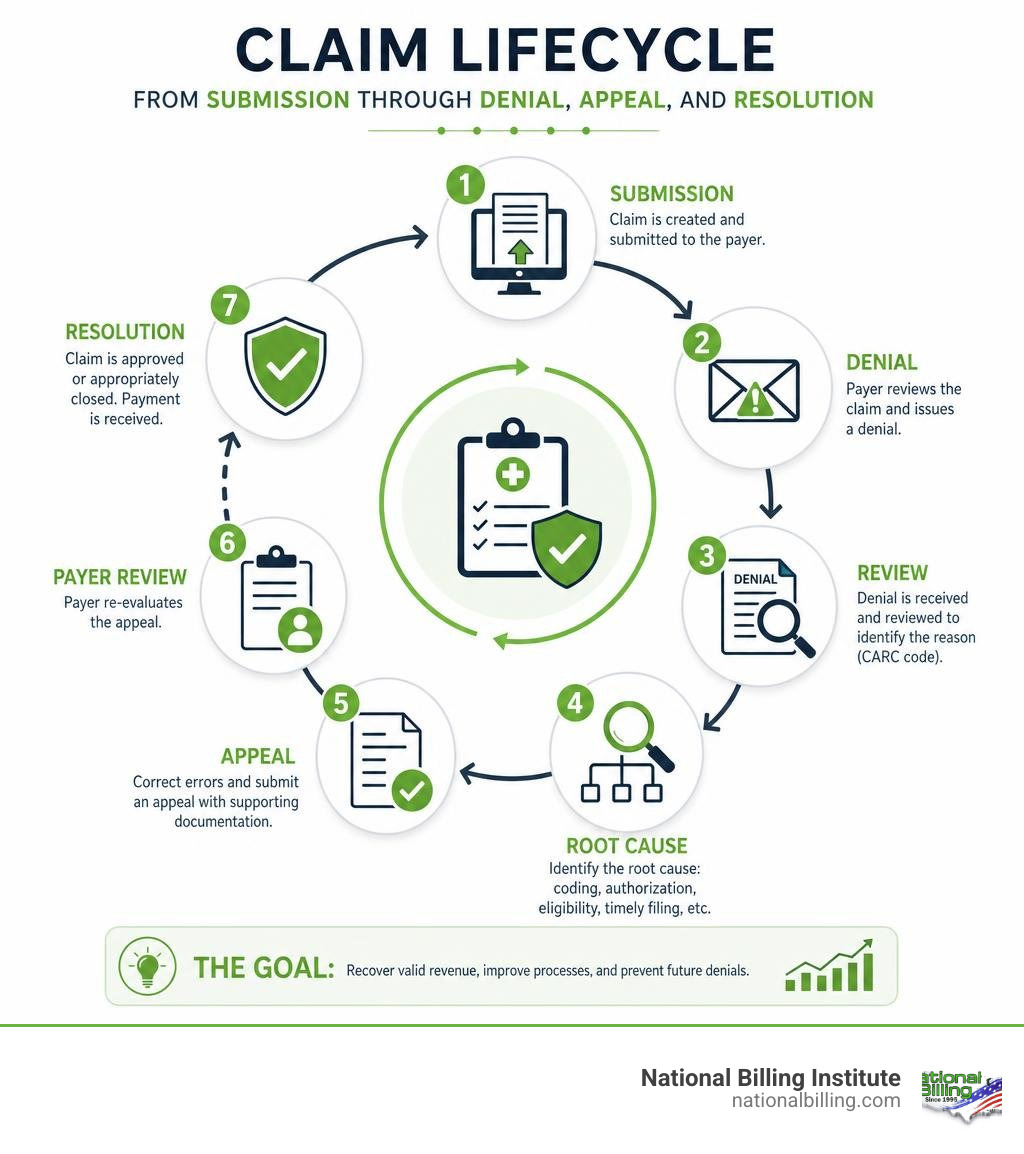
Here is a quick-reference overview of how to work a denied claim:
Identify the denial — Find it in your insurance A/R via ERA/EOB or your practice management system.
Read the CARC code — This tells you exactly why the payer denied the claim.
Classify it — Is it a hard denial (not recoverable) or a soft denial (correctable and appealable)?
Find the root cause — Was it a coding error, missing auth, eligibility issue, or late filing?
Correct and appeal — Fix the error or write a formal appeal with supporting documentation.
Track and prevent — Feed the root cause back to the front-end team so it doesn't happen again.
The numbers in 2026 are hard to ignore. Industry-wide claim denial rates have climbed to 10–15%, and providers reporting denial rates above 5% have nearly doubled in just one year. Denied and rejected claims now represent $262 billion in annual revenue exposure across the industry.
Most of those denials are preventable. And a staggering 60% of returned claims are never resubmitted at all — meaning practices are simply leaving earned revenue on the table.
More than one-third of physicians today say they are more worried about denials than declining reimbursement rates. That shift in concern tells you everything about where the real pressure is coming from.
I'm Olivia Harper, Founder and Denial Management & Reimbursement Specialist at National Billing Institute, and with over 30 years of hands-on experience working denials in medical billing, I've seen how the right systems can move a practice from a 12% denial rate to well under 3%. In this guide, I'll walk you through everything you need to know to stop losing revenue and start winning your appeals.
Understanding the 2026 Denial Landscape
The healthcare landscape of 2026 is vastly different from even just a few years ago. The single biggest driver behind the rising wave of denials is the widespread adoption of artificial intelligence by commercial insurance payers. Payers now deploy sophisticated, automated algorithms that scan incoming claims and issue batch denials within seconds of submission. Instead of a human reviewer carefully evaluating medical necessity, claims are frequently auto-denied by AI engines targeting specific billing combinations.
This rapid-fire denial strategy has shifted the administrative burden entirely onto the provider. If your practice relies on manual, legacy billing workflows, you are structurally mismatched against the automated efficiency of insurance companies.
To protect your cash flow, you must understand the fundamentals of denials management. According to the AAPC, What Is Denials Management? - AAPC covers the essential definition: it is the systematic process of investigating, resolving, and preventing unpaid insurance claims. It is no longer just a back-office administrative task; it is a core business survival strategy.
The Financial Impact of Working Denials in Medical Billing
The true cost of a denied claim extends far beyond the unpaid service amount. When a claim is denied, your practice faces a cascading series of expenses. Industry data shows that the average cost to manually rework a single denied claim ranges from $25 to $118, depending on the complexity of the appeal.
When you factor in staff time, administrative overhead, and the delayed time-value of money, a high denial rate acts as a silent drain on your practice’s bottom line. In fact, practices operating without proactive denial prevention tools lose an average of $5 million annually.
Every day a claim sits unpaid in your accounts receivable (A/R) is a day your practice is financing the insurance company's operations interest-free. To dive deeper into how unmanaged claims erode your profitability, read our detailed analysis of medical billing denials.
Industry Benchmarks: Denial Rates, Clean Claims, and Days in A/R
To understand if your denial management workflows are successful, you must measure your performance against established industry benchmarks. In 2026, the key metrics to track include:
Initial Denial Rate: This is the percentage of claims denied on first submission. A healthy denial rate target is under 5%, with under 3% considered best-in-class. The current industry average, unfortunately, sits at 12–15%.
Clean Claim Rate (First-Pass Yield): The percentage of claims accepted and paid on their first submission. Best-in-class practices maintain a clean claim rate of 98% or higher, whereas the industry average has slipped to 85–90%.
Days in A/R (Accounts Receivable): The average number of days it takes to get paid after a service is rendered. You should target under 35 days (with under 30 days being best-in-class). If your average exceeds 40 days, it is a clear warning sign of high denial rates or sluggish follow-up.
Net Collection Rate: The percentage of legally collectable revenue you actually recover. Top-performing practices achieve 98% or higher, while the average practice hovers around 90–94%.
We outline the strategies required to hit these aggressive targets in our guide on RCM denial management.
Rejections vs. Denials: The Foundational Distinction
One of the most common mistakes billing teams make is treating claim rejections and claim denials as the same thing. This confusion leads to massive operational inefficiencies, duplicate claims, and missed timely filing deadlines.
The core difference lies in whether the claim was adjudicated by the insurance payer.
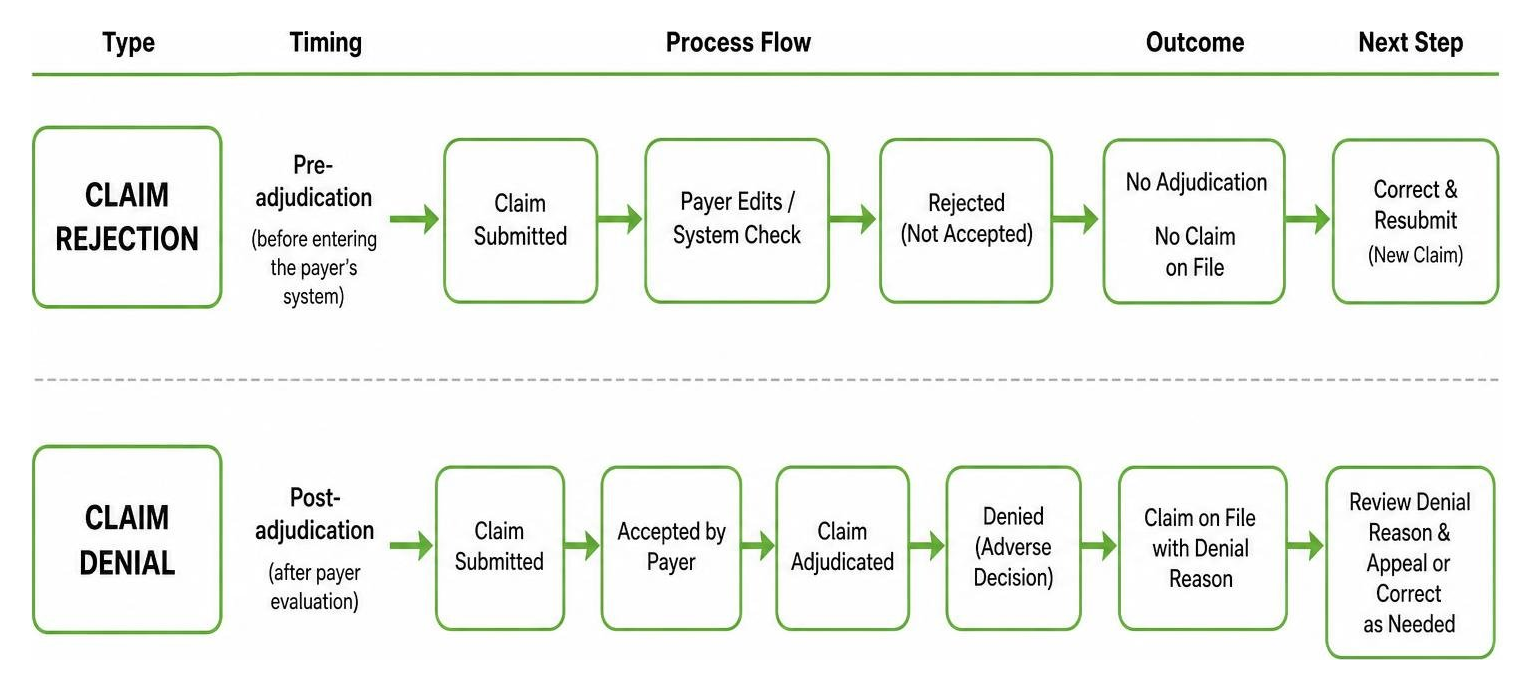
Comparison of Claim Rejections and Claim Denials
Feature Claim Rejection Claim Denial Timing Pre-adjudication (occurs before entering the payer's system) Post-adjudication (occurs after payer evaluation) Sender Clearinghouse or payer's front-end gateway The insurance payer's claims department Primary Cause Formatting errors, missing fields, invalid CPT/ICD codes Lack of prior auth, eligibility issues, medical necessity Payer Processing The claim was never processed or evaluated The claim was processed, evaluated, and formally refused Resolution Path Correct the data error and resubmit immediately Correct/appeal via ERA/EOB with supporting documents Timely Filing Risk High (does not stop the timely filing clock) Medium (stops the initial filing clock, but starts appeal deadlines)
Understanding this distinction is critical for your accounts receivable team. For a step-by-step breakdown of how to structure your A/R workflows around these categories, explore our resource on AR denial management.
How to Handle Clearinghouse Rejections
Clearinghouse rejections are typically caused by simple, administrative data mismatches. These include misspelled patient names, transposed insurance ID numbers, or invalid billing codes. Because these claims are stopped before they are processed, they do not appear on your Explanation of Benefits (EOB) or Electronic Remittance Advice (ERA).
Instead, they are flagged via 277CA (Claim Acknowledgement) reports. The key to handling rejections is speed. Because a rejected claim has not officially been filed with the payer, the timely filing clock continues to tick. Your team should review clearinghouse rejections daily, correct the formatting errors, and resubmit them within 24 to 48 hours.
How to Handle Payer Denials
Payer denials require a much more structured, analytical approach. A denial means the payer received the claim, evaluated it against the patient’s policy benefits, and decided not to pay all or part of the billed services.
Denials are communicated through an 835 ERA or a paper EOB, which contains standardized Claim Adjustment Reason Codes (CARCs) and Remittance Advice Remark Codes (RARCs) explaining the decision.
To handle a payer denial, you must:
Verify the specific CARC and RARC combination to understand the payer's logic.
Determine if the denial is "hard" (unappealable, such as a service explicitly excluded from the patient's benefits) or "soft" (appealable, such as a missing modifier or an incorrect prior authorization number).
Gather the necessary clinical documentation or correct the administrative error.
Submit a formal appeal or a corrected claim within the payer's strict appeal window (which can be as short as 30 to 90 days).
For detailed guidance on setting up an efficient appeals workflow, refer to our playbook on denials and appeals management.
Top 10 Claim Denial Reasons and CARC Codes
To successfully prevent and resolve denials, your team must speak the language of payers. This means understanding the standardized CARC and RARC codes that accompany every denied claim.

Understanding the root cause of each code is the first step toward building a denial-resistant revenue cycle. To help your team decode these messages, we've compiled a comprehensive library of medical billing denial codes.
Administrative and Eligibility Denials (CO-16, CO-22, PR-27)
Administrative errors represent the lowest-hanging fruit in denial prevention.
CO-16 (Missing or Invalid Information): This is one of the most common codes. It indicates that a critical field, such as a modifier, patient date of birth, or primary care provider (PCP) referral, is missing.
CO-22 (Coordination of Benefits Errors): This occurs when a patient has multiple insurance plans, and the claim was sent to the secondary payer before the primary payer processed it, or the patient has not updated their coordination of benefits (COB) information with their insurer.
PR-27 (Coverage Terminated): This means the service was rendered after the patient's policy was canceled. This is almost entirely preventable through real-time eligibility verification at the time of service.
Coding, Modifiers, and Bundling Denials (CO-4, CO-97, CO-151)
Coding-related denials require clinical and technical expertise to resolve.
CO-4 (Modifier Inconsistent with Procedure): This occurs when a modifier (such as -25 or -59) is appended to a CPT code that does not support it, or when the documentation does not justify the use of the modifier.
CO-97 (Service Bundled into Another Procedure): This occurs when a payer determines that a billed service is an inherent part of another larger procedure performed on the same day. Resolving this requires verifying NCCI edits and appending the appropriate modifier if the services were distinct.
CO-151 (Frequency or Quantity Limit Exceeded): This occurs when a service is billed more times than allowed within a specific timeframe (e.g., billing for more physical therapy sessions than the policy allows).
Medical Necessity and Prior Authorization Denials (CO-50, CO-197, CO-252)
These are often the most complex and expensive denials to resolve, frequently requiring clinical intervention.
CO-50 (Medical Necessity Not Met): This means the payer's algorithm or medical director determined that the service was not clinically necessary for the patient's diagnosed condition. Resolving this requires submitting detailed clinical progress notes, physician letters, and peer-reviewed literature.
CO-197 (Prior Authorization Absent): The service required pre-approval, but the provider failed to obtain it before rendering care. In 2026, this is especially common with Medicare Advantage plans, which deny initial claims at approximately 15.7% — often due to prior authorization hurdles.
CO-252 (Documentation Required to Adjudicate): The payer needs to see the clinical chart, lab results, or operative report before they will consider making a payment.
To establish a systematic approach to resolving these complex clinical denials, refer to the step-by-step methodology outlined in Claims Denials: A Step-by-Step Approach to Resolution.
Best Practices for Working Denials in Medical Billing

Shifting your practice from a reactive "denial management" mindset to a proactive "denial prevention" strategy is the only way to build long-term financial resilience. Up to 90% of claim denials are completely preventable. By focusing on front-end processes, you can stop denials before they ever leave your office. To learn more about building these upstream defenses, read our guide on denial prevention.
A Step-by-Step Workflow for Working Denials in Medical Billing
When a denial does slip through, your team must follow a highly structured, repeatable workflow to resolve it. We recommend the following six-step approach:
Triage and Route: Automatically route the denial to the appropriate specialist. For example, eligibility denials should go to the registration team, while complex coding denials should go to a certified coder.
Prioritize by Value: Sort denials by dollar amount and timely filing deadline. Focus your highest-skilled staff on high-dollar, time-sensitive claims.
Perform Root-Cause Analysis: Do not simply resubmit the claim. Figure out why it was denied.
Correct the Claim or Write the Appeal: Use payer-specific appeal templates that cite the exact clinical guidelines or policy language.
Submit and Track: Log the submission date, the tracking number, and the payer's expected response window.
Follow Up: If the payer does not respond within their standard window (typically 30 to 60 days), call to escalate the claim.
To implement this structured workflow in your practice, review our operational guide on denial management in medical billing.
Root-Cause Analysis and Upstream Feedback Loops
If your billing team is repeatedly correcting the same errors month after month, you don't have a denial problem — you have a process problem.
To break this cycle, you must implement a formal feedback loop using tools like the 5 Whys and the Pareto (80/20) Framework:
The 5 Whys: Ask "why" five times to drill down to the true systemic cause of a denial. For example:
Why was the claim denied? Because prior authorization was missing.
Why was prior authorization missing? Because the scheduler didn't request it.
Why didn't the scheduler request it? Because they didn't know the procedure required it.
Why didn't they know? Because our internal authorization list hasn't been updated in two years.
Why hasn't it been updated? Because no single person is assigned to update the payer rules. (This is your root cause!)
The Pareto Framework: Analyze your denial data monthly. You will likely find that 80% of your denied revenue is driven by just 20% of your denial codes. Focus your training and process improvements on those top three codes to achieve maximum financial impact.
Establishing a cross-functional denials workgroup that meets monthly to review this data and implement changes can drastically reduce your denial rate. Discover how our denial reduction services can help you automate this feedback loop.
Leveraging AI and Automation in Denial Prevention
As payers increasingly use AI to deny claims, providers must fight fire with fire. Manual claim scrubbing is no longer sufficient to keep pace with modern payer rules.
By integrating advanced automation into your practice management system, you can predict and prevent denials before submission:
Automated Eligibility Verification: Run real-time insurance checks automatically at three touchpoints: when the appointment is scheduled, 48 hours before the visit, and at check-in. This catches terminated coverage and coordination of benefits issues before the patient ever sees a provider.
EHR-Embedded Prior Authorization Prompts: Use software that automatically flags procedures requiring prior authorization and guides clinical staff to complete the necessary documentation during the patient encounter.
Rules-Based Claim Scrubbing: Deploy a claim scrubber that applies NCCI edits, LCD/NCD rules, and payer-specific guidelines to every claim before it is sent to the clearinghouse.
AI-Driven Denial Prediction: Advanced tools can analyze historical payment data to predict the likelihood of a denial before submission, allowing your billing team to correct potential issues proactively.
To explore how these cutting-edge technologies can protect your revenue, see our breakdown of healthcare denial management systems.
When to Outsource Your Revenue Cycle Management
Managing an in-house billing department has become increasingly difficult. Between constant payer policy changes, the complex transition to new coding standards, and the high cost of training and retaining certified billing staff, many practices find that denial management consumes too much of their time and resources.
You should consider outsourcing your RCM and denial management services if:
Your initial denial rate is consistently above 8%.
Your average days in A/R exceed 40 days.
Your billing team is falling behind on appeals, leaving denied claims unworked.
You are struggling with high staff turnover or a lack of specialized coding expertise.
Your net collection rate has dropped below 95%.
Outsourcing to a dedicated revenue cycle partner ensures that every single denial is worked to completion by certified specialists, allowing your clinical staff to focus on what they do best: caring for patients. Learn more about the benefits of a dedicated partner by exploring our denial management billing services.
Frequently Asked Questions about Denial Management
What is the difference between a hard denial and a soft denial?
A hard denial occurs when a payer refuses payment due to a fundamental, irreversible policy issue. Examples include services that are explicitly excluded from the patient's insurance benefits or claims submitted past the payer's absolute timely filing limit. Hard denials cannot be appealed and must be written off as contractual adjustments or billed to the patient (if allowed by contract and law).
A soft denial is a temporary refusal of payment due to missing, incorrect, or incomplete information. Examples include missing modifiers, incorrect patient demographics, or a lack of supporting medical records. Soft denials are highly correctable and can be successfully overturned through a corrected claim submission or a formal appeal.
How long do providers have to appeal a denied claim?
Appeal windows vary significantly by payer and plan type.
Commercial Payers: Typically allow between 30 and 180 days from the date of the initial denial (as listed on the ERA/EOB) to file a formal appeal.
Medicare: Generally allows 120 days from the date of receipt of the Redetermination Notice for a first-level appeal.
Medicaid: Often has much stricter timelines, sometimes requiring appeals to be filed within 30 to 60 days.
Crucial Tip: Never wait until the end of the appeal window. The best practice is to resolve and resubmit all soft denials within 7 to 10 business days of receiving the ERA.
What is a good denial rate for a medical practice in 2026?
In 2026, a denial rate under 5% is the industry standard for a healthy practice. Achieving a denial rate under 3% is considered best-in-class and represents a highly optimized, proactive revenue cycle.
If your practice's denial rate is above 10%, it indicates systemic issues in your front-end registration, prior authorization, or clinical documentation workflows. To understand how your practice measures up and how to begin lowering your rates, read our introductory guide on what is denial management in medical billing.
Conclusion
Winning the medical billing appeals game in 2026 requires more than just a hardworking billing team — it requires a strategic, technology-driven approach to both denial recovery and proactive prevention. Every denied claim is a revenue recovery opportunity, but the ultimate goal must always be to get paid correctly on the first submission.
At National Billing Institute, based in Boca Raton, FL, we help healthcare providers across the United States reclaim control of their revenue cycles. Our 100% USA-based team brings over 30 years of specialized billing and denial management experience to your practice. By combining state-of-the-art AI-automated claims processing with clinical documentation expertise, we consistently deliver the industry's lowest denial rates and help our clients achieve a 15-30% increase in overall revenue — all while maintaining strict, full HIPAA compliance.
Stop letting insurance companies dictate your cash flow. Partner with National Billing Institute Services today, and let our experts handle the appeals while you focus on your patients.
