The Secret Sauce of Denial Management in AR Calling
Why AR Denial Management Is the Difference Between a Thriving Practice and a Leaking Revenue Cycle
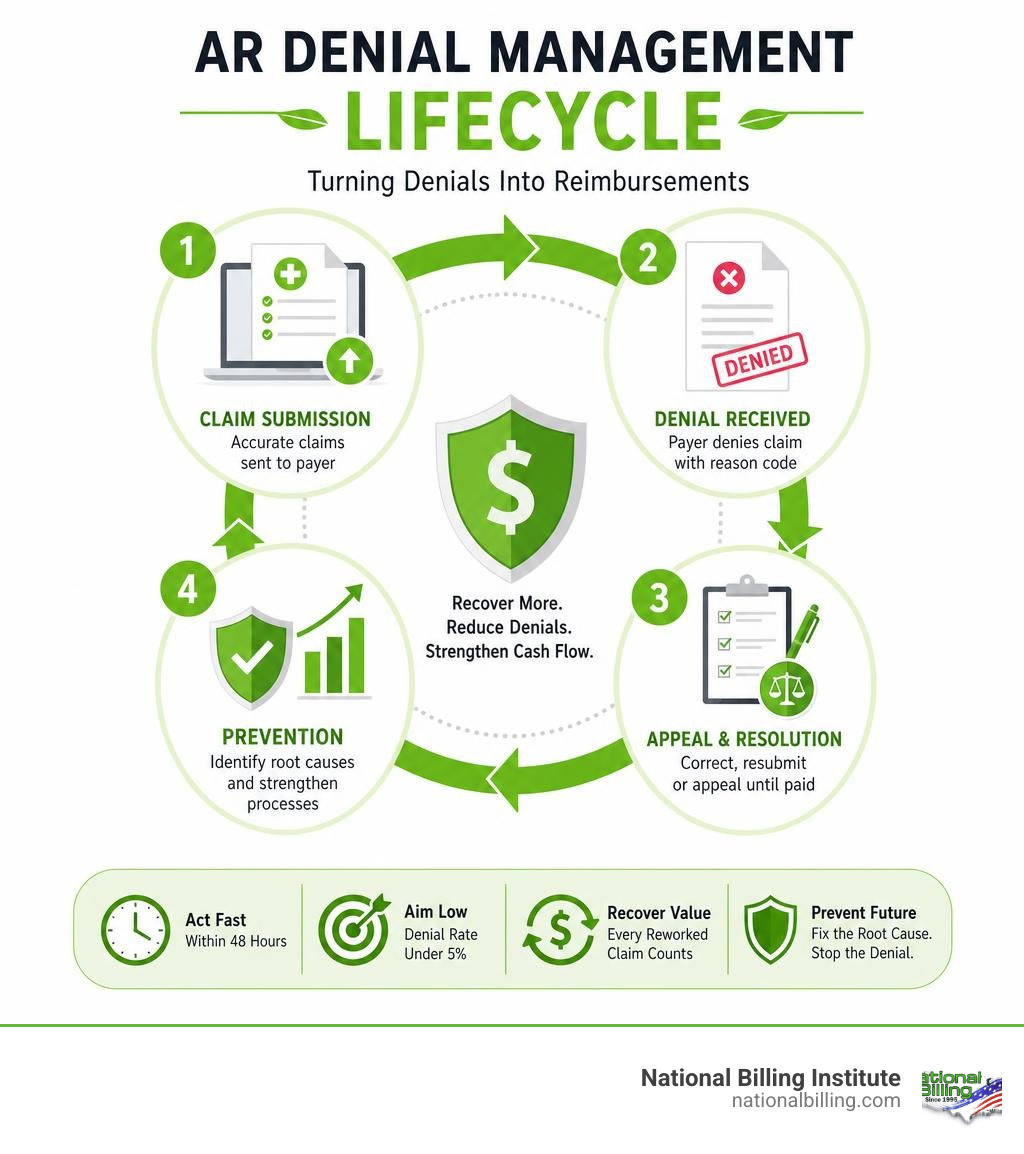
AR denial management is the process of identifying denied insurance claims, finding out why they were denied, correcting them, and resubmitting or appealing them — while also fixing the upstream problems that caused the denials in the first place.
Here's the quick version of what you need to know:
Question Answer What is it? Tracking, resolving, and preventing denied insurance claims Why does it matter? Up to 65% of denied claims are never reworked, causing permanent revenue loss How much does it cost? $25–$117 to rework a single denied claim What's the target denial rate? Under 5% (best-in-class: 2–3%) How fast should you act? Within 48 hours of receiving a denial What's the industry loss? Over $20 billion in unreimbursed claims per year in the U.S.
The U.S. healthcare system processes over 3 billion medical claims per year. Roughly 1 in 10 are denied on first submission. Most of those denials? Never touched again.
That's not a billing problem. That's a revenue hemorrhage.
And here's what makes it worse: the majority of denials are caused by preventable front-end errors — wrong patient data, missing authorizations, coding mismatches. Problems that should never reach a payer's desk in the first place.
If your practice is seeing mounting AR, slow cash flow, or a growing pile of unresolved denials, you already know the frustration. This guide breaks down exactly how the AR denial management process works — and how to stop leaving money on the table.
I'm Olivia Harper, Founder and Denial Management & Reimbursement Specialist at National Billing Institute, and I've spent over 30 years helping practices across the U.S. master AR denial management from our 100% in-office team in Boca Raton, Florida. Everything in this guide reflects what we've learned working with 500+ practices to consistently achieve some of the lowest denial rates in the industry.
What is AR Denial Management in Medical Billing?
To truly grasp the value of ar denial management, we first have to look at the broader picture of accounts receivable (AR) in healthcare. AR represents the outstanding payments owed to your practice by both insurance payers and patients. When claims are submitted, they enter the AR cycle. If everything runs smoothly, they are paid within 14 to 30 days, keeping your cash flow healthy and predictable.
However, when an insurance company refuses to pay a claim, it transitions from standard AR tracking to the specialized discipline of denial management.
While general AR management focuses on tracking all open balances and following up on unpaid claims, denial management is a highly targeted, analytical process. It is the financial immune system of your practice. It involves identifying the exact reasons behind a payer's refusal to reimburse, correcting those underlying errors, resubmitting the claims, and building systemic guardrails to prevent those same errors from happening again.
When denial management is neglected, the consequences are immediate. Unresolved denials lead to severe revenue leakage, where services are rendered but never reimbursed. It also drives up administrative costs; studies show that reworking a single denied claim can cost your practice anywhere from $25 to $117 in labor and administrative resources.
Because of the high stakes involved, the demand for specialized talent in this field has skyrocketed. A quick look at Ar Denials Specialist Jobs, Employment - Indeed reveals how aggressively healthcare organizations are recruiting dedicated experts to protect their bottom lines.
If you want to understand the foundational mechanics of this process, we highly recommend reading our guide on What is Denial Management in Medical Billing. Once you master those basics, you can explore how structured AR Follow-Up Services keep your cash flow moving without placing an administrative burden on your clinical staff.
Claim Rejection vs. Claim Denial: Why the Difference Matters
In medical billing, "rejected" and "denied" are often used interchangeably in casual conversation. But in our billing office in Boca Raton, treating them the same is a cardinal sin. Understanding the distinction between a claim rejection and a claim denial is critical for designing efficient workflow resolution patterns.
The difference comes down to where the claim is stopped in the submission pipeline.
A claim rejection occurs at the front end of the process, typically at the clearinghouse level or during the initial automated screening by the payer. The claim has not actually been processed or adjudicated. It was stopped because it failed basic formatting, syntax, or demographic checks. Because it was rejected before entering the payer's adjudication system, it is not technically considered a "denied" claim.
A claim denial, on the other hand, occurs at the back-end adjudication stage. The payer has received the claim, entered it into their system, evaluated it against the patient's policy guidelines, and formally decided not to pay all or part of it.
To help your team visualize these differences, we have mapped them out in the table below:
Feature Claim Rejection Claim Denial Point of Failure Clearinghouse or initial payer gateway Payer's back-end adjudication system Primary Cause Front-end errors (typos, incorrect ID numbers) Complex adjudication issues (medical necessity, policy limits) Adjudication Status Never processed or evaluated Fully processed and formally adjudicated How It's Communicated Clearinghouse error report Electronic Remittance Advice (ERA) or EOB Resolution Workflow Correct the data and retransmit immediately Requires formal appeal, corrected claim, or clinical notes Timely Filing Impact Does not pause timely filing clocks Subject to strict payer appeal deadlines
Why does this matter for your daily operations? Because their workflows are entirely different.
Rejections are quick fixes. If a patient's middle initial was missing or their policy ID had a transposed number, your billing team can correct the data and retransmit the claim within minutes. There is no need to write appeal letters or gather clinical records.
Denials, however, require a deeper dive. Because a payer has officially adjudicated the claim, you cannot simply "resubmit" it without addressing the specific reason it was turned down. Doing so will result in a duplicate claim denial, further complicating your AR. Resolving a denial requires analyzing payer correspondence, gathering supporting documentation, and submitting a formal appeal.
To learn more about navigating these complex back-end decisions, read our deep dive on Medical Billing Denials.
Common Causes and Specialty-Specific Denial Risks
Insurance companies have hundreds of reasons for denying claims, but the vast majority of denials stem from a few highly preventable administrative issues. By understanding these root causes, we can stop them before they leave your office.
Eligibility and Registration Errors: This is the most common culprit. If a patient’s insurance policy has terminated, if they have changed employers, or if their demographic information is entered incorrectly, the claim will be denied.
Prior Authorization Failures: Many high-cost procedures, imaging services, and specialty medications require prior approval from the payer. If your team performs a service without securing this authorization first, the claim is almost guaranteed to be denied.
Coding Errors: Using outdated ICD-10 diagnosis codes or incorrect CPT procedure codes leads to immediate denials. This also includes failing to append necessary modifiers (such as modifier -25 or -59) when performing multiple services on the same day.
Untimely Filing: Every payer has a strict window within which claims must be submitted. If you miss this window, the claim is denied, and recovering that revenue becomes incredibly difficult. If you've struggled with these strict deadlines, check out our guide on Untimely Filing in Medical Billing.
Specialty-Specific Denial Risks
While administrative errors plague every healthcare provider, different medical specialties face distinct denial landscapes based on the nature of their services.
Orthopedics: Orthopedic practices face high denial rates due to the extensive prior authorization requirements for surgeries and advanced imaging (like MRIs). Payers also heavily scrutinize modifier usage for bilateral procedures or multiple surgical inputs performed during the same operative session.
Wound Care: Wound care is highly documentation-dependent. Payers frequently deny these claims under the guise of "lack of medical necessity." If your clinical notes do not meticulously document the precise measurements of a wound, its progression, and the specific materials used, you will face constant denials.
Behavioral Health: Behavioral health practices struggle with session limits and complex coordination of benefits (COB). Many insurance plans have strict caps on the number of therapy sessions allowed per year, and credentialing issues for individual therapists often trigger administrative denials.
Home Health: Home health agencies operate under some of the most rigid regulatory guidelines in the U.S. Denials here are frequently triggered by OASIS documentation gaps, missing face-to-face physician encounter certifications, or plan of care signatures that do not meet strict Medicare timelines.
The Step-by-Step AR Denial Management Process
To turn your billing department from a reactive fire-fighting unit into a proactive revenue recovery machine, you need a structured, repeatable process. You cannot simply work denials as they pop up; you must track, prioritize, and analyze them systematically.
When we take over a practice's billing, we implement a comprehensive Denials and Appeals Management protocol designed to maximize recovery while minimizing the administrative burden on your clinical staff.
Step-by-Step AR Denial Management Workflow
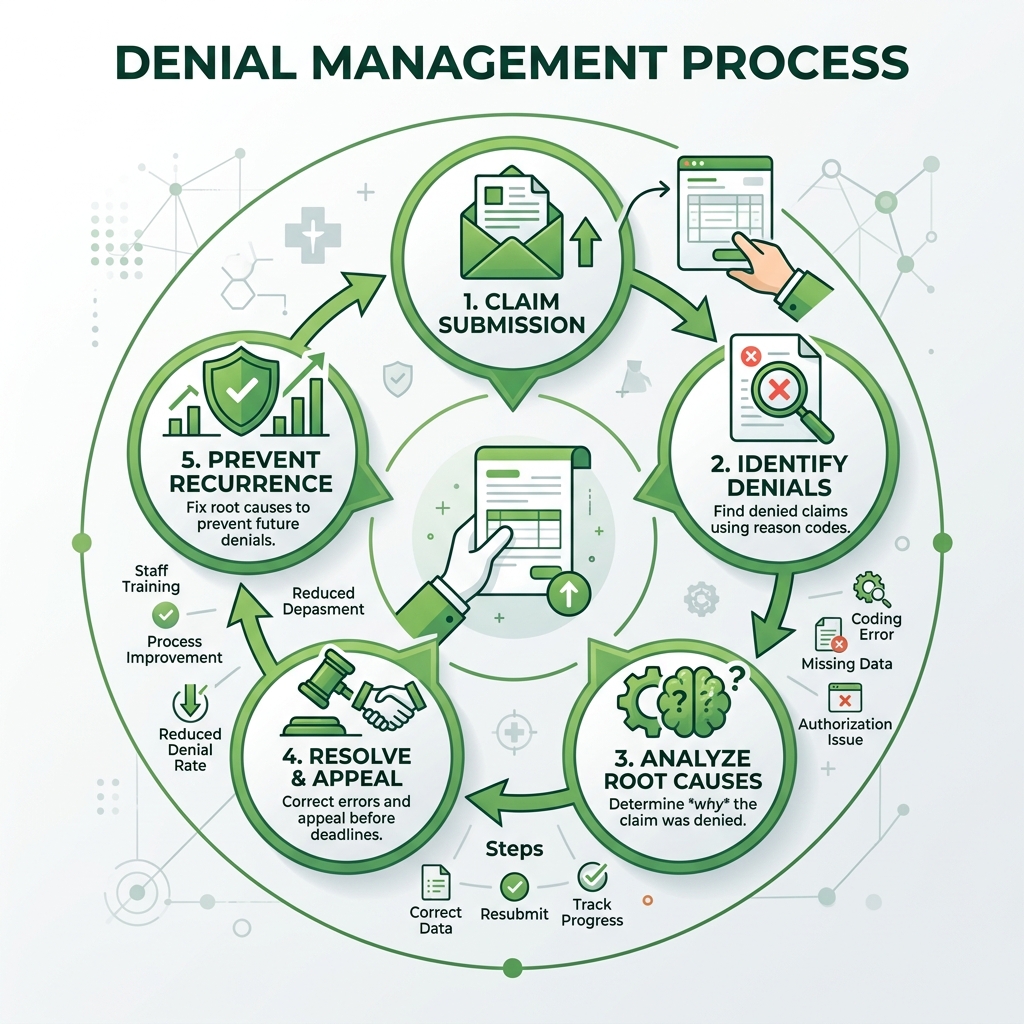
An effective ar denial management workflow consists of five key stages:
Identification: The moment an Electronic Remittance Advice (ERA) or Explanation of Benefits (EOB) arrives with a non-zero adjustment code, the claim must be flagged. Your billing software or clearinghouse should automatically route these flagged claims to a dedicated denial work queue.
Categorization: Next, group the denials by their root cause. Is it an eligibility issue? A coding error? A prior authorization failure? Categorizing your denials allows you to assign them to the right specialists. For example, demographic issues can go to front-desk coordinators, while complex coding denials should be routed to certified medical coders.
Triage & Prioritization: Not all denials are created equal. Working them in chronological order is a mistake. Instead, triage your work queue based on two factors: the dollar value of the claim and the payer's timely filing limit. High-value claims nearing their appeal deadlines must always be worked first.
Appeal Submission: Once the error is identified and corrected, your team must prepare the appeal package. This should include a clear, concise appeal letter, the corrected claim form, and all necessary supporting documentation (such as clinical notes, operative reports, or proof of prior authorization).
The Prevention Feedback Loop: This is where the "secret sauce" comes in. Working individual denials recovers past revenue, but analyzing trends prevents future losses. Your billing team must regularly share denial data with your front-desk and clinical teams so they can adjust their upstream processes.
For a deeper look at how to build an analytical framework for your denials, read the expert insights in Analyzing AR Denial Patterns to Improve Payer Response and Reimbursement Timelines - Tech Hopes.
Key CARC and RARC Codes in AR Denial Management
To resolve denials efficiently, your billing team must speak the payers' language. Payers communicate the reasons for their payment decisions using standardized codes: Claim Adjustment Reason Codes (CARC) and Remittance Advice Remark Codes (RARC).
Understanding these codes is the key to unlocking faster appeals. Some of the most common codes we encounter include:
CO-11 (Diagnosis/Procedure Mismatch): This code indicates that the billed CPT procedure code does not align with the ICD-10 diagnosis code on the claim. Resolving this requires reviewing the clinical documentation to ensure the diagnosis code reflects the highest level of specificity.
CO-16 (Missing Information): The payer needs more data to process the claim. This is often accompanied by an RARC specifying what is missing, such as medical records, an operative report, or a primary insurance EOB.
CO-29 (Timely Filing Limit Expired): The claim was submitted past the payer's deadline. To resolve this, your team must provide proof of timely filing, such as a clearinghouse acceptance report showing the claim was originally sent within the allowed window.
CO-197 (Pre-certification/Authorization Missing): The service required prior authorization, but none was found on file. Resolving this requires contacting the payer to request a retro-authorization, though these are notoriously difficult to secure.
To keep a handy cheat sheet of these codes at your workstation, refer to our comprehensive guide on Medical Billing Denial Codes.
KPIs, Benchmarks, and State-by-State Variations
To know if your ar denial management program is actually working, you must measure your performance against established industry standards. We recommend tracking three core key performance indicators (KPIs) on a weekly and monthly basis:
Clean Claim Rate (CCR): This measures the percentage of claims that are accepted and paid on their very first submission. Industry Benchmark: Above 95%. Anything lower means your team is spending too much time reworking basic front-end errors.
Days in AR (DAR): This measures the average number of days it takes for your practice to get paid after a service is rendered. Industry Benchmark: Under 35 days. If your DAR is creeping above 40 or 50 days, it is a clear indicator that denials are stalling your cash flow.
Initial Denial Rate: This measures the percentage of your total submitted claims that are denied on first contact. Industry Benchmark: Under 5%. If your denial rate is in the double digits, your revenue cycle is highly vulnerable.
When appeals become necessary, keeping track of payer-specific timelines is vital. If you are dealing with government payers, make sure your team is fully aligned with the strict guidelines detailed in our article on Medicare Appeal Timely Filing.
State-by-State Variations in Denial Management
It is important to recognize that the revenue cycle does not look the same in every state. Payer mixes, local regulations, and Medicaid structures vary significantly across the country:
Florida: In our home state, the high concentration of Medicare Advantage plans and a highly competitive commercial payer market mean billing teams must navigate incredibly complex prior authorization rules and frequent policy updates.
Texas: Texas practices operate under some of the nation's strictest prompt-pay laws, which require insurance companies to pay or deny clean electronic claims within 30 days. However, the state's highly fragmented Medicaid managed care network requires meticulous tracking of plan-specific guidelines.
California: With a massive patient population covered by Medi-Cal (California's Medicaid program) and highly integrated managed care organizations (HMOs), providers face unique delegation-of-risk models. Here, denials must often be appealed directly to independent physician associations (IPAs) rather than the primary insurance carrier.
New York: New York's complex regulatory environment features strict consumer protection laws and unique prompt-payment regulations. The state's commercial payers are heavily regulated, but navigating the state-specific workers' compensation and no-fault auto insurance billing rules requires specialized local expertise.
Proactive Prevention Strategies to Reduce Claim Denials
Resolving denials is reactive; preventing them is proactive. While recovering money from denied claims is important, the ultimate goal of any healthy medical practice should be to stop denials from happening in the first place.
By shifting your focus upstream, you can build a denial-resistant revenue cycle. Here are the core strategies we use to help our clients achieve this:
1. Real-Time Eligibility Verification
Never assume a patient's insurance coverage is active just because they saw you last month. Implement a strict policy of verifying eligibility 48 hours before every scheduled appointment and again at the check-in desk. Automated verification tools can instantly check copays, deductibles, active coverage, and coordination of benefits (COB) status before the provider even enters the exam room.
2. Comprehensive Claim Scrubbing
Do not let your claims leave your practice without a thorough inspection. Utilize advanced claim-scrubbing software that automatically checks claims for common errors before they are transmitted to the clearinghouse. A good claim scrubber will check for coding mismatches, missing modifiers, gender-specific procedure mismatches, and payer-specific billing rules.
3. AI-Driven Automation
Leverage modern technology to reduce human error. AI-powered billing systems can analyze clinical documentation to suggest highly accurate codes, track timely filing limits across dozens of different payers, and automatically flag high-risk claims that are likely to be denied based on historical payer behavior.
4. Continuous Staff Training
The medical billing landscape changes rapidly. CPT codes are updated annually, ICD-10 guidelines shift, and payers constantly modify their internal medical necessity policies. Provide your billing, coding, and front-desk teams with regular, structured training sessions to keep their skills sharp and up to date.
5. Meticulous Provider Credentialing
A surprising number of denials are triggered because the rendering provider is not properly credentialed or enrolled with the patient's insurance plan. Maintain a proactive credentialing calendar to ensure all licenses, CAQH profiles, and payer contracts are renewed well ahead of their expiration dates.
If you are ready to transition your practice from reactive billing to proactive prevention, explore our specialized Denial Reduction Services and learn how our comprehensive Denial Management Services can safeguard your hard-earned revenue.
Frequently Asked Questions about AR Denial Management
What is the average claim denial rate in 2026?
In June 2026, the average claim denial rate across the U.S. healthcare industry ranges between 6% and 11%, depending on the practice’s specialty and payer mix. While this is the industry average, it should not be your target. High-performing, financially healthy practices consistently maintain an initial denial rate of under 5%, with best-in-class organizations pushing that number down to 2% or 3%.
How quickly should providers follow up on denied claims?
Industry best practice dictates that your billing team should follow up on denied claims within 48 hours of receiving the denial notification. Letting denied claims sit in your work queue is a recipe for revenue loss. The longer a claim remains unpaid, the harder it becomes to collect, and delaying your follow-up increases the risk of missing the payer's strict timely filing and appeal deadlines.
What is the difference between hard and soft denials?
A hard denial is an irreversible decision by the payer that results in permanent revenue loss. These typically occur when a service is deemed medically unnecessary, is explicitly excluded from the patient's policy, or when a timely filing deadline was missed without a valid excuse. Hard denials must be written off.
A soft denial is a temporary, correctable refusal to pay. These are triggered by minor administrative errors, missing documentation, or coding mistakes. Soft denials can be easily corrected and resubmitted, or successfully overturned through a standard appeal process.
Conclusion
At the end of the day, AR denial management isn't just a back-office billing task. It is a critical business strategy that directly impacts your cash flow, your administrative costs, and your ability to focus on what matters most: patient care.
Leaving up to 65% of your denied claims unworked is equivalent to leaving cash on the table. But building an in-house team with the analytical expertise, technology, and time to fight insurance companies is a massive undertaking.
That is where we come in. At National Billing Institute, we combine over 30 years of industry experience with a 100% USA-based team operating entirely out of our office in Boca Raton, Florida. We don't just work your denials; we build customized, AI-driven prevention frameworks that help our clients achieve some of the lowest denial rates in the industry and see an average revenue increase of 15% to 30%.
Stop letting insurance companies dictate your financial health. Contact us today to explore our full suite of National Billing Services and let us turn your leaking revenue cycle into a highly optimized cash flow engine.
