Why Revenue Cycle Management Services are Worth the Investment
Why Denial Management Billing Services Are Critical for Your Practice's Financial Health
Denial management billing services are specialized solutions that identify, correct, appeal, and prevent insurance claim denials — protecting your practice's revenue and keeping cash flow healthy.
Quick answer: What do denial management billing services do?
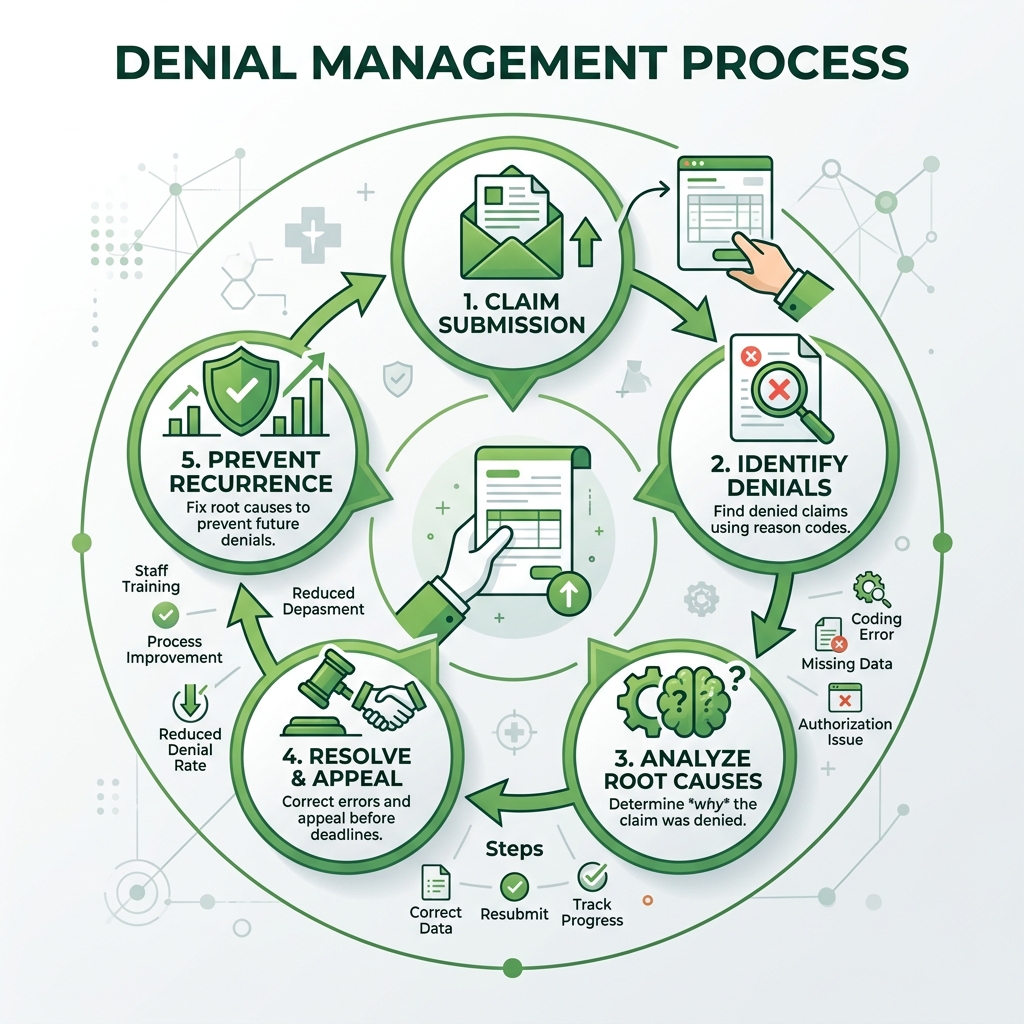
Stage What Happens Identify Find denied claims using CARC/RARC codes from ERAs and EOBs Correct Fix coding errors, missing documentation, or eligibility issues Appeal Submit payer-specific appeals with clinical justification Prevent Analyze root causes and update workflows to stop repeat denials
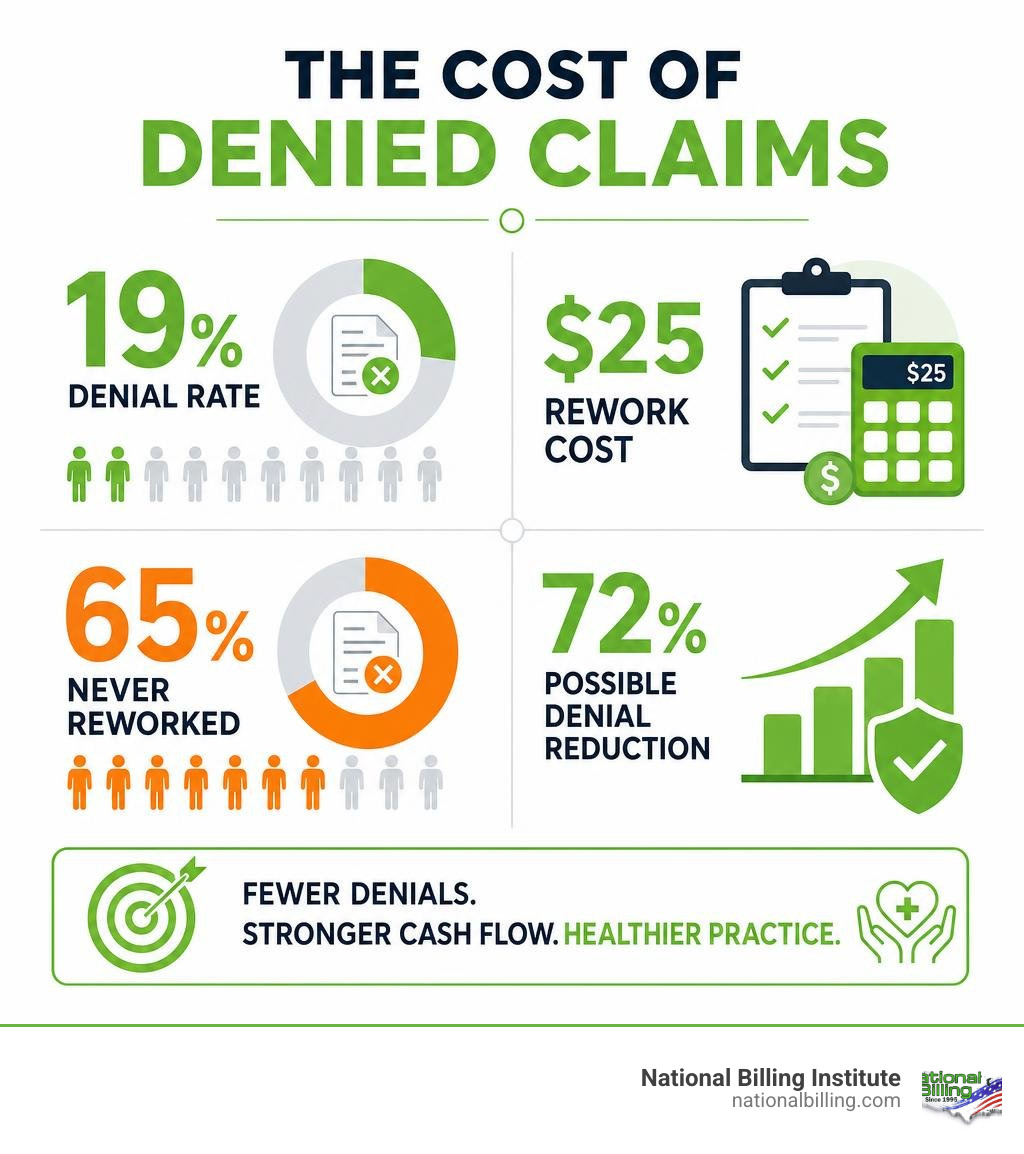
If your practice is processing thousands of claims each month, denials are quietly draining your revenue. Consider this: at the current average denial rate of 19%, a practice submitting 10,000 claims monthly faces roughly 1,900 rejections. Each denied claim costs about $25 to rework — and 65% of denied claims are never reworked at all.
That's not a billing inconvenience. That's a revenue crisis.
Eight out of ten healthcare finance leaders say their denial management process has room to improve. Yet most practices are too short-staffed — or too overwhelmed — to fix it from the inside.
The good news? Most denials are preventable. And the right denial management service can reduce your denial rate by as much as 72%, while boosting collections by 20–35%.
I'm Olivia Harper, Founder and Denial Management & Reimbursement Specialist at National Billing Institute, and I've spent over 30 years building and refining denial management billing services for practices across the United States. In this guide, I'll walk you through exactly how the denial management process works, what drives denials up, and why outsourcing to a certified US-based team is often the fastest path to financial recovery.
Understanding the Impact of Medical Billing Denials on Healthcare Revenue
In the complex ecosystem of healthcare, your revenue cycle is the circulatory system. When it functions smoothly, your practice remains financially healthy, allowing you to focus on what matters most: your patients. However, when insurance payers begin issuing denials, it acts like a series of blockages, disrupting cash flow and placing an immense administrative burden on your team.
This is where structured What Is Denials Management? becomes essential. Rather than simply reacting to payment rejections as they trickle in, an effective strategy treats denial management as a core, proactive business function. Understanding What is Denial Management in Medical Billing means shifting from a defensive posture of "fixing mistakes" to an offensive strategy of system-wide prevention. Without this shift, your administrative staff will spend more time chasing past-due insurance payments than helping patients in the clinic.
The True Cost of Unresolved Claims
When a payer denies a claim, many practices assume they can just "get to it when they have time." But in medical billing, time is literally money. Industry benchmarks show that reworking a single denied claim costs an average of $25 in administrative labor.
Worse yet, due to lack of time or specialized training, an astonishing 65% of Medical Billing Denials are never reworked at all. They are simply written off as bad debt.
Let's look at the math for a mid-sized clinic:
Monthly Claims Submitted: 5,000
Average Denial Rate (19%): 950 denied claims
65% Never Reworked: 617 claims abandoned
Average Claim Value: $150
Monthly Revenue Lost Forever: $92,550
Over a single year, that adds up to more than $1.1 million in lost revenue that your practice rightfully earned. By partnering with professional denial management billing services, you plug this financial leakage and ensure that no claim is left behind.
Why Denial Rates Are Rising in 2026
If you feel like getting paid has gotten harder recently, you aren't imagining things. As of June 2026, healthcare providers are facing denial rates that are 10% higher than in previous years, with the national average hovering around 19%.
Payers are continuously updating their policies, introducing highly complex coding requirements, and utilizing automated algorithms to flag and deny claims for minor discrepancies. From subtle changes in telehealth billing guidelines to increasingly strict medical necessity definitions, keeping up with these shifts requires dedicated vigilance.
Without a team that analyzes Medical Billing Denial Codes daily, practices simply cannot adapt fast enough to stay ahead of these evolving rules.
The Core Pillars of Denial Management Billing Services
To successfully combat rising rejections, we utilize a highly structured, systematic framework known as the IMMP process (Identify, Manage, Monitor, and Prevent). This methodology transforms how your practice handles Denial Management Services by establishing clear protocols for every stage of a claim's lifecycle.
Step 1: Identify and Categorize Denials
The first step in resolving a denial is understanding why it happened. This goes beyond reading a basic "claim rejected" notification. We dive deep into the Electronic Remittance Advice (ERA) to analyze the specific Claim Adjustment Reason Codes (CARCs) and Remittance Advice Remark Codes (RARCs).
By sorting and categorizing these codes, we can trace each issue back to its source—whether it's a front-desk registration error, a coding mismatch, or a missing authorization. This structured tracking forms the foundation of Denial Management in Medical Billing, allowing us to map out the exact solution required for each specific payer.
Step 2: Manage and Appeal Claims Proactively
Once a denial is identified, we don't let it sit in an aging accounts receivable (A/R) bucket. We prioritize and route the claim to the appropriate specialist immediately.
Different payers have wildly different rules for appeals, and their timely filing limits can range from a tight 90 days to a full year. Our team utilizes custom, payer-specific appeal templates backed by clinical documentation and coding logic to ensure a high success rate. By handling Denials and Appeals Management proactively, we aim to submit first-touch appeals within 48 hours, significantly accelerating your cash flow.
Step 3: Monitor and Prevent Future Rejections
Resolving a single denial is great, but preventing ten more from happening is even better. The final pillar of our process involves continuous monitoring and root cause analysis.
We track which payers are denying which codes, look for trends, and feed this information back upstream. Through regular workflow audits and targeted staff training on Denial Prevention, we help your team correct administrative errors at the front desk or clinical documentation gaps in the exam room before they ever turn into a denial.
Key Strategies to Prevent Claim Denials at the Source
The most cost-effective denial is the one that never happens. By focusing on front-end optimization, we help practices build a "denial-resistant" revenue cycle where claims are validated and cleared before they are sent to the insurance company.

Eligibility Verification and Prior Authorization
The single most common reason for claim denials is simple: patient eligibility and coverage issues. Patients change insurance plans, employer groups update benefits, or specific services require prior authorization that wasn't obtained.
To eliminate these errors, we implement real-time eligibility (RTE) verification protocols. By verifying insurance coverage during scheduling and again at check-in, we catch inactive policies, coordination of benefits (COB) conflicts, and authorization requirements upfront. Utilizing specialized Denial Reduction Services ensures your front-office staff always has the exact information they need to secure authorizations before care is delivered.
Coding Accuracy and Documentation Integrity
Medical coding is a language that is constantly changing. A single misplaced modifier or an outdated ICD-10 code can result in an automatic rejection. Furthermore, payers frequently audit claims to ensure that the clinical documentation matches the level of service billed.
Our certified coding experts conduct thorough documentation reviews to verify that all CPT modifiers, diagnostic codes, and procedural details align perfectly with Billing Compliance standards. By training providers on precise documentation requirements, we ensure your claims stand up to the strictest payer scrutiny.
Leveraging Technology and AI in Revenue Cycle Management
In 2026, manual claim tracking is no longer sufficient to keep up with the automated systems used by major insurance carriers. To level the playing field, modern denial management billing services must leverage advanced technology, robotic process automation (RPA), and artificial intelligence.

Leveraging AI-Driven Denial Management Billing Services
At National Billing, we integrate AI-driven claim scrubbing and automated mapping technology into your existing Electronic Health Record (EHR) and Practice Management (PM) systems. Our software automatically cross-references every claim against millions of payer-specific rules before submission. If an anomaly is found—such as a missing modifier or an incorrect demographic field—the system flags it for immediate correction, ensuring a first-pass clean claim rate of over 98%.
Prioritizing Denied Claims with Predictive Analytics
When denials do occur, they shouldn't be worked in random order. Our predictive analytics tools automatically sort and prioritize outstanding claims based on several key factors:
Claim Age: Prioritizing claims approaching their timely filing limits.
Dollar Amount: Ensuring high-value claims are resolved first to maximize immediate cash recovery.
Probability of Success: Using historical payer data to target claims with the highest likelihood of an successful appeal.
This intelligent prioritization is a core feature of our AR Follow Up Services, allowing our specialists to work efficiently and recover your revenue faster.
In-House vs. Outsourced Billing Solutions
Many practice managers struggle with the decision to keep their billing in-house or outsource to a dedicated partner. Below, we've broken down the key differences to help you evaluate which model makes the most sense for your practice's bottom line.
Feature / Metric In-House Billing Team Outsourced Denial Management Services Average Denial Rate Typically 15% – 25% Targeted under 5% First-Pass Clean Claim Rate 75% – 85% Above 98% Rework Rate Low (many denials are abandoned due to lack of time) 100% of recoverable denials are worked Staffing & Overhead Costs High (salaries, benefits, training, billing software) Low (percentage of collections or flat monthly fee) Payer Rule Updates Staff must research updates manually Automated software and dedicated compliance experts A/R Collection Speed Often exceeds 45–60 days Average A/R reduced to under 30 days
Why Outsourcing Denial Management Billing Services is Worth the Investment
Outsourcing your denial management to a specialized partner like National Billing isn't just an administrative decision; it's a highly profitable investment.
By utilizing our 100% USA-based team of certified AAPC and AHIMA coders, practices regularly experience a 72% reduction in overall denial rates and 30% faster payment collection cycles. With fewer claims stuck in limbo, our clients see an average increase in collections of 20% to 35% within the first few months. We handle the administrative heavy lifting so your in-house staff can focus entirely on patient care and clinical operations.
Frequently Asked Questions about Denial Management
What is the difference between a claim rejection and a claim denial?
A claim rejection occurs at the clearinghouse level before the claim is ever processed by the payer. Rejections are typically caused by simple formatting errors, such as a missing digit in an NPI or a typo in the patient's name. They are not adjudicated and can be quickly corrected and resubmitted.
A claim denial, on the other hand, occurs after the insurance payer has fully reviewed and adjudicated the claim. The payer has determined that, for a specific policy or clinical reason (such as lack of medical necessity or missing prior authorization), they will not pay for the rendered services. Denials require formal correction, appeals, or clinical justification to resolve.
What are the most common reasons for medical claim denials?
The vast majority of denials can be categorized into four main buckets:
Eligibility and Coverage: The patient's policy was inactive, expired, or did not cover the specific service.
Missing Prior Authorization: The provider performed a procedure or scheduled a service without obtaining the required pre-approval from the payer.
Coding Errors: Incorrect use of ICD-10 diagnostic codes, CPT procedure codes, or missing/invalid modifiers.
Timely Filing: The claim was submitted after the payer's strict deadline for submission.
What key performance indicators (KPIs) should our practice track?
To measure the financial health of your practice, you should closely monitor these four KPIs:
Denial Rate: Total denied claims divided by total claims submitted. A healthy practice targets a rate under 5%.
Clean Claims Rate: The percentage of claims accepted on the first submission. The industry benchmark is 95% or higher.
Days in A/R: The average number of days it takes to get paid. Best practice is to keep this under 30 days.
Net Collection Rate: The percentage of clean, collectible revenue actually collected. You should aim for 98% or higher.
Conclusion
A high denial rate isn't just an administrative headache—it's a direct threat to the longevity and growth of your practice. In 2026's challenging billing environment, relying on manual processes or an overworked in-house team to manage complex insurance appeals is no longer a viable strategy.
Protecting your revenue cycle requires a combination of advanced technology, proactive front-end verification, and persistent, certified billing experts who know how to stand up to major payers.
At National Billing, our 100% US-based team in Boca Raton, FL, brings over 30 years of industry experience to your practice. We combine AI-automated claims processing with expert clinical appeal strategies to deliver the lowest denial rates in the industry, full HIPAA compliance, and a 15% to 30% average increase in practice revenue.
Don't let preventable denials drain your hard-earned revenue. Contact us today to Outsource to National Billing Services and let us transform your denials into reliable, predictable cash flow.
