
Mastering the Healthcare Money Maze
What Revenue Cycle Management Really Means for Your Practice
Revenue cycle management is the end-to-end financial process healthcare providers use to track, manage, and collect payment for medical services — from the moment a patient schedules an appointment to the moment the final balance is paid.
Here's a quick summary:
Element What It Means What it is The full financial workflow from patient scheduling to final payment Who it affects Every healthcare provider — hospitals, clinics, private practices Why it matters Lost or delayed revenue directly threatens practice survival Key steps Registration → Insurance verification → Coding → Claims → Collections Biggest risks Claim denials, billing errors, revenue leakage, compliance failures
The stakes are high. Claim denials alone cost U.S. hospitals roughly $262 billion per year. And providers typically fail to collect 2%–5% of net patient revenue simply due to inefficient processes.
That's not just a billing problem — it's a survival problem.
For many practices, the revenue cycle runs quietly in the background until something breaks. A denied claim. A payment that never arrives. A compliance flag. By then, the damage is already done.
I'm Olivia Harper, founder of National Billing Institute and a denial management and reimbursement specialist with over 30 years of hands-on experience in revenue cycle management. In this guide, I'll walk you through everything you need to know to protect your practice's revenue and stop leaving money on the table.
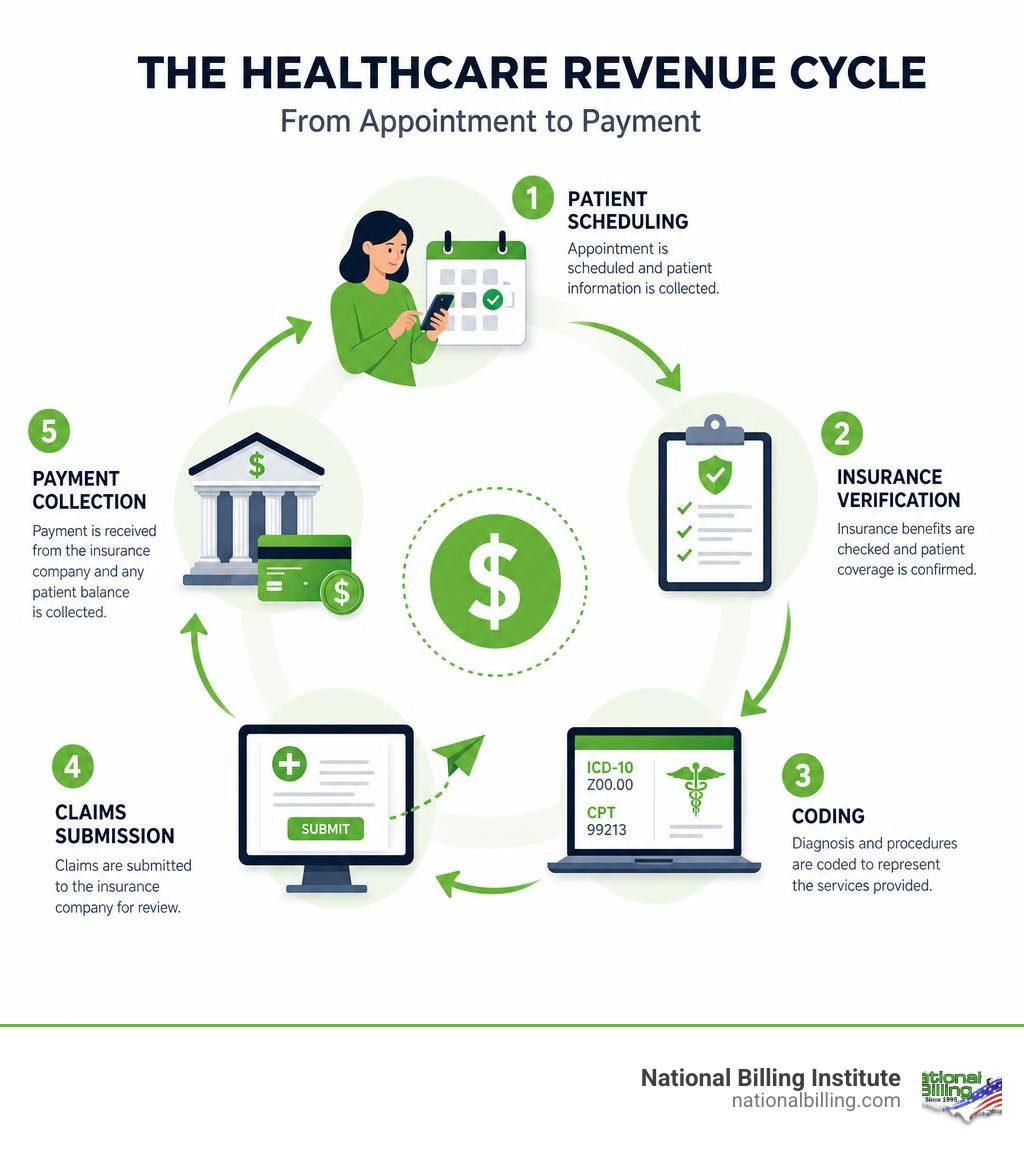
What is Revenue Cycle Management?
To understand revenue cycle management (RCM), we must look at it as the bridge connecting clinical care to financial stability. Every time healthcare providers deliver care, they participate in a complex, multi-party financial transaction. Unlike traditional retail businesses where a customer pays at the register and the transaction is complete, healthcare billing involves patients, providers, and third-party insurance payers operating under thousands of constantly changing rules.
The primary goal of RCM is to ensure that clinical productivity translates directly into healthy cash flow. When a practice has an optimized RCM strategy, clinical staff can focus entirely on the patient journey, confident that the administrative engine is working to secure every dollar earned.
According to the AAPC definition of RCM, the cycle encompasses everything from pre-registration to the final resolution of an account. Without a structured approach to Revenue Cycle Management Healthcare, practices face severe revenue leakage, high denial rates, and administrative friction that degrades both patient satisfaction and staff morale.
The 7-Step Healthcare Revenue Cycle Workflow
Managing the financial health of a modern medical practice requires running multiple distinct workflows in perfect coordination. To make this complex machine manageable, we break it down into a standardized, seven-step Healthcare Revenue Cycle Workflow.

Key Steps in the Healthcare Revenue Cycle Management Process
The front-end of the revenue cycle is where financial success is won or lost. In fact, the vast majority of claim denials can be traced directly back to errors made before the patient ever sees the provider.
Patient Registration and Scheduling: The cycle begins when a patient contacts our office to schedule an appointment. During this initial touchpoint, capturing highly accurate demographic information is critical. A single misspelled name or transposed digit in a policy number can result in an immediate claim rejection weeks down the line.
Insurance Verification and Eligibility Checks: Before clinical services are rendered, we must confirm the patient's active insurance coverage, copay responsibilities, deductibles, and out-of-pocket maximums. As outlined in Stripe's guide to healthcare RCM, establishing clear financial expectations upfront dramatically reduces bad debt and delinquency rates.
Prior Authorization Management: Many modern insurance plans require explicit pre-authorization for specific procedures, imaging, or therapies. Failing to secure these authorizations beforehand guarantees a hard denial that is incredibly difficult to appeal. Implementing strict front-end accountability ensures no patient is scheduled for a restricted procedure without an approved authorization on file.
By focusing heavily on front-end data accuracy, practices lay the groundwork for seamless downstream billing. Our comprehensive Revenue Cycle Management Solutions emphasize these early checkpoints to stop billing errors before they occur.
Mid-Cycle and Back-End Operations
Once the clinical encounter occurs, the revenue cycle transitions into its mid-cycle and back-end phases. This is where clinical documentation is transformed into financial claims and routed through the payer network.
Medical Coding and Charge Entry: Professional coders analyze the provider's clinical notes to assign standardized medical codes. This includes ICD-10 (and ICD-11) diagnosis codes, CPT procedure codes, and HCPCS modifier codes. Accurate RCM Medical Coding is essential; under-coding leads to lost revenue, while over-coding or incorrect modifier usage can trigger compliance audits and immediate denials.
Claims Submission: Once coded, the charge is compiled into an electronic claim format (typically an 837 transaction) and sent to a clearinghouse. The clearinghouse "scrubs" the claim for formatting errors before routing it to the insurance payer.
Payment Posting and Reconciliation: When the payer processes the claim, they send an Electronic Remittance Advice (ERA) or Explanation of Benefits (EOB) alongside the payment. We must carefully reconcile these payments against our practice management system to ensure we are reimbursed according to our contracted fee schedules.
Denial Management and Appeals: If a claim is denied, the clock starts ticking. Effective RCM Denial Management requires categorizing denials by their root cause, correcting the underlying errors, and submitting formal appeals within strict payer-mandated filing windows.
Overcoming Common Challenges in Revenue Cycle Operations
Even the most dedicated healthcare teams face systemic bottlenecks within their Revenue Cycle Operations. Today's healthcare landscape in the United States is uniquely challenging, characterized by severe administrative burdens, rising labor shortages, and widespread physician burnout.
To help visualize where practices lose money, let's examine the most common RCM errors and their direct financial impacts:
Common RCM Error Root Cause Financial Impact Prevention Strategy Demographic Errors Manual data entry at front desk Immediate claim rejection, delayed cash flow Automated insurance card scanning & OCR Missing Prior Authorization Lack of tracking or front-end checks Hard denial, 100% write-off of service cost Real-time EHR alerts and automated clearance Coding Inaccuracies Outdated code sets, lack of certified staff Underpayments, compliance audits, denials Certified AAPC/AHIMA coding audits Neglected Aged A/R Staff shortages, lack of prioritization Uncollectible debt after timely filing limits Prioritizing worklists by collection probability
When administrative staff are bogged down by manual phone calls for eligibility checks or tedious appeals paperwork, clinical operations suffer. Providers are forced to spend more time documenting for billing compliance rather than focusing on patient care, fueling the industry-wide crisis of clinician burnout.
The Power of Automated Systems
The solution to these operational bottlenecks lies in modern technology. By transitioning from manual, queue-driven workflows to Automated Revenue Cycle Management, practices can dramatically scale their billing operations while reducing human error.

With Automated Revenue Management, artificial intelligence (AI) and machine learning (ML) handle repetitive, rules-based tasks. For example, AI-native platforms can instantly interpret ANSI 271 data to check patient eligibility in real-time, pre-populate billing codes from clinical notes, and even predict the likelihood of a claim denial before submission.
Furthermore, automated systems can convert paper EOBs into clean, electronic ERAs when payers fail to offer digital options. This saves hours of manual data entry and ensures that payment posting is completed with near-perfect accuracy.
Key Performance Indicators for Measuring Success
You cannot manage what you do not measure. To maintain high-performing financial operations, practices must leverage Healthcare Revenue Cycle Analytics to track key performance indicators (KPIs).
The industry standards and benchmarks we recommend tracking include:
Clean Claim Rate (CCR): The percentage of claims accepted on the first submission without errors.
Benchmark: 95% or higher. Anything lower indicates systemic front-end or coding issues that require immediate evaluation.
Days in Accounts Receivable (DAR): The average number of days it takes to collect payments after a service is rendered.
Benchmark: 30 days or less.
Aged A/R over 90 Days: The proportion of outstanding claims that have remained unpaid for more than three months.
Benchmark: Less than 15% of your total A/R should fall into this category.
Net Collection Rate (NCR): The percentage of expected, contractually allowed revenue that your practice actually collects.
Benchmark: More than 95% of expected revenue collected.
Professional Opportunities in Healthcare Finance
As healthcare financial systems grow increasingly complex, the demand for highly skilled revenue cycle professionals continues to soar. Utilizing specialized Healthcare RCM Services has become a top priority for medical groups across the country, turning healthcare finance into an incredibly stable and lucrative career path.
Career Paths and Roles in Revenue Cycle Management
For those looking to enter or advance within this field, several distinct roles offer excellent career growth:
Patient Access Representative: Front-end specialists focused on scheduling, registration, and upfront insurance verification.
Medical Biller / Billing Specialist: Mid-to-back-end experts who compile claims, submit them to clearinghouses, and post payments.
Certified Medical Coder: Highly trained professionals (often certified by AAPC or AHIMA) who translate clinical documentation into standard CPT and ICD-10 codes.
Revenue Integrity Analyst: Specialists who audit billing data to identify compliance risks and prevent revenue leakage.
Denials Management Specialist: Experts dedicated to analyzing claim rejections, filing appeals, and identifying systemic payer underpayment trends.
For professionals based in Florida, local opportunities are highly abundant. You can explore active job openings in our region by checking Revenue Cycle Jobs, Employment in Boca Raton, FL on Indeed.
Frequently Asked Questions
What is the primary goal of RCM?
The primary goal of revenue cycle management is to optimize reimbursement, ensuring that healthcare providers are paid fully and quickly for the services they perform. By streamlining administrative workflows, RCM allows clinical teams to focus their energy entirely on patient care rather than financial stress.
How does medical coding affect billing?
Medical coding acts as the translator between clinical medicine and financial reimbursement. If a coder selects an incorrect code or fails to append the proper modifier, the claim will be denied or underpaid. Accurate coding ensures compliance with federal regulations and directly prevents costly claim denials.
Why do healthcare claims get denied?
Most claims are denied due to simple administrative errors, including misspelled patient names, inactive insurance coverage, missing prior authorizations, or coding discrepancies. Implementing automated front-end checks can eliminate the majority of these common errors.
Conclusion: Partner with a Trusted RCM Billing Company
Mastering the healthcare money maze doesn't mean your clinical staff has to become expert billers. At National Billing, we handle the administrative heavy lifting so you can focus on what matters most: your patients.
As a premier RCM Billing Company with a 100% USA-based team in Boca Raton, FL, we bring over 30 years of industry experience to your practice. By combining advanced, AI-automated claims processing with dedicated human expertise, we consistently deliver the lowest denial rates in the industry and help our clients achieve a 15% to 30% increase in net revenue.
Ready to eliminate revenue leakage and optimize your practice's financial health? Explore our full suite of Healthcare Revenue Cycle Management Systems and Healthcare Revenue Cycle Companies solutions today.
Contact National Billing today to schedule your free revenue cycle assessment.
