
The Ultimate Healthcare Revenue Cycle Workflow Checklist
What Is a Healthcare Revenue Cycle Workflow (And Why It Matters Right Now)
The healthcare revenue cycle workflow is the complete chain of clinical and administrative steps that begins the moment a patient schedules an appointment and ends only when every dollar owed has been collected.
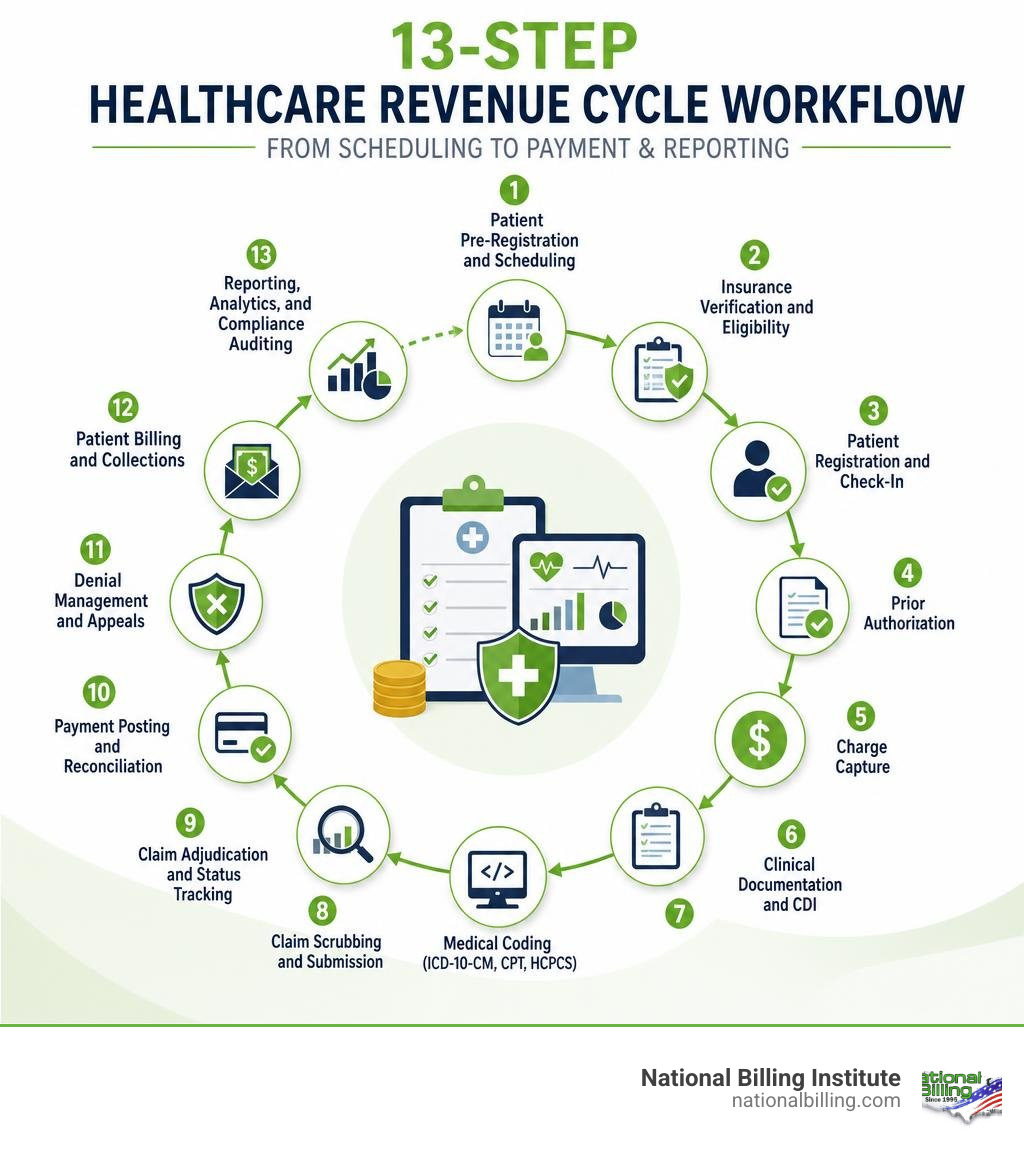
Here is the end-to-end process at a glance:
Patient Pre-Registration and Scheduling — collect demographics, insurance, and scheduling details
Insurance Verification and Eligibility — confirm active coverage before the visit
Patient Registration and Check-In — update records and collect copays at the point of service
Prior Authorization — obtain payer approval for required procedures
Charge Capture — record every billable service rendered
Clinical Documentation and CDI — ensure documentation supports the codes billed
Medical Coding (ICD-10-CM, CPT, HCPCS) — translate clinical notes into standardized billing codes
Claim Scrubbing and Submission — validate and transmit clean claims to payers
Claim Adjudication and Status Tracking — monitor payer decisions in real time
Payment Posting and Reconciliation — match payments received against amounts expected
Denial Management and Appeals — investigate, correct, and resubmit denied claims
Patient Billing and Collections — send accurate statements and collect patient balances
Reporting, Analytics, and Compliance Auditing — measure performance and close the loop
When any one of these steps breaks down, the damage does not stay contained. A wrong insurance ID entered at pre-registration can trigger an eligibility failure, which leads to a claim denial, which costs an average of $63.76 to rework — and that is if the denial is caught in time. In 2024, initial claim denial rates hit 11.8%, up from 10.2% the year before, and CMS reported $28.83 billion in Medicare Fee-for-Service improper payments for FY2025 alone. Revenue lost to denied claims now averages 7% of total provider revenue across the industry.
The pressure is real, and it is growing every quarter.
I'm Olivia Harper, Founder and Denial Management & Reimbursement Specialist at National Billing Institute, and with over 30 years of hands-on experience optimizing the healthcare revenue cycle workflow for practices nationwide, I have seen how small process gaps compound into significant revenue losses. In this checklist, I will walk you through every step of the cycle with the specific actions, benchmarks, and tools that consistently move the needle for our clients.
Why Optimizing Your Healthcare Revenue Cycle Workflow is Critical in 2026
The administrative and financial landscape of American healthcare in 2026 is unforgiving. If your practice operates with the "we will fix it on the back end" mentality, you are essentially watching hard-earned revenue evaporate. Today, payer rules change with dizzying frequency, and their algorithms are sharper than ever.
Relying on manual processes to navigate these changes is no longer viable. Modern practices must leverage advanced Healthcare Revenue Cycle Analytics to identify real-time bottlenecks before they result in permanent write-offs. Managing your financial operations is as much of a science as medicine itself. In fact, Scientific research on RCM efficiency demonstrates that treating the revenue cycle as a highly integrated, continuous system—rather than a series of disconnected back-office tasks—directly correlates with reduced administrative waste and improved clinical focus.
The Financial Impact of Rising Claim Denials
If you feel like you are fighting a losing battle against claim denials, you are not alone. The administrative barrier has risen significantly over the past few years. Medicare Advantage denial rates spiked 4.8% from 2023 to 2024, reaching nearly 17%.
When a claim is denied, it is not just a delayed payment; it is a direct blow to your bottom line. Reworking a single commercial claim denial costs an average of $63.76 in staff time and administrative overhead. For many organizations, the cumulative weight of these unresolved denials is staggering: one in three hospitals now reports bad debt levels exceeding $10 million.
If your team is simply resubmitting rejected claims without a structured strategy, you are wasting valuable resources. Protecting your bottom line requires a proactive approach to RCM Denial Management that uncovers the root cause of every rejection, whether it stems from a front-end registration error or a complex clinical necessity dispute.
Regulatory Compliance Pressures in 2026
To make matters more complex, several major regulatory shifts have redefined billing requirements in 2026:
CMS-0057-F: This landmark rule mandates the implementation of Fast Healthcare Interoperability Resources (FHIR) APIs to streamline and accelerate prior authorizations. Practices must adapt to these digital connection points or risk severe delays in care and reimbursement.
No Surprises Act (Good Faith Estimates): Healthcare providers must deliver highly accurate Good Faith Estimates (GFEs) to self-pay and uninsured patients prior to scheduled services. Failing to do so can trigger federal penalties and patient disputes.
ICD-10-CM Updates: Payer compliance requires strict adherence to the latest clinical coding guidelines. Using outdated codes or failing to document to the highest level of specificity results in immediate rejections.
The 13-Step Healthcare Revenue Cycle Workflow Checklist
To keep your practice financially healthy, we must break down the healthcare revenue cycle workflow into three distinct operational phases: Front-End, Mid-Cycle, and Back-End.
Phase Core Focus Key Steps Included Primary Goal Front-End Patient Access & Intake Steps 1–5 (Scheduling, Verification, Check-In, Prior Auth) Prevent denials at the source (Target: 95%+ registration accuracy) Mid-Cycle Clinical Integrity & Coding Steps 6–8 (Charge Capture, CDI, Medical Coding) Ensure clinical services are fully and accurately represented Back-End Billing, Resolution & Analytics Steps 9–13 (Submission, Adjudication, Posting, Appeals, Reporting) Accelerate cash flow and resolve underpayments
By establishing clear checkpoints for each phase, your practice can run a highly efficient, leak-proof financial operation. Let's look at how to optimize these Revenue Cycle Operations step by step.
Phase 1: Front-End Steps of the Healthcare Revenue Cycle Workflow
The front end is where the money is won or lost. More than 25% of all claim denials can be traced directly to inaccurate or incomplete data collected at patient intake. If your front desk makes a single typo in a subscriber ID, the downstream effects are disastrous.
To build a flawless intake system, your team must execute these five steps diligently:
Patient Pre-Registration and Scheduling: Capture the patient's full legal name, date of birth, current address, and primary/secondary insurance details during the initial phone call or digital intake.
Insurance Verification and Eligibility: Never assume a returning patient's coverage is still active. Run electronic eligibility checks (HIPAA X12 270/271 transactions) 24 to 48 hours before every scheduled appointment to verify active benefits, deductibles, and co-insurance.
Patient Registration and Check-In: Verify the patient’s physical insurance card and photo ID at arrival. Implement digital check-in kiosks or online portals to minimize manual data entry errors.
Prior Authorization (HIPAA X12 278): Identify which procedures require payer pre-approval and secure authorizations well in advance.
Point-of-Service (POS) Collections: Establish a clear financial policy. Train your front-desk staff to collect copays, outstanding balances, and estimated co-insurance before the patient leaves the office.
For a deeper dive into optimizing these early touchpoints, check out this guide on 7 Steps to Build an Efficient RCM Workflow.
Phase 2: Mid-Cycle Steps of the Healthcare Revenue Cycle Workflow
Mid-cycle operations bridge the gap between clinical care and financial reimbursement. This phase is entirely about accuracy and clinical documentation integrity (CDI).
Charge Capture: Ensure every single supply, medication, and clinical service is recorded. Missing charges (such as a fluoroscopy charge during an orthopedic procedure) cost practices between 1% and 5% of their total annual revenue.
Clinical Documentation and CDI: If a service is not documented in the medical record, in the eyes of the payer, it never happened. Insufficient documentation accounts for 53% of all Medicare improper payments. We must train clinical teams to document to the highest level of specificity.
Medical Coding: Translate complex clinical notes into standardized ICD-10-CM, CPT, and HCPCS codes.
Because coding guidelines change constantly, having certified, specialty-specific coders is essential. Utilizing professional RCM Medical Coding services ensures your claims are fully compliant with the latest regulatory updates, reducing audit risks and maximizing legitimate reimbursement.
Phase 3: Back-End Steps and Claims Resolution
The back end of the cycle is where claims are processed, monitored, and turned into actual cash flow.
Claim Scrubbing and Submission (HIPAA X12N 837): Before sending a claim to the clearinghouse, run it through an automated scrubbing engine to check for coding conflicts, missing modifiers, and payer-specific rules.
Claim Adjudication and Status Tracking: Do not wait 30 days to see if a claim was received. Track claims electronically (HIPAA X12 276/277) to catch rejections immediately.
Payment Posting and Reconciliation (HIPAA X12 835): Auto-post Electronic Remittance Advices (ERAs) and reconcile payments against your contracted fee schedules to catch underpayments.
Denial Management and Appeals: When a denial occurs, perform a root-cause analysis. Do not just resubmit the claim; appeal it with compelling, documentation-backed arguments.
Reporting and Compliance Auditing: Review your financial KPIs monthly to spot payer trends, write-off patterns, and staff training opportunities.
Implementing Automated Revenue Cycle Management workflows at this stage dramatically reduces the manual labor required to track claims, post payments, and manage appeals, allowing your team to focus on resolving complex administrative issues.
Key Performance Indicators (KPIs) and Benchmarks for RCM Success
To know if your healthcare revenue cycle workflow is healthy, you must measure it. Relying on "gut feelings" about your cash flow is a recipe for financial instability.

Every healthcare leader should monitor these four key metrics closely:
Clean Claim Rate (CCR): The percentage of claims that pass through your billing system and are paid on the first submission.
Industry Benchmark: 95% or higher
Days in Accounts Receivable (DAR): The average number of days it takes to collect payment after a service is rendered.
Industry Benchmark: Under 35 days (Excellent performance is under 30 days)
Net Collection Rate: The percentage of contracted, allowable revenue your practice actually collects.
Industry Benchmark: 95% to 98%
Initial Denial Rate: The percentage of submitted claims that are initially denied by payers.
Industry Benchmark: Below 5%
Industry Benchmarks for Financial Performance
In addition to the operational metrics above, successful practices in 2026 must benchmark their front-end and back-end efficiency against these strict industry standards:
Registration Accuracy Rate: 95% or higher on initial intake. If your team falls below this, your clean claim rate will suffer.
Point-of-Service Collection Rate: Collect 90% or more of expected copays at the time of check-in.
Bad Debt Levels: Keep bad debt write-offs below 2% of your gross revenue.
Leveraging AI and Automation in Modern Revenue Cycle Management
The competitive gap between automated and manual billing workflows is widening rapidly. Practices that rely on manual workflows are struggling to keep up with the volume of complex payer rules.
Modern Automated Revenue Management platforms utilize machine learning to handle repetitive, rule-based tasks with incredible speed and accuracy. For instance, AI-driven claim scrubbing engines can automatically cross-reference over 30,000 billing rules in real time, catching errors that even the most experienced human billers might miss.
To see how these technical systems connect, we can look at the system-level architecture of highly automated practices. According to industry-leading guides on RCM Automation Workflows, integrating real-time FHIR APIs and electronic data interchange (EDI) standards directly into your practice management software creates a closed-loop system. This structure eliminates data silos and prevents errors before they reach your clearinghouse.
Eliminating Unproductive Touches with Technology
An "unproductive touch" is any task that a staff member must handle manually that could have been resolved automatically. Examples include:
Calling a payer to check a claim's status (which wastes an average of 17 minutes per call).
Manually verifying active coverage on a payer's portal (which wastes 16 minutes compared to electronic batch verification).
Manually typing patient demographic data from a paper intake form.
By deploying Robotic Process Automation (RPA) for claim statusing, real-time eligibility checks, and automated payment posting, you free your staff to focus on high-value tasks—like counseling patients on their financial options and appealing complex clinical denials.
In-House vs. Outsourced RCM: A Decision Framework
As operational costs rise and staffing shortages persist, many healthcare organizations face a critical decision: Should we manage our revenue cycle in-house, or is it time to partner with an external specialist?
Managing your billing in-house gives you direct physical control over your staff, but it comes with substantial hidden costs. You must pay for billing software licenses, clearinghouse fees, staff salaries, benefits, and ongoing training to keep up with changing guidelines. When a key biller leaves, your cash flow can grind to a halt.
Conversely, partnering with professional Healthcare RCM Services shifts the administrative burden to a dedicated team of specialists. This approach ensures continuous coverage, access to advanced billing technology, and significantly lower overhead costs.
When to Partner with an RCM Billing Company
We recommend evaluating an external partnership if your practice meets any of the following criteria:
Your clean claim rate has dropped below 90%.
Your initial denial rate exceeds 8% to 10%.
More than 25% of your accounts receivable is over 90 days old.
You are struggling with high staff turnover or billing department vacancies.
Partnering with a specialized RCM Billing Company provides the scale, technology, and dedicated expertise required to clean up legacy AR backlogs, lower your denial rates, and establish a highly efficient, predictable cash flow.
Frequently Asked Questions about Revenue Cycle Workflows
What is the most critical step in the healthcare revenue cycle workflow?
While every step is connected, front-end registration and insurance eligibility verification is the most critical step. Over 25% of all claim denials stem from front-end intake errors. If you capture incorrect demographic or insurance information at the beginning, the claim is destined to fail, regardless of how accurate your medical coding or clinical documentation is. Preventing denials at the source is always more cost-effective than appealing them later.
How does clinical documentation integrity (CDI) affect reimbursement?
Clinical documentation integrity directly impacts your reimbursement by ensuring that the severity of the patient's condition and the exact services rendered are fully and accurately recorded. Without precise, detailed clinical notes, medical coders cannot assign the correct, high-specificity codes. This leads to underbilling (leaving money on the table), increased clinical necessity denials, and high audit risks from government and commercial payers.
What is a healthy clean claim rate benchmark for 2026?
A healthy clean claim rate benchmark is 95% or higher. This means that 95% of the claims you submit pass through your clearinghouse and are paid on the first submission without requiring manual intervention, corrections, or appeals. Achieving a clean claim rate of 98% or higher represents operational excellence and indicates a highly optimized front-end and coding workflow.
Conclusion
Optimizing your healthcare revenue cycle workflow is not just about boosting your collections; it is about protecting your independence, reducing administrative burnout, and securing the financial freedom to focus on what matters most: outstanding patient care.
At National Billing, we have spent over 30 years helping healthcare providers streamline their billing operations and maximize their revenue. Based entirely in Boca Raton, Florida, our 100% USA-based team combines decades of specialized expertise with advanced, AI-driven claims processing to deliver the lowest denial rates in the industry.
Our partners typically experience a 15% to 30% increase in overall revenue while maintaining full HIPAA compliance. We manage the administrative complexity so you can focus on your patients.
Ready to eliminate administrative leaks and accelerate your cash flow? Optimize Your Revenue Cycle Today and let our specialists build a high-performance workflow tailored to your practice.

