
Modern Healthcare Revenue Cycle Management Systems for Smart Providers
Why Healthcare Revenue Cycle Management Systems Are Critical for Every Practice
Healthcare revenue cycle management systems are the software platforms and processes healthcare organizations use to track, manage, and collect revenue — from the moment a patient schedules an appointment to the final payment on their account.
Choosing the wrong system — or sticking with manual, offshore, or fragmented billing — is one of the fastest ways to hemorrhage revenue. Hospitals alone lose an estimated 3–5% of annual revenue from missing charges and under-coding alone. For a mid-sized health system, that's millions of dollars walking out the door every year.
The stakes are just as high for smaller practices. High denial rates, slow reimbursements, and HIPAA compliance gaps don't just hurt cash flow — they put your entire practice at risk.
I'm Olivia Harper, Founder and Denial Management & Reimbursement Specialist at National Billing Institute, and I've spent over 30 years working directly with healthcare revenue cycle management systems to help practices across the U.S. recover revenue, cut denials, and stay fully compliant. In this guide, I'll walk you through everything you need to know to choose the right RCM approach for your practice.
What are Healthcare Revenue Cycle Management Systems?

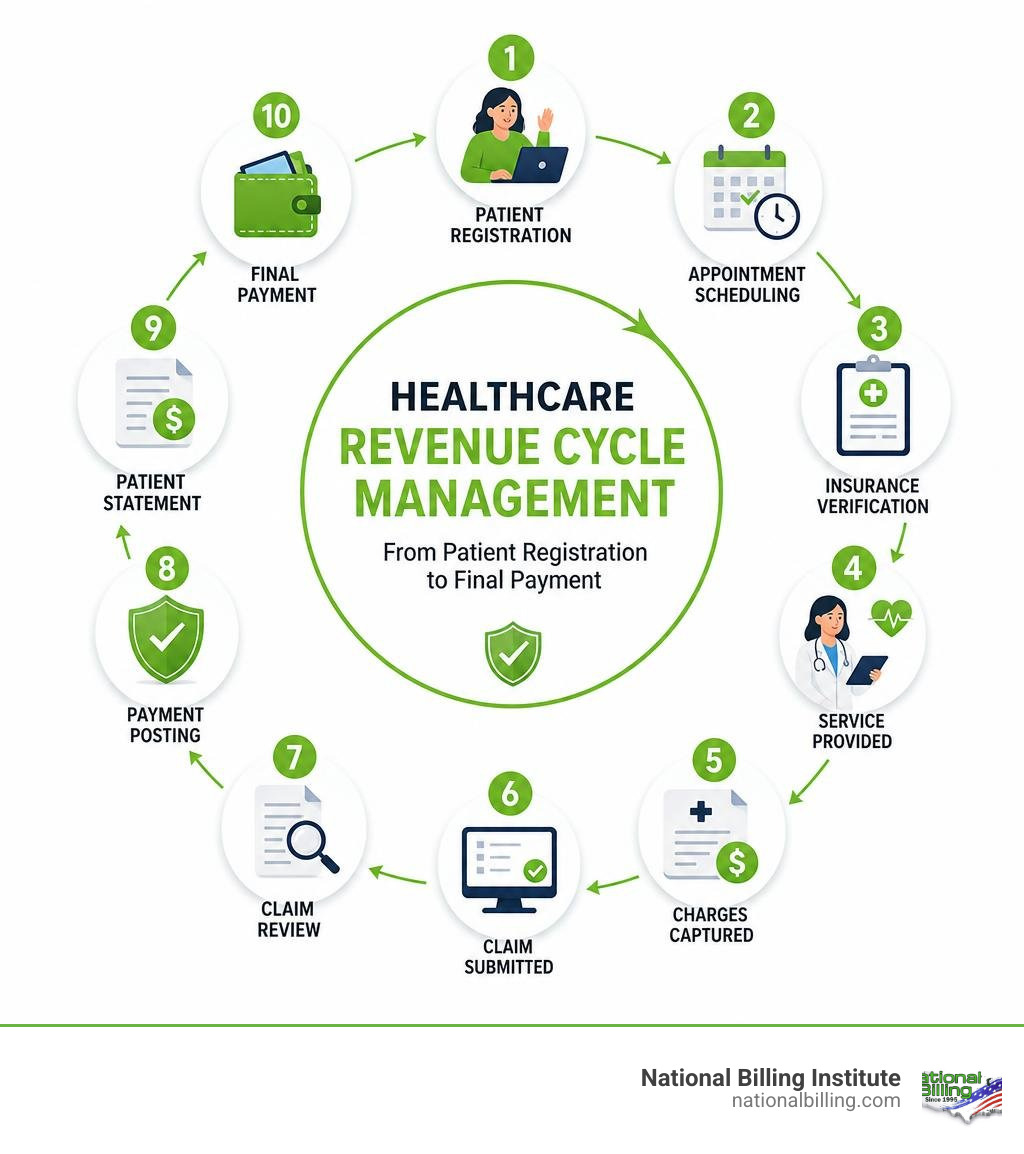
At its core, What Is Revenue Cycle Management (RCM)? is the financial process that healthcare facilities use to track patient care episodes from initial registration and appointment scheduling to the final payment of a balance.
Modern healthcare revenue cycle management systems act as the digital backbone of this process. They combine administrative and clinical data to ensure that providers are reimbursed accurately and promptly for their services. Instead of treating billing as an afterthought, these platforms integrate the entire lifecycle of a patient encounter into a single, cohesive workflow.
For many practices, managing this cycle internally becomes an overwhelming administrative burden. That is why smart providers often look to external Revenue Cycle Management Healthcare partners. By leveraging specialized software alongside certified billing experts, organizations can transition from reactive collections to proactive revenue optimization.
How EHR Integration Empowers Healthcare Revenue Cycle Management Systems
Historically, clinical records and financial records lived in separate silos. A doctor would write a clinical note in an Electronic Health Record (EHR) system, and a biller would manually translate those details into a billing platform. This disconnect was a breeding ground for transcription errors, missing charges, and delayed claims.
Today, tight interoperability between your EHR and your RCM platform is non-negotiable. When these systems are unified:
Data Integrity is Maintained: Demographic and insurance details entered at check-in flow directly into the billing module, eliminating duplicate data entry.
Clinical Documentation Improvement (CDI) is Automated: Modern systems utilize real-time clinical data to prompt providers for missing details before the patient leaves, ensuring the documentation supports the billed codes.
Real-Time Data Exchange: As soon as a clinical note is signed, the system can automatically suggest the correct ICD-10 and CPT codes, accelerating the transition from care to claim.
Optimizing these Revenue Cycle Operations ensures that clinical decisions and financial realities remain perfectly aligned, saving your staff hours of manual reconciliation.
The Financial Impact of Administrative Efficiency
Administrative inefficiencies do not just cause headaches; they actively drain your bottom line. Manual eligibility checks, paper-based statements, and slow denial follow-ups increase your cost-to-collect.
By automating repetitive front-office and back-office tasks, modern RCM platforms deliver immediate financial benefits:
Overhead Reduction: Staff members spend less time on hold with payers and more time on high-value patient care.
Accelerated Cash Flow: Electronically scrubbed claims are processed faster, dropping your average days in Accounts Receivable (A/R).
Higher Net Collection Rates: Standardized workflows prevent claims from falling through the cracks, ensuring you capture every dollar you are legally owed.
Key Stages of the Healthcare Revenue Cycle

To understand how to optimize your financial performance, it helps to visualize the revenue cycle as a journey. This journey is divided into front-end (patient-facing) and back-end (administrative) tasks.
Front-End RCM Tasks Back-End RCM Tasks Patient Scheduling & Registration Medical Coding & Charge Entry Insurance Verification & Eligibility Claim Scrubbing & Electronic Submission Prior Authorization Management Payment Posting & Reconciliation Upfront Copay & Deductible Collection Denial Management & Appeals Patient Financial Counseling Patient Statement Generation & Collections
Front-End RCM: Patient Access and Eligibility
The front end of the revenue cycle is where the vast majority of billing errors originate. If a patient's insurance ID is entered incorrectly, or if a required prior authorization is missed, the claim is doomed to fail before the provider even steps into the exam room.
To prevent these issues, modern systems emphasize:
Automated Eligibility Verification: Verifying insurance coverage in real time during scheduling. For instance, modern systems utilize AI-powered Automated Insurance Selection workflows that have driven significant reductions in insurance-related claim denials.
Prior Authorization Workflows: Flagging procedures that require payer approval beforehand, preventing costly write-offs.
Point-of-Service Collections: Calculating copays and deductibles upfront so your front-desk staff can collect patient balances before care is delivered.
Mid-and-Back-End RCM: Coding, Claims, and Collections
Once the clinical encounter is complete, the mid-and-back-end processes begin. This phase is all about translating clinical documentation into clean claims and securing final payments.
First, medical coders translate the clinical notes into standardized codes. Next, the system performs "claim scrubbing" — checking the claim against thousands of payer-specific rules to identify potential errors.
If the claim passes, it is sent electronically to the clearinghouse. Once paid, the reimbursement must be posted and reconciled against the contracted rates.
But what happens when a claim is denied? This is where professional Healthcare RCM Services become invaluable. Rather than letting denials sit unresolved, dedicated A/R recovery teams use automated alerts to appeal denied claims within days, protecting your hard-earned revenue.
For a deeper dive into how these workflows operate visually, check out this comprehensive video resource on Revenue Cycle Management.
Core Features of Modern RCM Platforms
If you are currently shopping for a new platform or looking to audit your existing setup, there are several core features you should expect from any modern vendor:
Comprehensive Claims Management: A built-in clearinghouse that connects directly to thousands of payers, enabling rapid electronic claim submission.
Proactive Denial Prevention: Intelligent rules engines that catch coding conflicts, outdated modifiers, and missing information before the claim is submitted.
Patient Pay Portals: Secure, mobile-friendly portals that allow patients to view statements, set up payment plans, and pay bills via credit card or digital wallets.
Contract Management: Tools that store your negotiated payer contracts and automatically flag underpayments or overpayments.
Compliance Tracking: Automatic updates that keep your billing practices aligned with evolving federal regulations, such as the No Surprises Act.
When you partner with National Billing, we handle these complex software integrations for you. Our full-service solutions leverage cutting-edge technology alongside our 100% USA-based team in Boca Raton, FL, to deliver the lowest denial rates in the industry and a 15–30% average revenue increase for our clients. You can explore our complete range of capabilities on our National Billing Services page.
The Role of AI and Automation in Modern Billing
Artificial intelligence is no longer a futuristic concept in medical billing; in 2026, it is an absolute necessity. The rise of Automated Revenue Cycle Management has transformed how practices handle high-volume administrative tasks.
Agentic AI systems can now autonomously review unstructured clinical notes, extract the correct diagnoses and procedures, and suggest highly accurate billing codes. For instance, advanced AI platforms report up to 95% accuracy in automated coding, which drastically reduces manual coding backlogs.
Furthermore, AI-driven predictive analytics can analyze historical payer behavior to predict which claims are most likely to be denied, allowing billing teams to correct issues pre-emptively. If a denial does occur, AI assistants can automatically draft customized appeal letters, pulling relevant clinical evidence directly from the patient’s chart with a single click.
Selecting the Right Healthcare Revenue Cycle Management Systems for Your Practice
There is no "one-size-fits-all" RCM platform. The system that works perfectly for a multi-state hospital network will likely overwhelm a single-provider physical therapy clinic. When evaluating your options, consider these key factors:
Practice Size & Volume: Enterprise systems are built to handle millions of claims annually but require significant administrative overhead. Independent practices are often better suited for streamlined cloud platforms.
Specialty Focus: Pediatricians, cardiologists, and mental health professionals all have highly specialized billing rules. Ensure your platform supports your specific clinical workflows and templates.
Technology Stack: Do you want a unified "all-in-one" platform (EHR + PM + RCM), or do you prefer a "best-of-breed" stand-alone billing engine that plugs into your existing EHR?
Pricing Models: Evaluate whether the vendor charges a flat monthly software fee, a transaction-based fee, or a percentage of your total collections.
Change Management: Upgrading your software requires extensive staff retraining. Be sure to model the workflow disruption and clarify the vendor's onboarding support before signing.
To help narrow down your search, review Becker's Hospital Review's list of 385+ revenue cycle management companies to know | 2026 or explore Gartner's latest rankings on the Best Revenue Cycle Management Software of 2026.
Frequently Asked Questions About RCM Software
How do RCM systems reduce claim denials?
Modern RCM platforms prevent denials by embedding automated "scrubbers" directly into the workflow. These tools check every claim against real-time payer rules, Medicare guidelines, and coding standards before submission.
Additionally, by integrating with clinical documentation, the software ensures that the coded diagnoses match the documented symptoms, proving medical necessity. If you find that software alone isn't keeping your denial rates below 2%, partnering with a professional RCM Billing Company can give you access to dedicated certified coders who manually audit and appeal complex claims.
What metrics measure RCM performance and ROI?
To measure the success of your RCM system, you should regularly track these Key Performance Indicators (KPIs):
Clean Claim Rate (First-Pass Acceptance): The percentage of claims accepted by the payer on the first submission. A healthy rate is 95% or higher.
Days in A/R (Accounts Receivable): The average number of days it takes to get paid. Aim for under 35 days.
Net Collection Rate: The percentage of legally collectable revenue you actually receive. This should be 96% to 98%.
Denial Rate: The percentage of claims denied by payers. Ideally, this should stay below 4%.
What are the main challenges of RCM implementation?
The most common hurdles include:
Integration Complexity: Connecting a new RCM system to legacy EMRs can lead to data sync errors or missing fields.
Staff Learning Curves: Resistance to new software workflows can temporarily slow down billing operations.
Data Migration: Moving years of historical A/R data from an old system to a new one without losing track of outstanding balances.
Conclusion
Maintaining a healthy cash flow in the modern healthcare landscape requires a delicate balance of advanced technology, regulatory compliance, and administrative efficiency. While choosing the right healthcare revenue cycle management systems is a step in the right direction, software alone cannot solve complex billing challenges. It takes experienced human oversight to navigate the nuances of payer contracts, appeal denials, and protect your bottom line.
At National Billing, we combine state-of-the-art AI automation with a highly experienced, 100% USA-based team of billing specialists. We handle the administrative burden so you can focus on what you do best: caring for your patients.
Ready to eliminate billing headaches and increase your practice's revenue by up to 30%? Let's talk. Contact our experts today on our National Billing Services page to schedule your free revenue cycle audit.
