The Definitive Guide to Achieving a 90 Percent Clean Claim Rate
Why Clean Claims Medical Billing Determines Whether You Get Paid
Clean claims in medical billing are the foundation of a healthy revenue cycle. Get them right, and you get paid fast. Get them wrong, and you're staring down denials, rework, and permanent revenue loss.
Here's what you need to know at a glance:
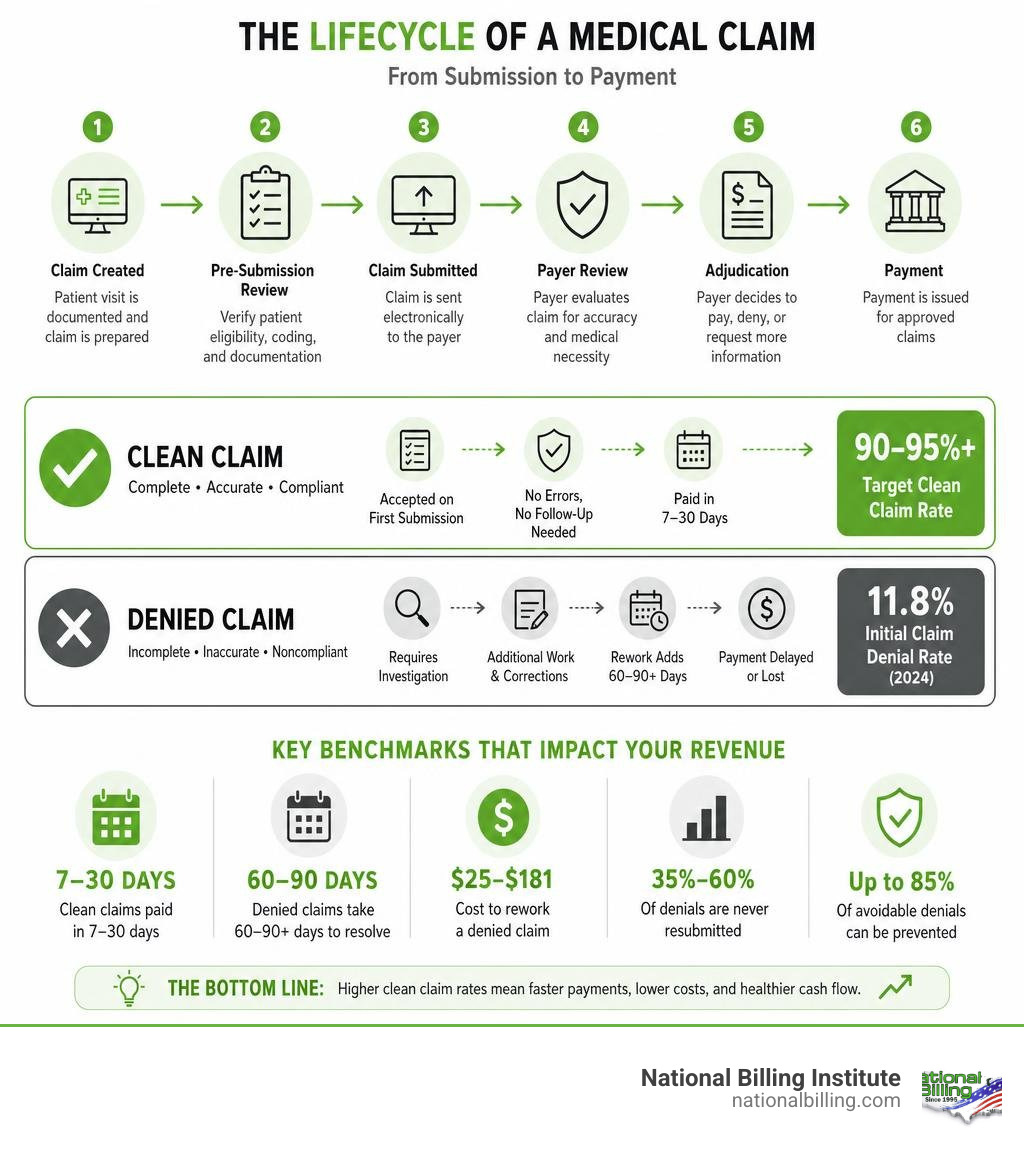
Question Quick Answer What is a clean claim? A complete, error-free claim a payer can process on first submission What's a good clean claim rate? 95% minimum; top performers hit 98%+ How fast are clean claims paid? 7–30 days vs. 60–90 days for denied claims What does a denial cost to rework? $25 to $181 in administrative labor What share of denials are never resubmitted? 35% to 60% — that's permanent revenue loss
The numbers are hard to ignore. The initial claim denial rate hit 11.8% in 2024, up from 10.2% just a few years prior. Nearly one in five claims is denied, and more than half of those are never resubmitted. For a two-physician practice reworking just 500 claims a year at $25 each, that's $12,500 in pure administrative waste — before you count the revenue that walks out the door entirely.
And the trend is moving in the wrong direction. Denial rates have risen more than 20% over the past five years, driven by mounting claim backlogs, staff turnover, and payers adding more rules with less transparency.
The good news? Most denials are preventable. Up to 85% of avoidable denials can be caught before submission with the right processes in place. That's what this guide is about.
I'm Olivia Harper, Founder and Denial Management & Reimbursement Specialist at National Billing Institute, with over 30 years of hands-on experience optimizing clean claims in medical billing for practices across the United States. In this guide, I'll walk you through exactly what clean claims require, why your rate matters more than you think, and the specific steps that move the needle.
What is Clean Claims Medical Billing?
To understand how to fix your revenue cycle, we must first establish what a clean claim actually is. In health insurance, a "clean claim" is not just billing jargon—it is a legal and operational standard.
A clean claim is a healthcare claim submitted to an insurance payer that is completely error-free, accurate, and contains all necessary data elements required for immediate processing. It requires no additional information, investigation, or manual intervention from the insurance carrier before they can make a payment decision. When you submit a clean claim, it enables "straight-through processing," moving from your billing system directly to the payer’s adjudication engine.

This clean status is highly regulated by both federal and state laws, often referred to as prompt payment laws. Under these statutes, insurance plans are legally required to process and pay clean claims within strict timeframes.
Commercial Plans: Most commercial payers must pay clean electronic claims within 30 days and paper claims within 45 days.
Medicare: Under CMS rules, Medicare must pay clean electronic claims within 14 calendar days of receipt, and paper claims within 29 days.
Medicaid: Federal guidelines require Medicaid programs to pay 90% of clean claims within 30 days of receipt.
State Regulations: Many states enforce even stricter prompt payment laws. For example, in Michigan, clean claims must be paid within 45 days, or the health plan faces a 12% simple interest penalty per annum, alongside potential civil fines.
If you want to dive deeper into the mechanics of everyday billing, you can check out our detailed guide with more info about medical billing. To understand how a clean claim is structured, we can look at the foundational guidelines outlined in What Is a Clean Claim in Health Insurance Billing?.
Required Data Elements for Clean Claims Medical Billing
For a claim to qualify as clean under CMS guidelines and commercial contract rules, it must contain specific, highly accurate data elements. Think of a medical claim like a digital passport; if a single digit or letter is out of place, the border control (the payer) will turn it away.
Every clean claim must include the following essential components:
Patient Demographics: The patient's full legal name (exactly as it appears on their insurance card), date of birth, gender, and current address.
Subscriber & Policy Information: The primary insured's details, the correct policy ID number, and the group plan number. If secondary insurance is involved, coordination of benefits (COB) details must be clear.
Provider Information: The billing provider's name, physical address, National Provider Identifier (NPI), and Tax Identification Number (TIN). If applicable, the rendering and referring providers' NPIs must also be present.
Valid Diagnosis Codes: Current ICD-10-CM codes mapped to the highest level of specificity. Outdated or inactive codes from prior fiscal years will immediately make a claim non-clean.
Procedure Codes: Accurate CPT or HCPCS codes representing the exact services rendered.
CPT Modifiers: Correct modifiers (such as -25 for significant, separately identifiable E/M services, or -50 for bilateral procedures) applied in accordance with National Correct Coding Initiative (NCCI) edits.
Place of Service (POS) Codes: The two-digit code identifying where the service was performed (e.g., 11 for office, 21 for inpatient hospital, or 02 for telehealth).
Inclusion of Prior Authorization Numbers: If the payer requires pre-authorization for a service, that specific authorization number must be documented on the claim.
Ensuring these elements are present and compliant is a matter of strict adherence to federal standards. You can read more about these requirements in the Clean Claim Definition & CMS Rules manual. To ensure your practice stays on the right side of federal regulations, take a look at our resource containing more info about billing compliance.
Clean Claims vs. Dirty, Rejected, and Denied Claims
It is common for billing teams to use terms like "dirty," "rejected," and "denied" interchangeably, but they represent vastly different stages of claim failure. Knowing the difference is crucial for troubleshooting where your revenue cycle is leaking cash.
Claim Status Definition Process Stage Can It Be Appealed? Impact on AR Days Clean Claim Complete, error-free, and meets all payer rules. Adjudicated and paid on first pass. N/A Lowest (usually 7–14 days) Dirty Claim Contains missing data, invalid codes, or formatting errors. Returned or rejected before adjudication. No (must be corrected and resubmitted) Moderate delay (15–30 days) Rejected Claim Stopped by the clearinghouse or payer's front-end edits. Never enters the payer's adjudication system. No (must be fixed and sent as a new claim) Moderate delay (15–30 days) Denied Claim Processed by the payer but determined to be unpaid. Reaches adjudication; determined unpaid due to policy or clinical rules. Yes (requires formal appeal or correction) High delay (60–90+ days)
When a claim is classified as dirty or rejected, it is because of a technical defect. The clearinghouse or the payer’s intake portal identifies a missing NPI, an invalid policy number, or a formatting error and spits it back out. Because it never entered the adjudication system, the timely filing clock does not stop. You must correct the error and resubmit the claim.
A denied claim, on the other hand, has been processed and adjudicated. The payer received the claim, read it, and made a conscious decision not to pay. This usually happens because of clinical decisions (such as lack of medical necessity), benefit limitations, or administrative rules (like missing a prior authorization). Reworking these claims requires diving into specific reason codes. For a comprehensive breakdown of these reason codes, review our guide with more info about medical billing denial codes.
Common Errors That Prevent Clean Claims Medical Billing
Why do claims fail to qualify as clean? In our 30+ years of experience at National Billing, we have found that the vast majority of billing failures stem from predictable, recurring errors.
Eligibility and Registration Failures: This is the single largest cause of claim rejections, accounting for roughly 24% of all denials. It occurs when a patient's insurance has expired, the policy ID is typed incorrectly, or the primary payer is misidentified.
Outdated or Inactive Codes: Medical code sets are dynamic. ICD-10-CM codes update every October, while CPT codes update every January. Submitting a claim with an inactive code makes it non-clean immediately.
Missing or Misused Modifiers: Omitting a required modifier, or using an incorrect one (like applying bilateral modifier -50 to a procedure that doesn’t support it), triggers an automatic rejection.
NCCI Edit Violations: Submitting codes that are bundled under the National Correct Coding Initiative without an appropriate modifier to separate them.
Unbundling and Upcoding: Attempting to bill separately for procedures that should be captured under a single comprehensive code, which payers flag as potential fraud.
Prior Authorization Gaps: Failing to secure or document a required prior authorization number before the patient receives care.
To build a proactive defense against these common billing pitfalls, check out our insights with more info about denial prevention.
The Financial Impact of Your Clean Claim Rate
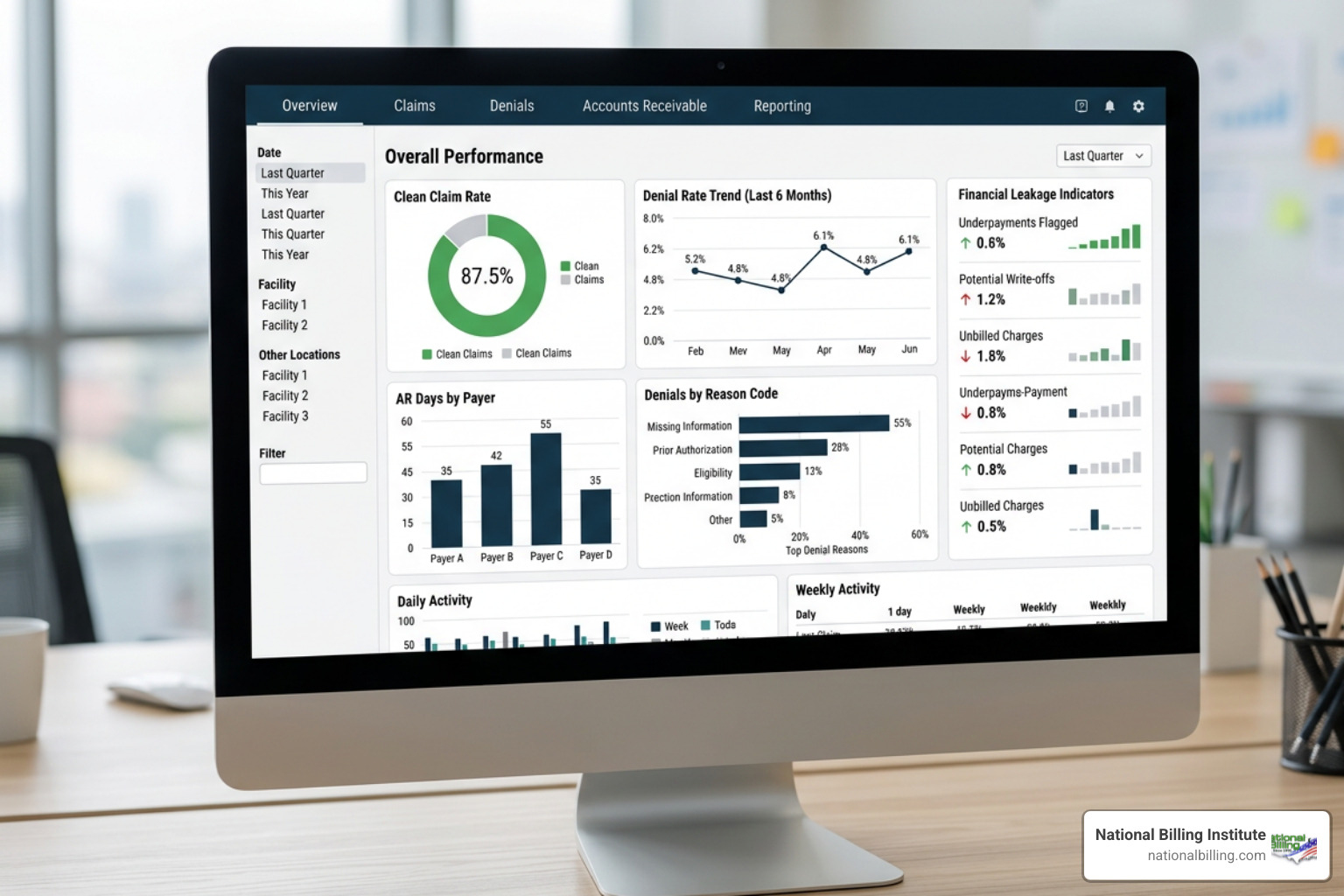
Your Clean Claim Rate (CCR)—often referred to as your first-pass clean claim rate—is the single most important leading indicator of your practice's financial health. When your clean claim rate drops, the negative financial impacts cascade throughout your entire business.
First, let's talk about rework expenses. The administrative cost to correct and resubmit a single denied claim is staggering. Industry benchmarks from the Medical Group Management Association (MGMA) show that reworking a single denied claim costs providers anywhere from $25 to $181 in administrative labor. In fact, the average administrative cost per denied claim rose from $43.84 in 2022 to $57.23 in 2023. If your team is constantly correcting simple typos or chasing down missing modifiers, you are actively burning your operational budget on administrative rework.
Second, a low clean claim rate leads to severe revenue leakage. Approximately 35% to 60% of denied claims are never resubmitted at all. This represents permanent revenue loss. Busy billing departments often lack the time or resources to appeal every denial, meaning millions of dollars in rendered care are simply written off every year.
Third, the cash flow bottleneck can paralyze your operations. Clean claims are typically paid within 7 to 14 days. When a claim is rejected or denied, that window stretches to 60, 90, or even 120 days. This drives up your Days in Accounts Receivable (AR) and leaves you without the liquid capital needed to run your practice.
To understand how to plug these financial leaks and stabilize your practice's cash flow, read our expert analysis with more info about revenue cycle management healthcare.
Industry Benchmarks and Revenue Cycle Performance
Where does your practice stand compared to the rest of the healthcare industry?
The Gold Standard (95% or higher): A healthy, high-performing billing operation maintains a first-pass clean claim rate of 95% or higher. The top-performing operations—including the clients we serve at National Billing—achieve 98% or higher.
The Danger Zone (Below 90%): Any clean claim rate below 90% indicates systemic upstream errors in patient registration, coding, or clinical documentation. If you are in this category, you are losing significant revenue to write-offs and administrative overhead.
It is also important to distinguish between your Clean Claim Rate (CCR) and your First Pass Yield (FPY). Your CCR measures the percentage of claims that pass through your pre-submission edits without requiring manual intervention. Your FPY, however, measures the percentage of claims that are actually paid upon first submission.
While CCR tells you how clean your data is before it leaves your office, FPY tells you how well your billing system aligns with actual payer rules. Tracking both metrics gives you a complete picture of your revenue cycle. For a deeper look at these metrics, check out our guide with more info about healthcare revenue cycle analytics.
Key Steps to Improve Your Clean Claim Rate and Reduce Denials
Achieving a clean claim rate above 95% requires a systematic approach. You cannot simply tell your billing team to "be more careful." You must design workflows that prevent errors from occurring in the first place.
The journey to clean claims starts at the front desk. Front-desk staff must be trained to treat data capture as a critical financial task, not just administrative paperwork.
Standardize Front-Desk Data Capture: Require front-desk staff to scan insurance cards (both front and back) and verify that the patient's name matches their government-issued ID.
Collect Payments Upfront: Train staff to communicate patient financial responsibility clearly and collect copays and outstanding balances at the time of service.
Conduct Ongoing Staff Education: Hold regular training sessions to keep both clinical and administrative staff updated on the latest billing compliance rules and insurance changes.
To discover how professional billing support can streamline these training processes, you can review more info about denial management billing services.
Optimizing Front-End and Back-End Workflows
To truly maximize your first-pass clean claim rate, you must bridge the gap between your front-end clinical workflows and your back-end billing processes.
Real-Time Eligibility (RTE) Verification: Implement automated real-time eligibility checks. This should happen twice: first when the appointment is scheduled, and second on the day of the encounter. RTE tools immediately flag inactive policies, coverage changes, or coordination of benefits issues.
Centralized Prior Authorization Tracking: Do not leave prior authorizations to chance. Create a centralized tracking system integrated with your scheduling software. If an appointment is booked for a procedure requiring authorization, the system should flag it and prevent check-in until the authorization number is secured.
Annual Coder Education: Ensure your coding team receives comprehensive, structured training every year before the October and January code set updates go live.
Denial Management Feedback Loops: When denials do occur, do not just fix them and move on. Perform a root cause analysis. Map your denials by payer, code, and department, and feed those insights back to your front-end staff to prevent the same mistakes from recurring.
For practical strategies on aligning your clinical and financial teams, read our guide with more info about healthcare revenue cycle workflow.
The Role of Payer Rules, Timely Filing, and Claim Scrubbing
One of the greatest challenges in medical billing is that there is no single standard for what makes a claim "clean." Every insurance company has its own proprietary set of rules, payment policies, and filing deadlines.
Medicare, Medicaid, and commercial payers all look at claims through different lenses. For example, Medicare strictly enforces rules under 42 CFR §424.44, allowing providers 12 months from the date of service to submit an initial claim. Commercial payers, however, are much less forgiving. Most commercial timely filing limits range from 90 to 180 days, and some managed care contracts require submission within 30 to 60 days. If you miss these windows, the claim is rejected as untimely, and you cannot bill the patient for the balance.
To navigate these complex deadlines, you can read our detailed breakdown with more info about untimely filing in medical billing.
This is where claim scrubbing software becomes invaluable. A claim scrubber is an automated tool that audits your claims against a vast library of federal, state, and payer-specific rules before they are transmitted. The scrubber flags missing modifiers, invalid codes, NCCI edit violations, and demographic mismatches. Implementing a payer-calibrated claim scrubbing tool can improve your first-pass acceptance rates by 8 to 12 percentage points, stopping errors before they ever reach the payer.
Frequently Asked Questions about Clean Claims
What is a good clean claim rate for a medical practice?
A healthy, standard clean claim rate for a medical practice is 95% or higher. This means that at least 95 out of every 100 claims you submit are processed and accepted on the first pass without rejections or requests for additional information. Top-performing billing operations, like those managed by National Billing, consistently achieve 98% or higher. Any rate below 90% requires immediate corrective action.
Can a clean claim still be denied by an insurer?
Yes. A clean claim meets all the technical, formatting, and administrative requirements for processing, but it is not a guarantee of payment. A payer can still deny a clean claim after adjudication for clinical reasons. Common examples include:
Medical Necessity: The payer determines that the documented procedure was not clinically necessary for the diagnosed condition.
Benefit Limits: The patient has exhausted their maximum allowed visits or benefits for that specific service.
Non-Covered Services: The specific procedure is excluded from the patient's insurance plan.
How does claim scrubbing software improve billing efficiency?
Claim scrubbing software acts as an automated quality control filter. It scans every field of a claim before submission, comparing the data against millions of payer-specific rules, NCCI edits, and coding guidelines. If it detects an error—such as a missing modifier, an inactive ICD-10 code, or an eligibility mismatch—it holds the claim and alerts your billing team. This automated validation prevents rejections, reduces manual labor, and significantly accelerates your reimbursement cycle. To learn more about selecting the right technology, see our guide with more info about claims processing software healthcare.
Conclusion
Achieving a clean claim rate above 95% is not an overnight task, but it is the single most effective way to secure your practice's financial future. By standardizing your front-desk workflows, keeping your coding knowledge current, and leveraging advanced claims processing technology, you can eliminate administrative waste and keep your cash flowing.
At National Billing Institute, we make clean claims simple. As a premier provider of full-service medical billing, AI-automated claims processing, and telemedicine support, our 100% USA-based team in Boca Raton, FL, brings over 30 years of experience to your revenue cycle. We are proud to maintain some of the lowest denial rates in the industry, delivering full HIPAA compliance and a 15% to 30% revenue increase for our clients.
Ready to stop working for free and secure the reimbursement you deserve? Get started with National Billing services today, and let us help you achieve the gold standard of billing efficiency.
