
How Outsourcing Can Save Your Revenue Cycle
Why Outsourcing Revenue Cycle Management Is Changing Healthcare Finance
Outsourcing revenue cycle management means hiring a specialized external company to handle some or all of your billing, coding, claims, and collections — so your team can focus on patient care instead of paperwork.
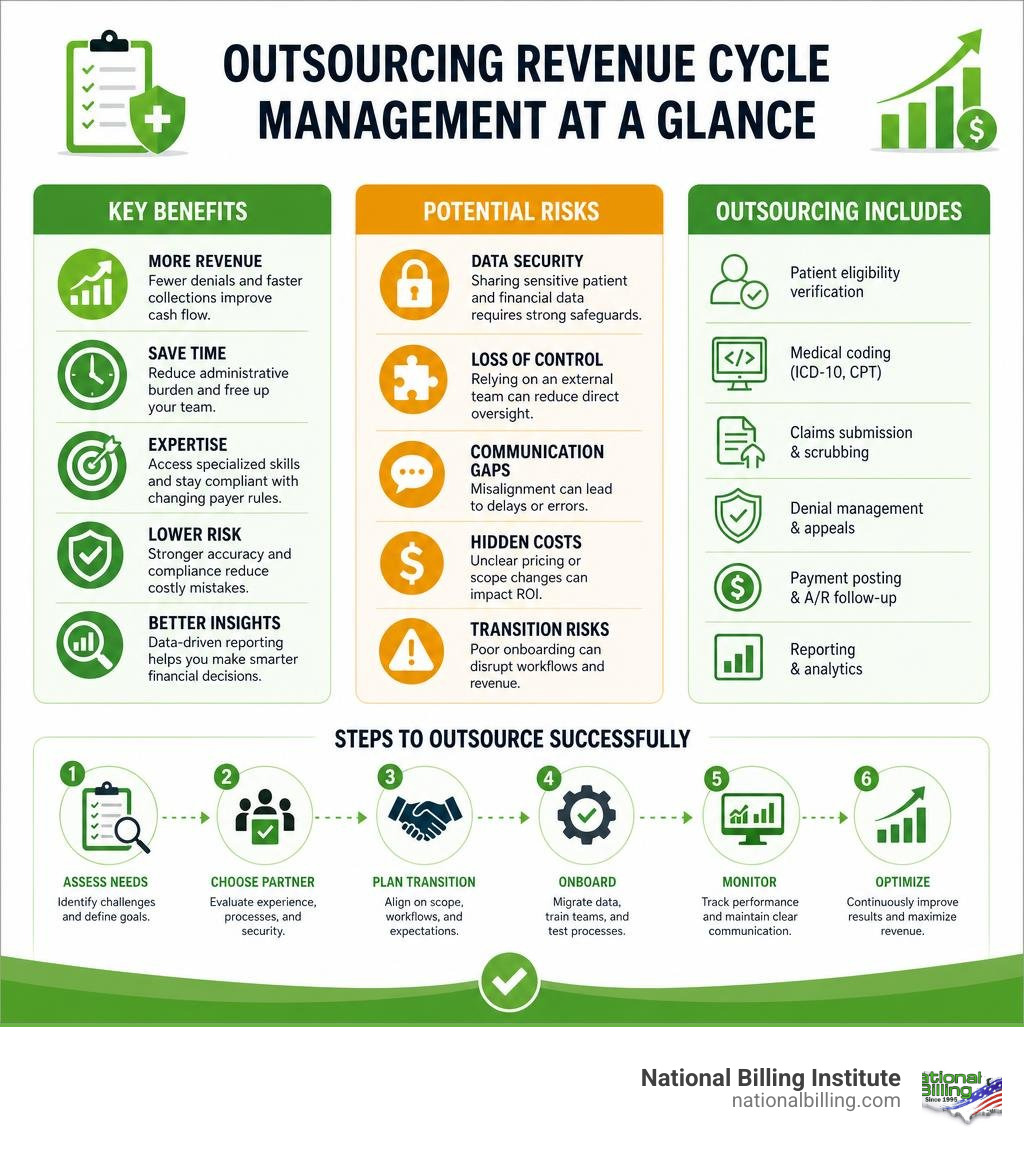
Here's a quick snapshot of what that includes:
What Gets Outsourced Why It Matters Patient eligibility verification Prevents front-end claim denials Medical coding (ICD-10, CPT) Ensures accurate reimbursement Claims submission & scrubbing Reduces rejections before they happen Denial management & appeals Recovers revenue that would otherwise be lost Payment posting & A/R follow-up Keeps cash flow moving Reporting & analytics Gives you visibility into financial performance
The financial pressure on U.S. healthcare providers has never been more intense. Rising operating costs, shrinking reimbursements, and an ever-growing pile of payer rules are stretching administrative teams thin. At the same time, claim denials are climbing — and payers are now using AI to automate those denials faster than most in-house teams can respond.
It's not just a billing problem. It's a revenue survival problem.
Running a successful revenue cycle requires coordinating at least 12 distinct workflows simultaneously — from scheduling and eligibility checks all the way through final payment reconciliation. Most practices struggle to do this well in-house, which is exactly why 36% of medical practice leaders say their organizations plan to outsource or automate part of their RCM (MGMA, 2024).
The stakes are real. One mid-Atlantic health system that outsourced its aged insurance claims collected $53.3 million against a $34.3 million goal — exceeding its cash target by 55% and achieving a 9:1 return on investment.
I'm Olivia Harper, Founder and Denial Management & Reimbursement Specialist of National Billing Institute, and I've spent over 30 years navigating every corner of revenue cycle management — including the critical question of when and how outsourcing actually works. In this guide, I'll walk you through exactly what to look for, what to avoid, and how to make outsourcing revenue cycle management work for your practice.
The Strategic Value of Outsourcing Revenue Cycle Management

To truly understand the strategic value of outsourcing revenue cycle management, we have to look past the surface-level administrative tasks. Many practices view billing as a simple back-office utility—a necessary chore. In reality, your revenue cycle is the financial heartbeat of your practice. When it stutters, your entire clinical operation feels the strain.
In the current landscape of July 2026, healthcare providers are facing a perfect storm. Operating costs are climbing, yet payers are tightening their purse strings, often deploying sophisticated AI algorithms designed to find any possible reason to deny a claim. If your billing team is still relying on manual, outdated workflows, you are essentially bringing a knife to a high-tech gunfight.
By shifting to a specialized partner, you transition from a defensive, reactive posture to an offensive, optimized strategy. This is where Revenue Cycle Management Healthcare becomes a powerful lever for growth. Instead of burning internal resources trying to keep up with thousands of constantly changing payer rules, you leverage a partner whose entire business model is built around staying ahead of those rules.
This strategic shift directly translates to improved financial performance. When claims are coded accurately, scrubbed thoroughly, and submitted promptly, your cash flow becomes predictable. You stop wondering if you will meet your budget next month and start planning how you will expand your services, upgrade your clinical technology, or hire more providers.
Core Functions in Outsourcing Revenue Cycle Management
A comprehensive approach to RCM cannot treat billing as an isolated event. It must address the entire lifecycle of a patient encounter. When we look at Healthcare RCM Services, we divide the revenue cycle into three core operational phases:
Front-End (Patient Access & Data Accuracy): This is where the foundation is laid. It includes patient scheduling, demographic registration, insurance eligibility verification, and prior authorizations. Front-end errors—like a misspelled name or an unverified policy—are the primary drivers of downstream claim denials. In fact, industry data shows that getting this phase right can eliminate up to 30% of eligibility-related denials before the patient even steps into the exam room.
Mid-Cycle (Clinical Integrity & Medical Coding): This phase is all about translating clinical care into standardized data. It encompasses Clinical Documentation Improvement (CDI), charge capture, and medical coding (using ICD-10, CPT, and HCPCS codes). Utilizing certified coders ensures that you are maximizing your yield while remaining fully compliant with federal guidelines.
Back-End (Claims, Collections & A/R Management): The final stretch involves claim scrubbing, electronic submission, payment posting, denial management, and accounts receivable (A/R) follow-up. This phase ensures that every submitted claim is tracked to its final resolution, rather than letting unpaid balances quietly age out and turn into write-offs.
The Role of AI and Automation in Modern RCM
In 2026, technology is no longer just an administrative aid—it is the engine driving modern RCM. The integration of Automated Revenue Cycle Management has completely redefined what is possible in terms of speed and accuracy.
At National Billing, we harness advanced workflow intelligence and predictive analytics to stay ahead of payers. Here is how modern technology transforms the process:
Predictive Denial Prevention: Instead of waiting for a rejection letter, AI engines analyze claims prior to submission. By comparing the claim against historical payer patterns, the system flags potential errors—such as missing modifiers or mismatched diagnosis codes—allowing our certified team to correct them instantly.
Agentic AI & Smart Workflows: Repetitive, high-volume tasks like checking claim statuses on payer portals can be entirely automated. This frees up human specialists to focus on complex, high-value appeals that require clinical judgment and negotiation.
Real-Time Eligibility Mapping: AI can interpret complex benefit data in seconds, providing visit-specific coverage details and calculating exact patient co-pays at the time of service, which dramatically improves point-of-service collections.
In-House vs. Outsourcing Revenue Cycle Management
Deciding whether to keep your billing in-house or transition to an outsourced model is one of the most critical decisions a healthcare executive will make. To make an objective choice, you must weigh several variables across cost, control, and scalability.
Evaluation Metric In-House RCM Outsourced RCM (National Billing) Direct Costs High (Salaries, benefits, payroll taxes, PTO) Variable (Often a percentage of collected revenue) Indirect Costs High (Software licenses, clearinghouse fees, hardware, office space) Included in the service fee Scalability Difficult (Requires hiring and training new staff to grow) Seamless (Instantly scales with your patient volume) Operational Control High physical control (but often low visibility due to fragmented reporting) High strategic control (supported by real-time KPI dashboards) Denial Rates Typically higher due to staff multitasking and lack of specialized tools Exceptionally low due to dedicated, certified experts Staff Turnover Risk Severe (Leaves the practice vulnerable to immediate cash flow interruptions) Zero (The partner manages all staffing redundancy)
While keeping operations in-house offers a sense of direct oversight, it often creates a "black box" effect. Without sophisticated reporting tools, executives are frequently left with static spreadsheets that show raw data but offer zero actionable insights. When you choose to Outsource Medical Billing, you gain access to enterprise-grade analytics that actually restore and enhance your executive visibility.
Human Capital and Staffing Challenges
The hidden crisis in healthcare administration today is the sheer difficulty of recruiting and retaining qualified billing personnel. The administrative labor market is highly competitive, and specialized billing talent is hard to come by.
Consider the real numbers behind staffing volatility in RCM Healthcare:
Replacing an entry-level revenue cycle specialist (0-5 years of experience) takes an average of 84 days (~3 months) and costs $2,167 in direct recruiting and onboarding expenses.
Replacing a senior revenue cycle specialist (10+ years of experience) takes a staggering 207 days (~7 months) and costs $5,699.
During those months of searching and training, who is managing your work queues? Who is fighting the timely filing limits on your denials? Typically, the answer is either "no one" or "a stressed-out clinical staff member who has been pulled away from patient care." This staffing gap directly causes claims to fall through the cracks, leading to a quiet collapse of your cash flow.
Key Benefits of Outsourcing RCM

When you partner with a dedicated RCM company, the advantages ripple across your entire organization—from your balance sheet to the patient exam room. By deploying Revenue Cycle Management Solutions, you establish a stable, high-performing financial foundation.
Improved Revenue Cycle Performance
The primary goal of any RCM optimization is simple: collect every dollar you have rightfully earned, as quickly as possible. When you transition to a highly specialized team, you see immediate, measurable improvements in your key performance indicators (KPIs).
Through deep Healthcare Revenue Cycle Analytics, we actively track and optimize the metrics that define your financial health:
First-Pass Clean Claim Rate: Industry benchmarks set by the Medical Group Management Association (MGMA) target a clean claim rate of 95% or higher. Many in-house teams struggle to maintain 80-85%. Our structured validation protocols routinely push first-pass acceptance rates past the 98% mark.
Days in Accounts Receivable (A/R): The Healthcare Financial Management Association (HFMA) benchmark for days in A/R is under 30 days. Specialized RCM teams typically achieve a 15% to 30% reduction in A/R days by prioritizing worklists based on the likelihood of collection rather than just the age of the account.
Net Collection Rate: This represents your true financial yield. By eliminating preventable billing errors and aggressively managing denials, practices frequently see a 15% to 30% increase in overall collections.
Reduced Administrative Burden and Costs
The true cost of an in-house billing department is far higher than most practice managers realize. Beyond basic salaries, you must account for employee benefits, payroll taxes, continuous training on ICD-10 updates, and the physical space required for administrative staff.
Furthermore, the technology infrastructure required to run a modern billing office is incredibly expensive. Software licenses for practice management systems, clearinghouse fees, automated patient statement services, and security compliance tools add up to thousands of dollars in fixed monthly overhead.
By utilizing Billing Outsourcing Services, you convert these heavy, unpredictable fixed costs into a single, predictable variable expense. This model aligns our incentives perfectly with yours: we only succeed when you succeed.
How to Choose the Right RCM Partner
Choosing an RCM partner is not a transaction; it is a long-term strategic marriage. The vendor you select will have direct access to your financial pipeline and your patient data. Therefore, your vetting process must be thorough, objective, and focused on finding a true extension of your practice.
When researching an RCM Billing Company, look beyond their marketing materials. You want to ask hard questions about their technology integration capabilities, their workflow transparency, and where their team is physically located.
We strongly believe that a 100% USA-based team is critical for maintaining quality and communication. When your billing team is in the same country—and the same time zones—as your practice and your payers, claims are resolved faster, and communication barriers disappear.
Evaluating Partners with Industry Benchmarks
A reputable partner should welcome the opportunity to be measured against industry standards. When evaluating potential Healthcare Revenue Cycle Companies, ask them how their current client portfolio performs against key HFMA and MGMA benchmarks.
Specifically, look for a partner that commits to:
A target denial rate of under 5%.
A clean claim rate of 95% or higher.
Average days in A/R of under 30 days.
Additionally, check third-party validation sources. Organizations like KLAS Research and Black Book Research publish annual rankings based on unbiased client feedback. Working with a team that aligns its delivery framework with these rigorous standards ensures that you are not just getting operational support, but a high-performing financial engine.
Establishing Effective Vendor Partnerships
A successful partnership requires clear guardrails from day one. To prevent the relationship from becoming a transactional "black box," you must establish structured Revenue Cycle Operations protocols.
Define the Playbook: Before any account-level work begins, collaborate with your partner to document exact procedures, payer-specific guidelines, and write-off thresholds in a dynamic, shared playbook.
Establish Clear KPIs and SLAs: Agree on written Service Level Agreements (SLAs) regarding claim submission turnaround times (ideally 24-48 hours) and denial appeal timelines.
Ensure Real-Time Visibility: Never accept static monthly spreadsheets as your only window into performance. Ensure your partner provides real-time access to performance dashboards so you can monitor your A/R inventory, cash collections, and denial trends at any moment.
Best Practices for a Successful Transition
Transitioning from an in-house billing model to an outsourced partner can feel daunting. The primary fear for most healthcare executives is a sudden disruption to their cash flow during the onboarding phase. However, by following a structured, phased implementation framework, you can achieve a seamless handover with zero revenue disruption.
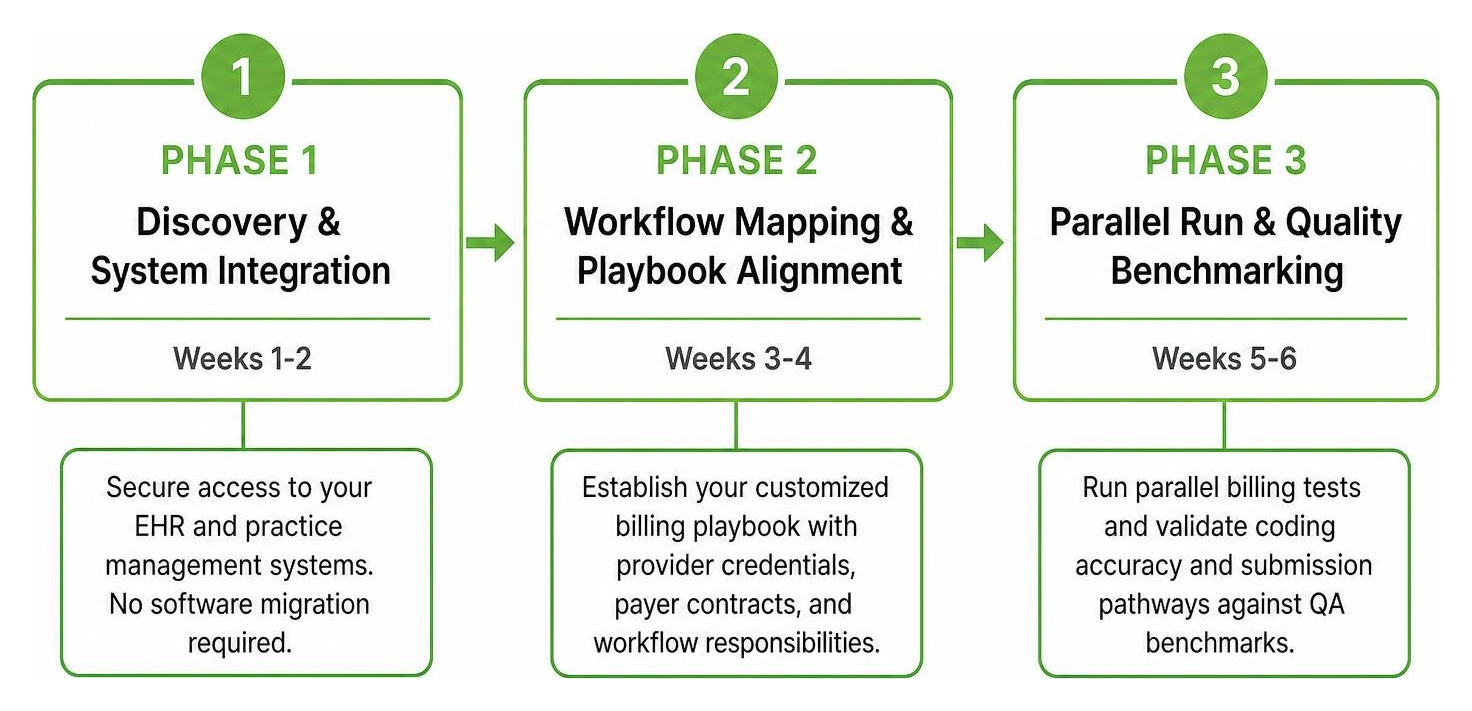
A successful Healthcare Revenue Cycle Workflow transition relies on a clear, step-by-step sequence:
Phase 1: Discovery & System Integration (Weeks 1-2): Your partner secures remote, secure access to your existing EHR and practice management systems. There should be no need to migrate your software; the billing team should integrate directly into your current platform to maintain continuity.
Phase 2: Workflow Mapping & Playbook Alignment (Weeks 3-4): Establish your customized billing playbook, outlining specific provider credentials, payer contracts, and workflow responsibilities.
Phase 3: Parallel Run & Quality Benchmarking (Weeks 5-6): The onboarding team runs parallel billing tests, validating coding accuracy and submission pathways against a QA benchmark to ensure 100% accuracy before going live.
Phase 4: Full Go-Live & Legacy A/R Run-Down (Month 2 and beyond): The partner takes over all new billing claims. Concurrently, a dedicated team can manage the legacy accounts receivable run-down, clean up old unpaid claims, and inject immediate cash back into your practice.
Mitigating Risks When Outsourcing Revenue Cycle Management
The primary risks associated with RCM outsourcing—such as loss of control and data security concerns—are highly manageable if you choose the right partner.
To safeguard your clinical and financial data within your Healthcare Revenue Management infrastructure, ensure your partner strictly adheres to these security protocols:
100% HIPAA Compliance: Verify that all data handling practices, secure remote access portals, and encrypted transmission protocols are fully compliant with federal regulations.
SOC 2 Type II Certification: This independent audit confirms that the company maintains the highest standards of data security, confidentiality, and processing integrity.
Role-Based Access Controls: Ensure that billing specialists are only granted access to the specific patient records and financial data required to perform their specific tasks.
Frequently Asked Questions about RCM Outsourcing
What is the difference between end-to-end RCM and point solutions?
An end-to-end RCM solution manages the entire lifecycle of the claim, from initial patient registration and eligibility verification through coding, billing, denial management, and final payment posting. This comprehensive model eliminates operational gaps and ensures a single point of accountability.
In contrast, point solutions are niche services that only handle one specific task—such as prior authorization or clinical coding. While point solutions can be useful for addressing a temporary bottleneck, managing multiple disparate vendors often creates fragmented reporting and leaves money on the table.
How does outsourcing RCM impact the patient experience?
A professional RCM partner actually enhances the patient experience by bringing clarity and transparency to the financial side of healthcare. By verifying eligibility and securing prior authorizations on the front end, we prevent patients from receiving unexpected bills weeks after their treatment.
Furthermore, a dedicated patient collections team handles billing inquiries with empathy, professionalism, and clear communication, protecting your practice's reputation in the community.
What are the typical pricing models for RCM outsourcing?
RCM pricing models are designed to be flexible and aligned with your practice's success:
Percentage-Based Fees: The most common model, where the partner charges a small percentage (typically ranging between 5% and 10%) of the total revenue successfully collected. This model ensures that the partner is highly motivated to maximize your collections.
Flat Rate or Per-Claim Fees: A fixed fee charged per submitted claim or per patient encounter, which can be highly predictable for high-volume, standardized practices.
Hybrid Models: A combination of a low base administrative fee paired with a performance-based contingency fee tied to specific recovery goals.
Conclusion
Your revenue cycle is too important to be treated as an administrative afterthought. In an era of rising costs, complex payer rules, and staffing shortages, trying to manage every step of the billing process in-house can quietly drain your practice of its hard-earned revenue.
At National Billing, we help healthcare providers take back control of their financial health. Based in Boca Raton, FL, our 100% USA-based team brings over 30 years of specialized experience to your practice. By combining advanced workflow technology with dedicated, certified billing experts, we consistently deliver the industry's lowest denial rates and help our clients achieve a 15% to 30% increase in revenue.
Let us handle the complexities of the revenue cycle so you can focus on what you do best: delivering exceptional care to your patients.
If you are ready to eliminate revenue leaks, accelerate your cash flow, and build a more resilient practice, explore our full suite of Services or reach out to our team today for a free, comprehensive revenue cycle audit.
