
Why Healthcare Revenue Management is the Backbone of Your Practice
Why Healthcare Revenue Management is the Backbone of Every Medical Practice
Healthcare revenue management is the end-to-end process your practice uses to get paid accurately and on time — from the moment a patient books an appointment to the final dollar collected.
Here's a quick snapshot of what it covers and why it matters:
What It Is What It Does Why It Matters Patient registration & insurance verification Confirms coverage before care is delivered Prevents denials before they start Medical coding & charge capture Translates services into billable codes Ensures nothing goes unbilled Claims submission & denial management Sends clean claims and fights rejections Protects cash flow Payment posting & patient collections Reconciles payments and collects balances Closes the revenue loop Process review & KPI monitoring Tracks performance metrics monthly Identifies leaks before they grow
The financial pressure on U.S. practices has never been greater. Medicare reimbursements have dropped 29% in inflation-adjusted dollars since 2001. Claim denials now cost hospitals roughly $262 billion every year. And providers are quietly losing 2%–5% of net patient revenue simply because their revenue cycle isn't running the way it should.
Meanwhile, around 63% of physicians report experiencing burnout — and a major driver is the crushing weight of billing complexity and administrative overload.
Simply working hard is no longer enough. Getting paid fully and on time for every service you deliver is just as critical as the care itself.
I'm Olivia Harper, Founder and Denial Management & Reimbursement Specialist at National Billing Institute, and I've spent over 30 years in the trenches of healthcare revenue management helping practices across the country stop the bleeding and start collecting what they've earned. In this guide, I'll walk you through exactly how the revenue cycle works, where most practices leak money, and what you can do about it.
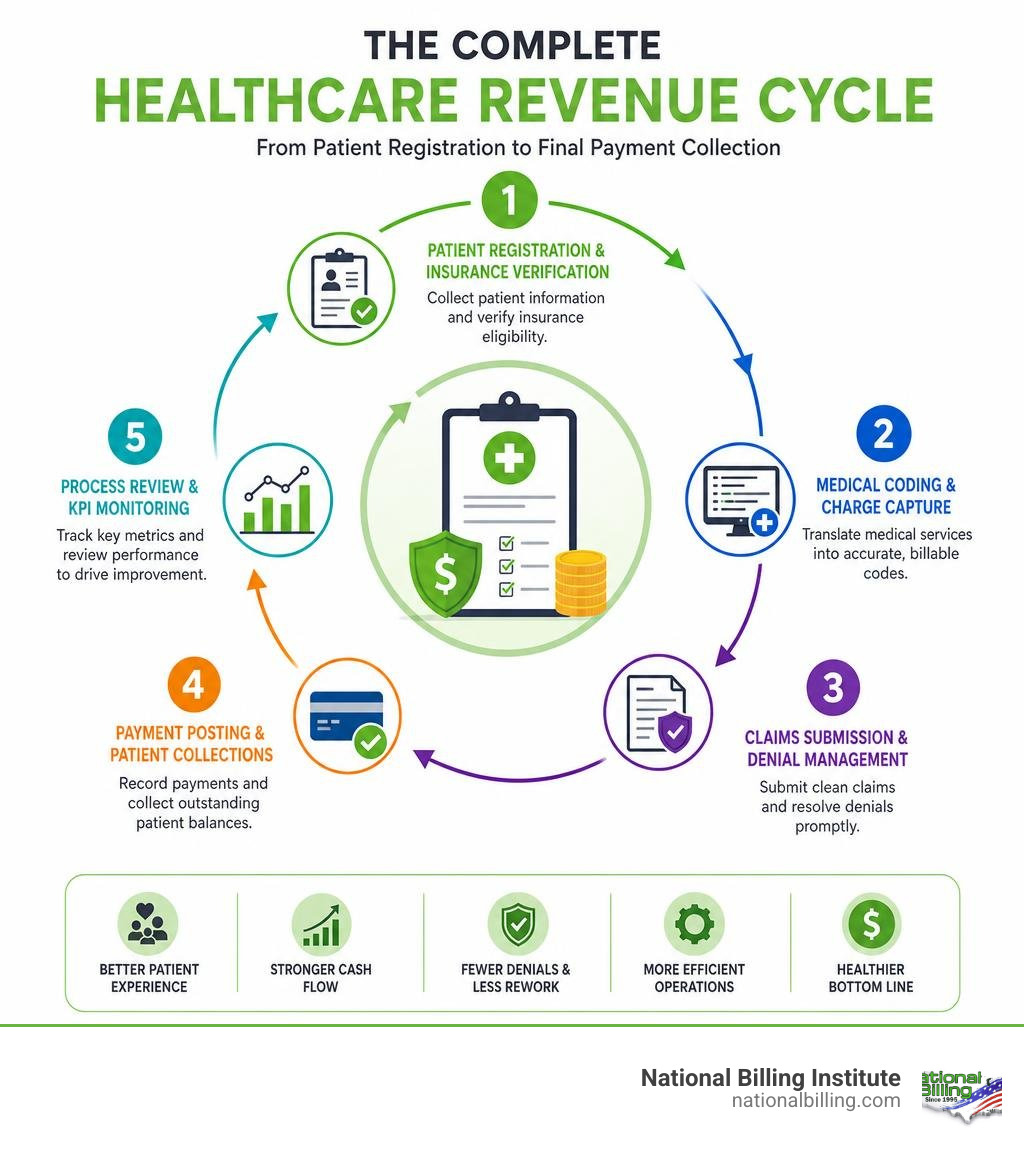
What is Healthcare Revenue Management and Why Does It Matter?
At its core, healthcare revenue management (commonly referred to as Revenue Cycle Management or RCM) is the operational engine that translates clinical care into financial viability. Without a structured, highly efficient system to manage this cycle, even the most clinically successful practices will struggle to survive.
In today's complex landscape, RCM is not just a back-office administrative task; it directly impacts your cash flow, your staff's daily workload, and the overall patient experience. When billing workflows are clunky or fragmented, patients suffer from confusing statements, unexpected out-of-pocket costs, and delayed care. Conversely, a smooth billing process builds trust and ensures your patients can focus on healing rather than financial stress.
According to the AAPC's guide to revenue cycle management, RCM encompasses everything from the initial patient registration to the final balance resolution. For many independent clinics and health systems, failing to optimize this cycle results in a perpetual leak: providers routinely fail to collect 2%–5% of their net patient revenue due to administrative inefficiencies, unworked denials, and coding errors.
By prioritizing Revenue Cycle Management Healthcare strategies, we help practices shift from a reactive state—where they are constantly chasing unpaid claims—to a proactive state that secures revenue before care is even delivered.
The 8 Essential Phases of the Revenue Cycle
To master your financial outcomes, we must break down the revenue cycle into its chronological phases. Every step is interconnected; an error in phase one will inevitably trigger a denial in phase five.
We can categorize these activities into three main operational buckets: Front-End (patient-facing), Mid-Cycle (clinical and coding), and Back-End (billing and collections).
Here is how these 8 essential phases unfold:
Patient Registration: The cycle begins the moment a patient schedules an appointment. Collecting accurate demographic information, contact details, and current insurance data is the foundation of a clean claim.
Insurance Verification: We must verify eligibility and benefits before every single visit. This includes confirming active coverage, copay responsibilities, deductibles, and whether a prior authorization is required for the scheduled services.
Charge Capture: This phase records the clinical services rendered during the patient encounter, translating medical documentation into billable transaction records.
Medical Coding: Certified medical coders translate clinical documentation into standardized ICD-10-CM, CPT, and HCPCS Level II codes. High-quality coding is crucial to prevent compliance issues and underpayments.
Claim Submission: Once coded, the claim is scrubbed for errors and electronically submitted to the commercial or government payer.
Remittance Processing: When the payer processes the claim, they send an Electronic Remittance Advice (ERA) or Explanation of Benefits (EOB). We post these payments and adjust accounts receivable balances accordingly.
Patient Collections: Any remaining balance—such as deductibles, co-insurance, or non-covered services—is billed to the patient. Offering clear statements and digital payment options is key here.
Process Review: The final phase involves continuous auditing, analyzing denial patterns, and reviewing key financial metrics to plug leaks and optimize future cycles.
To visualize how these responsibilities are divided across your clinical and administrative teams, review our comparison of Revenue Cycle Operations below:
RCM Phase Primary Focus Key Activities Common Pitfalls Front-End Patient Intake & Access Registration, insurance verification, pre-authorization, copay collection Misspelled names, outdated insurance cards, missing authorizations Mid-Cycle Clinical Documentation & Coding Charge capture, clinical documentation integrity (CDI), ICD-10/CPT coding Under-coding, missed charges, lack of specificity in physician notes Back-End Claims, Billing & Analytics Claim submission, denial management, remittance posting, patient collections Ignoring timely filing limits, failing to appeal denials, confusing patient bills
Strategies to Overcome Fragmented Workflows and Payer Complexity
One of the most persistent hurdles in clinical practice is the presence of siloed workflows. Too often, the front-desk staff, clinical providers, and billing department operate in isolation.
For instance, a physician might see a patient on a holiday weekend and miss out on capturing appropriate holiday care codes simply because there is no direct communication channel with the billing team. In other cases, a clinic might lose thousands of dollars on specialty medications because the front desk was not notified of an insurance coverage change.
To break down these walls, we recommend implementing cross-department education sessions. When your front-desk team understands why a misspelled name or missing digit in an insurance ID leads to a claim denial weeks later, they perform their duties with greater precision.
Similarly, investing in Clinical Documentation Improvement (CDI) programs helps clinicians document care with the level of specificity required by modern payers. In fact, comprehensive industry data highlights that integrating real-time clinical documentation reviews and robust payer rules engines can identify an average of $1.1 million in unbilled revenue per client, per year.
By establishing a unified workflow, you transform your billing from a series of isolated tasks into a cohesive strategy for Healthcare Revenue Cycle Management.

Overcoming Common Barriers in Healthcare Revenue Management
Practices frequently struggle with limited resources, administrative burdens, and rapidly evolving payer rules. Commercial insurers frequently adjust their coverage policies, medical necessity criteria, and prior authorization requirements. For a busy clinic, keeping up with these changes manually is nearly impossible.
To protect your bottom line, you need dedicated Revenue Cycle Management Solutions that act as an early warning system. By shifting from a reactive denial-management model to a proactive prevention model, you can stop denials before they occur.
For example, implementing automated pre-service eligibility checks and demographic validation tools significantly reduces the administrative burden on your front-office staff, allowing them to focus on patient care rather than paperwork.
Mastering Evolving Payer Rules Through Collaborative Learning
Staying ahead of shifting payer regulations requires a commitment to continuous education and structured feedback loops. It is not enough to simply hand your team a list of new coding guidelines once a year.
We recommend establishing a bi-weekly or monthly feedback loop where your billing team shares de-identified denial data with clinical and administrative staff. If a specific payer begins denying a common procedure due to a new documentation requirement, the clinical team needs to know immediately so they can adjust their charting patterns.
Leveraging resources such as HFMA's revenue cycle best practices or participating in collaborative learning networks can help your team master these complex landscapes. When everyone from the receptionist to the senior partner understands the financial "why" behind administrative tasks, compliance becomes a shared victory.
Enhancing Patient Financial Literacy and Building Trust
Patient collections have become an increasingly vital component of the revenue cycle. With the rise of high-deductible health plans (HDHPs), patients are now responsible for a larger portion of their medical bills than ever before.
Unfortunately, low patient financial health literacy is a massive barrier to timely collections. Many patients do not understand terms like "deductible," "co-insurance," or "out-of-pocket maximum," leading to confusion and distress when they receive a bill.

This issue is especially prominent among younger generations. Over half of Gen Z and Millennial patients report being more stressed about the cost of their medical bills than the actual quality of care they receive.
To build trust and improve collection rates, practices must practice transparent engagement:
Provide Upfront Estimates: Deliver accurate, easy-to-understand out-of-pocket estimates 2 to 3 weeks prior to scheduled procedures.
Proactive Outreach: Ask patients one week prior to their appointment if their insurance coverage has changed.
Modern Payment Portals: Implement updated, mobile-friendly digital payment systems that allow patients to view statements, set up payment plans, and pay bills with a single click.
When you demystify the billing process, you reduce patient anxiety, decrease the time it takes to collect outstanding balances, and strengthen the patient-provider relationship.
Key Performance Indicators (KPIs) and Best Practices for RCM Success
You cannot manage what you do not measure. To evaluate the health of your revenue cycle, your practice must regularly track specific Key Performance Indicators (KPIs).
Ignoring these metrics is financially dangerous—akin to ignoring a patient's vital signs during an operation.
To maintain a healthy cash flow, we recommend aligning your practice with these industry-standard benchmarks:
Days in Accounts Receivable (AR): This measures the average number of days it takes to collect payments due. The industry benchmark is 30 days or less.
Clean Claim Rate: The percentage of claims that pass all edits and are accepted by the payer on the first submission without manual intervention. The industry-leading benchmark is 95% or more.
Net Collection Rate: This reflects your practice's billing efficiency by showing the percentage of collectable revenue actually received. The benchmark is more than 95%.
AR > 90 Days: This tracks the percentage of your outstanding claims that have been unpaid for more than three months. To maintain healthy cash flow, less than 15% of your total claims should fall into this category.
Failing to meet these benchmarks can be incredibly costly. With claim denials costing the healthcare industry a staggering $262 billion annually, and average first-pass denial rates hovering between 5% and 10%, timely claims submission and immediate denial resolution are paramount.
By leveraging advanced Healthcare Revenue Cycle Analytics, you can identify exactly where your claims are getting stuck. Partnering with an experienced RCM Billing Company ensures that your denials are worked within 48 hours, keeping your AR days low and your collection rates high.
Technology and Innovation in Medical Billing
The days of manual medical billing are rapidly coming to an end. Traditional RCM systems that rely solely on human oversight are prone to data-entry errors, missed deadlines, and delayed appeals.
Today, technology is transforming the billing landscape, enabling practices to achieve unprecedented levels of accuracy and efficiency.
Innovative tools like agentic AI, automated coding, and real-time eligibility insights are changing the game. By utilizing an Automated Revenue Cycle Management platform, practices can automate repetitive tasks such as extracting insurance information from uploaded cards using AI-driven optical character recognition (OCR).
Furthermore, Automated Revenue Management software can cross-reference clinical progress notes with thousands of constantly changing medical codes to recommend highly precise billing codes. This level of automation helps practices achieve an industry-leading clean claim submission rate of 98.4%, drastically reducing the need for manual corrections and accelerating reimbursement.
Leveraging AI and Automation in Healthcare Revenue Management
Implementing machine learning and predictive analytics allows practices to anticipate denial patterns before claims are even sent to the payer. By scoring claims for denial risk prior to submission, your team can address potential issues proactively rather than waiting weeks for a rejection.
This shift to automation does not replace the need for skilled billing professionals; rather, it elevates their role. Instead of spending hours on manual data entry, your staff can focus on high-value tasks like resolving complex underpayments and managing payer contract negotiations.
For those looking to grow their careers in this exciting field, checking out healthcare revenue cycle jobs in Florida reveals a booming market for tech-savvy RCM professionals.
Whether you manage billing in-house or partner with top-tier Healthcare Revenue Cycle Companies, integrating AI into your workflow is the ultimate way to reduce administrative burden and secure your practice's financial future.
Frequently Asked Questions about Healthcare Revenue Management
What is the difference between medical billing and revenue cycle management?
While medical billing is a specific, back-end function focused on submitting claims and collecting payments, Revenue Cycle Management (RCM) is the entire, end-to-end umbrella process. RCM includes everything from front-end tasks (like patient registration and eligibility verification) to mid-cycle clinical documentation, all the way to back-end billing, appeals, and financial analytics.
How does inefficient RCM contribute to physician burnout?
When RCM workflows are fragmented, physicians are forced to spend hours dealing with administrative tasks, correcting coding errors, and responding to prior authorization demands. This administrative overload takes time away from patient care, leading to long hours, frustration, and contributing to the current 63% physician burnout rate.
What is a good clean claim rate benchmark for a medical practice?
The industry standard for a healthy medical practice is a clean claim rate of 95% or more. However, by leveraging advanced automation, AI-driven scrubbing tools, and expert oversight, high-performing practices can achieve an industry-leading clean claim rate of 98.4%.
Conclusion: Securing Your Practice’s Financial Future
Effective healthcare revenue management is the foundation upon which practice sustainability and quality of care are built. When your revenue cycle runs smoothly, your cash flow is protected, your administrative burden is minimized, and your clinical team can dedicate their full energy to delivering exceptional patient care.
At National Billing Institute, we believe you shouldn't have to choose between financial health and patient outcomes. As a premier provider of full-service medical billing, AI-automated claims processing, and telemedicine solutions, we help practices nationwide reclaim what they've earned.
Our 100% USA-based team in Boca Raton, FL, brings over 30 years of industry experience to the table, delivering the lowest denial rates in the industry, full HIPAA compliance, and a proven 15% to 30% increase in revenue for our clients.
Ready to stop the leaks and optimize your practice's financial performance? Visit our National Billing Services page today to schedule a comprehensive revenue cycle audit and see how we can transform your billing outcomes.
