 **RCM healthcare** — or Revenue Cycle Management in healthcare — is the financial process that keeps medical practices running. It covers everything from scheduling a patient's first appointment to collecting the final payment for services rendered. If you're a healthcare provider looking for staffing solutions that actually work, here's what you need to know upfront: **What is RCM in healthcare?** | Element | What It Means for You | |---|---| | Revenue Cycle Management | The end-to-end process of capturing, managing, and collecting patient service revenue | | Staffing impact | The right RCM staff directly reduces claim denials and revenue leakage | | Key challenge | The average claim denial rate hit **12% in 2023**, up from 10% in 2020 | | Financial reality | Only **38% of physicians** believe their organization is on solid financial footing | | Market size | The global RCM market is projected to exceed **$658 billion by 2030** | The stakes are high. Administrative burden, offshore billing risks, HIPAA exposure, and rising denials are squeezing practices from every direction. Getting your revenue cycle staffed and managed correctly isn't optional — it's survival. I'm **Olivia Harper**, Founder and Denial Management & Reimbursement Specialist at National Billing Institute, with over 30 years of hands-on experience in **RCM healthcare** operations from our fully US-based team in Boca Raton, Florida. I've seen how the right staffing and billing strategy can lift collections by 15–30% — and how the wrong approach quietly drains revenue year after year. 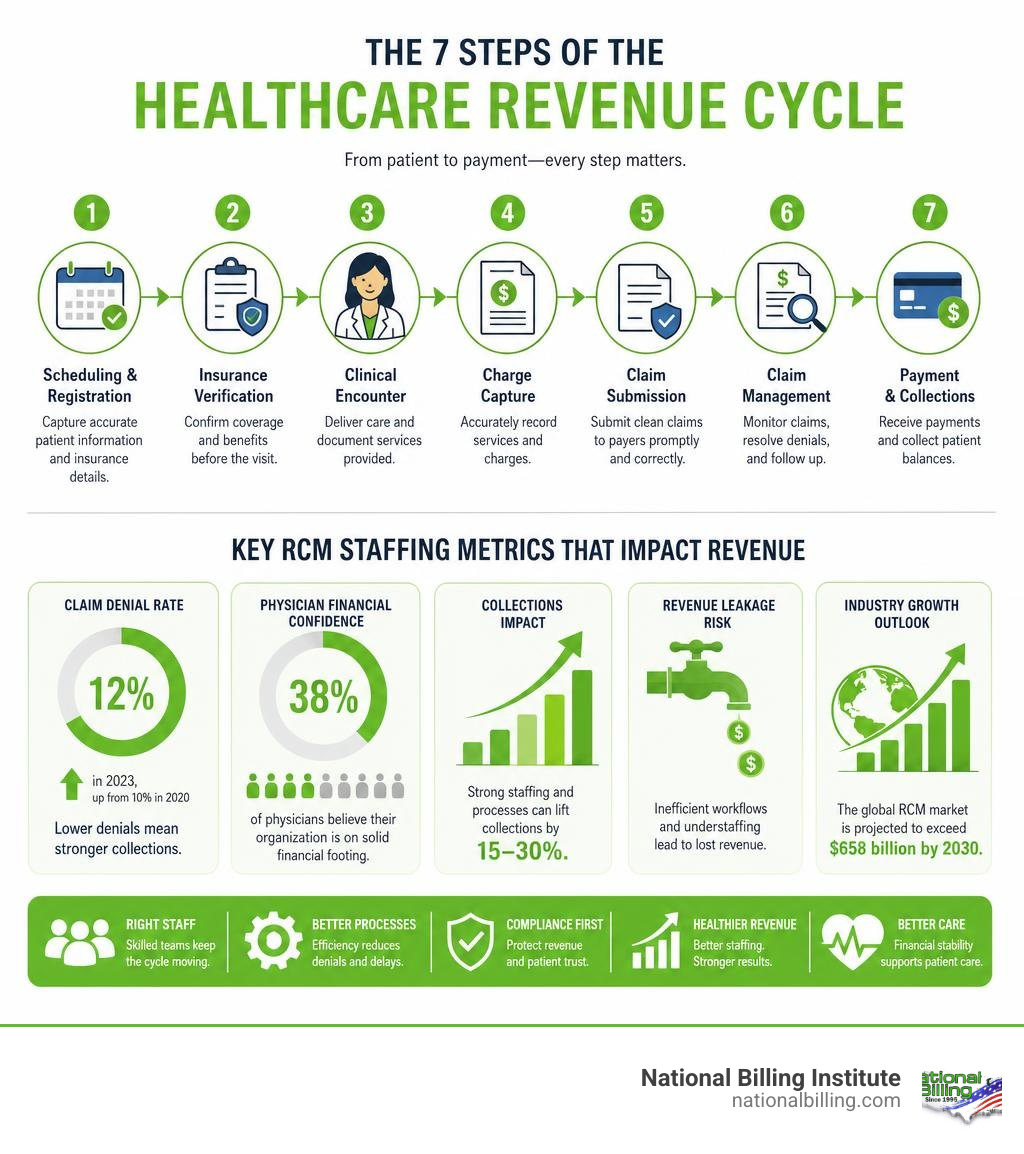 ## Understanding RCM Healthcare and Its Financial Importance At its core, **rcm healthcare** represents the operational backbone of any medical practice or hospital system. To understand its true value, we must look at how the industry defines it. According to the [What Is Revenue Cycle Management (RCM)? - AAPC ](https://www.aapc.com/resources/what-is-revenue-cycle-management), RCM is the absolute lifecycle of a patient account, starting before clinical care is delivered and extending long after the patient goes home. In the modern landscape of June 2026, managing this cycle effectively has become incredibly complex. The financial performance of a healthcare organization is no longer just about seeing more patients; it is about capturing every single dollar of earned revenue. A poorly managed [Revenue Cycle Management Healthcare](https://nationalbilling.com/post/revenue-cycle-management-healthcare) strategy leads to "revenue leakage"—money that is rightfully yours but is lost to coding errors, missed filing deadlines, or unappealed denials. Beyond the balance sheet, RCM directly influences patient satisfaction. When billing processes are transparent, insurance eligibility is verified upfront, and statements are clear, patients experience far less financial anxiety. Conversely, unexpected bills and clunky payment portals can ruin a patient's perception of an otherwise excellent clinical experience. The broader economic environment makes optimizing your revenue cycle even more urgent. While the global RCM market is projected to reach over $658 billion by 2030, individual providers are feeling the squeeze. With only 38% of physicians believing their organization is on solid financial footing, administrative efficiency is the differentiator between thriving practices and those forced to merge or close. ### The 7 Core Steps of the Revenue Cycle To optimize your cash flow, you must treat the revenue cycle as a continuous, seven-step machine. If any gear in this machine fails, the entire process grinds to a halt. Modern [Healthcare Revenue Cycle Management Systems](https://nationalbilling.com/post/healthcare-revenue-cycle-management-systems) are built to streamline these exact phases: 1. **Patient Registration and Scheduling:** The journey begins here. Capturing accurate demographic details, contact information, and preliminary insurance data prevents downstream errors. 2. **Insurance Verification and Eligibility:** Before care is delivered, staff must confirm active coverage, deductibles, co-pays, and prior authorization requirements. Skipping this step is the leading cause of preventable denials. 3. **Medical Coding and Charge Entry:** Clinical documentation must be translated into standardized medical codes (such as ICD-10, ICD-11, CPT, and HCPCS). Accurate coding ensures compliance and maximized reimbursement. 4. **Medical Claims Submission and Processing:** Once coded, claims are compiled into electronic formats and scrubbed for errors before being sent to payers or clearinghouses. 5. **Payment Posting and Reconciliation:** When the payer responds, payments and contractual adjustments are posted to patient accounts. This step reconciles physical deposits with Electronic Remittance Advices (ERAs). 6. **Claims Denial Management and Appeals:** If a claim is denied, certified specialists must quickly analyze the root cause, correct the errors, and submit structured appeals. 7. **Patient Billing and Collections:** The remaining balance is billed to the patient. Clear communication, flexible payment plans, and digital payment portals are essential for recovering these balances. ### Key Metrics for Measuring RCM Healthcare Performance To know if your RCM strategy is working, you must move beyond gut feelings and look at hard data. By leveraging advanced [Healthcare Revenue Cycle Analytics](https://nationalbilling.com/post/healthcare-revenue-cycle-analytics), we track several critical Key Performance Indicators (KPIs): * **Clean Claim Rate (CCR):** The percentage of claims that pass through the clearinghouse and are accepted by the payer on the very first submission. While the industry average hovers around 75% to 80%, an industry-leading clean claim submission rate of 98.4% is the benchmark of operational excellence. * **Days in Accounts Receivable (A/R):** The average number of days it takes for your practice to get paid after a service is rendered. Keeping this number under 35 days is ideal; anything over 50 days indicates a serious bottleneck. * **Denial Rate:** The percentage of claims rejected by payers. With the average healthcare claim denial rate increasing to 12% in 2023 (up from 10% in 2020), keeping this metric low is a primary focus for survival. * **Net Collection Rate (NCR):** This measures your efficiency in collecting collectable dollars (total payments received divided by charges minus contractual adjustments). A healthy RCM system should maintain an NCR of 95% to 98%. ## Overcoming Common Challenges in Revenue Cycle Operations  Managing the financial side of medicine has never been harder. Healthcare organizations face a relentless wave of operational challenges that threaten their financial viability. Foremost among these is the dramatic rise in claim denials. Payers are using increasingly complex algorithms to find reasons to reject claims, leaving administrative teams buried under a mountain of appeals. This creates a massive administrative burden. Clinicians and billing staff spend hours on administrative tasks rather than focusing on patient care. The constant back-and-forth with insurance companies leads to staff burnout, high turnover rates, and ultimately, a breakdown in daily [Revenue Cycle Operations](https://nationalbilling.com/post/revenue-cycle-operations). When vacancies go unfilled or are filled by undertrained staff, billing errors skyrocket, creating a vicious cycle of more denials and delayed payments. This is why proactive [RCM Denial Management](https://nationalbilling.com/post/rcm-denial-management) is no longer a luxury—it is a core operational requirement. ### Navigating Compliance and Evolving Regulations In addition to operational hurdles, compliance remains a constant, moving target. Managing patient health information requires strict adherence to HIPAA guidelines, HITECH, and security standards like SOC 2. A single data breach or compliance violation can result in devastating financial penalties and irreparable reputational damage. Furthermore, public programs like Medicare and Medicaid frequently update their physician fee schedules, billing codes, and payment policies. Staying compliant requires continuous education, regular medical record reviews, and structured compliance plans. This is why many organizations look to comprehensive [Revenue Cycle Management Solutions](https://nationalbilling.com/post/revenue-cycle-management-solutions) that build regulatory updates directly into their workflows, ensuring that claims are always compliant with the latest rules. ## The Role of Staffing and Outsourcing in RCM When it comes to staffing your billing department, healthcare leadership faces a classic dilemma: Do you build an internal team, or do you partner with specialized [Healthcare Revenue Cycle Companies](https://nationalbilling.com/post/healthcare-revenue-cycle-companies)? For many, the answer lies in leveraging external [Healthcare RCM Services](https://nationalbilling.com/post/healthcare-rcm-services). Finding, training, and retaining certified medical coders and billers in the local market is incredibly difficult and expensive. By outsourcing, practices can instantly access a deep pool of highly trained specialists without the overhead of physical office space, benefits, and ongoing training costs. To help you evaluate the best path for your organization, here is a direct comparison of in-house vs. outsourced RCM staffing: | Staffing Metric | In-House RCM Team | Outsourced RCM Partner (e.g., National Billing) | |---|---|---| | **Recruitment & Training** | High cost, time-consuming, continuous risk of turnover | Handled entirely by the partner; instant access to experts | | **Operational Costs** | High (salaries, benefits, office space, software licenses) | Variable/Predictable (typically a percentage of collections) | | **Technology Access** | Limited by capital budget; manual upgrades | Cutting-edge AI, automation, and real-time analytics | | **Denial Rates** | Often higher due to multi-tasking staff | Lowest denial rates due to dedicated focus | | **Scalability** | Difficult; requires hiring more staff to grow | Seamless; scales instantly with your practice volume | | **Compliance Management** | Internal responsibility; high risk of oversight | Managed by dedicated compliance officers; HIPAA-guaranteed | For organizations seeking staffing solutions or looking to transition their operations, partnering with established staffing networks is a proven model. Professional staffing solutions bring massive scale and reliability to the healthcare sector, helping practices secure highly qualified candidates who understand the complexities of medical billing and compliance. ### Leveraging Technology to Optimize RCM Healthcare Workflows In June 2026, manual data entry is a recipe for financial failure. The most successful practices are those that embrace [Automated Revenue Cycle Management](https://nationalbilling.com/post/automated-revenue-cycle-management) to streamline tedious workflows. By integrating AI-automated claims processing and machine learning into your daily operations, you can eliminate human error at key touchpoints. For example, AI can automatically verify insurance eligibility in real-time, suggest the most accurate medical codes based on clinical documentation, and scrub claims for errors before they are submitted. Additionally, machine learning models can analyze historical payer data to predict the likelihood of a denial, allowing your team to make preventive edits upstream. This blend of human expertise and smart technology dramatically accelerates cash flow and ensures that your staff is focused only on high-value, complex claims. ### Career Opportunities and Key Roles in RCM The rapid growth of the healthcare sector has created a wealth of career opportunities within the revenue cycle. This field is no longer just about basic data entry; it offers highly specialized, professional career paths. Key roles within an [RCM Billing Company](https://nationalbilling.com/post/rcm-billing-company) include: * **Patient Access Specialists:** The gatekeepers who handle registration, insurance verification, and pre-authorizations. * **Certified Medical Coders:** Detail-oriented professionals who translate complex medical charts into standardized codes. * **Claims Specialists:** Experts who manage the submission, tracking, and clearinghouse operations. * **Denial & Appeal Specialists:** Analytical problem-solvers who dissect payer rejections and write winning appeals. * **RCM Analysts:** Data experts who monitor practice KPIs, identify billing bottlenecks, and optimize workflows. For those looking to enter the field, the job market is incredibly active. Steady demand for these specialized roles highlights just how critical they are to the survival of the US healthcare system. ## Frequently Asked Questions about RCM  ### What is the average claim denial rate in healthcare? As of our latest industry data, the average healthcare claim denial rate has risen to **12%**. This is a significant increase from the 10% average seen in 2020. The primary drivers behind this spike include increasingly complex payer policies, frequent coding updates, and simple administrative errors made during the patient registration and insurance verification phases. ### How does outsourcing improve revenue cycle performance? Outsourcing your billing to a dedicated partner improves performance by bringing specialized focus and advanced technology to your operations. External partners have one job: to maximize your collections. They utilize dedicated denial management teams, continuous coder training, and advanced automated workflows that most in-house teams simply do not have the time or resources to maintain. This focus typically results in a **15% to 30% increase in revenue** and a dramatic reduction in days in A/R. ### What are the most critical roles in RCM staffing? While every step of the cycle is important, the most critical roles are **Insurance Verification Specialists** (who prevent denials before care is delivered), **Certified Medical Coders** (who ensure compliant and accurate charge capture), and **Denial Management Specialists** (who recover lost revenue through structured appeals). Having highly trained staff in these three positions is essential for maintaining a healthy cash flow. ## Conclusion Navigating the complexities of **rcm healthcare** requires a delicate balance of highly trained staff, strict regulatory compliance, and cutting-edge technology. Whether you choose to optimize your in-house team or partner with a specialized billing service, the goal remains the same: securing the financial health of your practice so you can focus on what matters most—delivering exceptional patient care. At National Billing, we help healthcare providers across the United States achieve financial peace of mind. Our 100% USA-based team in Boca Raton, Florida, brings over 30 years of hands-on experience to your practice. By combining full-service medical billing, AI-automated claims processing, and telemedicine support, we deliver the industry's lowest denial rates and help our clients achieve a **15% to 30% increase in revenue** under full HIPAA compliance. Ready to eliminate billing headaches and optimize your cash flow? Explore our full suite of solutions and [speak with an RCM expert at National Billing today](https://nationalbilling.com/Services).](https://images.leadconnectorhq.com/image/f_webp/q_80/r_1200/u_https://assets.cdn.filesafe.space/Xjy7TC7ycKWY5PgWtbGm/media/6a547cf39c9b37b5fd0257d4.webp)
Navigating RCM Healthcare for Better Staffing Results
Why RCM Healthcare Staffing Directly Affects Your Bottom Line
RCM healthcare — or Revenue Cycle Management in healthcare — is the financial process that keeps medical practices running. It covers everything from scheduling a patient's first appointment to collecting the final payment for services rendered.
If you're a healthcare provider looking for staffing solutions that actually work, here's what you need to know upfront:
What is RCM in healthcare?
Element What It Means for You Revenue Cycle Management The end-to-end process of capturing, managing, and collecting patient service revenue Staffing impact The right RCM staff directly reduces claim denials and revenue leakage Key challenge The average claim denial rate hit 12% in 2023, up from 10% in 2020 Financial reality Only 38% of physicians believe their organization is on solid financial footing Market size The global RCM market is projected to exceed $658 billion by 2030
The stakes are high. Administrative burden, offshore billing risks, HIPAA exposure, and rising denials are squeezing practices from every direction. Getting your revenue cycle staffed and managed correctly isn't optional — it's survival.
I'm Olivia Harper, Founder and Denial Management & Reimbursement Specialist at National Billing Institute, with over 30 years of hands-on experience in RCM healthcare operations from our fully US-based team in Boca Raton, Florida. I've seen how the right staffing and billing strategy can lift collections by 15–30% — and how the wrong approach quietly drains revenue year after year.

Understanding RCM Healthcare and Its Financial Importance
At its core, rcm healthcare represents the operational backbone of any medical practice or hospital system. To understand its true value, we must look at how the industry defines it. According to the What Is Revenue Cycle Management (RCM)? - AAPC , RCM is the absolute lifecycle of a patient account, starting before clinical care is delivered and extending long after the patient goes home.
In the modern landscape of June 2026, managing this cycle effectively has become incredibly complex. The financial performance of a healthcare organization is no longer just about seeing more patients; it is about capturing every single dollar of earned revenue. A poorly managed Revenue Cycle Management Healthcare strategy leads to "revenue leakage"—money that is rightfully yours but is lost to coding errors, missed filing deadlines, or unappealed denials.
Beyond the balance sheet, RCM directly influences patient satisfaction. When billing processes are transparent, insurance eligibility is verified upfront, and statements are clear, patients experience far less financial anxiety. Conversely, unexpected bills and clunky payment portals can ruin a patient's perception of an otherwise excellent clinical experience.
The broader economic environment makes optimizing your revenue cycle even more urgent. While the global RCM market is projected to reach over $658 billion by 2030, individual providers are feeling the squeeze. With only 38% of physicians believing their organization is on solid financial footing, administrative efficiency is the differentiator between thriving practices and those forced to merge or close.
The 7 Core Steps of the Revenue Cycle
To optimize your cash flow, you must treat the revenue cycle as a continuous, seven-step machine. If any gear in this machine fails, the entire process grinds to a halt. Modern Healthcare Revenue Cycle Management Systems are built to streamline these exact phases:
Patient Registration and Scheduling: The journey begins here. Capturing accurate demographic details, contact information, and preliminary insurance data prevents downstream errors.
Insurance Verification and Eligibility: Before care is delivered, staff must confirm active coverage, deductibles, co-pays, and prior authorization requirements. Skipping this step is the leading cause of preventable denials.
Medical Coding and Charge Entry: Clinical documentation must be translated into standardized medical codes (such as ICD-10, ICD-11, CPT, and HCPCS). Accurate coding ensures compliance and maximized reimbursement.
Medical Claims Submission and Processing: Once coded, claims are compiled into electronic formats and scrubbed for errors before being sent to payers or clearinghouses.
Payment Posting and Reconciliation: When the payer responds, payments and contractual adjustments are posted to patient accounts. This step reconciles physical deposits with Electronic Remittance Advices (ERAs).
Claims Denial Management and Appeals: If a claim is denied, certified specialists must quickly analyze the root cause, correct the errors, and submit structured appeals.
Patient Billing and Collections: The remaining balance is billed to the patient. Clear communication, flexible payment plans, and digital payment portals are essential for recovering these balances.
Key Metrics for Measuring RCM Healthcare Performance
To know if your RCM strategy is working, you must move beyond gut feelings and look at hard data. By leveraging advanced Healthcare Revenue Cycle Analytics, we track several critical Key Performance Indicators (KPIs):
Clean Claim Rate (CCR): The percentage of claims that pass through the clearinghouse and are accepted by the payer on the very first submission. While the industry average hovers around 75% to 80%, an industry-leading clean claim submission rate of 98.4% is the benchmark of operational excellence.
Days in Accounts Receivable (A/R): The average number of days it takes for your practice to get paid after a service is rendered. Keeping this number under 35 days is ideal; anything over 50 days indicates a serious bottleneck.
Denial Rate: The percentage of claims rejected by payers. With the average healthcare claim denial rate increasing to 12% in 2023 (up from 10% in 2020), keeping this metric low is a primary focus for survival.
Net Collection Rate (NCR): This measures your efficiency in collecting collectable dollars (total payments received divided by charges minus contractual adjustments). A healthy RCM system should maintain an NCR of 95% to 98%.
Overcoming Common Challenges in Revenue Cycle Operations

Managing the financial side of medicine has never been harder. Healthcare organizations face a relentless wave of operational challenges that threaten their financial viability. Foremost among these is the dramatic rise in claim denials. Payers are using increasingly complex algorithms to find reasons to reject claims, leaving administrative teams buried under a mountain of appeals.
This creates a massive administrative burden. Clinicians and billing staff spend hours on administrative tasks rather than focusing on patient care. The constant back-and-forth with insurance companies leads to staff burnout, high turnover rates, and ultimately, a breakdown in daily Revenue Cycle Operations.
When vacancies go unfilled or are filled by undertrained staff, billing errors skyrocket, creating a vicious cycle of more denials and delayed payments. This is why proactive RCM Denial Management is no longer a luxury—it is a core operational requirement.
Navigating Compliance and Evolving Regulations
In addition to operational hurdles, compliance remains a constant, moving target. Managing patient health information requires strict adherence to HIPAA guidelines, HITECH, and security standards like SOC 2. A single data breach or compliance violation can result in devastating financial penalties and irreparable reputational damage.
Furthermore, public programs like Medicare and Medicaid frequently update their physician fee schedules, billing codes, and payment policies. Staying compliant requires continuous education, regular medical record reviews, and structured compliance plans. This is why many organizations look to comprehensive Revenue Cycle Management Solutions that build regulatory updates directly into their workflows, ensuring that claims are always compliant with the latest rules.
The Role of Staffing and Outsourcing in RCM
When it comes to staffing your billing department, healthcare leadership faces a classic dilemma: Do you build an internal team, or do you partner with specialized Healthcare Revenue Cycle Companies?
For many, the answer lies in leveraging external Healthcare RCM Services. Finding, training, and retaining certified medical coders and billers in the local market is incredibly difficult and expensive. By outsourcing, practices can instantly access a deep pool of highly trained specialists without the overhead of physical office space, benefits, and ongoing training costs.
To help you evaluate the best path for your organization, here is a direct comparison of in-house vs. outsourced RCM staffing:
Staffing Metric In-House RCM Team Outsourced RCM Partner (e.g., National Billing) Recruitment & Training High cost, time-consuming, continuous risk of turnover Handled entirely by the partner; instant access to experts Operational Costs High (salaries, benefits, office space, software licenses) Variable/Predictable (typically a percentage of collections) Technology Access Limited by capital budget; manual upgrades Cutting-edge AI, automation, and real-time analytics Denial Rates Often higher due to multi-tasking staff Lowest denial rates due to dedicated focus Scalability Difficult; requires hiring more staff to grow Seamless; scales instantly with your practice volume Compliance Management Internal responsibility; high risk of oversight Managed by dedicated compliance officers; HIPAA-guaranteed
For organizations seeking staffing solutions or looking to transition their operations, partnering with established staffing networks is a proven model. Professional staffing solutions bring massive scale and reliability to the healthcare sector, helping practices secure highly qualified candidates who understand the complexities of medical billing and compliance.
Leveraging Technology to Optimize RCM Healthcare Workflows
In June 2026, manual data entry is a recipe for financial failure. The most successful practices are those that embrace Automated Revenue Cycle Management to streamline tedious workflows.
By integrating AI-automated claims processing and machine learning into your daily operations, you can eliminate human error at key touchpoints. For example, AI can automatically verify insurance eligibility in real-time, suggest the most accurate medical codes based on clinical documentation, and scrub claims for errors before they are submitted.
Additionally, machine learning models can analyze historical payer data to predict the likelihood of a denial, allowing your team to make preventive edits upstream. This blend of human expertise and smart technology dramatically accelerates cash flow and ensures that your staff is focused only on high-value, complex claims.
Career Opportunities and Key Roles in RCM
The rapid growth of the healthcare sector has created a wealth of career opportunities within the revenue cycle. This field is no longer just about basic data entry; it offers highly specialized, professional career paths.
Key roles within an RCM Billing Company include:
Patient Access Specialists: The gatekeepers who handle registration, insurance verification, and pre-authorizations.
Certified Medical Coders: Detail-oriented professionals who translate complex medical charts into standardized codes.
Claims Specialists: Experts who manage the submission, tracking, and clearinghouse operations.
Denial & Appeal Specialists: Analytical problem-solvers who dissect payer rejections and write winning appeals.
RCM Analysts: Data experts who monitor practice KPIs, identify billing bottlenecks, and optimize workflows.
For those looking to enter the field, the job market is incredibly active. Steady demand for these specialized roles highlights just how critical they are to the survival of the US healthcare system.
Frequently Asked Questions about RCM

What is the average claim denial rate in healthcare?
As of our latest industry data, the average healthcare claim denial rate has risen to 12%. This is a significant increase from the 10% average seen in 2020. The primary drivers behind this spike include increasingly complex payer policies, frequent coding updates, and simple administrative errors made during the patient registration and insurance verification phases.
How does outsourcing improve revenue cycle performance?
Outsourcing your billing to a dedicated partner improves performance by bringing specialized focus and advanced technology to your operations. External partners have one job: to maximize your collections. They utilize dedicated denial management teams, continuous coder training, and advanced automated workflows that most in-house teams simply do not have the time or resources to maintain. This focus typically results in a 15% to 30% increase in revenue and a dramatic reduction in days in A/R.
What are the most critical roles in RCM staffing?
While every step of the cycle is important, the most critical roles are Insurance Verification Specialists (who prevent denials before care is delivered), Certified Medical Coders (who ensure compliant and accurate charge capture), and Denial Management Specialists (who recover lost revenue through structured appeals). Having highly trained staff in these three positions is essential for maintaining a healthy cash flow.
Conclusion
Navigating the complexities of rcm healthcare requires a delicate balance of highly trained staff, strict regulatory compliance, and cutting-edge technology. Whether you choose to optimize your in-house team or partner with a specialized billing service, the goal remains the same: securing the financial health of your practice so you can focus on what matters most—delivering exceptional patient care.
At National Billing, we help healthcare providers across the United States achieve financial peace of mind. Our 100% USA-based team in Boca Raton, Florida, brings over 30 years of hands-on experience to your practice. By combining full-service medical billing, AI-automated claims processing, and telemedicine support, we deliver the industry's lowest denial rates and help our clients achieve a 15% to 30% increase in revenue under full HIPAA compliance.
Ready to eliminate billing headaches and optimize your cash flow? Explore our full suite of solutions and speak with an RCM expert at National Billing today.
