
Mastering Technical Telehealth Codes for Every Scenario
Why Getting Telehealth EM Codes Right Is Critical in 2026
Quick answer — the core telehealth E/M codes you need to know right now:
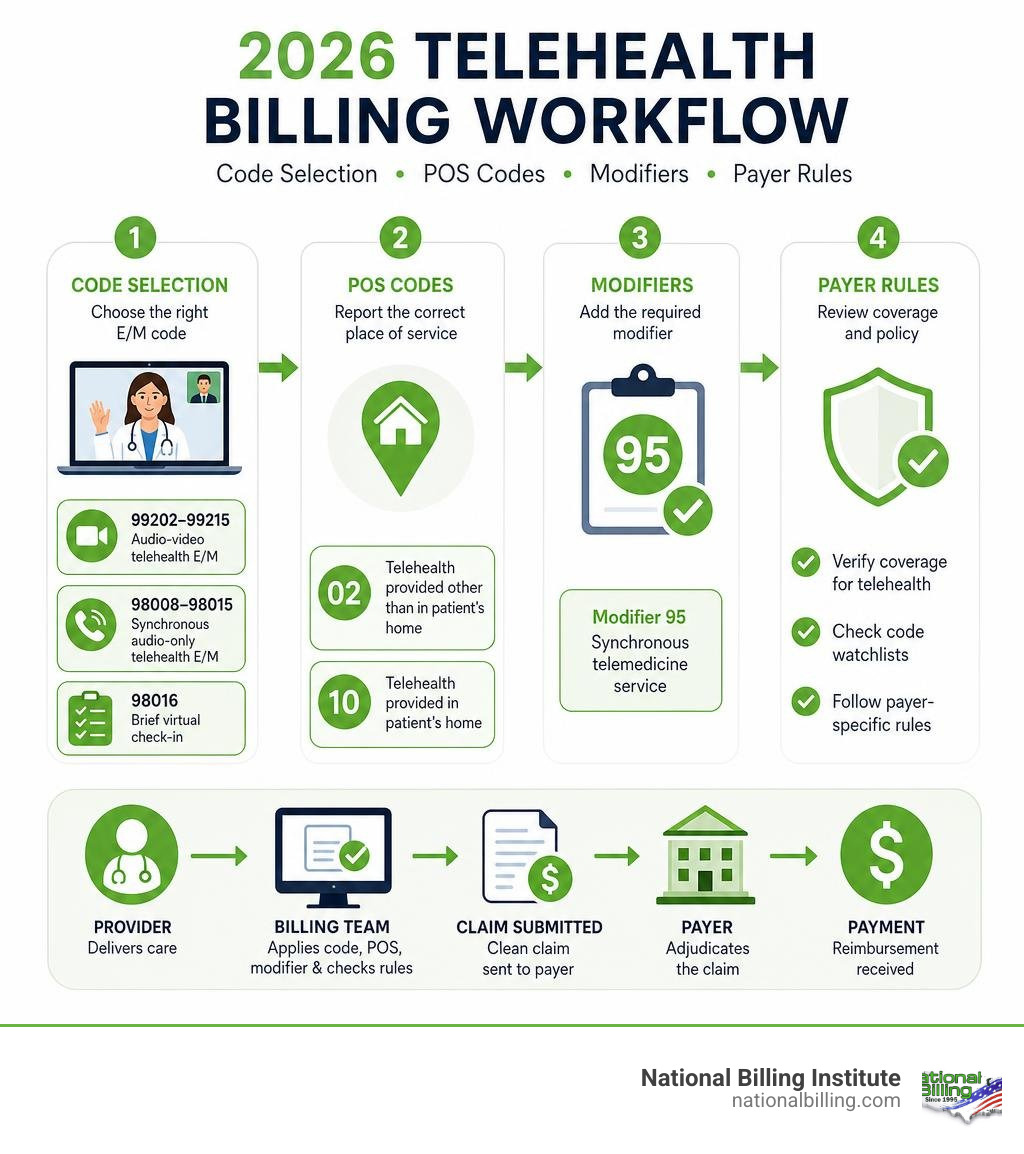
Code Range Type Medicare Recognized? 99202–99215 Office/outpatient E/M (audio-video telehealth) Yes 98000–98007 Synchronous audio-video telehealth E/M No (status "I" — invalid) 98008–98015 Synchronous audio-only telehealth E/M No (status "I" — invalid) 98016 Brief virtual check-in (replaces G2012) Yes 99441–99443 Telephone E/M Deleted as of Jan 1, 2025
Telehealth coverage for Medicare beneficiaries is extended through December 2027 — but the rules around telehealth EM codes have shifted dramatically heading into 2026.
The AMA introduced 17 new telemedicine E/M codes (98000–98016) in 2025. Most of them are not recognized by Medicare. At the same time, the old telephone-only codes (99441–99443) were permanently deleted. And the place-of-service codes, modifiers, and documentation requirements? They've all changed too.
For billing teams already stretched thin, this patchwork of new codes, deleted codes, payer-specific rules, and evolving legislation creates real risk. A single wrong code or missing modifier can mean a denied claim — or worse, a compliance audit.
I'm Olivia Harper, Founder and Denial Management & Reimbursement Specialist at National Billing Institute, with over 30 years of hands-on experience in revenue cycle management — including navigating every major shift in telehealth EM codes since the pandemic flexibilities first took effect. In this guide, I'll walk you through exactly which codes to use, when, and how to document them correctly so your claims get paid the first time.
Understanding the 2026 Telehealth EM Codes: CPT 98000–98015 vs. Legacy 99202–99215
To understand where we are in 2026, we have to look at the massive standardization effort initiated by the American Medical Association (AMA). For years, providers relied on the legacy office and outpatient Evaluation and Management (E/M) codes (99202–99215) to report both in-person and virtual services. This was a temporary bridge.
The AMA sought a permanent solution to distinguish digital care from traditional physical visits, leading to the creation of 17 new telemedicine-specific CPT codes. You can explore the full history of these changes in our guide on Telehealth Billing Codes.
These new codes are split into two major categories: synchronous audio-video encounters (98000–98007) and synchronous audio-only encounters (98008–98015). They differ from legacy codes because they are natively built for virtual delivery, with built-in time thresholds and rules that reflect digital workflows. For a deeper dive into the structural logic behind these codes, check out the analysis on Understanding the 2025 Telemedicine E&M Codes – ICD10monitor.
Synchronous Audio-Video Telehealth EM Codes (98000–98007)
The 98000–98007 series represents synchronous, real-time interactive encounters utilizing both audio and video technology. When the AMA designed these codes, the goal was to provide a distinct reporting mechanism that mirrors the complexity of traditional outpatient visits but acknowledges the virtual environment.
98000–98003: New patient synchronous audio-video E/M. These codes scale from straightforward to high-complexity medical decision-making (MDM) or are selected based on strict time thresholds. For instance, a level-2 new patient encounter (98001) requires a minimum of 15 minutes.
98004–98007: Established patient synchronous audio-video E/M. These similarly scale based on MDM or time, with established patient visits starting at a 10-minute minimum.
Many commercial payers have adopted this series to differentiate virtual visits from physical ones. If you are billing a commercial plan, you must check their policy to see if they require these dedicated codes instead of the legacy 99202–99215 series. You can learn more about formatting these claims in our article on How the AMA meets need for new telehealth CPT codes and our step-by-step instructions on How to Bill Telemedicine Visits 2025.
Synchronous Audio-Only Telehealth EM Codes (98008–98015)
Recognizing that not every patient has access to high-speed internet or a smartphone, the AMA established the 98008–98015 series specifically for synchronous audio-only (telephone) encounters.
98008–98011: New patient synchronous audio-only E/M.
98012–98015: Established patient synchronous audio-only E/M.
Unlike the legacy telephone codes they replaced, these audio-only codes can be initiated by either the patient or the provider. However, they carry a strict 10-minute minimum of medical discussion to be billed at all. If a phone call lasts only 5 minutes, it does not qualify for this series. For a breakdown of how to structure these phone-based claims, see our resource on How to Bill for Telemedicine Visits.
Medicare Telehealth Rules: Covered Codes vs. Invalid Statuses
Here is the most critical trap for billing teams in 2026: Medicare does not recognize CPT codes 98000–98015.
In the physician fee schedule, CMS assigned these codes a status indicator of "I" (Invalid). If you submit a claim to Medicare using CPT 98000 or 98008, it will be instantly denied. Instead, Medicare requires you to continue using the standard office/outpatient E/M codes (99202–99215) to report telehealth services.
However, CMS did adopt one major code from the new AMA list: CPT 98016. This code represents a brief synchronous communication technology service (5–10 minutes of medical discussion) and officially replaced the old HCPCS code G2012 for virtual check-ins.
To keep this clear for your team, we've outlined the major differences between Medicare and commercial policies on our CMS Telehealth Billing Codes page.
Payer / Program Synchronous Audio-Video (98000–98007) Synchronous Audio-Only (98008–98015) Legacy E/M Codes (99202–99215) Virtual Check-In (98016) Medicare FFS Invalid (Status I) Invalid (Status I) Covered (with correct POS/modifiers) Covered (Replaces G2012) Commercial Payers Varies (Many require 98000-98007) Varies (Some cover, some restrict) Covered by most (requires modifier 95) Covered by most State Medicaid Varies by state Varies by state Covered by most Varies by state
The Deletion of Telephone Codes 99441–99443
The transition to the new codes also meant saying goodbye to the old ones. CPT codes 99441–99443 (telephone E/M services) were permanently deleted.
During the pandemic, CMS paid for these telephone codes at parity with in-person office visits (equivalent to 99212–99214). With their deletion, providers can no longer use them for audio-only services. For Medicare patients, audio-only services must now be billed using the standard E/M codes (99202–99215) with modifier 93, provided the patient meets specific criteria (such as being in their home and unable to access video).
To understand how this deletion impacts your overall video and audio workflows, check out the Video Visits | ACP guidelines.
Selecting the Correct Level of Service: MDM vs. Total Time
When billing telehealth em codes—whether you are using legacy codes for Medicare or the new 98000-series for commercial payers—you must select the level of service based on either Medical Decision Making (MDM) or Total Time spent on the date of the encounter.

When coding by time, you can count both face-to-face and non-face-to-face time personally spent by the physician or qualified healthcare professional (QHP) on the day of the encounter. This includes:
Preparing to see the patient (e.g., reviewing history and external records).
Obtaining and/or reviewing a separately obtained history.
Performing a virtual exam or evaluation.
Counseling and educating the patient, family, or caregiver.
Ordering medications, tests, or procedures.
Documenting clinical information in the EHR.
Communicating with other healthcare professionals.
Note: You cannot count clinical staff time (such as a medical assistant setting up the video link) toward the total billable time. For a complete list of qualifying activities and exact time ranges, refer to the SAMPLE Evaluation and Management Coding Advisor.
Modality Switching and Connection Failures
What happens when technology fails? It’s a common scenario: you start a visit on high-definition video, but the patient's connection drops three minutes in, and you have to finish the visit over a standard telephone call.
The rule for modality switching is clear: report the service based on the modality where the majority of the time was spent.
If you spent 15 minutes trying to troubleshoot the video but ultimately conducted a 20-minute medical discussion over the phone, the encounter must be billed as an audio-only visit.
You must thoroughly document the connection failure in the clinical note, noting the time of the switch and the reasons why a video connection could not be maintained.
Place of Service Codes and Modifiers for Telehealth Reimbursement
Reimbursement parity depends heavily on your Place of Service (POS) codes. Medicare pays for telehealth services based on where the patient is located during the encounter.
POS 10 (Telehealth Provided in Patient’s Home): This is the default code when the beneficiary receives services in their private residence. Medicare pays for POS 10 claims at the non-facility rate, which is higher than the facility rate and matches standard in-person office reimbursement. You can read more about how this impacts your bottom line on our POS 10 resource page.
POS 02 (Telehealth Provided Other than in Patient’s Home): Use this code if the patient is located at an originating site that is not their home (such as a clinic, hospital, or skilled nursing facility). This code reimburses at the lower facility rate.
For a breakdown of which modifiers must accompany these POS codes to secure full reimbursement, check out our updated guide on Telehealth Modifiers 2026.
Essential Modifiers: 95, 93, and FQ
Modifiers tell payers exactly how a service was delivered. Missing or misapplying them is one of the leading causes of telehealth claim denials.
Modifier 95 (Synchronous Audio-Video): Append this modifier to legacy E/M codes (99202–99215) when billing commercial payers or Medicare Advantage plans for real-time video visits. Note: For traditional fee-for-service Medicare, POS 10 or 02 is usually sufficient, but many commercial plans still mandate modifier 95.
Modifier 93 (Synchronous Audio-Only): This modifier is required on standard E/M codes when a Medicare visit is conducted entirely via telephone. It proves that the provider had video capability available, but the patient either lacked the technology or declined to use it.
Modifier FQ (RHC/FQHC Audio-Only): Specifically reserved for Rural Health Clinics (RHCs) and Federally Qualified Health Centers (FQHCs) to designate that a mental or behavioral health service was delivered via audio-only communication.
We have compiled a complete modifier crosswalk by payer on our Telehealth Billing Modifiers page to help your billing team prevent simple coding errors.
Compliance, Documentation, and Operational Readiness for Telehealth Claims
With CMS and commercial payers increasing audit scrutiny on virtual services, your documentation must be completely bulletproof. If a recovery auditor pulls a telehealth chart, they should instantly see that the encounter met all federal and state requirements.

Every compliant telehealth note must include:
Patient Consent: Explicitly document that the patient consented to a virtual visit. This is especially critical for virtual check-ins (98016) because they trigger patient co-pays.
Modality Statement: Explicitly state whether the visit was conducted via synchronous audio-video or audio-only (e.g., "This visit was conducted via a HIPAA-compliant synchronous audio-video platform.").
Locations: State the physical location of both the patient and the provider (e.g., "The patient was located at their home in Boca Raton, FL, and the provider was located at the clinic office."). This is vital because the patient’s physical location governs state licensure requirements.
Time Statement: If billing by time, document the exact start and stop times, or the total face-to-face and non-face-to-face minutes spent, along with a list of qualifying activities.
Medical Necessity: Ensure the complexity of the medical discussion justifies a virtual encounter.
To protect your practice from audits, we recommend reviewing our comprehensive guide on USA Telemedicine Billing and aligning your templates with the official Billing for telehealth guidelines.
Dual-Eligible Beneficiaries and Commercial Payer Variations
Billing for dual-eligible Medicare/Medicaid beneficiaries requires extra caution. While Medicare’s rules are standardized nationally, state Medicaid programs have their own unique billing and reimbursement policies.
In some states, Medicaid requires specific state-level modifiers or place-of-service combinations that differ from Medicare. Furthermore, commercial payers like Blue Cross Blue Shield (BCBS) may have already adopted the 98000–98015 series, requiring your billing team to split workflows depending on the patient's primary insurance.
To help navigate these variations, we have built dedicated resources for Medicaid Telehealth Billing and BCBS Telehealth Billing Codes.
Legislative Outlook and Emergency Department Telehealth
Congress extended major Medicare telehealth flexibilities through December 31, 2027. This extension permanently allows physical therapists, occupational therapists, and speech-language pathologists to bill for virtual services, and it continues to suspend geographic restrictions for non-behavioral health visits.
Additionally, CMS delayed the strict in-person visit requirement for mental health telehealth services provided to beneficiaries in their homes until January 1, 2026. This means that for mental health virtual visits, patients do not need a prior in-person visit to qualify for home-based telehealth.
In the emergency department (ED), CMS has also approved ED E/M codes (99281–99285) to be delivered via telehealth under specific circumstances. To ensure compliance when billing emergency virtual care, refer to the Telehealth in Emergency Departments Post-COVID-19 FAQ | ACEP.
Frequently Asked Questions about Telehealth Billing
Will Medicare pay for audio-only telehealth in 2026?
Yes, but only under limited circumstances. Medicare will cover synchronous audio-only E/M services (using standard codes 99202–99215 with modifier 93) if the patient is in their home, the distant site provider has interactive audio-video technology available, and the patient either does not have access to video technology or declines to use it. Additionally, behavioral and mental health services remain permanently eligible for audio-only delivery.
What is the difference between POS 02 and POS 10?
POS 10 is used when the patient is located in their private residence (home) during the telehealth visit, which reimburses the provider at the higher, non-facility rate. POS 02 is used when the patient is located at an originating site other than their home (like a hospital or clinic), which pays the provider at the lower facility rate.
How does CPT 98016 differ from the old G2012 code?
CPT 98016 is a direct replacement for the CMS virtual check-in code G2012. It covers a brief (5–10 minute) synchronous communication technology service initiated by an established patient. The rules remain the same: it cannot originate from a related E/M service provided within the previous 7 days, nor can it lead to an E/M service within the next 24 hours (or soonest available appointment).
Secure Your Telehealth Revenue with National Billing Institute
Navigating the shifting landscape of telehealth EM codes in 2026 requires constant vigilance. With Medicare rejecting the new CPT 98000 series while commercial payers embrace it, keeping your charge masters clean and your billing workflows compliant is a full-time job.
At National Billing Institute, we take the complexity out of your revenue cycle. Based entirely in Boca Raton, FL, our team brings over 30 years of medical billing expertise to your practice. By combining advanced AI-automated claims processing with dedicated certified coders, we maintain some of the lowest denial rates in the industry, helping our clients achieve a 15% to 30% increase in revenue.
Let us handle the coding transitions, modifier rules, and payer audits so you can focus on delivering exceptional patient care.
Explore Our Medical Billing Services today to schedule a consultation and optimize your practice's telehealth reimbursement.
