Telehealth Billing Codes for the Big Insurers
Why BCBS Telehealth Billing Codes Are Changing — and What It Means for Your Revenue
Understanding the correct bcbs telehealth billing codes is now more urgent than ever for providers submitting virtual care claims. As of January 1, 2025, the American Medical Association introduced a new set of telemedicine-specific E/M codes (98000–98016), and Blue Cross Blue Shield plans across multiple states have moved quickly to adopt them — with some, like BCBS Michigan and Blue Care Network, making them mandatory starting July 1, 2025.
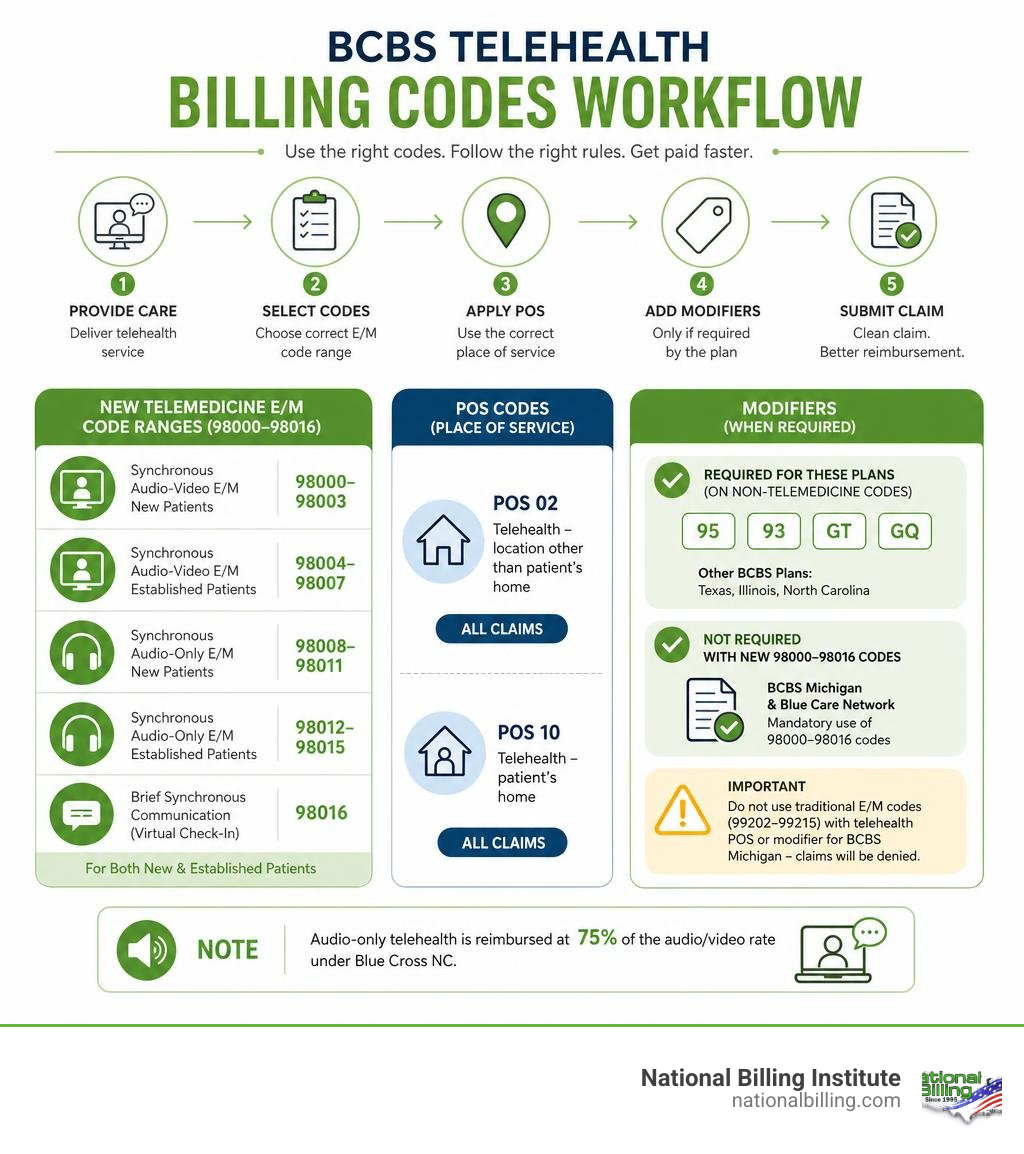
Here is a quick reference for the most critical BCBS telehealth billing codes currently in use:
Code Range Service Type Patient Type 98000–98003 Synchronous audio-video E/M New patients 98004–98007 Synchronous audio-video E/M Established patients 98008–98011 Synchronous audio-only E/M New patients 98012–98015 Synchronous audio-only E/M Established patients 98016 Brief synchronous communication (virtual check-in) Both POS 02 Telehealth — location other than patient's home All claims POS 10 Telehealth — patient's home All claims
Key rules to know right now:
Do not use traditional E/M codes (99202–99215) with a telehealth place of service or modifier for BCBS Michigan — claims will be denied
The new 98000–98016 codes do not require modifiers when billed with BCBS Michigan or Blue Care Network
Other BCBS plans (Texas, Illinois, North Carolina) still require modifiers such as 95, 93, GT, or GQ on non-telemedicine codes
Audio-only telehealth is reimbursed at 75% of the audio/video rate under Blue Cross NC
Getting these details wrong is one of the fastest ways to trigger denials and leave real money on the table.
I'm Olivia Harper, Founder and Denial Management & Reimbursement Specialist at National Billing Institute, and with over 30 years managing bcbs telehealth billing codes and virtual care claims for practices nationwide, I've seen how these policy shifts cause revenue disruption when providers aren't prepared. In this guide, I'll walk you through exactly what each major BCBS plan now requires — so your claims go out clean the first time.
The Shift to New BCBS Telehealth Billing Codes (98000–98016)

For years, billing for virtual care felt like trying to hit a moving target while wearing a blindfold. Providers relied on traditional evaluation and management (E/M) codes (like 99202–99215) and appended a variety of modifiers to show the service was virtual. However, the American Medical Association (AMA) changed the game by establishing dedicated telemedicine E/M codes (98000–98016).
This shift is not just a minor update; it is a structural redesign of how we report virtual healthcare. The standard telehealth symbols have been stripped from traditional outpatient E/M codes (with the exception of 99211), meaning those codes are officially reserved for face-to-face, in-office encounters.
The real-world friction began when major payers started mandating these codes. For instance, Blue Cross Blue Shield of Michigan and Blue Care Network implemented a hard transition on July 1, 2025. If you submit a claim to BCBS Michigan using a traditional E/M code paired with a telehealth modifier or place of service, it will be rejected.
Adapting to this change is critical to maintaining a healthy cash flow. To get a solid grasp of basic virtual visit workflows before diving deeper, check out our guide on How to Bill for Telemedicine Visits. You can also read the official announcement regarding the Michigan transition in this summary of the New Telemedicine Billing Codes Effective July 1 for Blue Cross Blue ... .
Understanding the New BCBS Telehealth Billing Codes (98000–98015)
The new code set splits E/M telemedicine services into two main modalities: synchronous audio-video and synchronous audio-only. Within these categories, codes are selected based on either the level of Medical Decision Making (MDM) or the total time spent on the date of the encounter.
Let's break down the specific code ranges:
Synchronous Audio-Video (98000–98007):
98000–98003 (New Patients): Time thresholds start at 15 minutes for straightforward MDM (98000) and scale up to 60 minutes for high-complexity MDM (98003).
98004–98007 (Established Patients): Time thresholds begin at 10 minutes for straightforward MDM (98004) and go up to 40 minutes for high-complexity MDM (98007).
Synchronous Audio-Only (98008–98015):
98008–98011 (New Patients): Time thresholds mirror the audio-video codes but require a minimum of 15 minutes of medical discussion for straightforward MDM.
98012–98015 (Established Patients): These codes require at least 10 minutes of medical discussion.
By separating audio-only from audio-video, payers can track exactly how care is delivered and adjust their reimbursement rates accordingly. For a deeper look at how these codes are structured across different clinical scenarios, read our comprehensive piece on Telehealth Billing Codes.
Virtual Check-Ins and Brief Communications (98016)
For brief, real-time technology-based communications that do not escalate into a full E/M visit, the AMA introduced code 98016. This code represents a brief synchronous communication service (often referred to as a virtual check-in) requiring a minimum of 5 minutes of medical discussion.
To bill 98016 successfully, keep these rules in mind:
It is used for both new and established patients.
The discussion must be initiated by the patient or scheduled as a follow-up.
It cannot originate from a related E/M service provided within the previous 7 days, nor can it lead to an E/M service within the next 24 hours (or the soonest available appointment).
Your clinical documentation must explicitly show at least 5 to 10 minutes of medical discussion and confirm that the technology used was synchronous.
For more details on how federal policies match up with these private payer check-in rules, check out our analysis of CMS Telehealth Billing Codes.
Place of Service (POS) and Modifier Rules for Blue Cross Claims
When submitting claims to any Blue Cross Blue Shield plan, your Place of Service (POS) code is your first line of defense against automated denials. The industry currently utilizes two primary POS codes to designate where the patient was located during the virtual visit:
POS 02 (Telehealth Provided Other than in Patient's Home): Use this code when the patient is at an originating site, such as a clinic, hospital, or nursing facility, during the encounter.
POS 10 (Telehealth Provided in Patient's Home): Use this code when the patient is physically located in their private residence or temporary lodging (like a hotel) during the virtual visit.
The critical billing pitfall in 2026 is the mismatch of traditional codes and telehealth indicators. If you submit a claim to BCBS Michigan using a traditional E/M code (99202–99215) paired with POS 02 or POS 10, the claim will be immediately denied. Under their policy, the new 98000–98016 codes are designed specifically for virtual care, meaning they inherently represent telehealth. Therefore, no modifiers are required when billing the new 98000–98016 codes to BCBS Michigan.
However, other regional BCBS plans have not yet completely banned traditional E/M codes for telehealth, meaning they still rely on modifiers to distinguish virtual care. Understanding these modifiers is essential for national billing compliance. To master this complex landscape, consult our guides on Telehealth Billing Modifiers and Telehealth Modifiers 2026.
Modifiers 95, 93, GT, GQ, and G0
When billing plans that still require modifiers for non-telemedicine-specific codes, you must append the correct modifier based on the technology used:
Modifier 95 (Synchronous Audio-Video): This modifier indicates that the service was delivered via real-time interactive audio and video telecommunications. It should only be appended to codes marked with a star symbol in the CPT codebook.
Modifier 93 (Synchronous Audio-Only): Introduced for synchronous telemedicine via telephone or audio-only systems, this modifier applies to codes listed in the AMA CPT appendix with an audio symbol.
Modifier GT (Interactive Telecommunication): Used primarily for state Medicaid and some commercial plans to denote interactive audio-video systems.
Modifier GQ (Asynchronous Store-and-Forward): This indicates asynchronous telecommunications. Be extremely careful here: plans like BCBS Illinois (BCBSIL) explicitly state they will not accept asynchronous telecommunication services, and claims with modifier GQ are not eligible for reimbursement.
Modifier G0 (Acute Stroke Services): This specialized modifier is only accepted by plans like BCBSIL and BCBS Texas (BCBSTX) when combined with GQ, GT, or 95 for telemedicine services related to diagnosing, evaluating, or treating an acute stroke.
For an exhaustive breakdown of when and how to apply these modifiers to prevent payment delays, read our dedicated article on the Telehealth Modifier. You can also review the formal policy language in the RP033 - Telemedicine and Telehealth/Virtual Services Policy documentation.
Comparing BCBS Texas, Illinois, and North Carolina Telehealth Policies
While the AMA creates the codes, individual BCBS plans decide how to pay them. This regional fragmentation is one of the biggest headaches for medical billers. Below is a comparison table showcasing how BCBSTX, BCBSIL, and Blue Cross NC handle key telehealth rules:
Policy Feature BCBS Texas (BCBSTX) BCBS Illinois (BCBSIL) Blue Cross NC Core Policy Document CPCP033 RP033 Commercial Reimbursement Policy Accepts Asynchronous (GQ) Yes (with strict limits) No (claims will be denied) No (mostly excluded) Audio-Only Reimbursement Reimbursed if >10 mins Reimbursed if >10 mins Reimbursed at 75% of face-to-face rate Accepts Modifier G0 Yes (acute stroke only) Yes (with GQ/GT/95) No separate policy Originating Site Fee (Q3014) Reimbursable (if criteria met) Reimbursable (if criteria met) Considered incidental (non-reimbursable)
To review the exact legal and clinical language for these plans, you can access the CPCP033 - Telemedicine and Telehealth/Virtual Health Care Services Policy Effective 01/01/2025 and the official Telehealth | Providers | Blue Cross NC portal.
Audio-Only Reimbursement and the 75% Rule
Audio-only telehealth is a vital access point for patients who lack high-speed internet, live in rural areas, or struggle with digital literacy. However, payers do not always reimburse it at parity with audio-video visits.
Blue Cross NC has implemented a clear 75% reimbursement rule for audio-only services. This means that if an audio-only E/M service is billed, it will receive 75% of the allowed reimbursement rate of an equivalent audio-video or face-to-face encounter.
Furthermore, plans like BCBSTX and BCBSIL require that audio-only E/M services involve more than 10 minutes of medical discussion to qualify for reimbursement. Brief telephone calls that do not meet this time threshold are considered non-reimbursable administrative tasks. For additional guidance on managing these audio-only billing nuances, refer to the federal recommendations on Billing for telehealth.
Originating Site Fees (Q3014) and Out-of-State Licensing
The originating site is the physical location where the patient is during the telehealth encounter. When a provider hosts a patient in their office so the patient can conduct a virtual visit with an off-site specialist, the hosting provider can bill HCPCS code Q3014 for the originating site facility fee.
However, the rules for Q3014 are strictly enforced:
Patient at Home: If the patient is at home (POS 10), no provider can bill Q3014. The home does not qualify as a billable originating site.
Blue Cross NC Exclusion: Under Blue Cross NC policy, the originating site fee is considered incidental to the overall care and is not separately payable.
Out-of-State Licensing: If you are treating a BCBS member who is physically located in another state at the time of the call, you must be licensed in that state. For example, North Carolina law (Senate Bill 780) mandates that any out-of-state provider treating an NC resident electronically must hold an active North Carolina medical license.
Establishing a valid patient-provider relationship and verifying state licensure is mandatory before rendering out-of-state telehealth services. You can read more about these originating site distinctions in the Clinical Payment and Coding Policy 033 - Telemedicine and Telehealth Services document.
Non-Reimbursable Services and Strict Exclusions Under BCBS
To protect your practice from costly write-offs, you must know what BCBS plans will not pay for. Telehealth is not simply an electronic version of your office; it has strict boundary lines.
The following services are universally excluded from telehealth reimbursement across almost all major BCBS plans:
Same-Day Face-to-Face Visits: You cannot bill a telemedicine visit if it occurs on the same day as an in-person visit by the same provider for the same clinical condition.
Administrative Tasks: Standard phone calls to report lab results, schedule appointments, or issue prescription refills are considered part of basic office overhead and are not separately reimbursable.
Global Surgical and Maternity Periods: Virtual visits performed within a global surgical or maternity period are bundled into the global surgical/maternity package and will be denied if billed separately.
Transmission Fees: HCPCS code T1014 (telehealth transmission fee) is explicitly non-reimbursable by plans like Blue Shield of California.
Text Messaging: Standard SMS text messaging, email, or secure portal messages that do not meet the definition of interactive, synchronous communication do not qualify as telehealth.
To review these exclusions in detail, check out the Blue Shield of California Payment Policy and read our master guide on USA Telemedicine Billing.
Remote Monitoring and Online Digital E/M Services
Remote Physiologic Monitoring (RPM) and Remote Therapeutic Monitoring (RTM) are highly regulated. To bill for these services, you must use specific CPT codes (such as 98970–98972) and ensure the monitoring device meets FDA definitions.
Similarly, Online Digital E/M services (CPT 99421–99423) represent patient-initiated digital communications through a secure portal. These codes are strictly limited to established patients and require a cumulative time assessment over a 7-day period. You cannot bill these services for new patients, and secure text messaging alone does not qualify.
Frequently Asked Questions
What are the primary bcbs telehealth billing codes for virtual check-ins?
The primary code used across BCBS plans for virtual check-ins is 98016 (Brief synchronous communication technology service). This code requires a minimum of 5 minutes of documented medical discussion and must not be related to an E/M service provided within the previous 7 days or lead to an appointment within the next 24 hours.
What happens if I bill traditional E/M codes with a telehealth modifier to BCBS Michigan?
Your claim will be denied. Starting July 1, 2025, BCBS Michigan and Blue Care Network made the transition to the new telemedicine-specific codes (98000–98016) mandatory. Traditional outpatient E/M codes (99202–99215) submitted with a telehealth modifier or place of service will not be accepted.
Is the originating site facility fee (Q3014) reimbursable when a patient is at home?
No. HCPCS code Q3014 is only reimbursable when the patient is physically present at an eligible originating medical facility (using POS 02). If the patient is at home (POS 10), the originating site fee is non-reimbursable.
Conclusion
Navigating the constantly shifting landscape of bcbs telehealth billing codes in 2026 requires absolute precision. A single misplaced modifier, an incorrect Place of Service code, or using an outdated E/M code can trigger immediate denials and stall your practice's cash flow.
At National Billing Institute, we specialize in taking the complexity out of medical billing. Our 100% USA-based team in Boca Raton, Florida, brings over 30 years of industry experience to help healthcare providers maximize their revenue. By combining advanced AI-automated claims processing with dedicated human expertise, we deliver some of the lowest denial rates in the industry, full HIPAA compliance, and an average revenue increase of 15% to 30% for our clients.
Let us handle the billing headaches so you can focus on what matters most: caring for your patients. Learn more about our medical billing services today and see how we can optimize your practice's financial health.
