The Definitive Guide to Telehealth Coding Guidelines in 2026
Why Telehealth Modifiers 2026 Matter for Your Revenue Cycle
Telehealth modifiers 2026 are the billing codes appended to CPT claims that tell payers how a telehealth service was delivered — and getting them wrong is one of the fastest ways to trigger a denial.
Here is a quick reference for the modifiers you need to know:
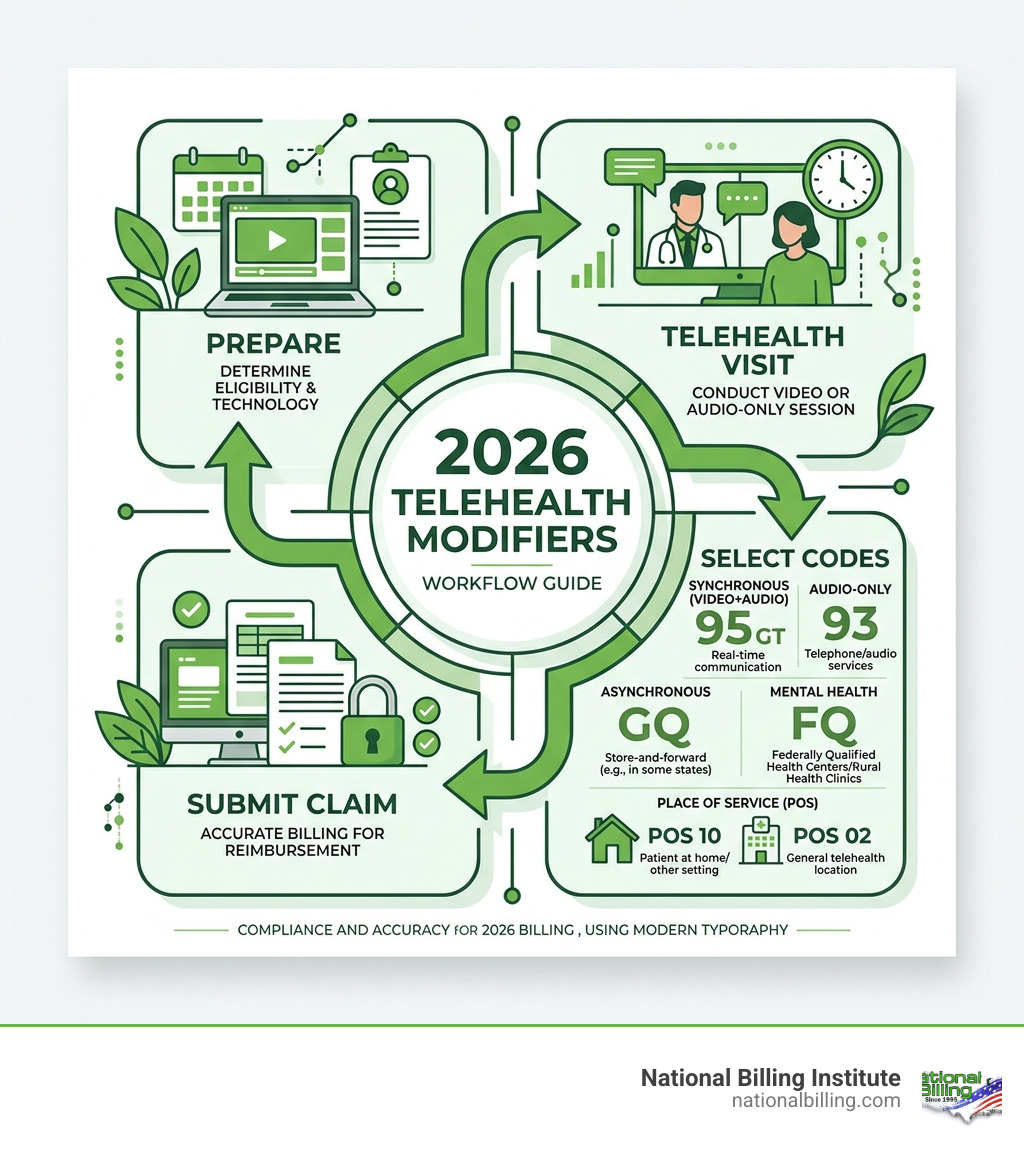
Modifier Use Case Payer 95 Synchronous audio-video telehealth (Appendix P codes) Commercial, Medicare Advantage 93 Synchronous audio-only telehealth Medicare FFS, some Medicaid GT Interactive audio-video; legacy use for CAH Method II institutional claims Limited; some Medicaid/commercial GQ Asynchronous (store-and-forward) telehealth Select payers, some FQHCs/RHCs FQ Audio-only behavioral health by FQHCs/RHCs Medicare, Medicaid G0 Telehealth services in specific originating site contexts Medicare
Quick answer: For most Medicare fee-for-service claims in 2026, you do not append modifier 95. Instead, you use Place of Service (POS) code 10 (patient's home) or 02 (other telehealth location). Modifier 95 is required by most commercial payers and Medicare Advantage plans.
The 2026 telehealth billing landscape is more complex than ever. Congress extended core Medicare telehealth flexibilities through December 31, 2027 via the Consolidated Appropriations Act, 2026. At the same time, CMS introduced significant changes through the CY 2026 Physician Fee Schedule — permanently removing frequency limits on certain visits, streamlining the Telehealth Services List, and ending a key billing flexibility that allowed practitioners to use their enrolled practice address when working from home.
For overworked billing teams, these overlapping federal rules, combined with payer-specific modifier requirements, create real risk. A single wrong modifier does not just delay payment — it can trigger audits, inflate denial rates, and quietly drain revenue month after month.
I am Olivia Harper, Founder and Denial Management and Reimbursement Specialist at National Billing Institute, with over 30 years of experience helping practices across the country navigate exactly these kinds of telehealth modifiers 2026 challenges. In this guide, I will walk you through every modifier, POS code, and compliance update you need to bill telehealth correctly and get paid in 2026.
Primary Telehealth Modifiers 2026: A Comprehensive Breakdown
Navigating telehealth modifiers 2026 requires a keen eye for detail. While the industry has moved toward standardization, "uniformity" is still a dream. Different payers want different modifiers to describe the same encounter.

Modifier 95: The Synchronous Standard
Modifier 95 is used for synchronous (real-time) interactive audio and video telecommunication. In 2026, this modifier remains the "gold standard" for commercial payers like Blue Cross Blue Shield, UnitedHealthcare, and Aetna. It should only be appended to codes listed in Appendix P of the CPT codebook.
Modifier 93: The Audio-Only Essential
Introduced to account for the reality that not every patient has a high-speed video connection, Modifier 93 is used for synchronous telehealth services rendered via audio-only technology. For Medicare, this is typically reserved for behavioral health services or cases where the patient is unable or unwilling to use video.
Modifier GT: The Legacy Choice
Modifier GT was once the primary way to signal a telehealth service. Today, its use has declined significantly. In 2026, it is primarily used for institutional claims by Critical Access Hospitals (CAH) under Method II. Some state Medicaid programs still cling to GT, so always check your local Telehealth Billing and Coding: CPT Codes and Place-of-Service Rules guide for specific state requirements.
Modifier GQ: Asynchronous Store-and-Forward
This modifier is for "asynchronous" telehealth, where medical information (like an X-ray or a photo of a skin lesion) is transmitted to a provider who reviews it at a later time. It’s common in teledermatology and teleophthalmology.
Modifier FQ: The FQHC/RHC Specialist
Specifically for Federally Qualified Health Centers (FQHCs) and Rural Health Clinics (RHCs), Modifier FQ indicates that a mental health service was furnished using real-time audio-only technology.
Modifier G0: Stroke and Specialty Care
Modifier G0 is used for telehealth services furnished for purposes of diagnosis, evaluation, or treatment of symptoms of an acute stroke.
Modifier 2026 Usage Status Primary Payer 95 Active & Required Commercial / MA GT Legacy / Declining CAH Method II / Select Medicaid 93 Growing Medicare / Behavioral Health
Understanding Audio-Only Telehealth Modifiers 2026
Audio-only billing is a lifeline for rural populations, but it comes with strict documentation requirements. To use Modifier 93 or FQ, the provider must document in the medical record that the patient was offered video but was unable to use it, or that the patient specifically preferred audio-only.
Under the CY 2026 rules, Medicare has permanently removed frequency limits for subsequent inpatient and nursing facility visits via telehealth. However, for audio-only services, the service must still be found in Appendix T of the CPT manual to be eligible for reimbursement.
Navigating Payer-Specific Telehealth Modifiers 2026
The biggest headache for our clients at National Billing Institute is the "payer crosswalk." While Medicare Fee-For-Service (FFS) relies on POS codes 02 and 10 to identify telehealth, many commercial payers require Modifier 95 even if you use the correct POS code. If you omit the modifier for a commercial claim, it will likely be processed as an in-person visit, leading to potential audits for "place of service" mismatches.
Place of Service (POS) Codes and Reimbursement Impacts
In 2026, the distinction between POS 02 and POS 10 is critical for your bottom line.
POS 02 (Telehealth Provided Other than in Patient’s Home): Use this when the patient is at a clinic, a hospital, or another medical facility. These claims are generally paid at the "facility rate," which is often lower because the facility is expected to bill an originating site fee (HCPCS Q3014).
POS 10 (Telehealth Provided in Patient’s Home): Use this when the patient is in their own home, or even in temporary lodging like a hotel or a car. Since January 1, 2024, Medicare pays these claims at the higher "non-facility rate," recognizing that the provider bears more of the overhead cost.
Getting these mixed up doesn't just result in a denial; it can result in overpayments that you'll have to pay back later. We always recommend that our providers verify the patient's physical location at the start of every call. For more technical details on these rates, you can refer to the Medicare Physician Fee Schedule Final Rule Summary: CY 2026.
Key Changes in the CY 2026 Physician Fee Schedule
CMS has introduced several "administrative hurdles" in the 2026 rule that have practitioners worried. Perhaps the most burdensome change is the end of the policy that allowed telehealth providers to bill from their enrolled practice location while working from home.
In 2026, if you are providing telehealth from your home address, you must enroll that home address as a "Home office for administrative/telehealth use only." Industry experts estimate this will result in a fortyfold increase in the number of billing addresses tracked by health systems. For a large health system, the operational cost of managing this change is estimated at approximately $1 million in labor.
New CPT Codes for 2026
The 2026 CPT codebook has expanded its telehealth appendices. Newly added codes in Appendix P (Audio-Video) and Appendix T (Audio-Only) include:
90853: Group psychotherapy.
96202, 96203: Caregiver training.
96130–96139: Psychological and neuropsychological testing evaluation and administration.
For the full list of questions regarding these codes, see the updated Telehealth FAQ - CMS.
Impact of the 2026 Medicare Economic Index (MEI)
The Medicare Economic Index (MEI) increase for 2026 is 2.7%. This adjustment directly impacts the HCPCS code Q3014 (telehealth originating site facility fee). For CY 2026, the payment for the originating site fee is set at $31.85 (or 80% of the lesser of the actual charge or this amount). While it seems like a small fee, for rural clinics, these facility fees add up to significant support for their digital infrastructure.
Therapy Thresholds and KX Modifier Updates
If you provide physical, occupational, or speech therapy via telehealth, you must keep an eye on the KX modifier thresholds. For CY 2026, these are:
$2,480 for occupational therapy services.
$2,480 for physical therapy and speech-language pathology services combined.
Once a patient hits this limit, you must append the KX modifier to signify the services are medically necessary, or the claim will be automatically denied.
Compliance and Documentation Standards for 2026
Compliance in 2026 isn't just about the right telehealth modifiers 2026; it's about the "virtual presence" of the provider.
Virtual Direct Supervision
Starting in 2026, CMS has permanently adopted the definition of "direct supervision" to include virtual presence via real-time audio-visual technology. This is a massive win for "incident-to" billing, allowing physicians to supervise non-physician practitioners (NPPs) without being in the same physical room.
Teaching Physicians
Teaching physicians can also use virtual presence to supervise residents during telehealth visits through the end of 2026. This allows for three-way calls where the patient, the resident, and the teaching physician are all in different locations.
Permanent Telehealth Services
CMS has eliminated the "provisional" telehealth service designation. Services are now either on the list or they aren't. Permanently recognized services now include:
Psychological and neuropsychological testing.
Group psychotherapy.
Remote outpatient therapy (PT/OT/SLP) through 2027.
To ensure your practice stays ahead of these changes, it's often best to partner with experts. You can find more info about medical billing services that specialize in these 2026 updates.
Frequently Asked Questions about Telehealth Billing in 2026
What is the difference between GT and 95 modifiers in 2026?
Modifier 95 is the modern standard for synchronous audio-video telehealth used by most commercial payers. Modifier GT is a legacy modifier primarily used by Medicare for Critical Access Hospitals (CAH) Method II and some specific Medicaid programs. In 2026, if you aren't a CAH, you should likely be using 95 for commercial and POS 10/02 for Medicare.
Are Medicare telehealth flexibilities extended beyond 2026?
Yes! The Consolidated Appropriations Act, 2026 extended most Medicare telehealth flexibilities through December 31, 2027. This includes the waiver of geographic restrictions (allowing patients in urban areas to receive telehealth) and the ability for patients to receive care in their homes.
How does the elimination of provisional status affect the Telehealth Services List?
By eliminating the "provisional" category, CMS has simplified the list. Services like psychological testing are now permanently recognized. This provides long-term certainty for providers, allowing them to invest in telehealth infrastructure without the fear that a code will be "deleted" from the list next year.
Conclusion
Mastering telehealth modifiers 2026 is about more than just checking a box — it’s about protecting your practice’s financial health. With the 2.7% MEI increase and the new $31.85 originating site fees, every dollar counts. However, the increased administrative burden of tracking home billing addresses and the complexities of POS 10 vs. 02 can easily overwhelm a small billing department.
At National Billing Institute, we take that burden off your shoulders. Our 100% USA-based team in Boca Raton, FL, leverages over 30 years of experience and AI-automated claims processing to ensure your telehealth claims are perfect the first time. We don't just "process" claims; we optimize your entire revenue cycle, typically helping our clients see a 15-30% increase in revenue while maintaining the industry's lowest denial rates.
Don't let 2026's regulatory shifts slow you down. Let our Boca Raton experts handle the coding so you can focus on your patients. Contact us today for Expert Telehealth Billing Services.
