
Telehealth Billing Codes That Actually Get You Paid
Why Getting Telehealth Billing Codes Right Is the Difference Between Getting Paid and Getting Denied
Telehealth billing codes are the specific CPT and HCPCS codes used to submit claims for virtual care services — and choosing the wrong one is one of the fastest ways to lose revenue.
Here are the most commonly used codes in 2026:
Code(s) Service Type Coverage Status 99202-99205 New patient E/M (audio-video) Permanent 99211-99215 Established patient E/M (audio-video) Permanent 90832-90837 Psychotherapy (audio-video) Permanent 90791-90792 Psychiatric evaluation Permanent 99453-99458 Remote Patient Monitoring (RPM) Permanent 99421-99423 Online digital E/M (patient portal) Permanent 98016 Virtual check-in (replaced G2012) 2025 update 98000-98015 New audio-video/audio-only codes Commercial payers only (not Medicare) Q3014 Originating site facility fee $31.85 in 2026
Key modifiers to know:
Modifier 95 — synchronous audio-video (most commercial payers)
Modifier 93 — audio-only telehealth
Modifier GT — legacy Medicare modifier (still used on some CAH claims)
Modifier FQ — audio-only at FQHCs and RHCs
Place of Service codes matter too:
POS 10 — patient is at home (pays at the higher non-facility rate)
POS 02 — patient is at another location (pays at the lower facility rate)
Telehealth adoption exploded during the COVID-19 pandemic — Medicare telehealth visits jumped from just 0.1% of all visits in 2019 to 13.1% in 2020. That growth stuck. But the billing rules didn't get simpler. They got more complex.
Today, practices face a maze of overlapping rules: which codes Medicare has permanently adopted versus which are still on extension, when audio-only is allowed, which modifier to use for which payer, and how POS codes silently affect your reimbursement rate. One wrong code, one missing modifier, one incorrect place of service — and the claim comes back denied.
Telehealth denial rates run 2-3 times higher than standard in-office claims. And most practices are only capturing 60-70% of their billable virtual revenue without even realizing it.
This guide breaks it all down — clearly, without jargon, and with the current 2026 rules.
I'm Olivia Harper, Founder and Denial Management & Reimbursement Specialist at National Billing Institute, and with over 30 years of hands-on experience in revenue cycle management, telehealth billing codes have become one of the most critical — and most mishandled — areas I see across the hundreds of practices we serve nationwide. In the sections ahead, I'll walk you through exactly what you need to know to bill telehealth correctly, reduce denials, and protect your revenue.
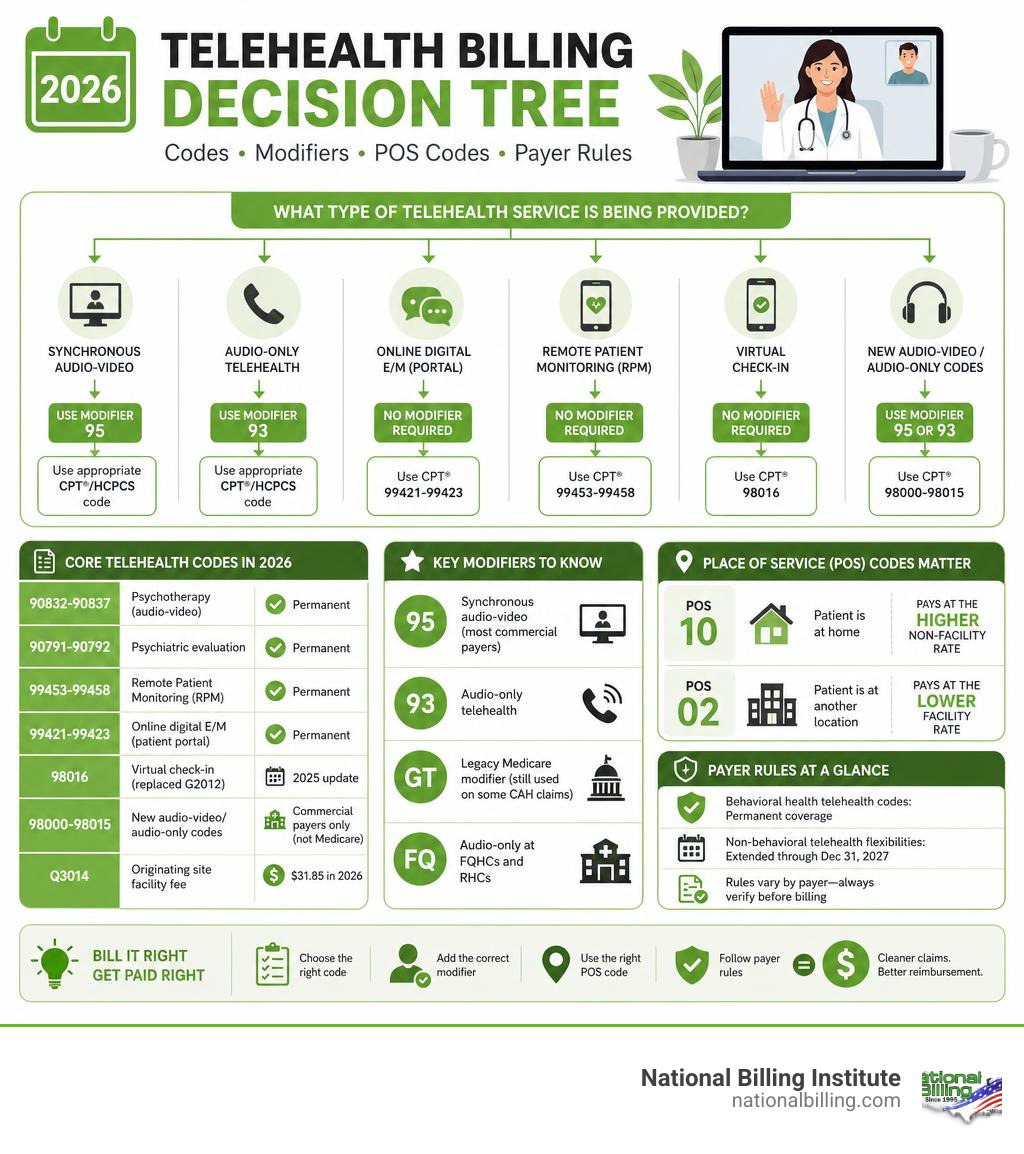
Core telehealth billing codes and Modifiers in 2026
Navigating the landscape of virtual care in 2026 requires a firm grip on which codes are permanently accepted and which remain subject to evolving legislative timelines. While the Consolidated Appropriations Act of 2026 extended non-behavioral Medicare telehealth flexibilities through December 31, 2027, behavioral health services have secured permanent coverage status. For practices aiming to protect their bottom line, understanding these distinctions is critical to maintaining billing compliance.
Standard telehealth billing codes for Audio-Video and Audio-Only Visits
For primary care and specialty medical practices, the workhorses of virtual billing remain the standard Evaluation and Management (E/M) codes. When you perform a synchronous audio-video visit, you will bill the exact same E/M codes you use for in-person encounters:
99202–99205: Office or other outpatient visit for the evaluation and management of a new patient.
99211–99215: Office or other outpatient visit for the evaluation and management of an established patient.
For behavioral and mental health services, the industry has transitioned to robust, permanent telehealth coverage. The most common codes billed include:
90832–90837: Individual psychotherapy sessions (ranging from 30 to 60 minutes).
90791–90792: Psychiatric diagnostic evaluations.
According to the official Medicare Telehealth Coverage: Eligible Services and Billing Codes guidelines, these mental health codes enjoy permanent status without the geographic restrictions that historically limited virtual care to rural areas. To keep your system optimized, verify that your billing software maps these to the correct CMS Telehealth Billing Codes to prevent front-end rejections.
Telehealth Modifiers for Synchronous and Audio-Only Care
Modifiers are the flags that tell payers exactly how a service was delivered. Misapplying them is the single largest driver of telehealth claim rejections.
Modifier 95: This modifier indicates a "synchronous telemedicine service rendered via a real-time interactive audio and video telecommunications system." It should only be applied to codes listed in CPT Appendix P. Most commercial payers and Medicare Advantage plans require Modifier 95 to process video-based claims.
Modifier 93: Introduced to address the growing need for telephone-based care, Modifier 93 indicates a synchronous service delivered via audio-only technology.
Modifier FQ: Used primarily by Federally Qualified Health Centers (FQHCs) and Rural Health Clinics (RHCs) to denote that a mental health service was delivered via audio-only telecommunications.
Modifier GT: While CMS largely retired the GT modifier for standard Part B professional claims in favor of Place of Service codes, it remains mandatory for institutional claims, such as those submitted by Critical Access Hospitals (CAHs) billing under Method II.
Modifier GQ: Used for asynchronous "store-and-forward" telecommunications, which is highly restricted under Medicare but occasionally utilized in specific demonstration projects.
Understanding how to pair these modifiers with your CPT codes is essential. For a complete deep dive into current modifier compliance, consult our resources on Telehealth Modifiers 2026 and Telehealth Modifiers.
Place of Service, Reimbursement Rates, and the 2025/2026 Code Shift
Reimbursement parity is one of the most misunderstood areas of virtual care. Many providers assume that a telehealth visit pays less than an in-office visit. In reality, the payout depends entirely on the Place of Service (POS) code you select.
POS 10 vs POS 02: Patient at Home vs Facility Rates
Since January 1, 2024, Medicare and many commercial payers have distinguished reimbursement based on the physical location of the patient at the time of the encounter:
POS 10 (Telehealth Provided in Patient’s Home): When a patient connects from their personal residence, the service is reimbursed at the non-facility rate. This is the higher office-based rate, reflecting the standard overhead costs of running a practice.
POS 02 (Telehealth Provided Other than in Patient’s Home): If the patient is located at a hospital, clinic, or other facility during the visit, you must use POS 02. This pays at the facility rate, which is lower because the payer assumes the distant site practitioner does not bear the overhead costs of the physical site.
CPT Code POS 10 (Non-Facility / Home) POS 02 (Facility / Other) The Reimbursement Gap 99213 ~$98.00 ~$65.00 $33.00 99214 ~$148.00 ~$115.00 $33.00 99215 ~$201.00 ~$168.00 $33.00
As this table demonstrates, accidentally coding a patient-at-home visit as POS 02 instead of POS 10 costs your practice $33 per visit. If you run 30 telehealth visits a day, that simple error drains nearly $1,000 daily from your revenue. For step-by-step guidance on setting up your EHR to capture these locations automatically, review How to Bill Telemedicine Visits 2025.
Originating Site Facility Fees and Q3014 Rules
An originating site is the physical location where the patient is located during the telehealth encounter. When a patient goes to a local clinic or hospital to connect with a specialist located elsewhere, that local facility can bill an originating site facility fee using HCPCS code Q3014.
For CY 2026, reflecting a 2.7% Medicare Economic Index (MEI) increase, the Medicare originating site facility fee is set at $31.85 (up from $31.04 in 2025). That Q3014 is only reimbursable if the originating site is an authorized medical facility operated by a different entity than the distant site provider. You cannot bill Q3014 if the patient is connecting from their own home. For specific commercial payment policies, refer to the [PDF] Telehealth Facility Procedure Code Q3014 - Florida Blue Portal.
Understanding the New 98000-Series telehealth billing codes
The AMA introduced a major structural shift in telehealth coding with the release of the CPT 98000–98015 series. These codes were designed to build the modality (audio-video vs. audio-only) directly into the code descriptor, theoretically eliminating the need for modifiers like 95 or 93.
98000–98007: Synchronous audio-video telemedicine E/M services.
98008–98015: Synchronous audio-only telemedicine E/M services.
98016: Virtual check-in service (which officially replaced the legacy HCPCS code G2012).

However, there is a major catch: Medicare has not adopted the 98000-series codes. For Medicare Fee-for-Service (FFS) claims, you must continue to use the legacy office E/M codes (99202–99215) paired with POS 10 or POS 02.
Furthermore, Medicare officially discontinued the telephone-only codes 99441–99443 as of January 1, 2025. Commercial payers, however, have fragmented: some have fully transitioned to the 98000-series, while others still require legacy E/M codes with Modifier 95 or 93. This fragmentation requires billing teams to carefully track individual payer policies to avoid immediate denials.
Medicare Audio-Only Rules and Behavioral Health In-Person Mandates
While Medicare allows audio-only billing under specific circumstances, the rules are highly restrictive. Audio-only encounters are generally permitted only when:
The provider is technically capable of delivering synchronous audio-video care.
The patient is located at home but does not have the technology, has a poor connection, or does not consent to a video-based visit.
The provider documents the specific reason for opting for audio-only in the medical record.
For mental and behavioral health, Medicare permanently allows audio-only care, but with a strict caveat: the in-person visit mandate. Under current 2026 rules, a provider must conduct an in-person, non-telehealth visit with the patient within 6 months prior to the initial telehealth session, and at least once every 12 months thereafter.
Failing to document these annual in-person visits during audits will result in immediate clawbacks of your telehealth revenue. To safeguard your practice, follow the billing workflows outlined in How to Bill for Telemedicine Visits.
RPM, CCM, and Payer-Specific Compliance Strategies
To maximize clinical efficacy and practice revenue, virtual care should not exist in a vacuum. Integrating Remote Patient Monitoring (RPM) and Chronic Care Management (CCM) alongside standard telehealth can significantly boost patient outcomes and recurring revenue.
Billing RPM Codes 99453-99458 Alongside Telehealth
Remote Patient Monitoring allows practices to track physiological data (like blood pressure or blood glucose) from the patient's home.
99453: One-time setup and patient education on the device (reimburses ~$19).
99454: Device supply and daily recordings/programmed transmissions, requiring at least 16 days of data collection within a 30-day period (reimburses ~$55/month).
99457: First 20 minutes of clinical monitoring and interactive communication with the patient/caregiver per calendar month (reimburses ~$51/month).
99458: Each additional 20 minutes of monitoring per calendar month (reimburses ~$41/month).
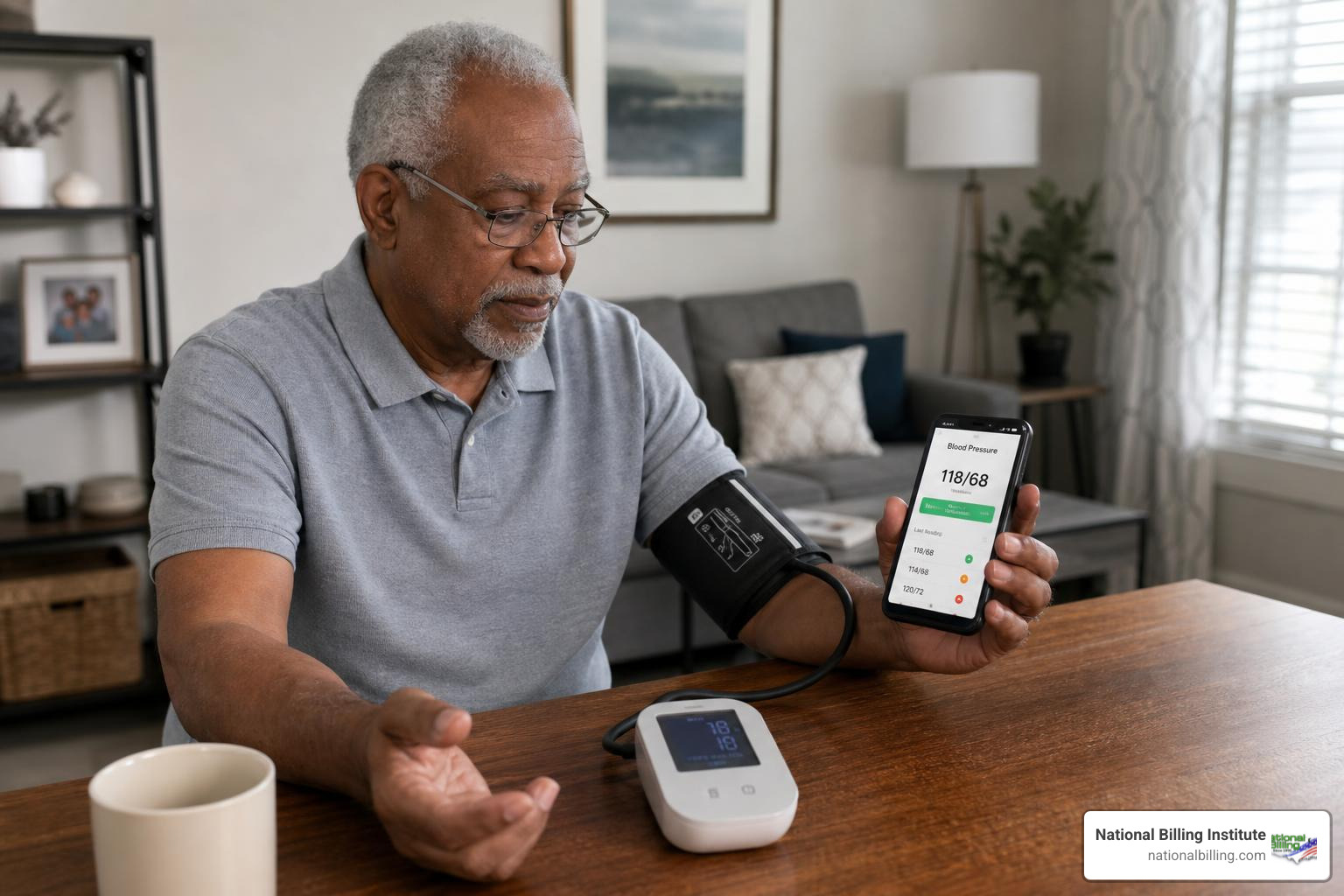
It is critical to note that RPM codes are considered asynchronous care management services, not interactive telehealth. Therefore, you should never append telehealth modifiers (like 95 or 93) to RPM codes.
You can bill RPM and CCM codes in the same month as telehealth E/M visits, provided that the time spent on care management (CCM) is completely separate from the time billed for the telehealth E/M encounter.
Navigating Medicare, Medicaid, and Commercial Payer Variations
The rules governing virtual care vary wildly depending on who is paying the bill:
Medicare FFS: Uses POS 10 and 100% home-based non-facility rates. Does not require Modifier 95 for professional claims, relying instead on POS codes to identify telehealth.
Medicare Advantage (MA): MA plans are legally required to cover everything traditional Medicare covers, but they often require different modifiers (such as 95) and may offer expanded coverage for non-medical virtual services.
State Medicaid Programs: Medicaid is highly fragmented. Some states offer broad payment parity, while others restrict audio-only care or require legacy modifiers like GT.
Commercial Payers: Over 43 states and DC have enacted telehealth parity laws requiring private insurers to reimburse telehealth at the same rate as in-person care. However, many commercial contracts in 2026 have begun squeezing audio-only payments, reducing reimbursement rates to 70–85% of video visit rates.
To stay compliant, practices must maintain an active payer matrix. For a national perspective on managing these multi-payer streams, see our guide on USA Telemedicine Billing.
Preventing Common Telehealth Billing Errors and Denials
With denial rates for virtual care running significantly higher than traditional claims, avoiding simple mistakes is paramount. The most common errors we resolve for practices include:
Incorrect POS Selection: Billing POS 02 when the patient connected from home, resulting in a permanent 20-30% reduction in your payout.
Missing Patient Consent: Failing to document verbal or written patient consent for virtual care (especially for audio-only visits) in the encounter note.
Time Miscalculation: Telehealth E/M codes billed based on time must document the exact start and stop times, or the total time spent, along with a detailed description of the counseling or coordination of care.
Cross-State Licensure Violations: Billing for a telehealth visit where the patient was physically located in a state where the provider is not licensed. Under healthcare law, the patient's physical location at the time of service governs licensure.
If your practice is struggling with high rejection rates, studying standard Medical Billing Denial Codes and implementing a proactive Denials and Appeals Management strategy can recover thousands in lost monthly revenue.
Frequently Asked Questions About Telehealth Billing
Are audio-only telehealth visits still covered by Medicare in 2026?
Yes, but with strict limitations. Medicare continues to cover audio-only telehealth visits primarily for mental and behavioral health services, provided that the clinician has the technical capacity for video and the patient either lacks the technology or declines video. For non-behavioral services, audio-only coverage is highly restricted and requires the use of Modifier 93.
What is the difference between POS 02 and POS 10?
POS 10 indicates that the telehealth service was provided while the patient was in their own home, which reimburses at the higher, non-facility (office) rate. POS 02 is used when the patient is in a facility or location other than their home, which reimburses at the lower facility rate.
Do you still need modifier 95 with the new CPT 98000-98015 codes?
No. The new CPT 98000–98015 codes have the delivery modality (audio-video vs. audio-only) built directly into their code descriptions. However, because Medicare and several major commercial payers have not adopted these codes, you must still use standard E/M codes with Modifier 95 for video-based Medicare claims.
Conclusion
Mastering telehealth billing codes is no longer just an administrative task — it is a foundational pillar of your practice's financial health. With the constant shifts in Medicare extensions, the introduction of the 98000-series codes, and the strict rules governing POS 10 and POS 02, trying to manage your revenue cycle in-house can feel like chasing a moving target.
That is where we come in. At National Billing Institute, our 100% USA-based team in Boca Raton, FL, brings over 30 years of specialized medical billing experience to your practice. We maintain full HIPAA compliance, boast the industry's lowest denial rates, and consistently deliver a 15% to 30% increase in revenue for our clients by capturing missed virtual care codes, correcting POS errors, and stopping denials before they happen.
Stop leaving virtual care revenue on the table. Contact us today to Optimize your revenue with National Billing Services and get paid for every single visit you perform.
