
Stop losing money with these telemedicine billing experts
Navigating the 2025-2028 Medicare Telehealth Roadmap
The landscape of usa telemedicine billing is currently defined by a series of "cliffs" and transition periods. As we move through 2025, it is vital to understand that the flexibilities we grew accustomed to during the pandemic are not all permanent.
The most immediate date on the radar is September 30, 2025. This marks the "telehealth policy cliff" for several temporary waivers. Without further Congressional action, certain provider types—such as physical therapists, occupational therapists, and speech-language pathologists—could lose their eligibility to bill for distant site telehealth services. Furthermore, the broad permission to treat the patient's home as an originating site for all service types is tied to these expiring provisions.
However, the Consolidated Appropriations Act has extended many of the most critical Medicare Fee-for-Service (FFS) flexibilities through December 31, 2027. This includes:
The waiver of geographic requirements (allowing patients in urban areas to receive telehealth).
The allowance of the patient's home as an originating site.
The use of audio-only communication for certain services.
Starting January 1, 2028, the roadmap shifts significantly. Unless new legislation is passed, most non-behavioral health services will revert to pre-pandemic rules, requiring the patient to be located in a rural area and at a formal medical facility. For a deep dive into these shifting timelines, you can review the [PDF] Telehealth FAQ - CMS.
The In-Person Requirement for Mental Health
Behavioral health is the "exception to the rule" in many 2025-2028 guidelines, but it comes with its own strings attached. Under the Consolidated Appropriations Act, 2021, geographic restrictions for mental health services were permanently removed. This means patients can receive telemental health care in their homes regardless of whether they live in a rural or urban area.
The catch is the in-person visit requirement. Current guidelines suggest that for Medicare to reimburse telemental health, there must be an in-person visit within six months prior to the initial telehealth service, followed by an in-person visit every 12 months thereafter. While enforcement of this has been delayed, it is slated to become a major compliance hurdle by 2028. We recommend documenting any exceptions to this rule—such as when an in-person visit would be detrimental to the patient's health or when the patient is in a location where no in-person provider is available.
RHC and FQHC Billing Transitions
For our partners in safety-net clinics, usa telemedicine billing has undergone a massive structural shift. Historically, Rural Health Clinics (RHCs) and Federally Qualified Health Centers (FQHCs) could not serve as "distant site" providers (the site where the practitioner is located).
Currently, and through the end of 2027, RHCs and FQHCs can bill for synchronous telehealth services using HCPCS code G2025.
For non-behavioral health: Medicare pays a flat rate (roughly $95-$98) for G2025, which is a composite of the average of all PFS telehealth payment rates.
For mental health: RHCs and FQHCs can bill their standard Prospective Payment System (PPS) or All-Inclusive Rate (AIR) for telehealth visits, provided they meet the same requirements as in-person visits.
After the 2025 policy cliff, the ability for these clinics to act as distant sites for non-behavioral services remains a point of legislative contention. Staying updated via Billing for telehealth | Telehealth.HHS.gov is essential for these facilities to avoid sudden revenue drops.
Mastering usa telemedicine billing: CPT Codes and Place of Service Rules
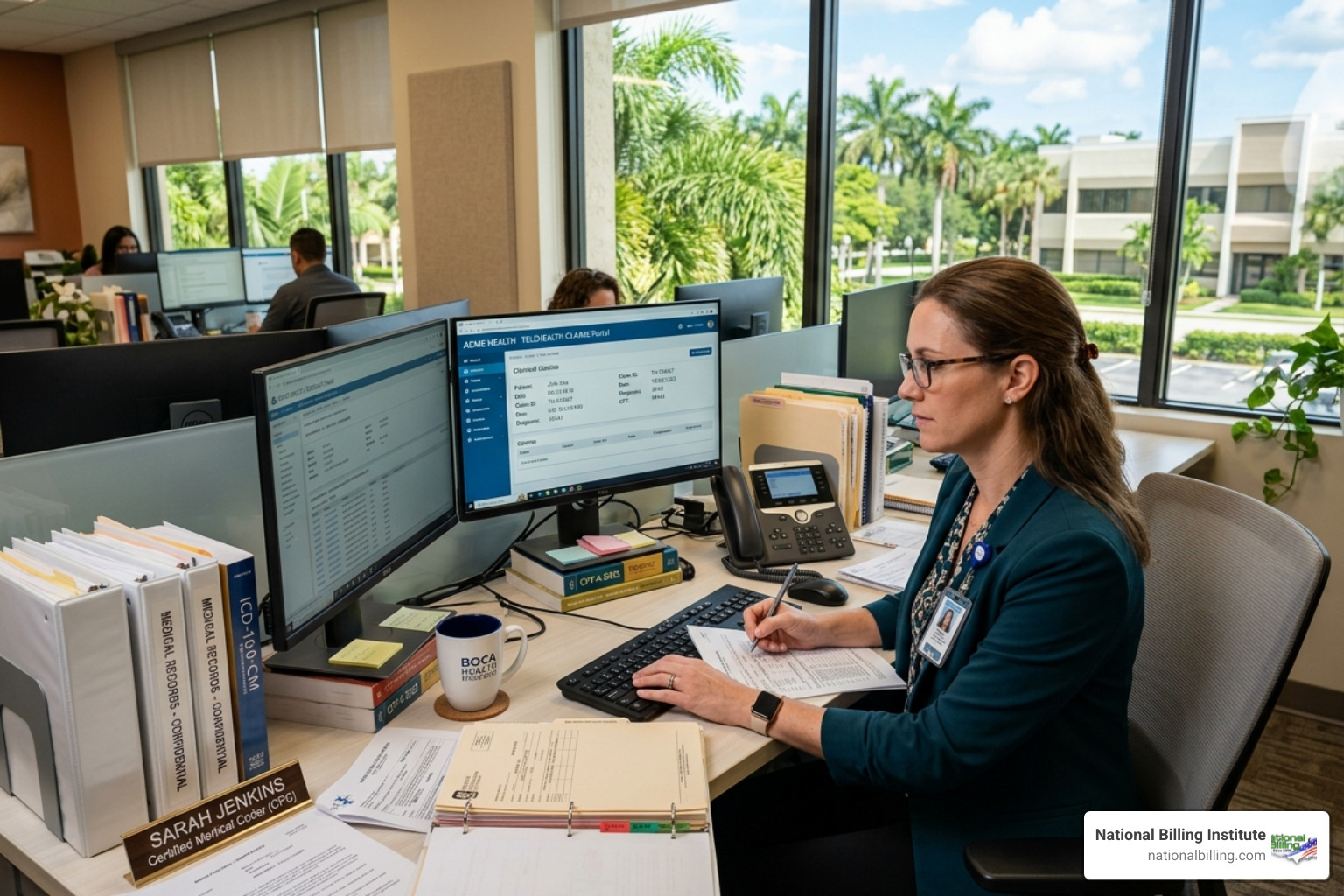
One of the most common reasons we see for claim denials at National Billing is the improper use of Place of Service (POS) codes. In usa telemedicine billing, the POS code tells the payer where the service "happened" and determines the reimbursement rate.
POS 02 vs. POS 10
In 2022, CMS introduced a distinction that every billing department must master:
POS 02 (Telehealth Provided Other than in Patient’s Home): Use this when the patient is at an originating site, such as a clinic, hospital, or physician's office. This typically triggers the "facility" rate of reimbursement, which is generally lower because the facility is expected to bill its own originating site fee.
POS 10 (Telehealth Provided in Patient’s Home): Use this when the patient is in their own residence. Under current Medicare rules, this typically pays at the "non-facility" rate, which is higher and comparable to what you would receive for an in-person office visit.
Feature POS 02 POS 10 Location Clinic, Hospital, SNF Patient's Private Home Reimbursement Facility Rate (Lower) Non-Facility Rate (Higher) Originating Fee Facility bills Q3014 No originating fee allowed
Misidentifying the patient's location doesn't just result in a lower payment; it can trigger an audit if the documentation doesn't match the code.
Essential CPT and HCPCS Codes for usa telemedicine billing
While there are hundreds of codes on the CMS Telehealth Services List, a few workhorses handle the bulk of the volume. For primary care, the Evaluation and Management (E/M) codes 99202-99205 (new patients) and 99211-99215 (established patients) are standard.
For behavioral health, psychotherapy codes 90832-90837 are used extensively. If you are the facility hosting the patient while they speak to a remote specialist, you should bill Q3014 (the telehealth originating site facility fee), which currently reimburses around $28-$30.
We are also seeing a massive rise in Remote Patient Monitoring (RPM). Codes like 99453 (initial setup) and 99457/99458 (monthly monitoring) are excellent ways to supplement income, especially for chronic care management. These codes often don't require the same "telehealth" modifiers because they are inherently remote services. You can find a detailed breakdown of these rates at Telehealth Reimbursement Rates and CPT Codes | National Telehealth Authority.
Audio-Only and Behavioral Health in usa telemedicine billing
Not every patient has the bandwidth or the hardware for a 4K video stream. Medicare has made audio-only coverage permanent for behavioral health services, provided the provider has the technical capability for video but the patient either cannot or chooses not to use it.
When billing audio-only for mental health, you must append Modifier FQ. For non-behavioral services that allow audio-only during the current waiver period (through 2027), Modifier 93 is typically required to indicate a synchronous telecommunications service rendered via audio-only technology. For brief "virtual check-ins" (5-10 minutes), use HCPCS code G2252. More resources on these specific conditions can be found at Telehealth for chronic conditions.
Medicaid and Private Insurance: State Parity and Licensure
Medicaid is a different beast entirely. Because Medicaid is state-run, there is no "one size fits all" rule for usa telemedicine billing. Some states are incredibly progressive, offering full payment parity, while others only reimburse a fraction of the in-person rate.
As of 2025, 24 states and Washington D.C. have enacted "payment parity" laws. These laws legally require private insurers to reimburse providers for telehealth services at the same rate they pay for in-person visits. If you practice in a non-parity state, you might see reimbursements that are 20-30% lower for the exact same CPT code.
The Licensure Trap
This is where many providers get into legal trouble. In usa telemedicine billing, the service is legally considered to take place at the patient's location. If you are sitting in our home town of Boca Raton, FL, but your patient is in Georgia, you must be licensed to practice in Georgia (or be covered by a compact like the IMLC). Billing a claim for a patient in a state where you aren't licensed is a fast track to a "fraud and abuse" investigation.
For a state-by-state breakdown of these rules, refer to Reimbursement for Telehealth and Provider and Facility Guidelines.
Private Payer Requirements and Modifiers
Commercial payers like Aetna, Cigna, and UnitedHealthcare often lag behind Medicare in updating their systems. While Medicare has moved toward using POS codes (02 and 10) to identify telehealth, many private payers still require Modifier 95 (synchronous telemedicine) to be appended to the CPT code.
Failure to verify the specific modifier requirements for a commercial contract is a leading cause of "missing/invalid modifier" rejections. At National Billing, we recommend performing a dedicated eligibility verification for telehealth benefits before every visit, as some employer-sponsored plans have specific "carve-outs" that only allow patients to use certain third-party telehealth platforms. Learn more about how we handle these complexities at Why choose National Billing.
Compliance and Revenue Cycle Management Strategies

Compliance in usa telemedicine billing isn't just about the code; it's about the "paper trail." To survive a CMS or OIG audit, your documentation must explicitly state:
That the visit was conducted via telehealth.
The specific technology used (e.g., "secure HIPAA-compliant video platform").
The physical location of the provider and the patient.
That the patient provided informed consent for a virtual visit.
Documentation and BAAs
You cannot bill for a telehealth visit conducted via FaceTime or Skype. You must use a platform that will sign a Business Associate Agreement (BAA). Without a BAA, you are in violation of HIPAA, and any claims generated from those sessions are technically non-reimbursable.
Our team at National Billing ensures that your technology stack and your billing workflow are fully integrated and compliant. Check out our full range of Services to see how we protect your practice.
Avoiding Common Telemedicine Billing Errors
We've analyzed thousands of denied telehealth claims, and the "Top 3" errors are remarkably consistent:
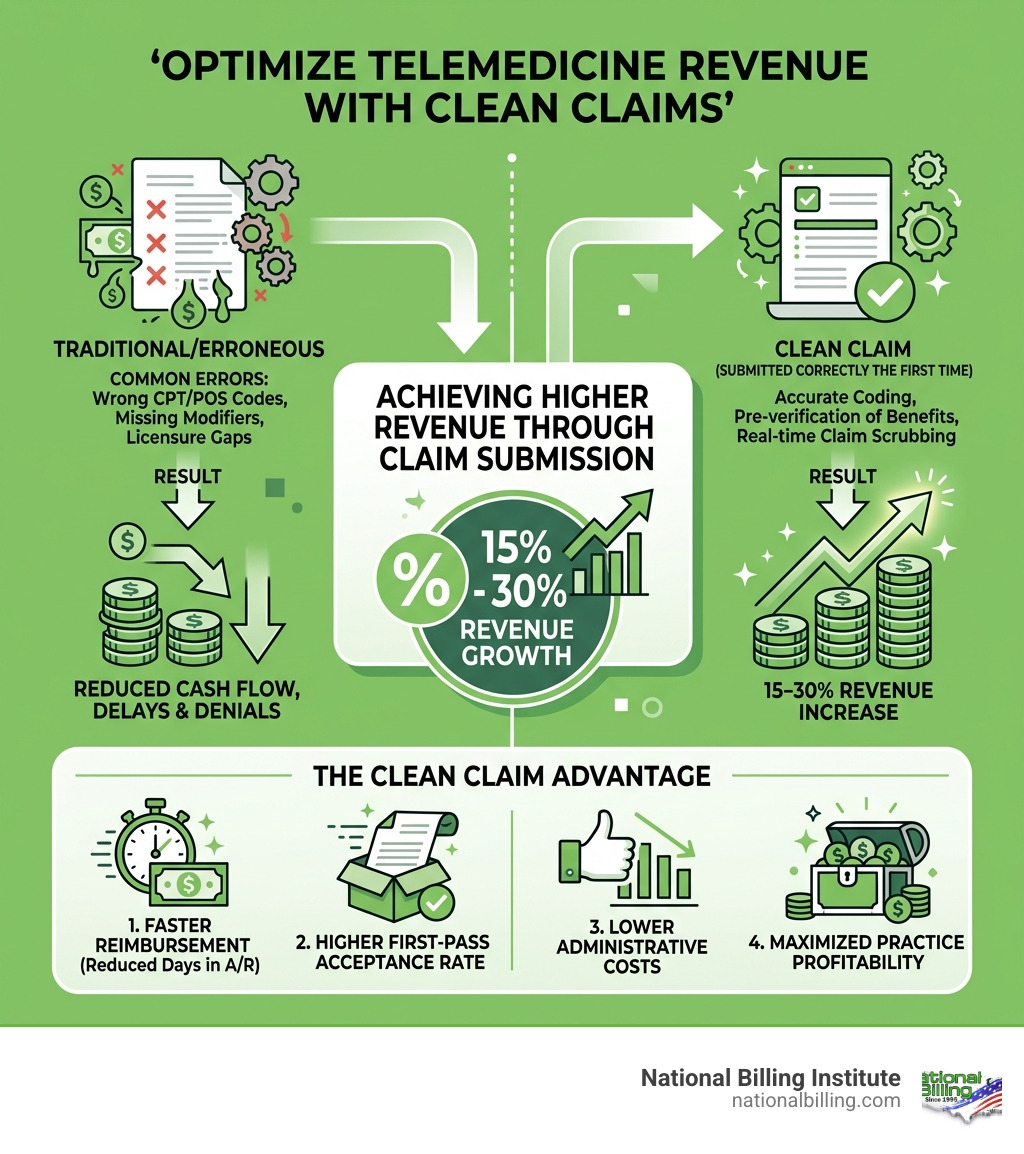
Wrong POS Code: Using POS 11 (Office) instead of 02 or 10. This is an automatic "red flag" for auditors because it implies you are billing for office overhead that wasn't used.
Missing Modifiers: Forgetting Modifier 95 for commercial payers or Modifier FQ for audio-only mental health.
Licensure Gaps: Billing for a patient who was "on vacation" in another state where the provider isn't licensed.
Our AI-automated scrubbing technology catches these errors before they ever reach the payer. By "scrubbing" the claim against a database of state-specific and payer-specific rules, we ensure that your first-pass clean claim rate stays above 98%.
Frequently Asked Questions about USA Telemedicine Billing
What is the "telehealth policy cliff" occurring in 2025?
The "policy cliff" refers to the expiration of temporary waivers granted during the Public Health Emergency. On September 30, 2025, several flexibilities are set to expire, including the eligibility of certain non-physician providers (like PTs and OTs) to bill for telehealth and the broad allowance of home-based originating sites for all services. However, many other Medicare flexibilities have been extended through 2027.
When should I use Place of Service (POS) code 10 vs 02?
Use POS 10 if the patient is at their home (non-facility rate). Use POS 02 if the patient is at a healthcare facility or any location other than their home (facility rate). Choosing the wrong one can lead to underpayment or audit risk.
Are audio-only services permanently covered by Medicare?
Audio-only coverage is permanently allowed for mental and behavioral health services, provided the provider has video capability but the patient cannot or will not use it. For most other medical services, audio-only is a temporary flexibility that is currently scheduled to expire after December 31, 2027.
Conclusion
The era of "easy" telehealth billing is over. As the temporary waivers of the pandemic expire and are replaced by a patchwork of permanent rules and shifting deadlines, providers can no longer afford a "set it and forget it" approach to their revenue cycle.
At National Billing Institute, we specialize in navigating the minefield of usa telemedicine billing. Based in Boca Raton, FL, our 100% USA-based team brings over 30 years of experience to your practice. We don't just process claims; we optimize your entire revenue cycle using AI-automated scrubbing and expert denial management.
Our clients typically see a 15-30% increase in revenue and enjoy the peace of mind that comes with the industry's lowest denial rates and full HIPAA compliance. Don't let confusing POS codes or expiring waivers drain your practice's bank account.
Stop losing money and optimize your revenue today by partnering with the experts at National Billing Institute. Let us handle the codes so you can focus on your patients.
