
Everything You Need to Know About CMS Telehealth Codes
Why CMS Telehealth Billing Codes Are Harder to Get Right Than Ever in 2026
CMS telehealth billing codes determine whether your virtual care claims get paid — or denied. Here is a quick reference to the most critical codes and rules for 2026:
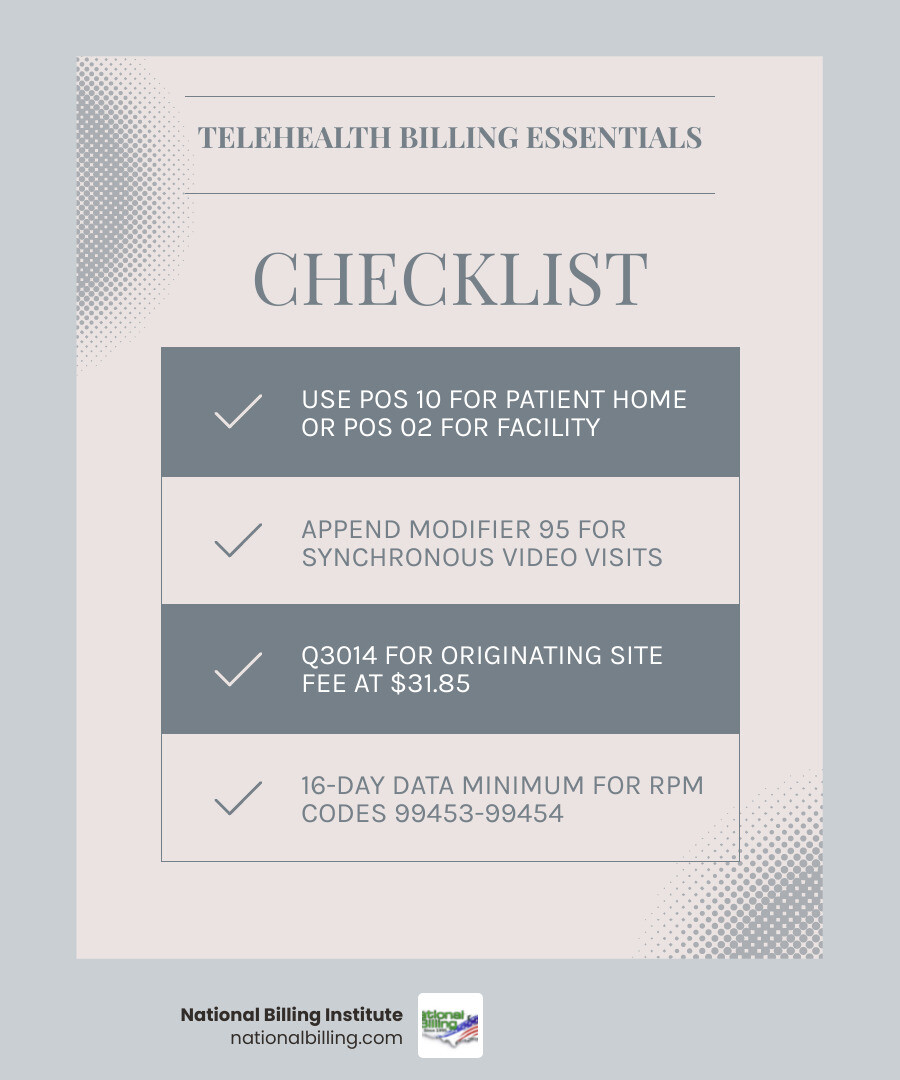
Category Code(s) Key Rule E/M Telehealth (new patient) 99202–99205 Use POS 10 (home) or POS 02 (facility) E/M Telehealth (established) 99211–99215 Append Modifier 95 for synchronous video Virtual Check-In G2012 5–10 min; verbal consent required Originating Site Facility Fee Q3014 $31.85 in 2026; billed by hosting facility Audio-Only Telehealth 99441–99443 Modifier 93 + FQ (FQHCs/RHCs) Remote Patient Monitoring 99453, 99454 Device must meet FDA definition; 16-day data minimum Behavioral Health 90832–90837 In-person visit required within 6 months of first telehealth visit
Over 250 codes are now eligible for Medicare telehealth reimbursement. Telehealth utilization is 38 times higher than pre-pandemic levels, and more than $10 billion in telehealth services were billed to Medicare in 2025 alone. The stakes for getting the coding right have never been higher.
Yet most claim denials don't come from the wrong CPT code. They come from a wrong Place of Service, a missing modifier, or a documentation gap — errors that are easy to miss and hard to catch after the fact.
2026 is also a transition year. Key Medicare flexibilities were extended only through January 30, 2026, and CMS has introduced structural changes — including eliminating the "provisional" service category entirely. If your billing team is not keeping pace, you are likely leaving money on the table.
I'm Olivia Harper, Founder of National Billing Institute and a denial management specialist with over 30 years of hands-on experience navigating CMS telehealth billing codes and Medicare revenue cycle management. In this guide, I'll walk you through exactly what your practice needs to know to bill telehealth correctly, compliantly, and profitably in 2026.
Core CMS Telehealth Billing Codes and CPT Categories for 2026

As we move through 2026, the List of Telehealth Services | CMS remains the ultimate source of truth. There are currently more than 250 codes on the Medicare telehealth services list that are eligible for reimbursement. While the list was once divided into "permanent" and "provisional" categories, CMS has streamlined this for CY 2026, moving away from temporary classifications to provide a more stable regulatory environment.
For most providers, the bulk of billing involves Evaluation and Management (E/M) visits, but virtual care has expanded far beyond simple office visits. We also see heavy utilization of:
HCPCS G2012 (Virtual Check-ins): A brief communication service (5–10 minutes) for established patients to determine if an office visit is necessary.
HCPCS G2010 (Remote Image Evaluation): Also known as "Store and Forward," this allows providers to evaluate recorded images or videos sent by a patient.
E-Visits (CPT 99421–99423): Online digital evaluation and management services conducted via secure patient portals over a 7-day period.
Understanding USA Telemedicine Billing requires recognizing that these services are no longer "emergency" measures; they are foundational to modern practice.
Evaluation and Management (E/M) cms telehealth billing codes
The most common cms telehealth billing codes for 2026 are the standard E/M codes:
New Patients: CPT 99202–99205
Established Patients: CPT 99211–99215
In 2026, time-based coding has become a strategic tool. Total time measurement now officially includes pre-service, intra-service, and post-service time on the date of the encounter. This means your time spent reviewing charts, ordering medications, or documenting in the EHR can count toward your billable level, provided it occurs on the same day as the visit. For an established patient (99214), the threshold is typically 30–39 minutes of total time. If you aren't billing by time, you must ensure your Medical Decision Making (MDM) documentation is robust enough to support the chosen level. You can find a detailed breakdown in this Telehealth CPT Codes (2025–2026): Updated List with Modifiers resource.
Remote Patient Monitoring (RPM) and Therapeutic Monitoring (RTM)
Remote monitoring has evolved into a permanent fixture for managing both chronic and acute conditions. According to the Telehealth & Remote Monitoring MLN Booklet, the core codes include:
CPT 99453: Initial setup and patient education on use of equipment.
CPT 99454: Device supply with daily recordings or programmed alerts transmission, each 30 days.
CPT 98975: Initial setup and education for Remote Therapeutic Monitoring (RTM).
A critical compliance rule for 2026 is the 16-day data requirement. For most RPM codes, the device must monitor and transmit physiological data for at least 16 days out of a 30-day period. Furthermore, the device used must meet the FDA definition of a medical device, and data collection must be automated rather than patient-reported for RPM.
Essential Modifiers and Place of Service (POS) Rules
One of the most common reasons for claim denials we see at National Billing Institute is the incorrect use of Place of Service (POS) codes. In 2026, the distinction between where the patient is located is paramount for reimbursement accuracy.
POS 02 (Telehealth Provided Other than in Patient’s Home): Use this when the patient is at a facility (like a rural clinic or hospital).
POS 10 (Telehealth Provided in Patient’s Home): Use this when the patient is at their private residence.
The choice between these two impacts your payment. Medicare typically pays a higher "non-facility" rate for POS 10 because it assumes the provider is bearing more of the overhead cost. Misidentifying the location is a high-risk audit area. For more details, see Telehealth Billing and Coding: CPT Codes and Place-of-Service Rules | National Telehealth Authority and our guide on Telehealth Billing Modifiers.
Required Modifiers for cms telehealth billing codes
Modifiers tell the story of how the service was delivered. The primary Telehealth Modifiers 2026 include:
Modifier 95: Synchronous telemedicine service rendered via a real-time interactive audio and video telecommunications system.
Modifier 93: Synchronous telemedicine service rendered via audio-only telecommunications.
Modifier GQ: Used for asynchronous "store and forward" technology (mainly limited to federal demonstration programs in Alaska and Hawaii).
Modifier GT: While largely replaced by POS codes for Medicare, it is still required by some state Medicaid programs and private payers.
Special Modifiers for FQHCs and RHCs
Federally Qualified Health Centers (FQHCs) and Rural Health Clinics (RHCs) have unique requirements. When these facilities act as the distant site, they must use specific modifiers to ensure proper payment under the all-inclusive rate or prospective payment system.
Modifier FQ: Used for services furnished using audio-only communication.
Modifier 93: Also applied for audio-only encounters to align with CPT standards.
As noted in How to Bill Telemedicine Visits 2025, RHCs and FQHCs have been granted an extension to bill as distant sites through December 31, 2026.
2026 Reimbursement Rates and Facility Fees
The financial landscape of telehealth is adjusted annually through the Medicare Economic Index (MEI). For CY 2026, CMS has implemented a 2.7% MEI increase. This adjustment affects both the professional fees and the facility fees.
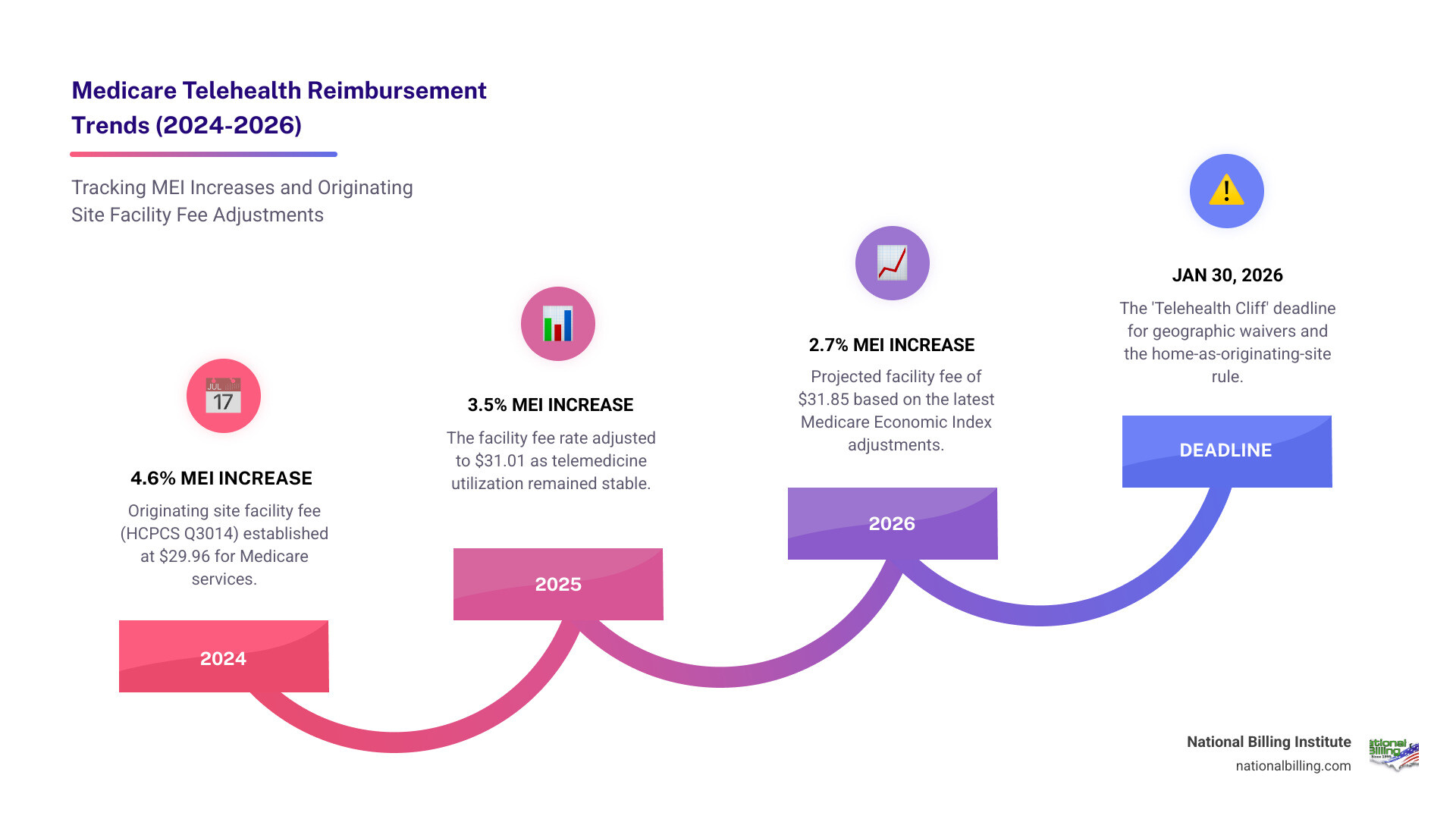
Year MEI Increase Originating Site Facility Fee (Q3014) 2024 4.6% $29.96 2025 3.5% $31.01 2026 2.7% $31.85
Staying updated on Telehealth Reimbursement Rates and CPT Codes | National Telehealth Authority is essential for accurate revenue forecasting.
Calculating the Originating Site Facility Fee (Q3014)
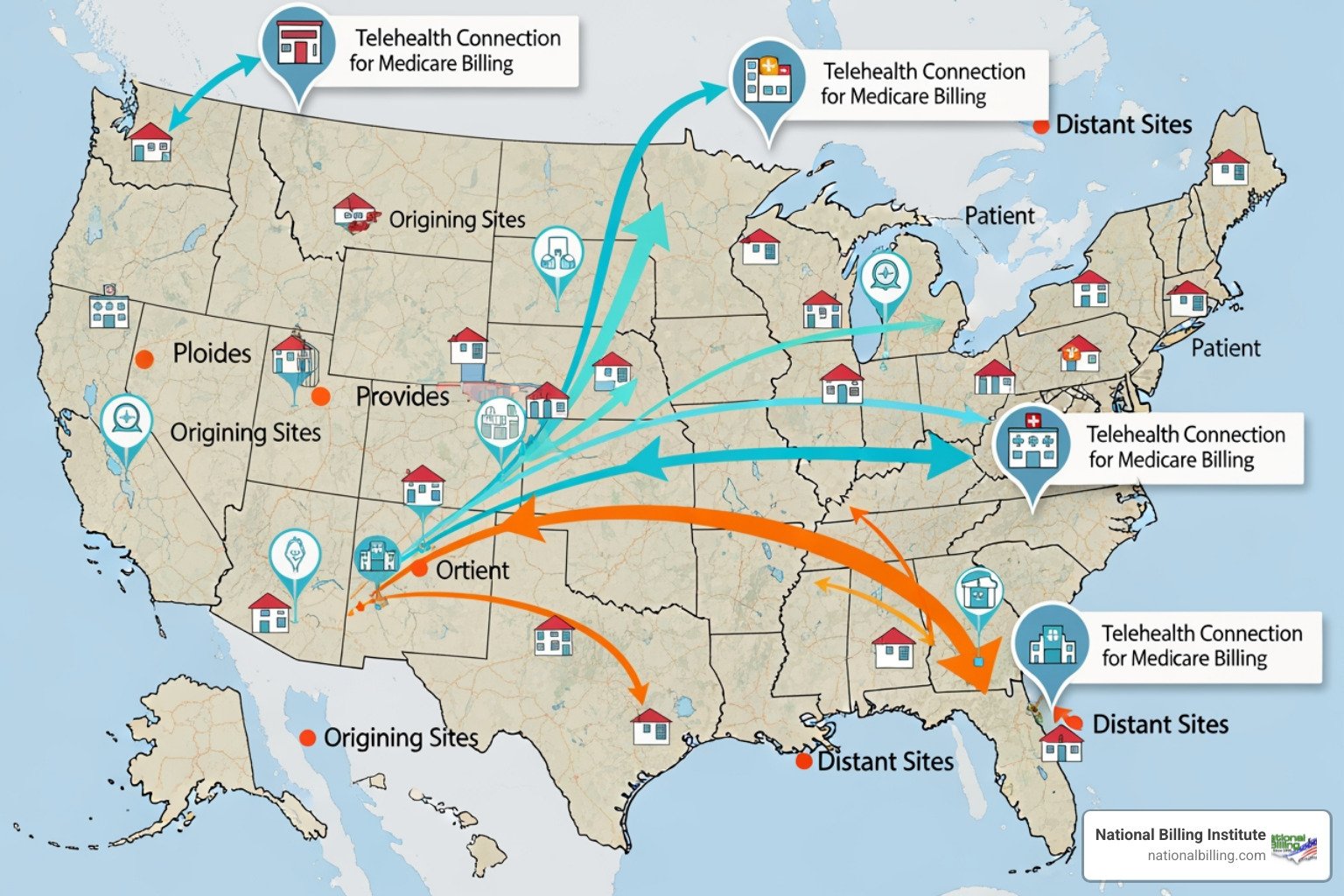
If your facility hosts a patient who is seeing a specialist elsewhere via telehealth, you are entitled to the Originating Site Facility Fee.
HCPCS Code: Q3014
2026 Rate: $31.85
This fee is designed to cover the costs of the room, the technology, and the staff required to facilitate the visit. The distant site provider (the one on the screen) cannot bill this fee; only the facility where the patient is physically located can. You can find the full List of Telehealth Services | CMS for more details. For a step-by-step guide, check out How to Bill for Telemedicine Visits.
Policy Extensions and the 2026 "Telehealth Cliff"
We are currently navigating what many in the industry call the "telehealth cliff." While the Consolidated Appropriations Act extended many pandemic-era flexibilities, several of these are tied to a January 30, 2026 deadline. This includes:
The waiver of geographic restrictions (allowing patients in urban areas to receive telehealth).
The allowance of the patient's home as an originating site.
The expanded list of eligible practitioners (PTs, OTs, Speech Pathologists).
However, behavioral health has been granted more permanent status. Audio-only telehealth for mental health is now a permanent fixture of the Medicare program, provided certain conditions are met.
Eligibility, Technology, and Documentation Requirements
To successfully bill cms telehealth billing codes, the technology used must meet specific federal standards. Medicare requires an interactive audio and video telecommunications system that permits real-time communication between the provider and the patient. While HIPAA enforcement discretion has technically ended, providers must continue to use platforms that offer end-to-end encryption and enter into Business Associate Agreements (BAAs).
Documentation is your best defense against audits. Every telehealth note should include:
A statement that the service was provided via telehealth.
The specific modality used (e.g., "Synchronous audio-video").
The physical location of both the patient and the provider.
Documentation of verbal or written patient consent.
Start and end times (especially for time-based billing).
Audio-Only vs. Audio-Video Modality Rules
While audio-video is the "gold standard," CMS recognizes that not every patient has access to high-speed internet. Audio-only services are permanently allowed for behavioral and mental health if the patient is at home and is unable or unwilling to use video. In these cases, you must use Modifier 93 (or FQ for RHCs/FQHCs) and document the reason why video was not used. For non-behavioral health services, the allowance for audio-only is much stricter and often tied to specific temporary extensions.
Mental Health and Behavioral Health Special Requirements
The Telehealth & Remote Monitoring MLN Booklet outlines a specific "in-person" requirement for telemental health. Generally, an in-person visit must occur within 6 months of the initial telehealth visit and at least once every 12 months thereafter. There are exceptions to this rule based on patient clinical stability and geographic location, but these must be clearly documented in the medical record to avoid denials for codes 90832–90837.
Common Errors and Compliance in cms telehealth billing codes
At National Billing Institute, we’ve identified several recurring "red flags" that trigger Medicare audits or immediate denials:
Using POS 11 for Telehealth: This is the code for an office visit. Using it for a virtual visit is a top cause of denials.
Unbundling RPM: Trying to bill for setup (99453) every month instead of just once per episode of care.
Missing Consent: Failing to document that the patient agreed to the telehealth format and understands their cost-sharing responsibility.
Ineligible Modalities: Billing a standard E/M code for a text-message-based interaction.
According to the National Telehealth Authority, "Modifier fatigue" is a real operational burden. Billing teams must manage distinct rule sets for dozens of different payers simultaneously, which is why AI-automated processing has become so vital in 2026.
Documentation Standards for Audit Protection
To ensure your practice survives a CMS audit, your documentation must prove "medical necessity" just as it would for an in-person visit. We recommend using EMR templates that automatically prompt for:
The name of the HIPAA-compliant platform used (e.g., "Doxy.me," "Zoom for Healthcare").
A confirmation that the provider’s location is suppressed in PECOS if they are working from a home office.
A clear link between the telehealth service and the patient's long-term plan of care.
Frequently Asked Questions about CMS Telehealth
What is the difference between POS 02 and POS 10 in 2026?
POS 10 is used when the patient is at their residence. POS 02 is used when the patient is at a healthcare facility other than their home. POS 10 typically results in a higher "non-facility" reimbursement rate from Medicare.
Can FQHCs and RHCs bill as distant sites for telehealth?
Yes, under current extensions, FQHCs and RHCs can serve as distant sites for telehealth services through December 31, 2026. They should use HCPCS code G2025 for most medical telehealth services.
Is an in-person visit required for all telehealth services?
No. For most medical services, the in-person requirement is currently waived. However, for mental health services, an in-person visit is generally required within 6 months of the start of telehealth treatment and annually thereafter.
Conclusion
Navigating cms telehealth billing codes in 2026 requires a mix of technical precision and regulatory foresight. With the "telehealth cliff" approaching in late January and the permanent shift toward value-based specialty models, practices can no longer afford "guesswork" in their billing departments.
At National Billing Institute, we help healthcare providers eliminate the stress of virtual care billing. Our 100% USA-based team in Boca Raton, FL, leverages 30+ years of experience and advanced AI-automated claims processing to deliver the industry's lowest denial rates. We don't just process claims; we optimize your entire revenue cycle, typically increasing provider revenue by 15–30%.
If your telehealth billing is generating denials or if you're worried about the 2026 policy shifts, let us help you stay compliant and profitable. Contact National Billing for Expert Telehealth Services today for a free consultation.
