How to Use Telehealth Modifiers Without Losing Your Mind
Why Getting Your Telehealth Modifier Right Is Make-or-Break for Your Revenue
A telehealth modifier is a code you add to a claim to tell the payer how a service was delivered — by live video, audio-only phone, or recorded (store-and-forward). Using the wrong one, or skipping it entirely, is one of the fastest ways to trigger a denial.
Here is a quick reference for the modifiers you will use most often:
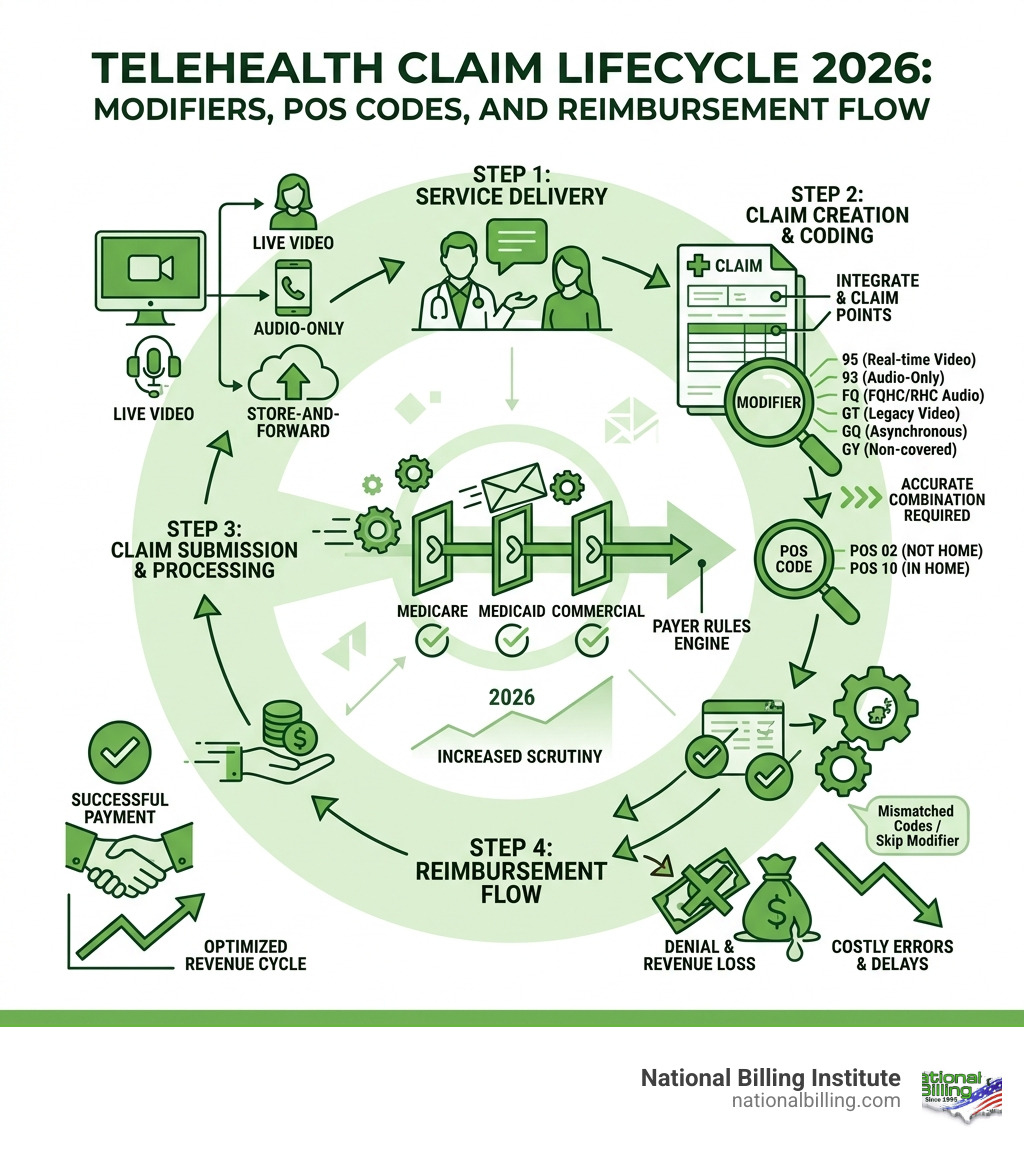
Modifier What It Means Who Uses It 95 Synchronous real-time audio and video Most commercial payers; behavioral health; therapy 93 Synchronous audio-only (phone) Medicare and many payers when video is unavailable or patient declines GT Interactive audio-video (legacy) CAH Method II institutional claims; some Medicaid and commercial plans GQ Asynchronous store-and-forward Alaska and Hawaii federal demo programs FQ Audio-only real-time FQHCs and RHCs billing audio-only services GY Non-covered service Used when originating site requirements are not met
And the two Place of Service codes that work alongside these modifiers:
POS 02 — Telehealth delivered somewhere other than the patient's home (e.g., a clinic or facility)
POS 10 — Telehealth delivered in the patient's home (including temporary lodging)
Getting the modifier and the POS code right on the same claim matters. One wrong digit can flip your reimbursement rate or send the claim straight to denials.
Telehealth billing has never been simple, but 2026 adds a new layer of pressure. The COVID-era Public Health Emergency (PHE) flexibilities that many practices quietly relied on for years are winding down. Geographic restrictions are returning for most services. Audio-only rules have tightened. And payers — Medicare, Medicaid, and commercial insurers — each have their own modifier requirements that do not always match.
The result? More opportunities for costly errors at exactly the moment when your revenue cycle can least afford them.
One denial for a mismatched modifier might cost you $46 on a straightforward E/M visit. Multiply that across hundreds of claims per month, and the losses compound fast — often without your billing team even realizing where the leak is coming from.
I'm Olivia Harper, Founder of National Billing Institute and a denial management specialist with over 30 years of experience navigating telehealth modifier rules, payer policy changes, and claim audits for practices across the country. In this guide, I'll walk you through exactly which telehealth modifiers to use, when to use them, and how to avoid the mistakes that quietly drain revenue.
The Essential Telehealth Modifier Toolkit for 2026
Navigating a telehealth modifier can feel like learning a second language, but it is the key to getting paid. As we move through 2026, the distinction between synchronous and asynchronous care is the foundation of your billing strategy.
Synchronous care refers to "real-time" interaction. This is your standard video call or phone session where the provider and patient are talking live. Asynchronous care, often called "store-and-forward," involves sending data like images or recorded videos to a provider who reviews them later. Each requires a specific telehealth modifier to satisfy payer requirements.

According to official Telehealth service modifiers - FCSO Medicare guidance, using these tools correctly ensures that the "distant site" (where the provider is) and the "originating site" (where the patient is) are aligned in the eyes of the auditor.
When to Apply the Modifier 95 Telehealth Modifier
Modifier 95 is the heavyweight champion of telehealth billing. It signifies a synchronous service rendered via interactive audio and video telecommunications. If you can see the patient and they can see you, and you are using a HIPAA-compliant platform with at least 128-bit encryption, Modifier 95 is likely your go-to.
However, you cannot just slap Modifier 95 on any code. It is generally limited to the services listed in CPT Appendix P. This includes:
Office or other outpatient E/M visits (99202–99215)
Many behavioral health and psychiatric diagnostic evaluations
Certain nutritional and educational services
While Medicare has transitioned toward using Place of Service (POS) codes to identify telehealth, many commercial payers still require Modifier 95 to trigger reimbursement. In 2026, it remains essential for outpatient therapy services provided by PTs, OTs, and SLPs.
Using the Modifier 93 Telehealth Modifier for Audio-Only
What happens when the video fails, or the patient simply doesn't have the technology? That is where Modifier 93 comes in. Introduced to account for synchronous audio-only services, this telehealth modifier is used when the encounter is limited to a phone call.
To use Modifier 93, we must ensure several conditions are met:
The provider must have the capacity for video, but the patient must either be unable to use it or decline it.
The patient's preference for audio-only must be clearly documented in the medical record.
The service must be on the approved list for audio-only delivery (which is more restrictive than the full telehealth list).
Medicare allows Modifier 93 for mental health services and certain Opioid Treatment Program (OTP) assessments. It is a vital tool for maintaining access to care for underserved populations who may struggle with the "digital divide."
Navigating Place of Service: POS 02 vs. POS 10
The modifier tells the payer how you did the work; the Place of Service (POS) code tells them where the patient was. This distinction is critical because it determines whether you are paid at a "facility" or "non-facility" rate.

Since 2022, CMS has used two specific codes to clear up the confusion:
POS 02 (Telehealth Provided Other than in Patient’s Home): Use this if the patient is at a clinic, a hospital, or a rural health center acting as an originating site.
POS 10 (Telehealth Provided in Patient’s Home): Use this when the patient is in their private residence. This also includes temporary lodging like a hotel or even a car, provided they have the privacy needed for a clinical encounter.
The reimbursement impact is significant. As noted in Telehealth Billing and Coding: CPT Codes and Place-of-Service Rules | National Telehealth Authority, POS 10 typically triggers the "non-facility" rate, which is higher because it assumes the provider is bearing the full cost of the overhead. In 2026, getting these mixed up can result in an overpayment (which you'll have to give back) or an underpayment (which hurts your bottom line).
Medicare Evolution and the 2026-2027 Landscape
We have come a long way from the pre-pandemic days when telehealth was restricted to a handful of rural patients. As of April 2026, there are more than 250 codes on the Medicare telehealth services list eligible for reimbursement.
The big news for CY 2026 is the elimination of the distinction between "provisional" and "permanent" services. CMS has moved to a permanent list, providing much-needed stability for practices. Additionally, the "One Big Beautiful Bill Act" and subsequent extensions have pushed several key flexibilities through the end of 2027, including:
Allowing Federally Qualified Health Centers (FQHCs) and Rural Health Clinics (RHCs) to continue serving as distant site providers.
Expanding virtual supervision rules, allowing teaching physicians to be "virtually present" via real-time audio/video for many services.
Originating Site Fees and Rural Restrictions
While many restrictions were lifted, the "originating site facility fee" (HCPCS code Q3014) is still a factor when the patient is not at home. For CY 2026, this fee has increased to $31.85, based on a 2.7% Medicare Economic Index (MEI) increase.
Only the facility where the patient is physically located can bill Q3014. If the patient is at home (POS 10), no originating site fee is billable. This is a common point of confusion for providers who try to bill the fee for their own office while they are talking to a patient at home—don't do it!
Specialized Modifiers: FQ, GQ, and GY
Beyond the common 95 and 93, there are specialized modifiers you might encounter:
Modifier FQ: Used specifically by RHCs and FQHCs for audio-only mental health services. It tells Medicare that the service was "real-time" but audio-only.
Modifier GQ: This is for asynchronous (store-and-forward) telehealth. Currently, Medicare only pays for this under federal demonstration programs in Alaska and Hawaii. However, some commercial payers use it for dermatology or radiology "reads."
Modifier GY: This is a "safety" modifier. You use it when you know a service is not covered by Medicare (perhaps because it doesn't meet originating site requirements) but you need a formal denial to bill the patient's secondary insurance.
Avoiding Common Telehealth Modifier Mistakes
Even the most seasoned billing teams make mistakes. In our 30+ years at National Billing Institute, we have seen it all. The most common "revenue killers" include:
Wrong Modality: Using Modifier 95 (video) for a phone call (should be 93). This is an audit red flag.
POS/Modifier Mismatch: Using POS 11 (Office) for a telehealth visit. You must use 02 or 10.
Assuming Universal Rules: Thinking that because Medicare accepts a certain telehealth modifier, your local commercial payer will too. Many private payers still demand Modifier GT, even though Medicare has largely phased it out for professional claims.
Missing Documentation: Billing for telehealth without noting the technology used or the patient's location.
The AAFP provides excellent Telehealth Coding and Billing: Basics - AAFP resources that highlight how these small errors lead to "modifier fatigue" and increased denial rates.
Documentation Requirements for Audit Protection
Documentation is your only defense in an audit. If you didn't write it down, it didn't happen. In 2026, auditors are looking for specific details to justify the use of a telehealth modifier.
Requirement Video (Modifier 95) Audio-Only (Modifier 93) Technology Used Must name the platform (e.g., Zoom for Healthcare) Must state "audio-only" or "telephone" Patient Location Verified and documented (e.g., Patient's home) Verified and documented Provider Location Verified (e.g., Office or Home Office) Verified Consent Obtained and noted in the chart Must include why audio-only was used Medical Necessity Same as in-person Same as in-person
For Medicare, the provider's home address can be suppressed in the PECOS system for privacy, but it must still be on file as a practice location if that is where you are working from.
Frequently Asked Questions about Telehealth Modifiers
What is the difference between Modifier 95 and Modifier GT?
Modifier 95 is the modern standard for synchronous audio-video services. Modifier GT is a "legacy" modifier. While Medicare no longer requires GT for most professional services (preferring POS codes), it is still required for Critical Access Hospital (CAH) Method II institutional claims. Many commercial payers and some state Medicaid programs haven't updated their systems and still require GT. Always check your specific payer's manual!
When should I use POS 10 instead of POS 02?
Use POS 10 if the patient is in their home or a private residence. Use POS 02 if the patient is anywhere else—like a nursing facility, a hospital, or a rural clinic. This is vital because POS 10 usually pays at the higher "non-facility" rate, while POS 02 pays the "facility" rate.
Are audio-only services still reimbursable in 2026?
Yes, but with caveats. For behavioral and mental health, audio-only is broadly covered through the end of 2026. For other medical services, it is much more restrictive. You must use Modifier 93 (or FQ for RHCs/FQHCs) and document that the patient did not have access to or declined video technology.
Conclusion
Navigating the telehealth modifier maze doesn't have to be a nightmare. By understanding the nuances between 95, 93, and the new POS codes, you can protect your practice from audits and ensure every dollar you earn actually stays in your bank account.
At National Billing Institute, based in Boca Raton, FL, we’ve spent over 30 years perfecting the art of the clean claim. Our 100% USA-based team uses AI-automated processing and deep industry expertise to deliver the lowest denial rates in the business. Our clients typically see a 15-30% increase in revenue simply by fixing the small coding errors that others miss.
Don't let modifier confusion drain your revenue. More info about our medical billing services is just a click away. Let us handle the complexity so you can get back to what matters most: your patients.
