The Secret Life of POS 10 and Telehealth Billing
What POS 10 Means for Telehealth Billing (And Why It Matters)
POS 10 — the Place of Service code for telehealth services delivered to a patient in their home — is one of the most important codes in modern virtual care billing.
Quick answer:
Detail POS 10 Full name Telehealth Provided in Patient's Home Effective date January 1, 2022 (Medicare: April 1, 2022) When to use Patient receives telehealth from their private residence Reimbursement type Non-facility rate (typically higher) Common modifier Modifier 95 (synchronous audio-video)
Before 2022, there was only one telehealth POS code: POS 02. It covered all telehealth visits, regardless of where the patient was sitting. That worked fine when telehealth was rare. But as virtual care exploded — the CDC reported a 154% increase in telehealth use in 2020 alone — a single code was no longer enough.
CMS introduced POS 10 specifically to distinguish home-based telehealth from visits conducted at a clinic, office, or other facility. Choosing the wrong code between the two isn't just a technicality. It directly affects your reimbursement rate, your compliance exposure, and whether your claim gets paid at all.
I'm Olivia Harper, founder of National Billing Institute, and in my 30+ years of revenue cycle management I've seen POS 10 errors quietly drain revenue from practices that didn't even realize they were miscoding their telehealth claims. In the sections below, I'll walk you through exactly how to use this code correctly — so your claims go out clean and your reimbursements come back in full.
Understanding the Role of POS 10 in Modern Telehealth

When we talk about the "secret life" of pos 10, we are really talking about the evolution of how the Centers for Medicare & Medicaid Services (CMS) views the patient's living room. In the early days of telemedicine, the patient usually had to travel to a "spoke" site—like a local clinic—to talk to a specialist far away. Today, the "spoke" is the patient's sofa.
According to the official Place of Service Code Set | CMS, pos 10 is defined as: "The location where health services are provided or received through telecommunication technology when the patient is located in their home."
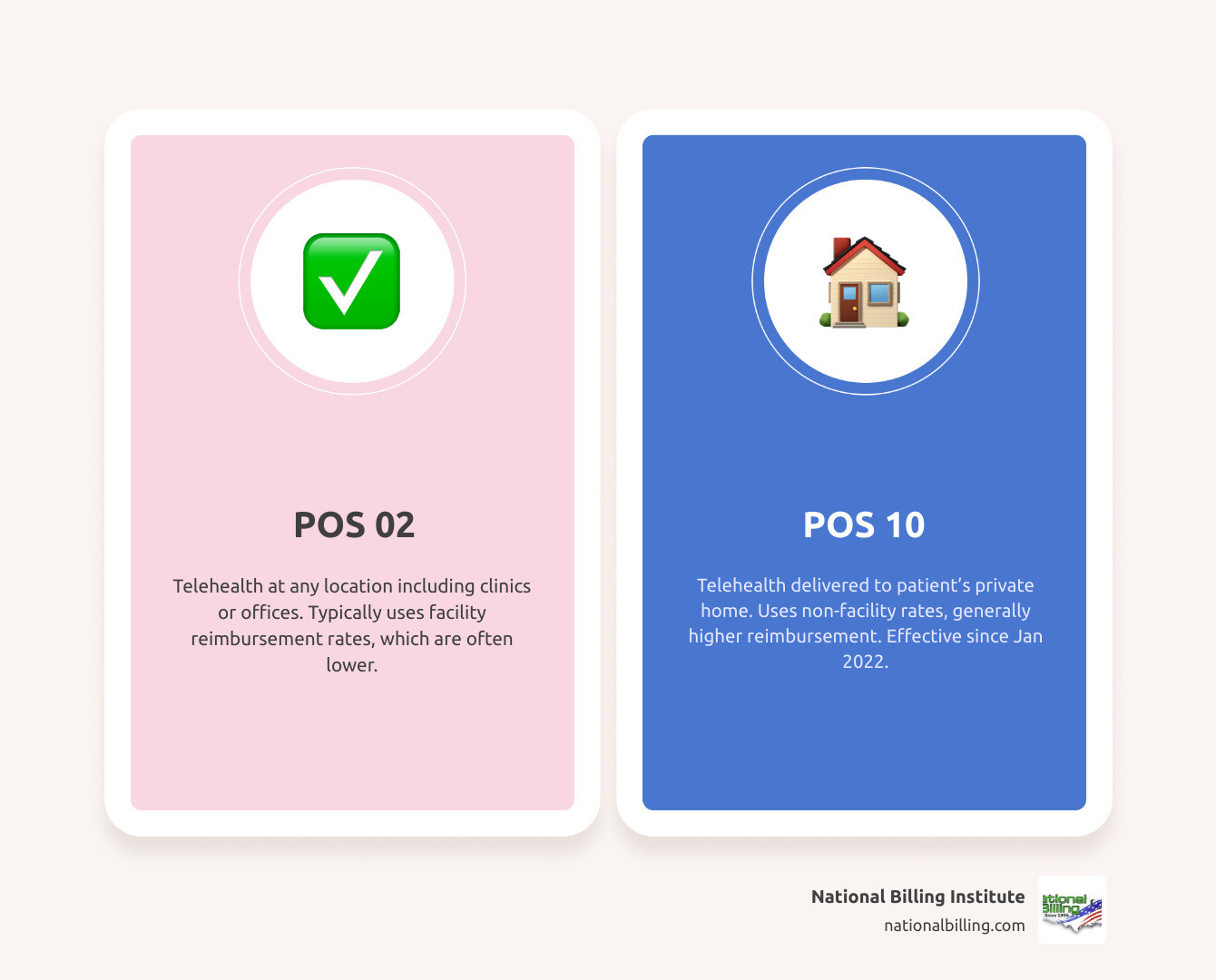
This code became effective on January 1, 2022, though Medicare didn't start fully processing it until April of that year. Its primary purpose is to identify that the patient is in a non-facility setting. This is a huge win for providers because, generally, services provided in a "home" setting are reimbursed at the non-facility rate, which is typically higher than the facility rate.
Why the higher pay? Because when a patient is at home, the billing provider is assumed to be bearing the full cost of the overhead, technology, and administrative work required to facilitate that visit. If you want to dive deeper into the basics of remote billing, check out our guide on How to Bill for Telemedicine Visits.
One nuance we often explain to our clients at National Billing Institute is what constitutes a "home." For the purposes of pos 10, a home can be a permanent residence, a temporary lodging (like a hotel or a relative's house), or even a dormitory. As long as it isn't a dedicated healthcare facility, it usually qualifies.
POS 10 vs. POS 02: Choosing the Right Code
The most common question we get in our Boca Raton office is: "When do I use 02 and when do I use 10?" It’s a great question because getting it wrong is a one-way ticket to a claim denial or, worse, an audit.
Here is the breakdown we use to keep things simple:
Feature POS 02 POS 10 Patient Location Anywhere other than their home (e.g., a clinic, hospital, or skilled nursing facility) The patient's home (permanent or temporary residence) Reimbursement Facility Rate (Lower) Non-Facility Rate (Higher) Focus Originating site is a medical facility Originating site is the patient's private space
The impact on your bottom line is significant. As noted in the Medicare POS 10 Non-Facility Rate: Recent Changes Explained, using pos 10 allows providers to capture the same rate they would receive for an in-person office visit. In contrast, POS 02 triggers the facility rate, which assumes the facility is capturing its own "originating site fee," leaving less for the professional fee.
We always recommend verifying the patient's physical location at the start of every call. If they took the call from their car in the parking lot of their workplace, that’s pos 10. If they are sitting in a satellite office of your own practice, that’s POS 02. For a look at how these rules have shifted recently, see How to Bill Telemedicine Visits 2025.
How to Configure Billing Systems for Telehealth Accuracy

Automation is the best friend of a busy practice. If you are manually changing the POS code for every single claim, you are going to make a mistake. At National Billing Institute, we specialize in AI-automated claims processing to prevent these human errors, but you can also do a lot of the heavy lifting within your Electronic Health Record (EHR) system.
Many of our clients use DrChrono, which has specific workflows for these codes. You can find more details in their support documentation: Telehealth POS codes 02 and 10 | DrChrono by EverHealth. For a broader look at the national landscape, our article on USA Telemedicine Billing provides excellent context.
Configuring pos 10 within DrChrono Settings
To ensure your claims are accurate, we recommend creating a specific "Office" within your EHR for home-based telehealth.
Create a New Office: Name it something like "Telehealth - Patient Home."
Assign the POS Code: Set the default Place of Service for this office to 10.
Billing Profiles: Link your telehealth CPT codes to this office so that whenever a "Telehealth - Patient Home" appointment is scheduled, the system automatically pulls pos 10.
Automation Rules: Set rules that automatically append Modifier 95 to any claim originating from this office if it is a synchronous audio-video visit.
Impact on Superbills and Patient Statements
Using pos 10 correctly doesn't just help with insurance; it helps with patient clarity. When a patient sees a superbill or statement, they want to understand what they are paying for.
If you use POS 02 for a home visit, the patient might see a "facility charge" or a lower reimbursement from their insurance, leading to a higher out-of-pocket cost for them. By accurately using pos 10, you ensure the claim reflects the actual service environment, which leads to more accurate patient cost-sharing and fewer "why is this bill so high?" phone calls to your front desk.
Compliance and Documentation for Virtual Care
Compliance is where the "warm and fuzzy" part of telehealth gets serious. To justify the use of pos 10, your documentation must be airtight. It isn't enough to just check a box; you have to prove the visit met all the requirements for a home-based telehealth encounter.
A key part of this is using the right modifiers. You can learn more about this in our detailed posts on Telehealth Billing Modifiers and Telehealth Modifiers 2026.
Documentation Standards for pos 10 Compliance
To survive an audit, every pos 10 encounter should include these elements in the chart:
Verification of Location: A statement like, "Patient confirmed they are currently at their residence in [City, State]."
Consent: Documentation that the patient provided verbal or written consent for a telehealth encounter.
Technology Used: Specify that the visit was conducted via a HIPAA-compliant, synchronous audio-video platform.
Time Stamps: Start and end times of the actual clinical encounter.
Participants: Who was present on the call (e.g., the patient, a caregiver, or a translator).
Avoiding Common Rejections and Audit Risks
The biggest reason for rejection we see is the "Modifier Mismatch."
For example, if you bill pos 10 but forget to include Modifier 95 (for synchronous video), many payers will kick the claim back. Conversely, if you are doing an audio-only visit, you should likely be using Modifier 93, depending on the payer's 2026 rules.
Different payers have different "personalities." While Medicare is fairly standardized, commercial payers may still require the GT modifier or have specific restrictions on which CPT codes can be paired with pos 10. We always tell our clients to keep a "payer cheat sheet" or, better yet, let us handle the Telehealth Modifier logic for them.
Frequently Asked Questions about POS 10
What is the primary difference between POS 10 and POS 02?
The difference lies entirely in the patient's location. POS 10 is used when the patient is at home (their private residence). POS 02 is used when the patient is at a healthcare facility or any location that is not their home. This distinction is vital because pos 10 typically pays the higher non-facility rate, whereas POS 02 pays the lower facility rate.
Can I use POS 10 for audio-only telehealth visits in 2026?
Yes, but with caveats. While pos 10 describes the location, you must use the correct modifier to describe the technology. For audio-only visits (where permitted by the payer), you would typically use Modifier 93. However, many payers still prefer synchronous audio-video (Modifier 95) for the majority of telehealth services. Always check the specific 2026 guidelines for your top payers, as audio-only flexibilities are subject to change.
Does POS 10 result in higher reimbursement than POS 02?
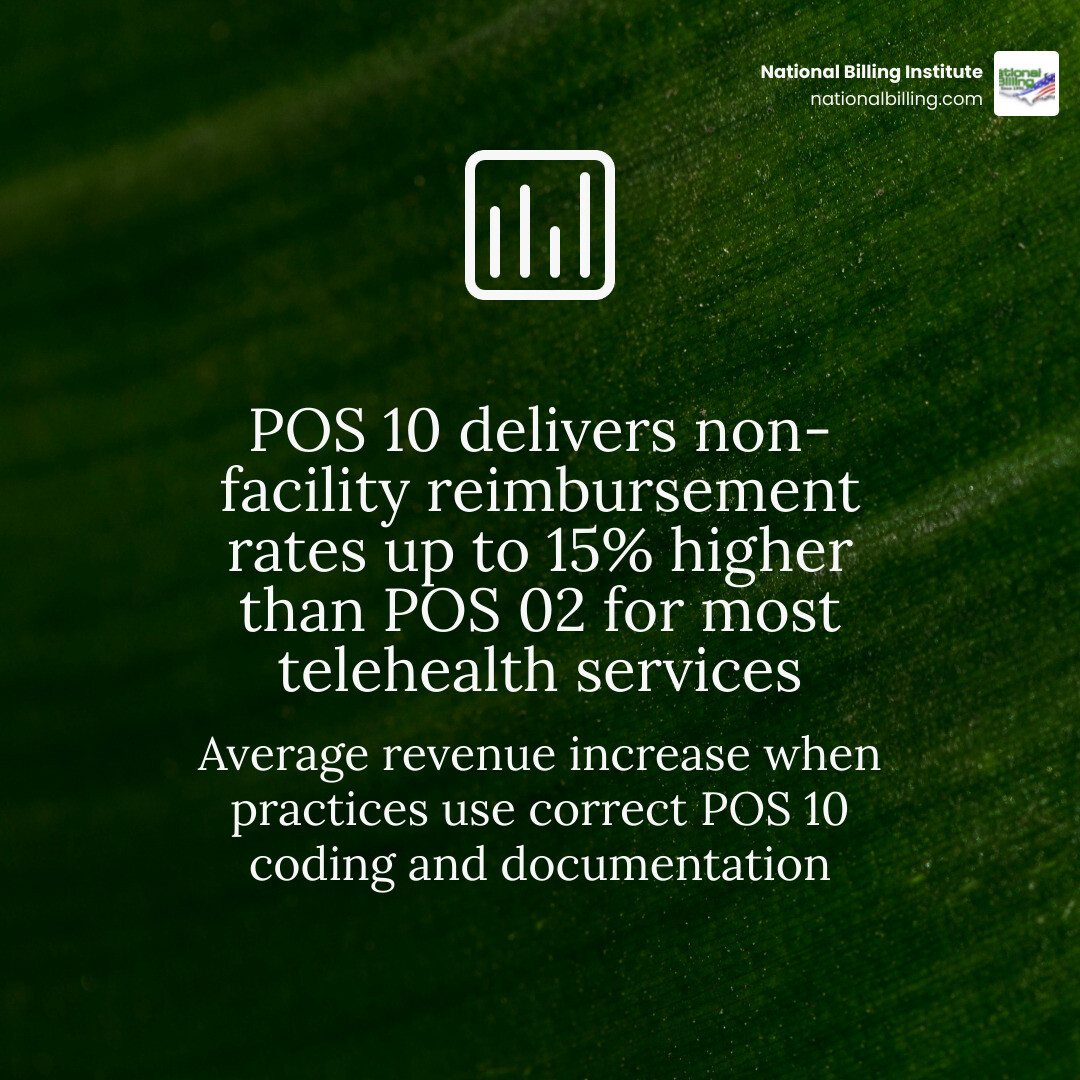
In most cases, yes. Because pos 10 is classified as a "non-facility" setting, Medicare and many commercial payers reimburse at the same rate as an in-office visit. POS 02 is a "facility" setting, which usually results in a lower professional fee because the payer assumes a separate facility fee is being paid to the site where the patient is located.
Conclusion
Navigating pos 10 doesn't have to be a mystery. By understanding that this code represents the patient's home and triggers a more favorable reimbursement rate, you can significantly optimize your practice’s revenue. However, with great reimbursement comes great responsibility—specifically in the form of rigorous documentation and correct modifier usage.
At National Billing Institute, we’ve spent over three decades helping healthcare providers in Boca Raton and across the United States master these complexities. Our 100% USA-based team is dedicated to reducing your denial rates and increasing your revenue by 15-30% through expert coding and AI-driven processes.
If you’re tired of guessing which codes to use or seeing your telehealth claims denied, we’re here to help. More info about medical billing services is just a click away. Let us handle the "secret life" of your billing so you can focus on the life-saving work of caring for your patients.
