
A Practical Guide to Medical Billing and Claims Processing
Why Medical Billing and Claims Processing Matter to Every Practice
Medical billing and claims processing is the workflow that turns a patient visit into a properly coded claim, payer payment, and, when needed, a patient balance. In simple terms, it connects clinical care, insurance rules, and a practice's revenue cycle.
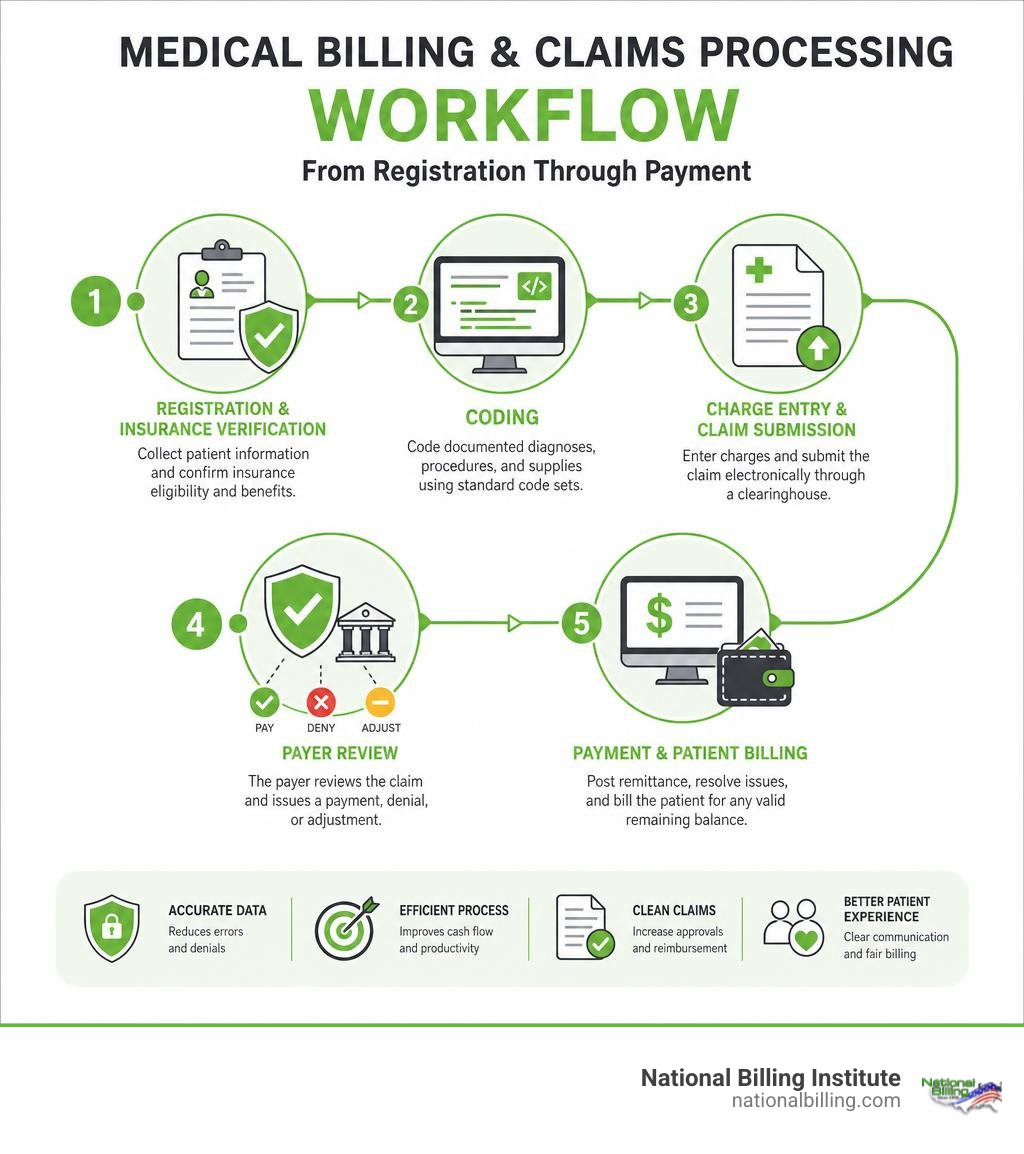
A clean process typically includes:
Registering the patient and confirming insurance coverage.
Coding documented diagnoses, procedures, and supplies.
Entering charges and submitting the claim, often through a clearinghouse.
Allowing the payer to review, pay, deny, or adjust the claim.
Posting the remittance advice, resolving problems, and billing the patient for any valid remaining balance.
For busy practices, small errors can create major delays. Wrong patient details, missing authorization, incomplete documentation, or an incorrect code may cause a claim rejection before it reaches the payer or a denial after payer review. Strong billing processes help protect cash flow, reduce rework, and support HIPAA-compliant handling of patient information.
I am Olivia Harper, founder of National Billing Institute and a denial management and reimbursement specialist with more than 30 years of experience in medical billing and claims processing. In this guide, I will break down how claims move from the exam room to payment and where practices can prevent costly mistakes.
Understanding Medical Claims and System Components
At its core, a medical claim is an itemized record sent by healthcare providers to insurance payors requesting payment for services rendered. It outlines the specific diagnoses, clinical procedures, evaluation levels, and medical supplies delivered to a patient during a specific visit or stay. Understanding how medical claims are structured and processed is essential for maintaining financial predictability across healthcare organizations.
Medical Claims vs. Pharmacy Claims
While both process healthcare expense requests, medical claims and pharmacy claims operate on distinct data standards, coding languages, and administrative pathways:
Medical Claims: These represent professional, institutional, and outpatient encounters provided by physicians, clinicians, hospitals, and outpatient facilities. Medical claims rely primarily on Current Procedural Terminology (CPT®) and Healthcare Common Procedure Coding System (HCPCS) codes for services, mapped to ICD-10-CM diagnosis codes. They are usually processed after care is delivered.
Pharmacy Claims: These record prescription drugs and biological products dispensed by retail, mail-order, or specialty pharmacies. Pharmacy claims rely on National Drug Codes (NDCs) that specify the drug manufacturer, strength, and package size. Unlike medical claims, pharmacy claims are adjudicated in real-time at the point of sale, determining patient copays before the medication is handed to the patient.
Anatomy of a Medical Claim: Header vs. Detail
Every standard medical claim is structured into two main levels: the claim header and the claim detail lines.
Claim Header: The summary section of the claim containing overarching billing parameters. This includes patient demographic data (name, date of birth, gender), subscriber insurance policy identification, rendering and billing provider National Provider Identifiers (NPIs), primary ICD-10-CM diagnosis codes, date of service range, and facility location details.
Claim Detail (Line Items): The individual service lines specifying exactly what care was delivered. Each detail line contains an individual CPT or HCPCS code, specific procedure modifiers, line-item diagnosis pointers linking back to the header, unit counts, billed charge amounts, and specific date of service indicators.
This structured breakdown enables automated billing systems to evaluate individual line items independently during reimbursement calculations.
The Role of a Clearinghouse in Medical Billing and Claims Processing
A healthcare clearinghouse acts as an intelligent secure bridge between medical providers and insurance payors. When claims leave a practice management system, they pass through a clearinghouse to ensure standard compliance.
The primary functions of a clearinghouse include:
Claims Scrubbing: Automated auditing of claim data against standard coding rules, payor policy requirements, and demographic accuracy prior to payor transmission.
EDI Format Standardisation: Converting claim data into Electronic Data Interchange (EDI) standards, specifically the ASC X12 837 transaction format required by federal law.
Error Identification: Rejecting non-compliant claims back to the practice instantly so billing specialists can fix errors within minutes rather than waiting weeks for a formal payor denial.
While most claims pass through clearinghouses, high-volume payors like Medicare or Medicaid sometimes establish direct electronic connections with large facilities to expedite submission. Implementing structured medical billing and comprehensive medical claims management ensures clean claim generation across every payor pathway.
The Seven Essential Steps of Medical Billing and Claims Processing
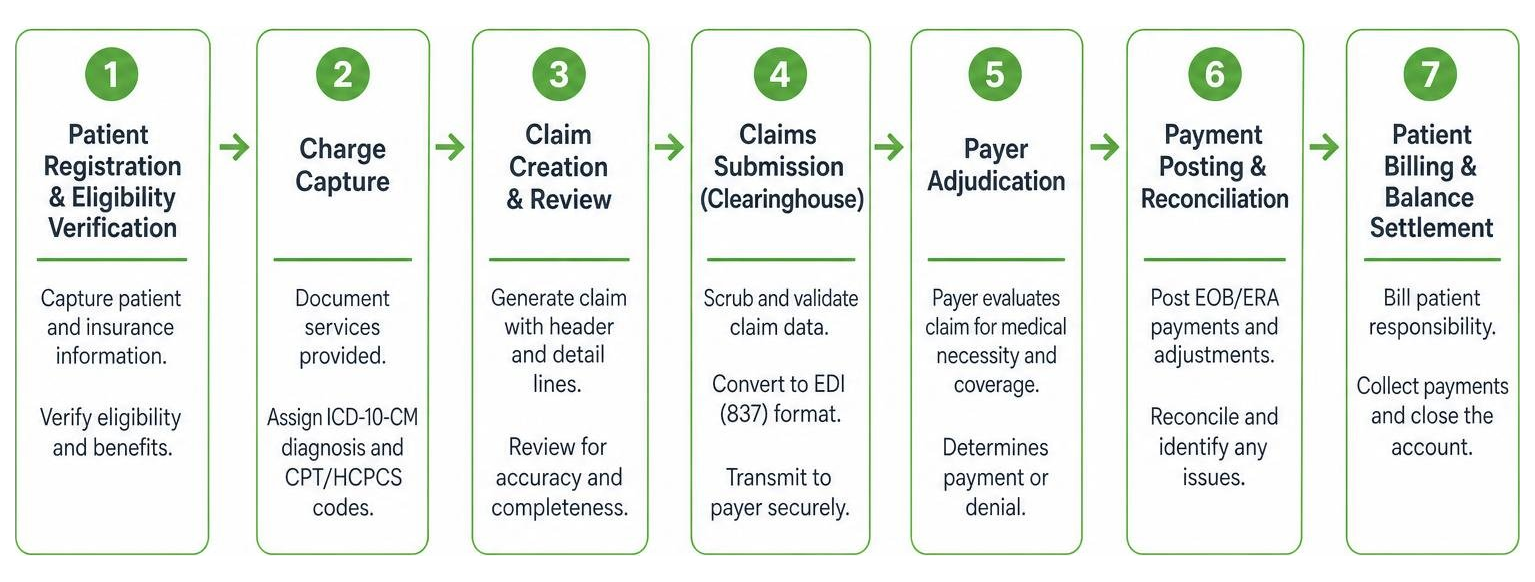
Executing a high-performing billing operation requires strict adherence to a systematic sequence. Below, we break down the seven core stages that turn clinical documentation into collected revenue.
1. Patient Registration and Insurance Eligibility Verification
Revenue cycle management begins long before a clinical provider sees a patient. The first step involves capturing complete patient demographic details—such as legal name, residential address, contact information, and primary/secondary insurance policy data.
Simultaneously, insurance eligibility verification must be conducted before care is delivered. Billing staff verify active coverage dates, co-pay responsibilities, remaining deductible amounts, co-insurance percentages, and out-of-pocket maximums. Crucially, staff must check whether planned procedures require prior authorization. Missing a required pre-authorization almost always results in an uncollectible claim denial. Streamlining these initial touchpoints establishes a clean foundation for the broader health insurance claim process.
2. Medical Coding and Charge Entry
Once the clinical encounter ends, health information professionals transcribe physician notes, diagnostic reports, and operational logs into standardized diagnostic and procedural code sets:
ICD-10-CM: International Classification of Diseases, 10th Revision, Clinical Modification, used to establish medical necessity by describing the patient’s condition or condition severity.
CPT®: Current Procedural Terminology, managed by the American Medical Association, describing medical, surgical, and diagnostic procedures performed by healthcare professionals.
HCPCS Level II: Standardized coding system maintained by CMS to report supplies, durable medical equipment, injectable drugs, and specialized services not covered in CPT.
During charge entry, coded services are paired with the practice’s fee schedule and entered into the billing software. Precise, compliant rcm medical coding prevents under-billing (which leaves earned money on the table) and over-billing (which triggers auditing penalties).
3. Claims Transmission, Adjudication, and Patient Statements
After charge entry, claims are compiled into electronic EDI files (ASC X12 837) and transmitted through the clearinghouse to the insurance payor.
Once received, the payor performs claim adjudication—a formal review process where the insurance company evaluates the claim against benefit rules, policy limitations, medical necessity guidelines, and fee schedules. The payor then determines its financial responsibility:
Approved: Payor approves reimbursement according to contracted fee schedules.
Denied: Payor refuses payment due to coverage exclusions, lack of authorization, or non-covered services.
Rejected: Payor or clearinghouse returns the claim without formal processing due to formatting or data errors.
After adjudication, the payor issues an Electronic Remittance Advice (ERA) or Explanation of Benefits (EOB) detailing paid amounts, write-offs, and patient liability. Finally, the billing team issues a patient statement for any remaining co-insurance, deductible, or non-covered balance. Effective execution across these steps hinges on maintaining strong protocols for adjudication in medical billing to achieve maximum rates of clean claims medical billing.
Medicare Submission Formats, Jurisdiction, and Compliance Guidelines
As the largest single healthcare payor in the United States, Medicare establishes baseline compliance rules that heavily influence broader industry standards. Reviewing official guidelines, such as the Medicare Claims Processing Manual, helps organizations stay up to date on statutory expectations.
Electronic vs. Paper Claim Submission Formats
Under the Administrative Simplification Compliance Act (ASCA), healthcare providers are statutorily required to submit all Medicare claims electronically, unless specific legal exceptions are met.
Electronic Claims Standards:
ASC X12 837P: The standard electronic format for professional healthcare claims submitted by physicians, group practices, and outpatient suppliers.
ASC X12 837I: The standard electronic format used by institutional facilities, including hospitals, skilled nursing facilities, and inpatient care centers.
Paper Claim Standards (Exceptions Only):
Form CMS-1500: The standard paper claim form for professional services, printed in specialized red drop-out ink for optical character recognition scanning.
Form CMS-1450 (UB-04): The standard paper claim form used by institutional facilities.
Leveraging modern electronic medical billing platforms allows practices to meet ASCA mandates effortlessly while avoiding paper processing delays.
Determining Payment Jurisdiction Between A/B MACs and DME MACs
Medicare delegates claim processing to regional Medicare Administrative Contractors (MACs). Determining correct payment jurisdiction is critical to ensure claims are routed to the proper MAC without misdirection:
A/B MACs (Part A and Part B): Process medical, surgical, and institutional claims based on the physical geographic location where the service was rendered, or where the practitioner’s office resides.
DME MACs (Durable Medical Equipment): Process claims for durable medical equipment, prosthetics, orthotics, and supplies (DMEPOS). Jurisdiction for DME MACs is determined by the beneficiary's permanent legal address, regardless of where the supplier is physically located.
Denial Management, Claims Data Usage, and Industry Careers
Optimizing revenue operations requires active oversight of denied claims, smart strategic use of healthcare data, and skilled billing staff. Practices seeking additional guidance on payer relations can consult industry organizations like the AMA Claims Processing Resource Center.
Common Denial Reasons and Remittance Advice Codes
Claim denials directly undermine medical practice profitability. To resolve unpaid claims efficiently, billing teams analyze standard electronic payment codes mandated by HIPAA:
Claim Adjustment Reason Codes (CARCs): Communicate why a claim line item was adjusted or denied (e.g., deductible liability, missing prior authorization, or non-covered service).
Remittance Advice Remark Codes (RARCs): Provide additional context or policy clarification regarding the specific CARC applied.
Group Codes: Identify financial responsibility (e.g., CO for Contractual Obligation, PR for Patient Responsibility).
Common causes for claim denials include missing pre-authorizations, automated AI payor algorithm rejections, non-compliance with No Surprises Act balance billing rules, and untimely claim filing. Developing robust internal strategies for denial management in medical billing ensures practices systematically reverse unpaid claims and recover earned revenue.
Strategic Utilization and Limitations of De-Identified Claims Data
Beyond reimbursement, aggregate de-identified medical claims data serves as a valuable resource for commercial analytics, epidemiological study, and healthcare business intelligence. Life science firms, device manufacturers, and health systems utilize de-identified claims to analyze clinical pathways, size market opportunities, and evaluate care patterns.
However, organizations using medical claims data must account for key limitations:
Claims Lag: Claims data can lag by several months due to submission timelines, multi-stage adjudication, and payor reporting cycles.
Clinical Billed Scope vs. Outcomes: Claims reflect billed procedure codes submitted for payment, not complete clinical medical records or final health outcomes.
Missing Unbilled Encounters: Claims fail to capture services delivered under non-billable capitation, cash-pay arrangements, or charity care programs.
Key Skills for Careers in Medical Billing and Claims Processing
With growing complexity across payor contracts and regulatory mandates, skilled medical billing professionals remain in high demand. Leading academic and professional bodies—including AAPC, Johns Hopkins University, MedCerts, and Coursera—offer specialized training programs.
Certification / Training Program Primary Focus Areas Key Competencies Taught Target Career Roles AAPC Certified Professional Biller (CPB™) Comprehensive Revenue Cycle Management Denial management, ICD-10/CPT guidelines, HIPAA rules, reimbursement methodology Medical Biller, RCM Specialist, Billing Manager Johns Hopkins Office Training Administrative Operations & Revenue Systems Billing compliance, EHR workflows, patient accounting, front-desk collection Office Manager, Healthcare Administrative Specialist MedCerts Billing & Coding Foundational Billing & Coding Mechanics Basic CPT/ICD coding, insurance claim forms, charge posting Entry-Level Billing Specialist, Claims Clerk Coursera Professional Certificates Modular Billing & Digital RCM Skills EDI transmission rules, clean claim preparation, basic payor guidelines Remote Billing Associate, Claims Scrubbing Specialist
Frequently Asked Questions About Medical Claims Processing
What is the main difference between a claim rejection and a claim denial?
A claim rejection occurs before the claim is formally processed or adjudicated by the payor—often at the clearinghouse stage—due to formatting, clerical, or data validation errors (such as a misspelled patient name or invalid policy ID). Rejections can be corrected and resubmitted immediately. A claim denial, by contrast, occurs after a payor adjudicates the claim and formally refuses payment based on coverage rules, lack of prior authorization, or medical necessity guidelines. Denials require a formal appeal process.
Why does medical claims data lag behind real-time clinical visits?
Medical claims data lags because of the administrative steps required between clinical care delivery and finalized payment. Providers often take days or weeks to finalize clinical documentation and assign codes. Subsequently, clearinghouse screening, payor adjudication rules, remittance advice generation, and monthly data aggregation build an inherent delay ranging from 30 to 90+ days.
What exceptions allow paper claim submissions to Medicare?
Under the Administrative Simplification Compliance Act (ASCA), providers must submit claims electronically unless they meet specific statutory exemptions. Key exceptions include: small provider practices (physician practices with fewer than 10 full-time equivalent employees or institutional facilities with fewer than 25 FTEs), disruption in electronic submission infrastructure beyond provider control, emergency situations, or specialized non-standardized submissions.
Conclusion
Mastering medical billing and claims processing is vital for any healthcare practice seeking long-term financial security and operational success. By standardizing patient intake, ensuring accurate medical coding, leveraging reliable clearinghouse scrubbing, and systematically resolving claim denials, medical organizations can significantly improve clean claim rates and protect cash flow.
At National Billing, we bring over 30 years of industry experience to help practices optimize every stage of their revenue cycle. Our 100% USA-based team in Boca Raton, FL, delivers full-service medical billing, AI-automated claims processing, and complete HIPAA compliance—helping practices reduce denial rates and boost total revenues by 15% to 30%. Practices looking to streamline operations and enhance practice performance can explore comprehensive medical billing solutions to strengthen their revenue cycle today.
