
Adjudication or Aggravation? Understanding How Insurance Companies Review Claims
Why Adjudication in Medical Billing Determines Whether You Get Paid
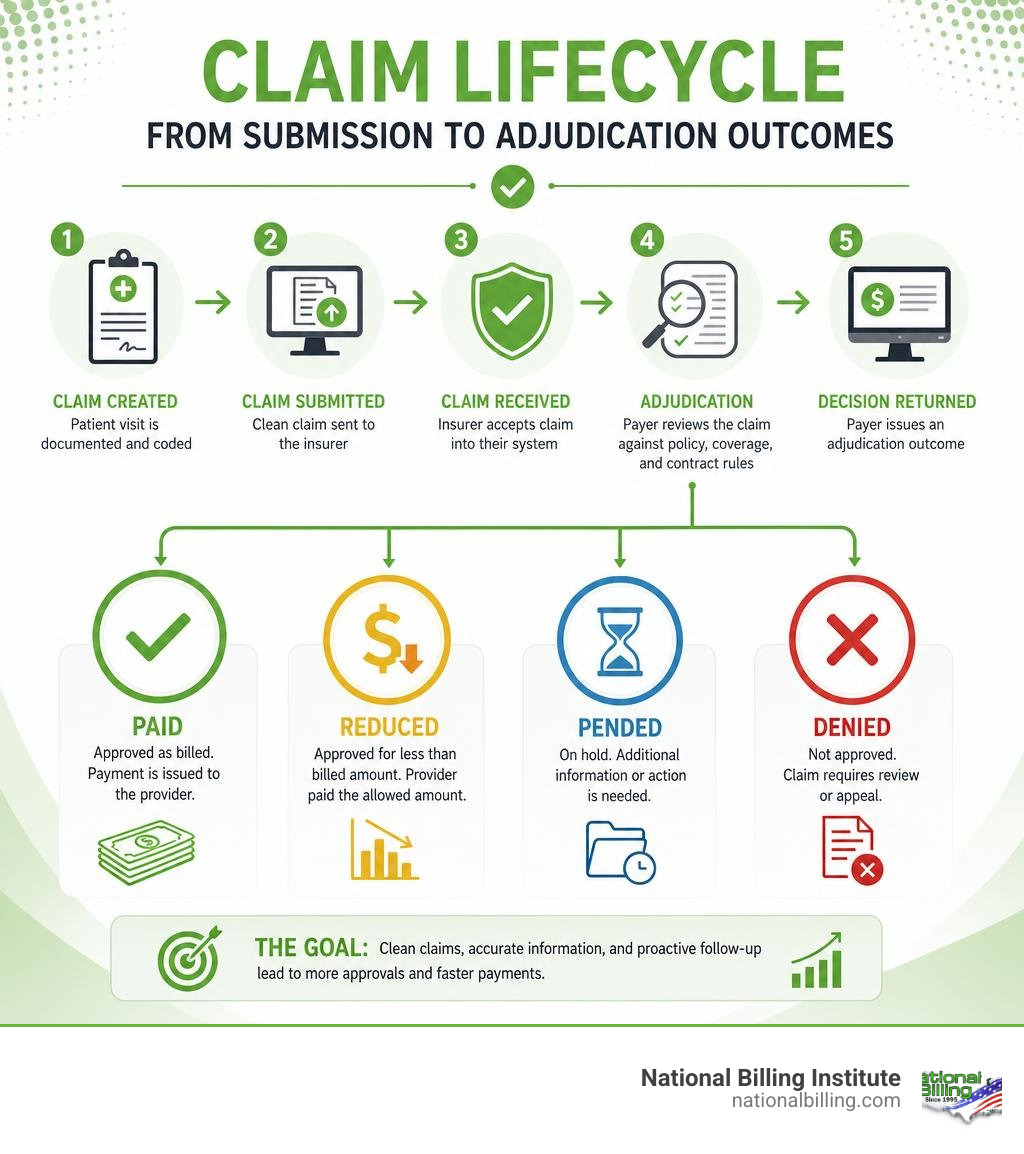
Adjudication in medical billing is the process insurance companies use to review a submitted claim and decide whether to pay it, reduce it, or deny it entirely.
Here's a quick breakdown of what that means in practice:
What it is: A payer's rules-based review of your claim against the patient's policy, coverage, and contract terms
Who does it: The insurance company (payer) — not your billing team
When it happens: After a clean claim is accepted and enters the payer's system
How long it takes: Typically 5 to 10 days for standard claims
What the outcomes are: Paid in full, reduced payment, pended (on hold), or denied
Why it matters: It's the moment your earned revenue either converts to cash — or gets trapped in rework
Most practices focus heavily on submitting claims. But submission is just the handoff. What happens next — inside the payer's system — is where your revenue is won or lost.
The scale of this problem is significant. Claims administration and adjudication consume roughly 3% to 6% of provider and payer revenues every year, which adds up to an estimated $150 billion to $300 billion annually across the U.S. healthcare system. And according to the American Medical Association, about 7% of commercial claims are adjudicated with errors — meaning practices are routinely underpaid or wrongly denied without ever knowing why.
If your collections aren't matching your patient volume, adjudication is usually where the leak starts.
I'm Olivia Harper, Founder and Denial Management & Reimbursement Specialist at National Billing Institute, and I've spent over 30 years helping practices across the country fix exactly these problems in adjudication in medical billing. In this guide, I'll walk you through every stage of the process — from how payers review your claims to what you can do to stop leaving money on the table.
What is Adjudication in Medical Billing?
To put it simply, adjudication in medical billing is the payer's decision-making engine. Once we package up a medical claim and send it off, the insurance provider doesn't just cut a check. Instead, they run the claim through a gauntlet of digital and manual checks to ensure it complies with their specific coverage policies, clinical guidelines, and contractual agreements.
Think of adjudication as a financial control point. It is the gatekeeper of your practice's cash flow. When a claim enters this phase, the payer is looking to answer one fundamental question: Do we actually owe this provider money for this specific service delivered to this specific patient?
Unfortunately, this gatekeeping is highly complex and costly. Administrative tasks related to claims consume an outsized portion of a practice's time. For example, while the average specialist office visit lasts about 20 minutes, managing the associated billing paperwork takes up a massive chunk of administrative staff time—with each manual claim submission requiring an average of three to four minutes of dedicated staff attention just to prepare.
When payers make errors during this high-volume process, it directly impacts your bottom line. This is why understanding medical billing at a granular level is essential for any healthcare provider who wants to remain profitable.
The Core Purpose of Adjudication in Medical Billing
At its heart, the adjudication process exists to validate three critical elements of a medical claim:
Accuracy Validation: Ensuring the patient's demographics, insurance ID, and provider credentials are valid and active.
Medical Necessity: Confirming that the clinical procedures performed (CPT/HCPCS codes) directly align with and justify the diagnosed conditions (ICD-10 codes).
Contractual Compliance: Calculating exactly how much the insurance company is obligated to pay based on their negotiated fee schedule with your practice, minus any patient responsibility (like copays, deductibles, or coinsurance).
To keep this data standardized across the entire healthcare system, modern IT frameworks rely on specific coding architectures. Payers use standard digital codes to categorize financial amounts during this review. For instance, the industry-standard FHIR Adjudication Value Codes define distinct categories—such as submitted amount, copay, eligible amount, deductible, and benefit amount—to ensure that systems can seamlessly talk to one another without human translation errors.
Claim Rejection vs. Adjudication in Medical Billing
One of the most common points of confusion for practice managers is the difference between a claim rejection and a claim denial (which occurs during adjudication).
A rejection happens before the claim ever reaches the payer’s adjudication system. Think of a rejection as a letter returned to sender because the address was written in gibberish. The clearinghouse or the payer’s front-end system catches a formatting error—like a missing National Provider Identifier (NPI) or a misspelled patient name—and spits it back out. Because the payer never officially accepted the claim into their system, it was never adjudicated.
An adjudication decision (denial or reduction), on the other hand, means the payer successfully received, processed, and evaluated the claim. They looked at the clinical and policy logic and made a conscious decision not to pay it.
Feature Claim Rejection Claim Adjudication (Denial/Reduction) When it occurs Before the claim is accepted by the payer After the claim is accepted and processed Who identifies it Clearinghouse or payer's intake portal Payer's automated rules engine or medical reviewer Primary cause Formatting errors, typos, missing mandatory fields Lack of medical necessity, coverage exclusions, coding mismatches Impact on A/R Does not count toward days in A/R (not yet accepted) Directly increases days in A/R and requires formal appeal Resolution Fix the typo and immediately resubmit File a formal appeal or submit corrected claim with clinical notes
The Step-by-Step Claim Adjudication Workflow
What actually happens once a claim leaves your office? Understanding the step-by-step journey can help your billing team anticipate where bottlenecks occur.
To keep your revenue flowing smoothly, you need to understand how this fits into the broader healthcare revenue cycle workflow. Here is the typical path a claim takes through the payer's adjudication system:
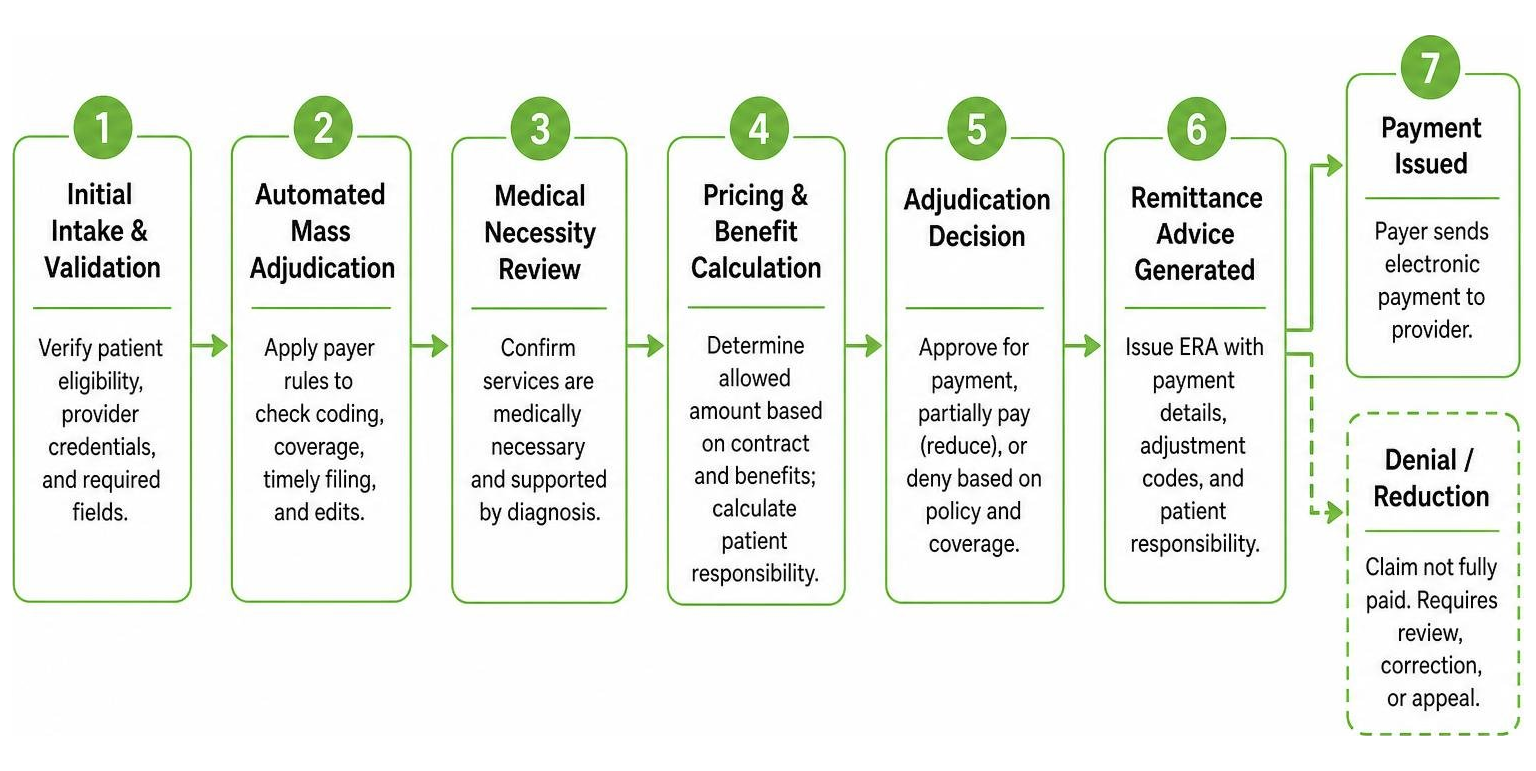
Step 1: Initial Intake and Validation
The moment a claim is received electronically, the payer's system performs basic "sanity checks." It verifies that the patient’s policy was active on the date of service, that the provider is credentialed with the network, and that no basic billing fields are empty. If it fails here, it is rejected.
Step 2: Automated Mass Adjudication
If the claim passes intake, it enters the automated rules engine. In today's healthcare landscape, roughly 80% of received claims are adjudicated automatically with no human intervention. These software engines check the claim against thousands of proprietary payment policies, looking for timely filing limit violations (which typically range from 90 to 180 days), duplicate submissions, and unbundled codes.
Step 3: Manual Exception Handling
The remaining 20% of claims fail automated edits and require manual inspection. This 20% is incredibly important because it contains the highest-cost, most complex, and clinically intense claims. During manual review, a trained medical examiner, nurse, or medical director reviews the clinical documentation to verify medical necessity and determine if the treatment matches the patient's benefits.
Decoding Adjudication Decisions and Common Denial Drivers
Once the payer completes their review, they issue a determination. This decision is sent back to your practice via an Electronic Remittance Advice (ERA) or a paper Explanation of Benefits (EOB).
To successfully manage your cash flow, you must have strong denials and appeals management systems in place to interpret these responses.

The Four Core Outcomes of Adjudication
There are four primary ways a payer will resolve a claim:
Paid in Full: The claim met all rules and is paid according to the contracted rate.
Reduced Payment: The payer pays a portion of the claim but reduces certain line items based on contract terms, bundling edits, or patient cost-sharing.
Pended Status: The claim is placed on "hold." The payer needs more information (such as medical records or coordination of benefits details) before making a final decision.
Denied Claim: The payer refuses to make any payment on the claim due to a policy or administrative violation.
When these decisions are transmitted electronically, they are mapped to standardized codes. For example, the HL7 ActAdjudicationCode specifications define how systems communicate these outcomes—using codes like "AA" (adjudicated with adjustments), "AR" (adjudicated as refused), or "AS" (adjudicated as submitted)—so your billing software can automatically flag and organize them into work queues.
Top Reasons for Claim Denials
If you want to protect your revenue, you have to know what triggers denials during adjudication. Most denials are entirely preventable. By focusing on proactive denial prevention, your practice can avoid the administrative headache of appealing claims after the fact.
The most common culprits include:
Missing Prior Authorization: Performing a procedure before getting the payer's green light. Shockingly, fewer than 15% of prior authorizations are fully electronic, which leads to massive manual coordination failures.
Expired Patient Eligibility: The patient's policy was terminated or changed before the visit occurred.
Coding Mismatches: Using invalid, outdated, or mismatched ICD-10 and CPT/HCPCS codes.
Duplicate Claims: Submitting the same claim twice because the first one was taking too long, which immediately triggers an automated denial.
Lack of Medical Necessity: Failing to document why a specific test or treatment was clinically required for the patient's diagnosed condition.
Key Metrics to Measure Adjudication Performance
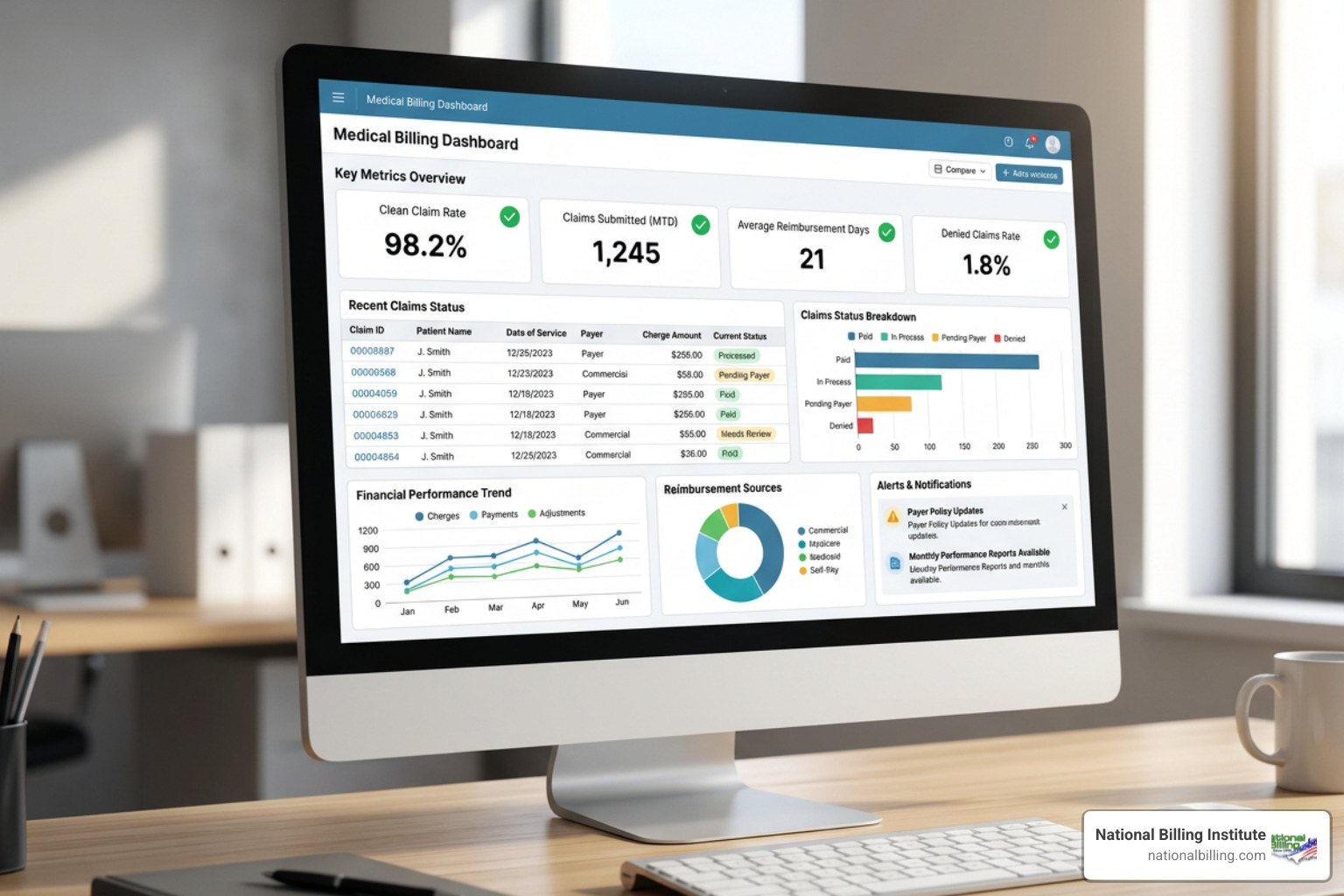
You cannot manage what you do not measure. If you want to stop revenue leakage and keep your practice financially healthy, your billing team must monitor key performance indicators (KPIs) through robust healthcare revenue cycle analytics.
Days in Accounts Receivable (A/R)
This metric measures how long, on average, it takes for a claim to be paid after a patient visit. Currently, the modal claim remains outstanding for five to 10 days post-encounter, leaving both practices and patients without reliable price estimates. If your average days in A/R creep past 35 to 40 days, it usually means your claims are getting stuck in manual adjudication or pended queues.
First Pass Resolution Rate (FPRR)
FPRR is the percentage of claims that are paid on the very first submission without being rejected, denied, or pended. A high-performing billing team should maintain an FPRR of 95% or higher. If your rate is lower, it means your front-end processes are letting errors slip through, forcing your team to waste time on manual rework.
Denial Rate and Pend Volume
Your denial rate should ideally sit below 5%. With commercial payers averaging a 7% error rate in their own adjudication processes, you must keep a close eye on pended claims. A high volume of pended claims acts as a massive bottleneck, tying up your expected cash flow in administrative limbo. To keep these bottlenecks in check, your team must actively engage in denial management in medical billing to quickly resolve outstanding issues.
Strategies to Optimize Adjudication Outcomes
To consistently win the adjudication game, you must treat the process as a strict financial control system rather than a clerical afterthought. By utilizing modern technology and automated revenue cycle management, you can dramatically reduce the manual labor required to get paid.
Enhancing Front-End Eligibility Verification
The absolute best way to prevent an adjudication failure is to verify the patient's insurance before they ever see the provider. Real-time coverage detection technology allows your front-desk staff to instantly confirm active coverage, identify deductible balances, and collect accurate copays at the point of care.
Improving Coding Accuracy and Compliance
Payers look for any excuse to deny high-value claims. Your clinical documentation must be incredibly detailed, and your billing team must meticulously match CPT, HCPCS, and ICD-10 codes. Regularly auditing your coding team and staying up to date on billing compliance guidelines will prevent payers from flagging your claims for manual review.
Frequently Asked Questions about Claim Adjudication
What is the difference between a denied claim and a rejected claim?
A rejected claim has formatting or clerical errors (like a typo in the patient's ID number) and is sent back by the clearinghouse or payer intake portal before being processed. A denied claim has been successfully received and adjudicated by the payer, but they have determined that they will not pay it due to clinical, coverage, or policy reasons.
How long does the claim adjudication process typically take?
For clean electronic claims, the adjudication process typically takes between 5 to 10 days. Paper claims or claims that require manual medical review can take anywhere from 30 to 45 days (or longer) to resolve.
What are the most common reasons a claim is pended during adjudication?
Claims are usually pended (placed on hold) when the payer needs additional information to make a payment decision. This most commonly occurs when they need to review complete medical records, verify coordination of benefits (COB) for patients with multiple insurance plans, or manually review high-cost specialty services.
Take Control of Your Revenue Cycle Today
Navigating the complexities of adjudication in medical billing shouldn't feel like a constant battle against insurance companies. When your team is buried under manual claims review, pended files, and rising denial rates, your practice's financial health takes a serious hit.
At National Billing Institute, based in sunny Boca Raton, FL, we provide the ultimate antidote to billing aggravation. Our 100% USA-based team brings over 30 years of specialized experience to your revenue cycle. By combining cutting-edge, AI-automated claims processing with dedicated, expert denial management specialists, we deliver some of the lowest denial rates in the industry. Our fully HIPAA-compliant solutions routinely help practices experience a 15% to 30% increase in revenue by ensuring claims are adjudicated correctly the very first time.
Stop letting administrative friction drain your hard-earned revenue. Partner with National Billing Institute for professional billing services and let us turn your adjudication headaches into predictable, maximized cash flow.
