
Stop the Bleeding with Better Denials Management in Healthcare
Why Denials Management in Healthcare Is Costing You More Than You Think
Denials management in healthcare is the systematic process of identifying, resolving, and preventing claim denials from insurance payers — so your practice gets paid for the care it already delivered.
Here's a quick breakdown:
What It Covers Why It Matters Identifying denied claims and their root causes Stops revenue from slipping through the cracks Correcting and resubmitting claims Recovers payments already earned Appealing payer decisions Overturns wrongful denials Preventing future denials Reduces administrative waste and improves cash flow
The numbers tell a hard story. Initial claim denial rates hit 11.8% in 2024, up from 10.2% in 2020. U.S. hospitals lose an estimated $262 billion annually to initial claim denials. And perhaps the most alarming stat: 65% of denied claims are never reworked or resubmitted — meaning most of that revenue is simply abandoned.
That's not a billing inconvenience. That's a financial emergency hiding in plain sight.
Every denied claim represents money your practice has already earned. When denials pile up without a structured process to address them, the result is delayed cash flow, strained staff, and revenue that quietly disappears — permanently.
I'm Olivia Harper, Founder and Denial Management & Reimbursement Specialist at National Billing Institute, with over 30 years of hands-on experience in denials management in healthcare and revenue cycle management. In this guide, I'll walk you through exactly how denials happen, how to fight them, and how to stop them before they start.
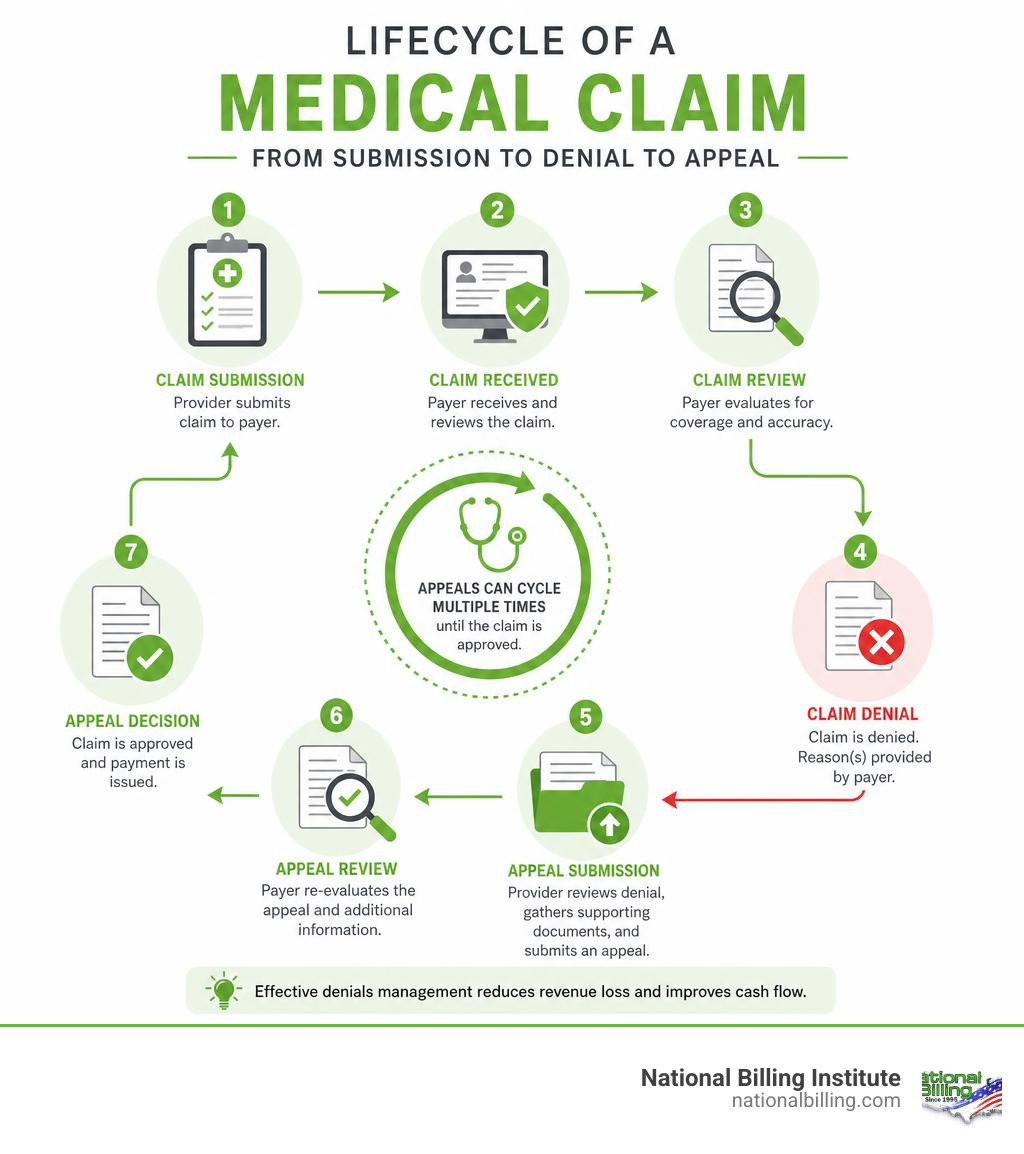
The Critical Role of Denials Management Healthcare in Modern RCM

In revenue cycle management (RCM), claims management is the engine that keeps your organization running. Within that engine, denials management healthcare is the safety valve. It is not just a back-office cleanup task; it is a strategic revenue function.
As insurance payers deploy increasingly complex, automated algorithms to scrutinize claims, providers are finding themselves outmatched. In fact, eight out of ten healthcare finance leaders admit there is significant room to improve their denial management processes. Without a focused effort to understand why payers say "no," your practice is essentially volunteering to work for free.
Effective denials management acts as revenue intelligence. It reveals exactly where your front-end, mid-cycle, and back-end processes are breaking down. When you systematically track and resolve denials, you don't just recover immediate revenue—you protect your future cash flow and operational stability. To understand how this fits into your broader financial strategy, explore What Is Denial Management In Medical Billing.
Understanding the Financial and Operational Impact
The financial toll of ignored or poorly managed denials is staggering. Let's look at the economics of a denial:
Direct Revenue Leakage: Unresolved denials can result in an immediate 5% reduction in net patient revenue.
The Cost to Rework: Correcting a denied claim is never free. The average expense of reworking a single claim is up to $25 for ambulatory providers and can skyrocket to $118 for hospitals.
Timeliness Loss: Around 50% to 60% of denials are left unaddressed in a timely manner, which translates to an unnecessary loss of 5% to 7% in overall revenue simply because deadlines passed.
The Industry Burden: In 2023, healthcare providers spent approximately $19.7 billion just on adjudicating and fighting claims through the denials management process.
When you fail to address denials, you aren't just losing the value of the claim; you are actively draining your administrative budget trying to fix old mistakes. This is why optimizing your entire Revenue Cycle Management Healthcare framework is the single most important action you can take for your bottom line.
Claim Rejection vs. Claim Denial: Key Differences
Before we can build a cure, we must diagnose the problem correctly. In medical billing, "rejections" and "denials" are treated as if they are the same thing, but they require entirely different responses.
Feature Claim Rejection Claim Denial Definition A claim that fails basic formatting or validation rules before entering the payer's system. A claim that has been received, processed, and determined to be unpayable by the payer. Payer Status Never adjudicated; does not exist in the payer's system. Adjudicated and officially processed as a "no." Primary Cause EDI front-end edits, typos, invalid member IDs, or simple formatting errors. Lack of prior authorization, medical necessity issues, or coding errors. Response Required Quick correction of data and immediate resubmission. Root cause investigation, correction, or a formal appeal. Reimbursement Impact Delays payment by 21 to 45 days but does not result in a permanent write-off. Can result in permanent revenue loss if the appeal window is missed.
When a claim is rejected, it's like a letter returned to sender because you forgot the stamp. When a claim is denied, the letter was opened, read, and rejected. To decode the specific reasons why payers deny claims, you must learn to read the Claim Adjustment Reason Codes (CARC) and Remittance Advice Remark Codes (RARC). You can learn more about translating these in our guide to Medical Billing Denial Codes.
Categorizing the Types and Common Causes of Claim Denials

Not all denials are created equal. If you treat every denial with the same generic appeal letter, you will waste time and see very few checks in the mail. To manage denials effectively, you must categorize them and perform a structured root cause analysis. This is the core philosophy behind professional denials management and educational resources like What Is Denials Management? - AAPC.
Hard Denials vs. Soft Denials and Clinical vs. Administrative
To build an efficient workflow, we divide denials into distinct categories:
Hard Denials
These are the "irreversible" denials. They occur when a payer decides a service is fundamentally unpayable under the patient's contract, or when a critical administrative deadline has been missed. Examples include services explicitly excluded from a plan or claims hit by Untimely Filing In Medical Billing. Hard denials usually must be written off, making front-end prevention your only real defense.
Soft Denials
These are temporary denials. The payer has put a hold on payment, but they are willing to pay if you provide the missing piece of the puzzle. Examples include requests for medical records, coordination of benefits (COB) updates, or corrected patient demographics. Soft denials are highly recoverable if you act quickly.
Clinical Denials
These require clinical expertise to resolve. They occur when a payer questions the medical necessity of a procedure, the level of care provided (such as inpatient vs. observation status), or the length of a hospital stay. Resolving these requires a certified coder or clinician to review clinical documentation and submit a formal, evidence-based appeal.
Administrative Denials
These are self-inflicted wounds. They occur due to errors in your registration, scheduling, or billing workflows. Missing prior authorizations, incorrect eligibility verification, and duplicate claims fall into this bucket. The good news? Administrative denials are 100% preventable.
The Top Reasons for Claim Denials in Healthcare
Why do payers deny claims? While there are hundreds of individual CARC codes, the vast majority of denials are driven by a few common culprits. Understanding these patterns is key to effective Denials And Appeals Management:
Eligibility and Registration Errors: This is the single most common reason for claim denials. It happens when a patient's coverage has terminated, they are enrolled in a different plan, or their demographic details (like a misspelled name or incorrect birthdate) don't match the payer's records.
Missing or Expired Prior Authorizations: Payers are increasingly requiring pre-approval for specialized procedures, imaging, and therapies. If you perform the service without obtaining this authorization—or if the authorization number is missing from the claim—it is an automatic denial.
Coding Errors: Coding mistakes account for a staggering 63% of medical billing errors. These include unbundling codes, using outdated CPT or ICD-10 codes, failing to use appropriate modifiers, or violating National Correct Coding Initiative (NCCI) edits.
Untimely Filing: Every payer has a strict window within which a claim must be submitted (ranging from 90 days to a year). If your billing team falls behind and misses this window, the claim is dead on arrival.
Duplicate Claims: Submitting the same claim twice—often because a biller didn't see a response to the first submission—creates administrative confusion and triggers immediate denials.
The IMMP Process: A Systematic Framework for Denial Resolution
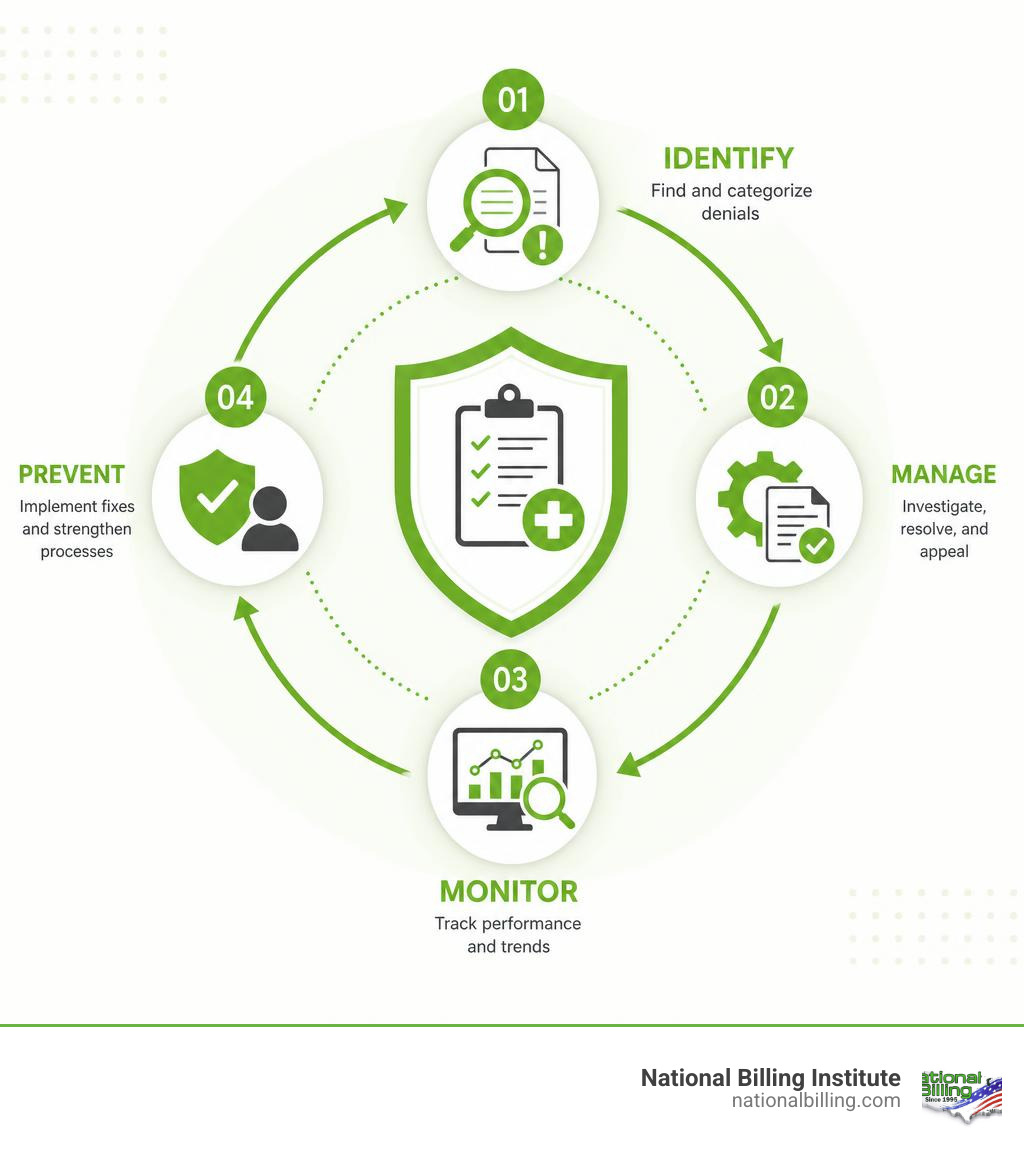
To stop guessing and start recovering, your billing department needs a reliable, repeatable system. We recommend the IMMP Process (Identify, Manage, Monitor, Prevent). This systematic framework shifts your team from a reactive "cleanup crew" to a proactive revenue protection squad. Let's break down how this works under professional Denial Management Services.
Identify and Manage: Root Cause Analysis and Appeals
The first half of the IMMP process is about getting your hands dirty with the denials you have right now.
Identify
You cannot fix what you do not see. The moment an Electronic Remittance Advice (ERA) or Explanation of Benefits (EOB) arrives with a denial, it must be logged and categorized. This means translating the CARC and RARC codes to understand exactly why the payer refused payment. For example:
CO-197 means the prior authorization was absent.
CO-16 indicates the claim lacks necessary information for adjudication.
Manage
Once identified, the denial must be routed to the right person. A coding error should go directly to a certified coder, while an eligibility issue should go to your front-desk or registration team.
From there, your team must execute the appeal. This involves gathering the original claim, the denial notice, and supporting documentation (like clinical charts or authorization letters), and drafting a clear appeal using structured templates. Remember to act quickly—most soft denials have tight correction windows, and keeping an eye on your Ar Follow Up Services ensures no claim sits idle.
Monitor and Prevent: Continuous Auditing and Workflow Adjustments
The second half of the IMMP process is where the real magic happens. This is where you stop the bleeding for good.
Monitor
You must track your denials over time to find systemic patterns. Are you getting an unusual number of denials from a specific commercial payer? Is one of your providers consistently failing to document medical necessity for a specific procedure? By building a monthly denial scorecard, you can turn raw billing data into actionable business intelligence.
Prevent
This is the ultimate goal of Denial Prevention. Use your monitoring data to adjust your upstream workflows. If eligibility errors are your biggest problem, it’s time to retrain your front-desk staff or upgrade your registration software. If coding errors are spiking, invest in continuous education for your clinical and billing teams.
Strategic Best Practices to Prevent Denials and Optimize Revenue
While recovering denied claims is important, prevention is three to five times more cost-effective than recovery. By implementing smart, proactive strategies, you can significantly reduce your administrative burden and protect your cash flow. This is the cornerstone of effective Denial Reduction Services.
Leveraging AI and Automation for Denials Management Healthcare
In 2026, relying on manual processes to manage claims is like bringing a butter knife to a laser fight. Payers are using advanced AI to adjudicate and deny claims in seconds. To level the playing field, providers must embrace smart Revenue Cycle Management Solutions.
Here is how automation and artificial intelligence can transform your workflow:
Three-Touch Automated Eligibility: Implement automated eligibility verification at three distinct points: when the appointment is scheduled, 48 hours before the visit, and at check-in. This catches terminated coverage and wrong-plan issues before the patient ever sees a provider.
Pre-Submission Claim Scrubbing: Use automated claim scrubbers to validate coding accuracy, check modifier requirements, and screen for NCCI edits before the claim is sent to the clearinghouse.
Predictive Denial Flagging: Machine learning models can analyze historical payer behavior to assign a "denial risk score" to claims. High-risk claims can be held for manual review, preventing an expensive denial before it happens.
Key Performance Indicators for Denials Management Healthcare
To measure the success of your denials management program, you must track the right metrics. We recommend focusing on these five key performance indicators (KPIs):
Initial Denial Rate: The percentage of claims denied on first submission.
Target: Under 5% (high-performing practices achieve under 3%).
Clean Claim Rate (First-Pass Resolution Rate): The percentage of claims paid on the first submission without any rejections or denials.
Target: 90% or above.
Appeal Success Rate (Overturn Rate): The percentage of appealed claims that are successfully overturned and paid.
Target: 60% or above.
Days in A/R (Accounts Receivable): The average number of days it takes to collect payment after a service is rendered.
Target: Under 35 days.
Cost-to-Collect: The total administrative cost required to collect your revenue.
Target: Under 4% of net patient revenue.
Prioritizing Denied Claims for Maximum Recovery
Your billing team only has so many hours in a day. If they try to work every single denial in chronological order, they will burn through their bandwidth without moving the needle on your cash flow. You must prioritize.
We recommend using a data-driven Denial Priority Score based on three factors:
Dollar Value: High-value claims should generally be worked first, but only if they are recoverable.
Claim Age and Payer Deadlines: Prioritize claims that are close to their timely filing or appeal deadlines to avoid permanent write-offs.
Probability of Success: Don't waste hours fighting a hard, non-appealable timely filing denial. Route your energy toward soft denials, clinical necessity appeals with strong documentation, and obvious administrative errors that are easily corrected.
Frequently Asked Questions about Denials Management
What is a normal claim denial rate for a healthcare practice?
Across the healthcare industry, a normal or average initial claim denial rate typically runs between 8% and 14%. However, "average" is not the same as "healthy."
The industry benchmark for a well-managed revenue cycle is under 5%, with high-performing practices consistently achieving under 3%. If your practice's denial rate is hovering in the double digits, you are losing significant revenue and spending far too much on administrative rework.
How long do healthcare providers have to appeal a denied claim?
Appeal timelines vary widely depending on the payer and your specific contract. Here are the general industry standards:
Medicare: Generally allows 120 days from the date of the initial determination (denial) to request a redetermination.
Medicaid: Varies significantly by state, but typically ranges from 30 to 90 days.
Commercial Payers (e.g., Blue Cross, Aetna, UnitedHealthcare): Typically allow anywhere from 60 to 180 days, depending on your provider contract.
Always check your specific payer contracts and state regulations to ensure you do not miss these strict deadlines. Once the appeal window closes, a soft denial permanently becomes a hard write-off.
Can artificial intelligence predict and prevent claim denials before submission?
Yes, absolutely. Modern AI and machine learning tools are incredibly effective at pre-submission denial prevention. By training algorithms on your historical billing data and payer-specific rules, these systems can scan outgoing claims in real time.
They can flag missing prior authorizations, identify mismatching demographic data, catch incorrect modifier usage, and predict the likelihood of a denial with remarkable accuracy. This allows your billing team to correct errors before the claim is submitted, protecting your clean claim rate.
Conclusion
Navigating the complexities of denials management in healthcare requires a perfect balance of clinical accuracy, administrative discipline, and cutting-edge technology. When denials are left unaddressed, they represent a quiet drain on your hard-earned revenue and your team's valuable time.
At National Billing Institute, we help healthcare organizations stop the bleeding. Based in Boca Raton, FL, our 100% USA-based team brings over 30 years of specialized medical billing and RCM experience to your practice. By combining advanced AI-automated claims processing with expert human oversight, we deliver some of the lowest denial rates in the industry—helping our clients achieve an average 15% to 30% increase in revenue.
Ready to transform your revenue cycle and secure the payments you’ve earned? Partner with National Billing Institute today, and let’s get your practice paid.
