
The Ultimate Revenue Cycle Strategy Playbook
What is Revenue Cycle Management and Why It Matters
Best practice revenue cycle management is the difference between a practice that collects 97 cents of every dollar it earns — and one that collects only 71 cents.
If you're looking for a quick answer, here are the core best practices:
Verify insurance eligibility before every patient visit (24–72 hours in advance)
Collect co-pays and known balances at the point of service
Submit clean claims within 24–48 hours of the date of service
Work every denial within 48 hours of receipt
Audit charge capture monthly to catch unbilled services
Use specialty-specific medical coders — not generalists
Track five core KPIs monthly: clean claim rate, denial rate, days in AR, net collection rate, and cost to collect
Automate routine tasks like eligibility checks, claim scrubbing, and payment posting
Build a denial prevention program with root cause analysis — not just reactive rework
Review AR aging weekly, not monthly
The financial stakes are real. Hospitals lost more than $48 billion in 2025 from denied claims and unpaid patient bills. The average practice loses 10–30% of collectible revenue every year — not because payers cheat them, but because of preventable process failures at every stage of the billing cycle.
More than 23% of all claim denials trace back to front-end errors in registration and eligibility. Coding issues cause another 25–30%. And studies consistently show that 5–10% of billable services go completely unbilled in practices without a formal charge reconciliation process.
These are not small numbers. They are the difference between a financially healthy practice and one that can't keep the lights on.
I'm Olivia Harper, Founder and Denial Management & Reimbursement Specialist at National Billing Institute, and with over 30 years of hands-on experience in best practice revenue cycle management, I've seen what separates practices that consistently collect 97%+ of what they bill from those hemorrhaging revenue to avoidable errors. In this playbook, I'll walk you through every stage of the cycle — front to back — with the specific actions that move the needle.
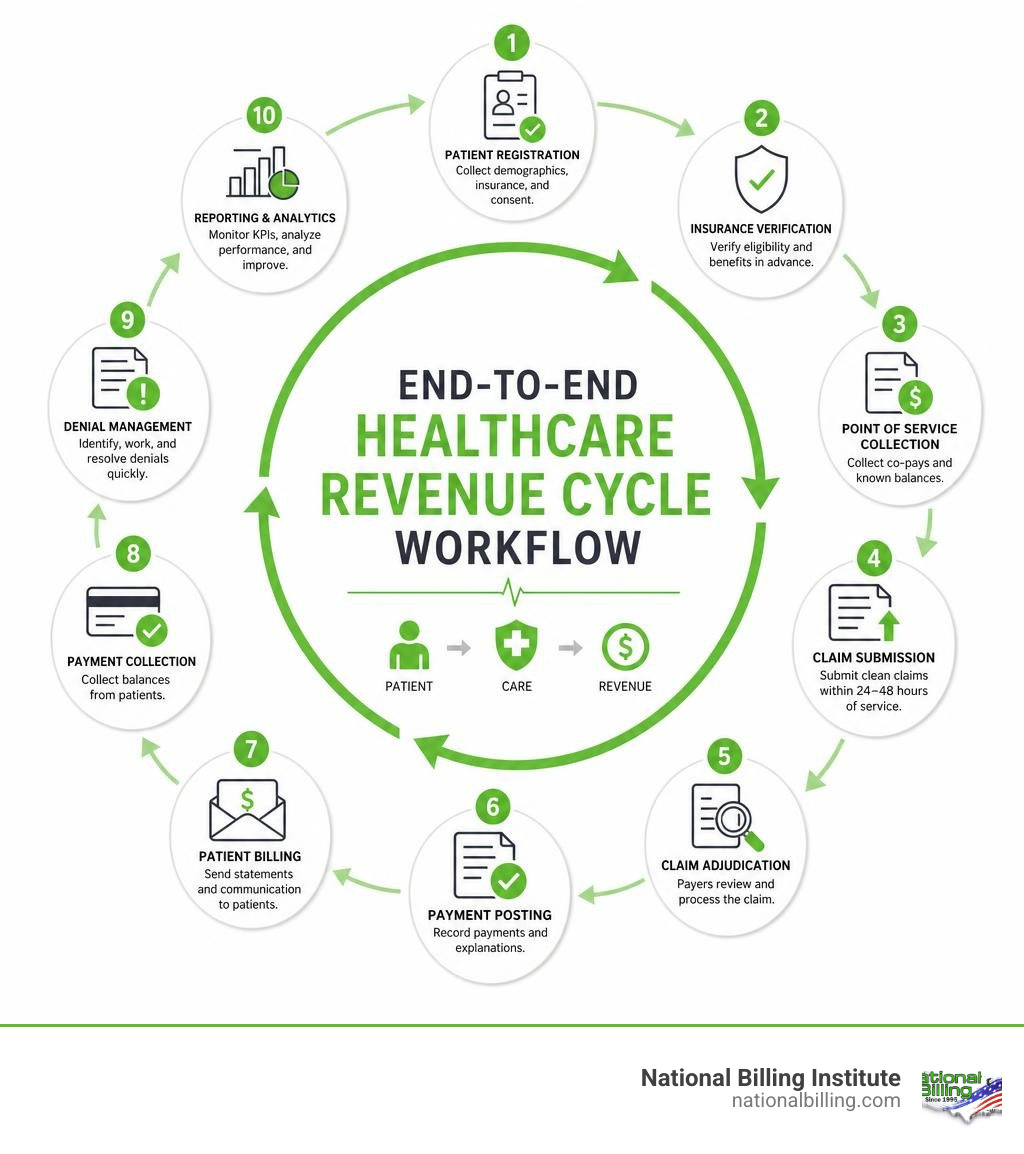
At its core, Revenue Cycle Management Healthcare is the financial circulatory system of your clinical practice. It describes the comprehensive administrative and clinical functions that contribute to the capture, management, and collection of patient service revenue. As outlined in Revenue Cycle Management: The Art and the Science - PMC, RCM is not just "medical billing"—it is an integrated science that spans from the moment a patient schedules an appointment to the final resolution of their account balance.
Maintaining a structured RCM program is the cornerstone of long-term financial sustainability. The financial contrast between optimized and unoptimized practices is staggering:
Practices utilizing a structured RCM program collect an average of 97 cents for every dollar billed.
Practices operating without structured protocols collect an average of only 71 cents for every dollar billed.
When we consider that hospitals lost over $48 billion in 2025 due to denied claims and uncollected patient balances, leaving your revenue to chance is no longer an option. A leaky revenue cycle directly threatens your clinical autonomy, limits your ability to invest in modern equipment, and drives administrative burnout.
Core Components of the Healthcare Revenue Cycle Workflow
To fix a broken system, we must first understand its anatomy. The Healthcare Revenue Cycle Workflow is traditionally divided into three distinct phases:
Front-End Operations: The patient-facing stage. This includes scheduling, patient registration, insurance eligibility verification, prior authorization procurement, and point-of-service (POS) collections.
Mid-Cycle Operations: The clinical intersection. This encompasses clinical documentation, clinical documentation improvement (CDI), charge capture, and medical coding.
Back-End Operations: The billing and resolution stage. This includes claim preparation, clearinghouse submission, denial management, accounts receivable (AR) follow-up, and patient statement generation.
When these components function as a unified ecosystem, claims flow smoothly, payments arrive rapidly, and administrative overhead plummets.
Front-End Best Practice Revenue Cycle Management
If you want to stop claim denials, you have to stop treating them at the end of the cycle. We often tell our clients: fixing back-end denials without fixing front-end controls is like mopping the floor while the kitchen faucet is wide open.

Front-end accuracy is your strongest shield against revenue loss. Industry data reveals that more than 23% of all claim denials originate from front-end registration and eligibility errors. Simple mistakes—like a misspelled middle initial, a transposed digit in an insurance ID number, or an outdated coordination of benefits (COB)—will trigger automated payer rejections before a human ever looks at the claim.
To combat this, high-performing practices enforce a policy of zero tolerance for registration errors. This begins by standardizing intake workflows and utilizing automated patient check-in kiosks or digital intake forms to capture structured data directly from the patient’s insurance card.
Real-Time Eligibility Verification and Prior Authorization
The foundation of a clean claim is real-time eligibility verification. We recommend running automated 270/271 eligibility transactions at three critical touchpoints:
At the time of scheduling.
24 to 72 hours before the scheduled appointment.
At the point of check-in.
This ensures that the patient’s coverage is active, the service is a covered benefit, and the patient’s deductible or co-insurance levels are accurately mapped.
Prior authorizations represent another massive front-end bottleneck. According to the American Medical Association (AMA), physicians and their staff spend an average of 14.6 hours per week managing prior authorizations.
To streamline these Revenue Cycle Operations, practices must adapt to the CMS prior authorization rules. Standard authorization requests must be completed within 7 days, and urgent requests within 72 hours. Utilizing electronic prior authorization (ePA) tools integrated directly into your workflow can accelerate approval cycles by 20% to 30%, saving precious staff hours and preventing costly "no-authorization" denials.
Optimizing Point-of-Service Patient Collections
With the rise of high-deductible health plans (HDHPs), patient responsibility now accounts for 30% to 35% of a practice’s total revenue. If you do not collect this portion at or before the point of service, your odds of collecting it drop by more than 50% once the patient walks out the door.
To optimize point-of-service collections:
Establish Clear Financial Communications: Train your front-desk staff with scripted, warm, yet firm communications. Instead of asking, "Would you like to pay your copay today?" train them to say, "Your copay today is $40. How would you like to take care of that—card, check, or mobile pay?"
Provide Transparent Estimates: Give patients accurate, digital Good Faith Estimates before their visit.
Leverage Propensity-to-Pay Scoring: Identify patients who may need financial counseling or structured payment plans early, allowing you to establish reasonable payment arrangements before care is delivered.
Mid-Cycle Optimization: Charge Capture, Coding, and Documentation
The mid-cycle is where clinical care is translated into billable revenue. It is also where a massive amount of revenue leakage occurs.
Studies consistently show that 5% to 10% of all billable services go completely unbilled in practices that lack a formal charge reconciliation process. This happens when a provider performs a procedure—such as an injection, a rapid strep test, or a minor skin lesion removal—but fails to document it or select the corresponding charge on the superbill.
To close this gap, practices must implement a daily charge reconciliation protocol. Every single clinical encounter logged in your EHR must be cross-referenced against the billing system's daily schedule to ensure a claim was generated.
Furthermore, investing in Clinical Documentation Improvement (CDI) is crucial. As highlighted in A physician’s guide to effective revenue cycle management | AMA , medical necessity denials are ultimately documentation problems, not coding problems. If the clinical narrative doesn't clearly support why a service was medically necessary, the claim will be denied.
Best Practice Revenue Cycle Management for Medical Coding
Medical coding is a highly specialized language that changes constantly. Attempting to use general administrative staff for complex coding is a recipe for financial disaster.
Consider the cost of Evaluation and Management (E/M) under-coding:
Under-coding costs the average primary care physician $26,000 per year.
For specialists, under-coding losses exceed $45,000 annually.
Conversely, over-coding or incorrect modifier usage triggers audits and compliance penalties. To protect your Healthcare Revenue Management, you must utilize specialty-specific certified coders who stay on top of the thousands of annual ICD-10, CPT, and HCPCS code updates. Regular external coding audits—sampling at least 10% of claims per coder quarterly—ensure that your coding practices remain highly accurate and fully compliant.
Back-End Excellence: Denial Prevention and AR Follow-Up
The back-end of the revenue cycle is where you collect the rewards of your hard work—or chase unpaid bills. When claims are rejected or denied, having robust Revenue Cycle Management Solutions in place is vital.
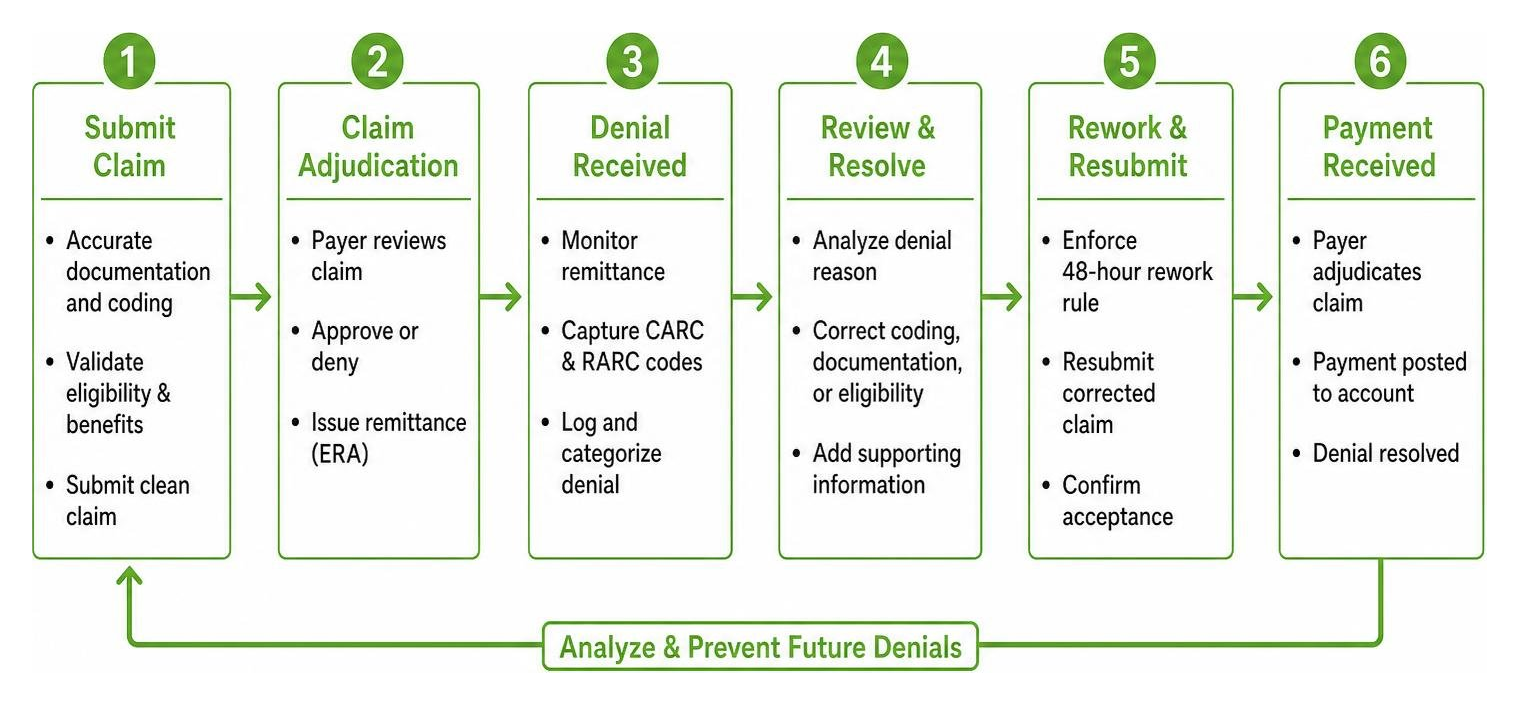
With nearly 18% of all in-network health insurance claims denied, a reactive approach to denials is incredibly expensive. In fact, appealing a single denied claim can cost between $25 and $118 just in staff time.
To build a proactive denial prevention framework:
Categorize Every Denial: Organize denials immediately using Claim Adjustment Reason Codes (CARC) and Remittance Advice Remark Codes (RARC).
Enforce a 48-Hour Rework Rule: Ensure that any denied claim is reviewed, corrected, and resubmitted within 48 hours of receipt.
Perform Root Cause Analysis: Meet monthly to review denial patterns. If a specific payer is suddenly denying a standard code combination, find out why and update your front-end or mid-cycle rules to prevent it from happening again.
Best Practice Revenue Cycle Management for Accounts Receivable
Aged accounts receivable is the enemy of cash flow. The longer a claim sits unpaid, the less likely it is to ever be collected.
High-performing practices establish disciplined follow-up protocols based on payer-specific timely filing limits. We recommend a structured follow-up timeline:
Day 21: Initiate automated or manual follow-up on unpaid commercial claims.
Day 28: Follow up on unpaid Medicare and Medicaid claims.
Weekly AR Aging Review: Do not wait for monthly reports. Review your AR aging weekly, focusing heavily on claims approaching the 60- and 90-day marks.
By leveraging advanced Healthcare Revenue Cycle Analytics, you can segment your AR queues by balance, payer, and age, allowing your billing team to focus their energy where it will yield the highest return.
Technology, Automation, and Governance in RCM
Modern RCM cannot be run on spreadsheets and manual entry. To achieve financial predictability, practices must deploy a blend of smart technology, automated workflows, and strong internal governance.
Feature / Metric In-House RCM Outsourced RCM (National Billing Institute) Average Clean Claim Rate 83% - 85% (Industry Average) 96% - 99% (Best-in-Class) Staffing Costs & Overhead High (Salaries, benefits, training, turnover) Low (Predictable, results-based pricing) Technology Access Limited to existing EHR/PM capabilities Enterprise AI-automation & custom rules engines Denial Rates 10% - 15% average Lowest in the industry Average Revenue Impact Baseline collection 15% - 30% revenue increase Team Location Varies 100% USA-Based (Boca Raton, FL)
By shifting to Automated Revenue Cycle Management, practices can eliminate repetitive manual tasks. AI-driven claim scrubbing platforms can check claims against millions of payer-specific rules before they are submitted. Similarly, Automated Revenue Management systems can automatically post Electronic Remittance Advices (ERAs) and route complex denials to the appropriate staff members.
To sustain these technological gains, establish a Revenue Integrity Committee. This group should meet monthly to review the practice's clinical, operational, and financial alignment. They should oversee continuous staff training, review CDM (Charge Description Master) updates, and maintain a rolling 12-month RCM optimization roadmap.
Selecting the Right Healthcare Revenue Cycle Management Systems
Choosing the right Healthcare Revenue Cycle Management Systems is a critical decision. Your practice management (PM) software, electronic health record (EHR), and clearinghouse must communicate seamlessly.
When evaluating Healthcare Revenue Cycle Companies, look for solutions that offer:
Deep, bi-directional EHR integration to prevent double data entry.
Real-time eligibility verification interfaces.
Robust, customizable claim scrubbing rules engines.
Transparent, dashboard-driven analytics that show you your financial health in real time.
For a deeper dive into these strategies, you can watch this comprehensive video on Revenue Cycle Management and read about 7 revenue cycle management best practices - Inovalon .
Frequently Asked Questions about Revenue Cycle Management
What is the industry benchmark for a clean claim rate?
The industry average clean claim rate sits around 83% to 85%. However, best-in-class practices achieve a clean claim rate of 96% to 99%. Improving your first-pass yield is incredibly lucrative; for example, a 1% improvement in first-pass yield can recover over $1 million annually for a 200-bed hospital, and thousands of dollars for independent clinics.
How does clinical documentation improvement reduce claim denials?
Clinical Documentation Improvement (CDI) ensures that the clinical record accurately reflects the patient's severity of illness and the complexity of the care provided. Because the majority of clinical denials are based on "lack of medical necessity," having precise documentation prevents payers from claiming a service was unnecessary. It also reduces the need for back-and-forth physician queries, saving time for both providers and billers.
What are the most critical KPIs to track in healthcare RCM?
Every practice should track these four key metrics monthly:
Days in Accounts Receivable (Days in AR): Target should be under 35 days (best-in-class is under 30).
Net Collection Rate (NCR): Target should be 95% or higher (best-in-class is 98%+).
Denial Rate: Target should be under 5%.
Clean Claim Rate (CCR): Target should be 95% or higher.
Conclusion
Maximizing your practice's financial health requires constant vigilance, specialized expertise, and advanced technology. In today's complex regulatory environment, you shouldn't have to choose between focusing on your patients and fighting for your hard-earned revenue.
At National Billing Institute, our 100% USA-based team of billing and coding experts in Boca Raton, FL, brings over 30 years of hands-on experience to your practice. We combine cutting-edge AI-automated claims processing with dedicated human expertise to deliver the industry's lowest denial rates and full HIPAA compliance—typically helping our clients achieve a 15% to 30% increase in revenue.
Ready to stop the revenue leaks and optimize your financial performance? Explore National Billing Institute Services today, or call us to schedule your free, comprehensive revenue cycle audit. Let us handle the complexities of billing while you focus on what you do best: caring for your patients.
