
AI Revenue Cycle Tools You Need in 2026
Why AI Revenue Cycle Tools Are Transforming Healthcare Billing in 2026
AI revenue cycle tools are software platforms that use machine learning, natural language processing, and autonomous AI agents to automate and optimize the full billing lifecycle — from eligibility verification and medical coding to denial management and payment posting.
Here is a quick look at the most impactful categories:
AI RCM Tool Category What It Does Eligibility & Prior Auth Verifies coverage in real time before the visit AI Medical Coding Converts clinical notes to ICD-10/CPT codes automatically Denial Prevention Flags likely rejections before claim submission Automated Appeals Drafts citation-backed appeal letters in under 60 seconds Accounts Receivable Agents Calls payers, navigates IVR, and resolves unpaid claims autonomously Ambient Documentation AI Captures billable details from the patient encounter in real time
The numbers tell a clear story. U.S. healthcare organizations lose over $262 billion annually to revenue cycle inefficiencies — denials, undercoding, delayed follow-ups, and manual workflows that simply cannot keep pace with today's payer complexity. The average medical billing company loses 11.8% of billed charges to claim denials alone, representing nearly $19.7 billion in uncollected revenue every year.
And yet, AI has the potential to save providers an estimated $175 billion annually — roughly 18% of all administrative spending.
That gap between what's being lost and what's recoverable is exactly why 63% of healthcare organizations have already integrated AI-powered automation into their revenue cycle workflows, and 80% of health systems are actively exploring or implementing generative AI tools for RCM.
The shift is no longer theoretical. It is happening right now, and the practices that move first are pulling ahead.
I'm Olivia Harper, Founder of National Billing Institute and a denial management specialist with over 30 years of hands-on experience in medical revenue cycle management — and I've spent the last several years evaluating and integrating AI revenue cycle tools into our 100% US-based billing operations. In this guide, I'll walk you through exactly which tools matter most in 2026, what they actually do, and how to choose the right ones for your practice.
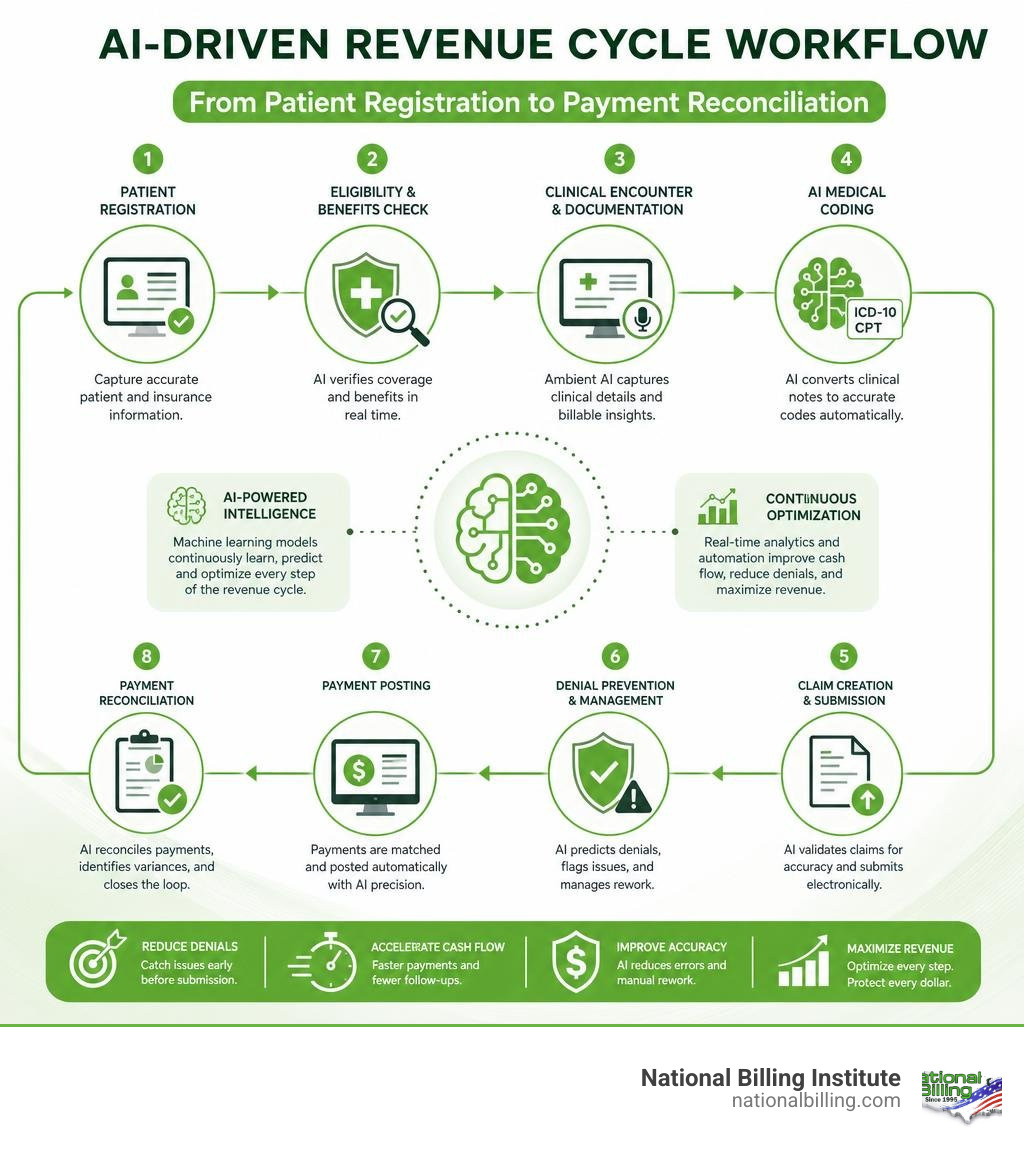
The Evolution of RCM: Traditional Automation vs. AI Revenue Cycle Tools

For decades, healthcare billing departments have relied on technology to help manage the flow of claims. However, there is a massive architectural and functional chasm between the old ways of doing things and the modern, intelligent systems we use today. Understanding this difference is key to unlocking true efficiency.
In the past, systems relied on simple, static automation. Today, we have transitioned into the era of automated revenue cycle management, where systems do not just follow static paths—they think, learn, and adapt to changing conditions in real time.
The Limitations of Legacy Rule-Based Systems
Traditional revenue cycle management healthcare platforms are built on "if-then" logic. For example: If the payer is Medicare, then require a specific modifier.
While this worked when payer guidelines were relatively stable, it fails miserably in today's environment. Payers update their policies, coverage rules, and billing edits thousands of times a year. When a rule changes, a legacy system continues using the outdated rule until a human programmer manually updates the database. This delay leads to a cascade of billing errors, timely filing rejections, and write-offs.
Furthermore, legacy systems are terrible at handling exceptions. When a claim falls outside of a predefined rule, the system simply stops and flags it for manual human review, creating massive backlogs for already overwhelmed billing staff.
Why Modern Practices Require AI Revenue Cycle Tools
The modern healthcare landscape is characterized by chronic administrative staffing shortages, shrinking operating margins, and increasingly aggressive payer denial tactics. Payers themselves are leveraging advanced algorithms to deny claims at unprecedented rates. Fighting back with manual workflows is like bringing a notepad to a cyber-battle.
According to research, embracing 3 Ways AI Can Improve Revenue-Cycle Management , healthcare organizations can shift from a reactive "firefighting" posture to a proactive, predictive workflow. AI tools continuously monitor payer behaviors, automatically update billing rules based on real-time rejection patterns, and handle complex exceptions without human intervention. This level of agility is no longer a luxury; it is a fundamental requirement for financial survival.
Key Technologies Powering Next-Generation RCM
Behind the buzzwords, several distinct branches of computer science work together to power modern ai revenue cycle tools. Let's demystify these technologies and look at how they function in a real-world billing environment to streamline ai in healthcare claims processing.
Machine Learning and Natural Language Processing in Action
Machine Learning (ML) is the engine of prediction. By analyzing millions of historical claims, ML models identify subtle patterns that correlate with rejections. For instance, an ML model can predict with 95% accuracy whether a specific combination of codes for an orthopedic procedure will be denied by a commercial payer, allowing the billing team to correct the issue before submission.
Natural Language Processing (NLP) is what allows computers to "read" and understand human language. In rcm medical coding, NLP algorithms scan unstructured clinical notes, physician dictations, and EHR records. They extract key diagnoses and procedures, matching them with high precision to their corresponding ICD-10 and CPT codes. This eliminates hours of manual chart-review time and significantly reduces human coding errors.
The Rise of Agentic AI and Autonomous Orchestration
The most exciting development in 2026 is the transition from predictive AI to Agentic AI. While earlier AI tools merely highlighted problems or recommended actions for humans to take, Agentic AI acts autonomously as a digital employee.
These advanced AI agents can:
Log into various payer portals to check claim statuses.
Place actual phone calls to insurance companies, navigate complex Interactive Voice Response (IVR) phone trees, and wait on hold to speak with representatives.
Analyze the reason for a denial, pull the required clinical documentation from the EHR, draft a citation-backed appeal letter, and submit it directly to the payer.
This is a massive leap forward. Major healthcare innovations, such as the strategic initiatives highlighted by the Cleveland Clinic, AKASA to Launch AI Tools for Revenue ... , demonstrate how enterprise-scale health systems are deploying these autonomous capabilities to handle high-volume, repetitive administrative tasks. By utilizing Generative AI for Healthcare and Revenue Cycle technologies, organizations can run their billing departments 24/7/365 without scaling their physical headcount.
Key Applications of AI Across the Revenue Cycle Lifecycle

To truly appreciate the power of these tools, we must look at how they integrate into every phase of the patient journey, transforming raw data into actionable healthcare revenue cycle analytics.
Pre-Registration and Front-End Eligibility Verification
A healthy revenue cycle starts before the patient even walks through the clinic door. Front-end errors—such as incorrect insurance details, inactive coverage, or missing prior authorizations—are responsible for a massive portion of downstream denials.
AI tools automate eligibility verification by instantly querying payer databases using ANSI 271 data. Instead of basic "active/inactive" checks, smart mapping algorithms break down visit-specific benefits, calculating exact co-pays, deductibles, and out-of-pocket maximums. This allows front-desk staff to provide patients with highly accurate cost estimations upfront, enhancing patient financial engagement and improving collection rates. For prior authorizations, generative AI reads the clinical order, determines if an authorization is required, and automatically submits the request with the necessary clinical documentation attached.
Autonomous Medical Coding and Clinical Documentation Integrity
Once care is delivered, the clinical encounter must be translated into billable codes. Ambient AI tools listen to the patient-clinician conversation in real time, compiling complete, structured clinical notes and suggesting the most accurate ICD-10 and HCC codes before the clinician even signs the chart.
This concurrent Clinical Documentation Improvement (CDI) ensures that the true acuity of the patient is captured immediately. By verifying clinical specificity upstream, we eliminate the need for back-office billing teams to send retrospective documentation queries to doctors days or weeks after the visit.
Intelligent Denial Management and Automated Appeals
When denials do occur, AI-driven healthcare denial management systems act as a digital defense force.
Instead of billers manually sorting through a massive work queue of denied claims, the AI automatically ingests the 835 Electronic Remittance Advice (ERA) or paper Explanation of Benefits (EOB). It interprets the denial codes, cross-references them against an active library of over 3,000 payer policies, and determines the exact root cause.
If the denial is invalid, the system uses advanced large language models to draft a highly technical appeal letter. This letter doesn't just ask for money; it cites the specific clauses of the payer's own medical policy, attaches the corresponding clinical notes, and queues the packet for submission in under 60 seconds.
Measuring the ROI: Performance Metrics and Financial Impact
Investing in AI must make financial sense. Fortunately, the return on investment for AI-driven revenue cycle tools is highly measurable.
Below is a comparison of typical performance metrics between traditional, manual billing processes and optimized, AI-driven workflows:
Key Performance Indicator (KPI) Traditional RCM Metrics AI-Driven RCM Metrics Average Days in A/R 45 – 55 Days 27 – 35 Days First-Pass Clean Claim Rate 70% – 80% 94% – 98% Average Claim Denial Rate 10% – 12% Less than 5% Cost per Claim Follow-Up $15.00 – $22.00 $2.00 – $4.00 Patient Pay Collection Yield Less than 50% 75% – 78%
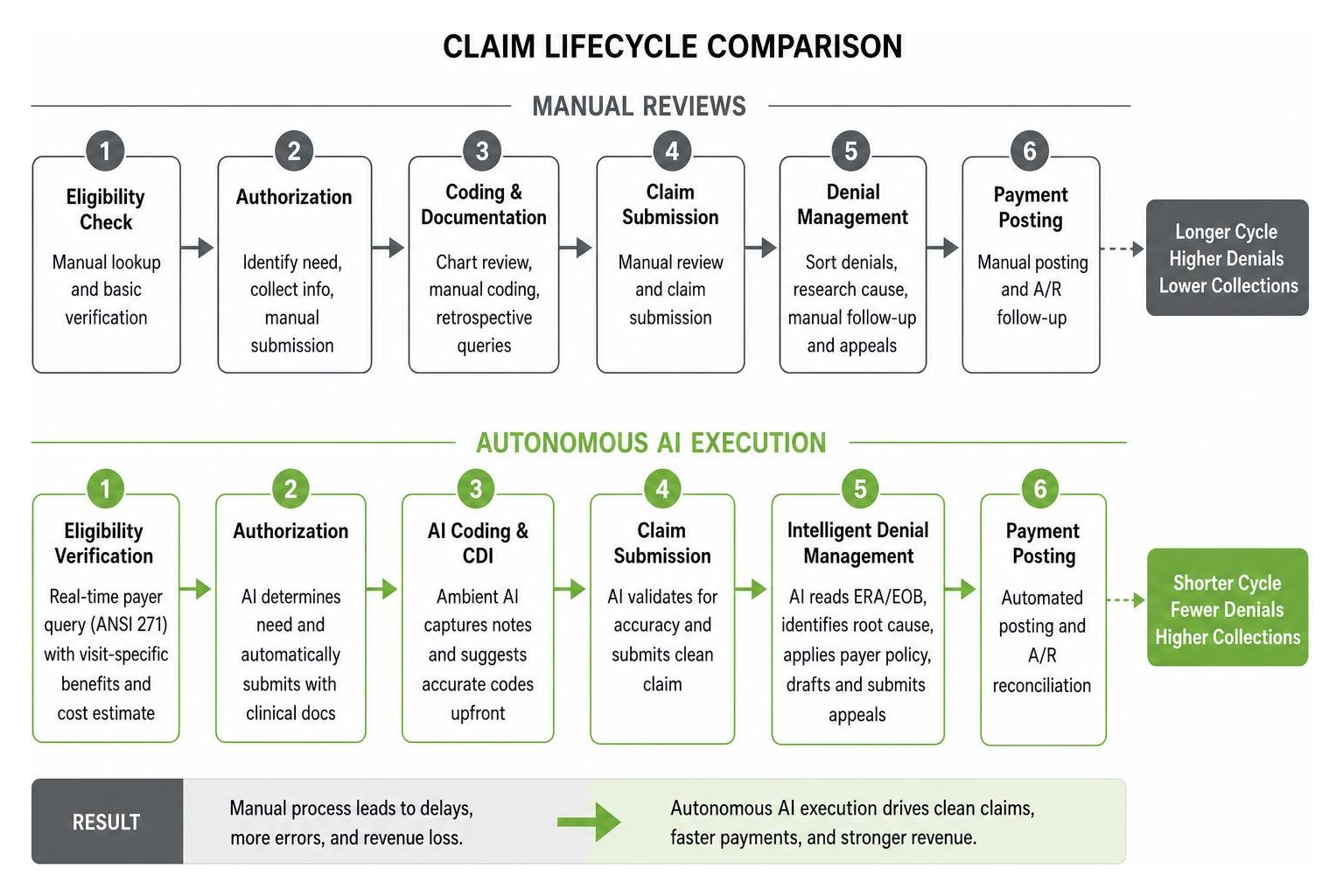
These improvements translate directly to the bottom line. For example, a mid-sized medical group processing 10,000 claims a month can easily recover hundreds of thousands of dollars in previously written-off denials and underpayments while cutting their administrative cost-to-collect in half.
Overcoming Barriers to AI Adoption in RCM
Despite the undeniable benefits, adopting AI in the revenue cycle is not without its hurdles. Healthcare leaders must navigate several challenges to ensure a smooth transition.
Data Integrity and Interoperability: AI is only as good as the data it consumes. If your existing EHR and Practice Management (PM) systems are siloed or contain messy, unstructured data, the AI will struggle. Ensuring clean integrations via secure APIs is critical.
Workforce Transition: Staff members often fear that AI is coming to replace their jobs. This can lead to resistance and low adoption rates. Leaders must communicate that AI is a tool designed to remove the tedious, repetitive tasks (like waiting on hold with payers) so billing specialists can focus on complex, high-value problem-solving.
Security and Compliance: Processing protected health information (PHI) through AI models requires strict medical billing hipaa compliance. Organizations must perform rigorous due diligence to ensure that any AI vendor executes a Business Associate Agreement (BAA), utilizes enterprise-grade encryption (AES-256), and holds SOC 2 Type II certifications.
How to Evaluate and Select the Right AI RCM Partner
With dozens of new software vendors entering the market, choosing the right platform can feel overwhelming. Healthcare executives must look past flashy marketing demos and evaluate tools based on their actual operational capabilities.
Selecting the Best AI Revenue Cycle Tools for Your Practice
When evaluating vendors, use these core criteria to guide your decision:
Explainability: Avoid "black box" AI. The tool must provide a clear, traceable rationale for every coding, billing, and denial decision it makes, referencing specific payer policies.
EHR Integration Depth: Does the tool natively read and write data back to your existing EHR, or does it require your staff to log into a separate, disconnected dashboard? True efficiency requires seamless, real-time data flow.
Specialty and Payer Coverage: Ensure the AI model has been trained on clinical documentation and payer rules specific to your medical specialty. A billing tool optimized for primary care will not perform well with complex cardiovascular or orthopedic claims.
Focus on Prevention: Look for platforms that prioritize denial prevention by scrubbing claims and validating clinical necessity before submission, rather than just managing denials after they happen.
Frequently Asked Questions about AI in RCM
What is the difference between RPA and Agentic AI in medical billing?
Robotic Process Automation (RPA) is rule-based and mimics human clicks to perform repetitive tasks (like copying and pasting data from one screen to another). It cannot make decisions or handle unexpected changes. Agentic AI, on the other hand, possesses reasoning capabilities. It can interpret complex clinical notes, adapt to changing payer rules, and autonomously determine the best path to resolve a denied claim without human intervention.
How do AI revenue cycle tools reduce claim denials?
AI tools prevent denials by performing real-time, pre-submission audits. They analyze claims against historical denial patterns, verify active insurance eligibility, check for bundling conflicts, and ensure that the clinical documentation supports the billed codes before the claim ever leaves your office.
Is patient data secure when using generative AI for billing?
Yes, provided you partner with a vendor that prioritizes healthcare security standards. Reputable AI billing tools are fully HIPAA compliant, SOC 2 certified, and run on dedicated, private cloud environments. Crucially, compliant vendors do not use your patient data or clinical notes to train public AI models.
Conclusion
The integration of ai revenue cycle tools is no longer a futuristic concept—it is the standard for operational excellence in 2026. Healthcare practices can no longer afford to combat sophisticated, AI-driven payer denials with manual, spreadsheet-based workflows.
At National Billing, we combine the power of cutting-edge AI automation with the irreplaceable expertise of our 100% USA-based team in Boca Raton, FL. With over 30 years of industry experience, we help healthcare providers achieve the lowest denial rates in the industry, maintain absolute HIPAA compliance, and realize a 15% to 30% increase in overall revenue.
Ready to eliminate revenue leaks and accelerate your cash flow? Explore our full suite of National Billing Services today, or schedule a personalized consultation with our billing experts.
