
Software Solutions to Supercharge Your Billing
The Best Revenue Cycle Management Software in 2026: A Quick Comparison
Revenue cycle management software is the backbone of getting paid accurately and on time in healthcare. If you're evaluating your options, here's a fast-reference breakdown of the leading software categories:
Software Category Best For Key Strength Enterprise EHR-Integrated Large hospital systems Seamless clinical-to-billing data flow, unified database Standalone Clearinghouse Engines Mid-to-large health systems Deep payer connectivity, advanced claim scrubbing Specialty-Specific Platforms Independent & specialty practices Tailored coding templates, custom clinical workflows Cloud-Native Billing Software Small-to-mid practices Low upfront cost, flexible API integrations, rapid deployment Tech-Enabled Managed Services Practices wanting outsourced billing Combines software automation with expert human oversight
Bottom line: No single platform type is right for every practice. The best choice depends on your size, specialty, EHR setup, and whether you want software only or a fully managed service.
If you're a healthcare provider dealing with climbing denial rates, slow reimbursements, or a billing team stretched too thin, the right software can make a measurable difference. But the wrong choice — or a poorly implemented one — can make things worse.
The market has exploded with options. Some platforms are built for massive hospital networks. Others target solo or small group practices. And a growing number now layer in AI and automation to catch errors before claims go out the door.
This guide cuts through the noise. We compare the top revenue cycle management software solutions across practice sizes, pricing models, and key features — so you can make a confident, informed decision.
I'm Olivia Harper, Founder of National Billing Institute and a denial management specialist with over 30 years of hands-on experience in revenue cycle management software and medical billing services. Since 1995, I've helped hundreds of practices across the U.S. recover revenue, cut denials, and stay fully HIPAA compliant from our 100% in-office team in Boca Raton, Florida. That real-world experience shapes everything in this guide.
What is Revenue Cycle Management Software and How Does It Work?
To understand how revenue cycle management software (RCM) optimizes a practice's financial health, we must first look at how the industry defines it. According to the Gartner definition of revenue cycle management software, this technology tracks and captures revenue received from patients and healthcare payers related to an episode of care, seamlessly combining administrative and clinical data.
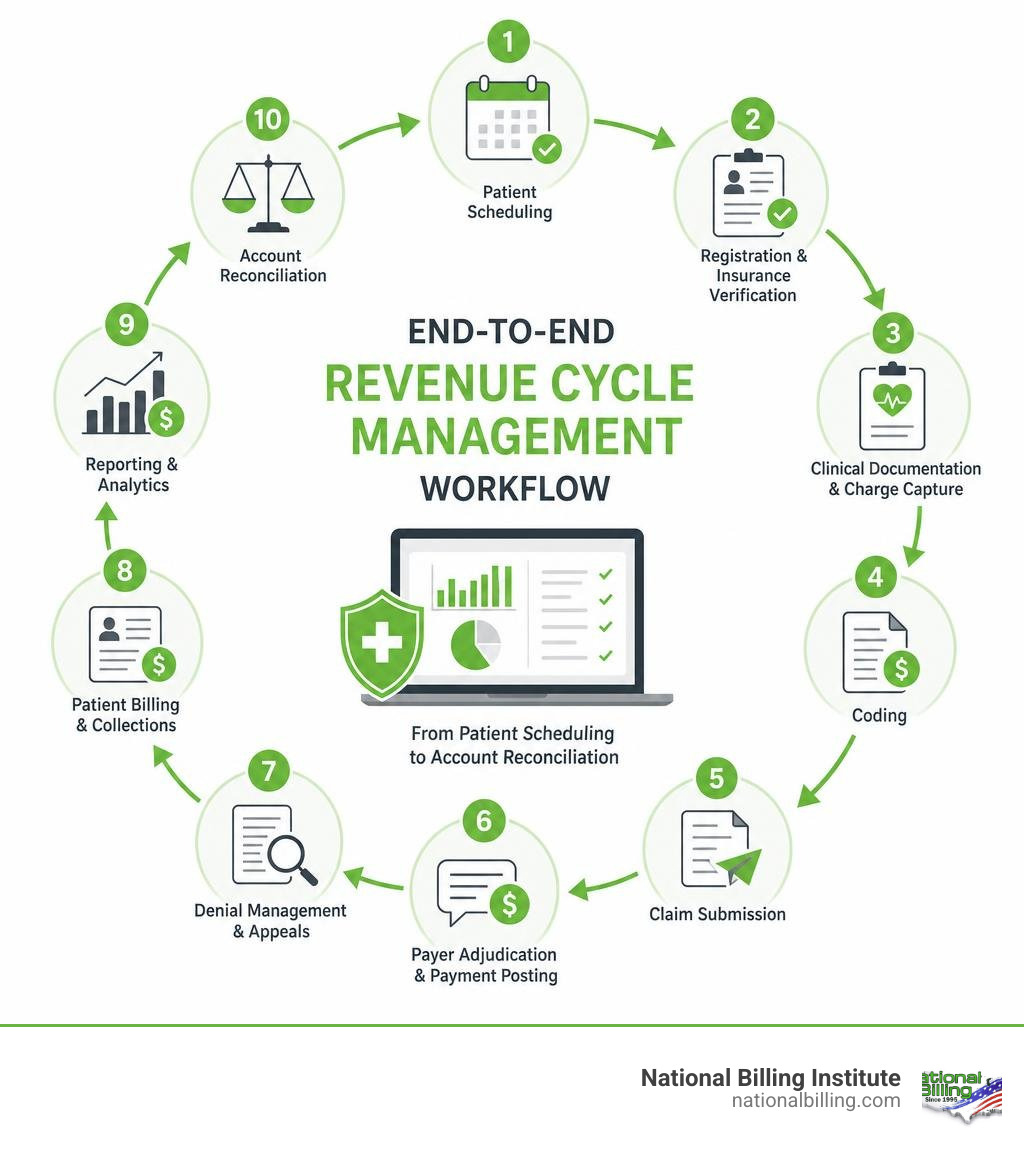
In practice, the revenue cycle is not a single event but a continuous loop. It begins the moment a patient schedules an appointment and only ends when the account balance reaches zero through successful reconciliation.
Modern healthcare revenue cycle management systems orchestrate this flow by breaking it down into distinct stages:
Patient Scheduling & Registration: Capturing accurate demographic information upfront to prevent downstream errors.
Eligibility & Prior Authorization: Verifying insurance coverage and securing payer approval before care is delivered.
Charge Capture & Coding: Translating clinical documentation (such as diagnoses and procedures) into standardized ICD-10 and CPT codes.
Claims Submission: Routing clean claims electronically to insurance clearinghouses and payers.
Payment Posting & Patient Billing: Reconciling Electronic Remittance Advice (ERA) files and billing patients for outstanding copays or deductibles.
When clinical and administrative data are siloed, healthcare organizations accumulate what we call "data debt." Data debt is the compounding cost of data quality issues, manual workarounds, and revenue leakage caused by disconnected systems. Robust RCM software unifies these data streams, turning passive records into active insights that prevent administrative friction before it hurts your cash flow.
Key Features to Look For in Modern Billing Platforms
Selecting the right platform requires looking beyond basic claim-filing capabilities. In 2026, top-performing organizations rely on advanced automation to keep their billing teams efficient.

When evaluating platforms, ensure these essential features are built into the core architecture:
Rules-Based Automation: This technology automatically routes flagged claims into specific work queues for manual review, ensuring staff members only spend time on exceptions rather than clean claims.
Real-Time Claim Scrubbing: Instantly analyzes coding accuracy and payer-specific rules before submission, catching errors that would otherwise trigger an immediate denial.
Patient Payment Portals: Features like automated text-to-pay and personalized video Explanation of Benefits (EOBs) make it easier for patients to understand and pay their bills, which can double patient payments and cut patient accounts receivable (A/R) days in half.
Electronic Remittance Advice (ERA) Processing: Automatically posts payer payments and reconciles accounts, reducing manual posting time by up to 50%.
Predictive Analytics: Centralized dashboards that track key performance indicators (KPIs) in real-time, helping you identify underpayment trends and pinpoint exactly where revenue leakage is occurring.
By implementing automated revenue cycle management, practices can shift from a reactive posture to a proactive workflow, capturing every dollar they are owed.
Standalone vs. Integrated EHR Revenue Cycle Management Software
One of the biggest decisions a practice must make is choosing between a standalone RCM solution and an integrated Electronic Health Record (EHR) and RCM platform.
Standalone RCM software acts as a specialized billing engine. It is often vendor-agnostic, meaning you can connect it to various existing clinical systems using secure Application Programming Interfaces (APIs). A powerful standalone engine layers over an existing EHR, connecting to thousands of payers to provide advanced scrubbing and clearinghouse capabilities.
On the other hand, integrated platforms combine clinical documentation, scheduling, and billing into a single, unified environment.
The primary advantage of an integrated platform is the elimination of data silos and duplicate data entry. When a clinician finishes documenting an encounter, the clinical notes immediately inform the billing rules, creating an "E-Superbill" that reduces coding handoff gaps.
However, integrated platforms can sometimes feel rigid or overbuilt for smaller practices. If you prefer a highly flexible setup, a cloud-based medical billing software option that easily integrates with third-party tools via APIs might offer the best of both worlds.
Comparing Software Solutions: Small Practices vs. Large Health Systems
The billing needs of a solo practitioner in Boca Raton are vastly different from those of a multi-state hospital system managing thousands of providers. Large enterprise systems must navigate complex specialty billing, diverse reimbursement models (such as value-based care, fee-for-service, and concierge contracts), and high claim volumes.
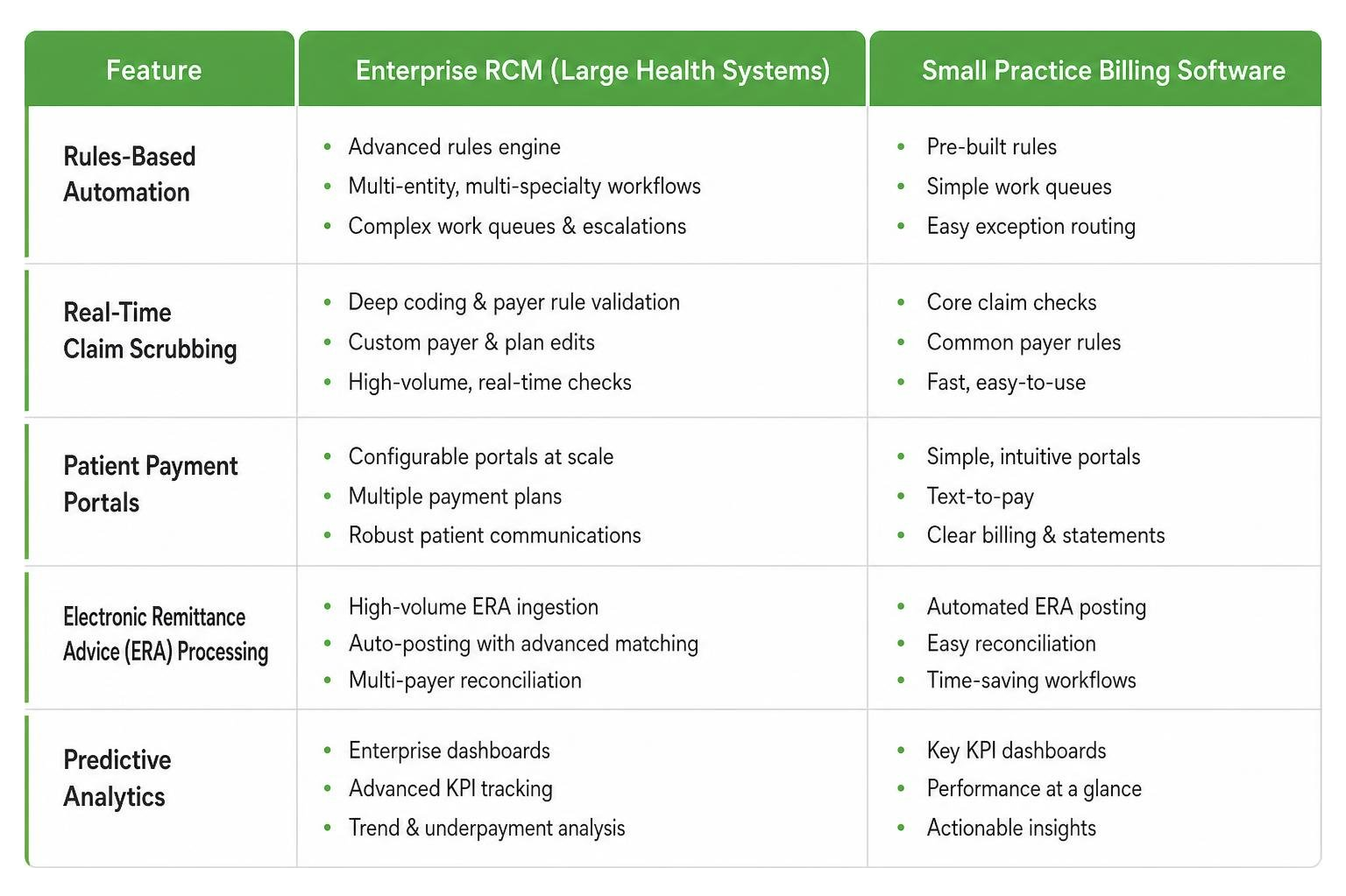
Enterprise-grade software is designed to handle immense scale, supporting multi-entity structures, central billing offices (CBOs), and extensive custom workflows for organizations submitting millions of claims annually.
Conversely, independent practices require highly intuitive, low-maintenance software that doesn't demand dedicated, in-house IT teams. These platforms are designed to streamline daily administrative tasks so clinicians can focus on patient care.
Regardless of your practice's size, partnering with professional healthcare rcm services can bridge the gap between software capabilities and real-world execution, ensuring you actually achieve the financial performance your platform promises.
Selecting the Right Revenue Cycle Management Software for Your Scale
Choosing a platform requires mapping your unique organizational needs against a vendor's offering. We recommend defining your "buying profile" before scheduling software demos:
Assess Your Internal Resources: Do you have a dedicated billing team to manage the software, or do you need a tech-enabled managed service?
Evaluate the Implementation Timeline: Enterprise rollouts can take 6 to 12 months and require extensive system configuration, whereas small practice cloud platforms can often be deployed in a matter of weeks.
Verify Specialty Customization: Ensure the software's rules engine supports your specific clinical workflows. A pediatric practice, for instance, has entirely different billing rules than an orthopedic group.
Check the Vendor Support Model: Many software giants rely on automated ticketing systems or offshore call centers. If you value direct, expert communication, verify how escalation works before signing a contract.
Reading peer-sourced Gartner RCM software reviews can provide invaluable insights into how these platforms perform during real-world rollouts, helping you avoid costly implementation surprises.
How AI and Automation Reduce Denials and Improve Cash Flow
The integration of artificial intelligence (AI) and machine learning has revolutionized modern billing. Traditional RCM software relied on static, "if-then" rules to catch errors. Today, agentic AI and machine learning models analyze historical claims, payer behaviors, and denial patterns to predict and resolve issues before a claim is ever submitted.
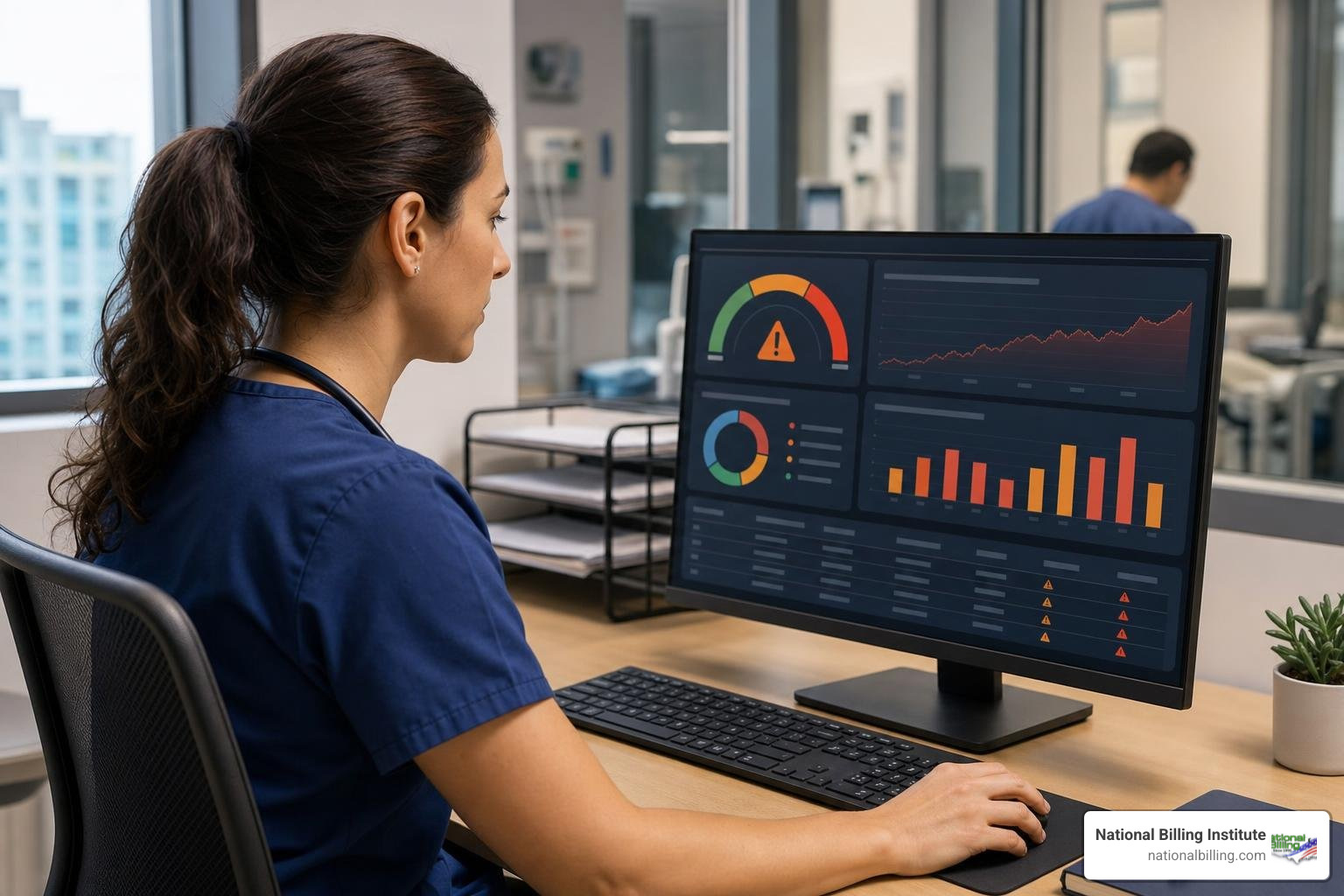
AI-driven platforms supercharge the billing cycle in several key areas:
Predictive Claim Scrubbing: By simulating payer scrutiny, AI can predict the likelihood of a denial and recommend specific corrections to clinical documentation or coding.
Automated Prior Authorizations: AI agents can instantly pull clinical notes, verify payer guidelines, and submit authorization requests, eliminating hours of manual phone calls.
Insurance Discovery: For accounts marked as uninsured, automated tools scan authoritative payer databases to find active coverage. Industry data shows an average identification hit rate of over 40% on uninsured accounts using this technology, allowing practices to bill insurance instead of writing off the care as bad debt.
Denial Appeals Automation: When a denial does occur, generative AI can analyze the rejection code, retrieve the necessary clinical documentation, and package a comprehensive appeal packet in seconds.
By embedding ai in healthcare claims processing, healthcare organizations have seen first-pass claim resolution rates improve from a standard 78% up to 95%, while simultaneously reducing total claim denials by up to 75%.
Implementation Challenges, Pricing Models, and Compliance Standards
While the benefits of modern billing software are clear, implementing a new system comes with distinct operational hurdles. The most common challenges include staff resistance to new workflows, data migration errors from legacy systems, and temporary drops in productivity during the training phase.
Furthermore, healthcare billing is heavily regulated. Any software you select must support strict compliance standards:
HIPAA Compliance: Ensuring patient data is encrypted both in transit and at rest, with role-based access controls and detailed audit trails.
ICD-10 & DRG Coding: Staying continuously updated with the latest diagnostic and hospital case classification standards.
MIPS/MACRA & Value-Based Care: Tracking quality performance metrics to ensure accurate reimbursement under outcomes-based payment models.
Pricing models also vary widely among software vendors. Subscription-based SaaS models charge a flat monthly fee per provider, which is highly predictable but can become expensive as you scale. Other vendors charge a per-claim fee or a percentage of overall collections (typically ranging from 3% to 8%).
Managing these software platforms, configuring rules, and chasing down complex denials still requires significant administrative effort. This is why many practices choose to combine their software with specialized rcm denial management services to ensure their technology is constantly optimized by certified experts.
Frequently Asked Questions about RCM Software
Navigating the transition to a new billing platform can bring up many questions. Here are the answers to the most common inquiries we receive from healthcare providers.
How does RCM software integrate with existing EHR systems?
Modern RCM platforms integrate with EHR systems using secure APIs and HL7 (Health Level Seven) standards. This enables real-time data exchange between your clinical documentation and your billing engine.
When a provider signs off on a chart in the EHR, the demographic and clinical data are instantly transmitted to the electronic claims management system, eliminating the need for manual data entry and drastically reducing registration errors.
What is the average cost and pricing model for RCM platforms?
The cost of an RCM platform depends on your practice size and the deployment model:
Subscription (SaaS) Model: Usually ranges from $200 to $1,000+ per provider, per month, depending on the features included.
Percentage of Collections: Typically ranges from 3% to 8% of your monthly collections, aligning the software vendor's incentives with your financial success.
Implementation Fees: One-time setup, data migration, and staff training fees can range from a few thousand dollars for small practices to six figures for large health systems.
How does automated insurance discovery find active coverage?
Automated insurance discovery tools search authoritative, real-time clearinghouse and payer databases using the patient's demographic details (such as name, date of birth, and Social Security number).
Even if a patient presents as uninsured or self-pay, these tools find active, primary, or secondary coverage in roughly 40% of cases, protecting your practice from uncompensated care and reducing bad debt write-offs.
Conclusion
Selecting the right revenue cycle management software is one of the most critical operational decisions your healthcare organization will make. The right platform can streamline your workflows, automate tedious coding tasks, and significantly improve your first-pass clean claim rates.
However, software is only as good as the team operating it. Even the most advanced AI-powered platforms require constant oversight, rule updates, and diligent follow-up on complex payer denials.
At National Billing Institute, we combine cutting-edge billing technology with the human expertise of a 100% USA-based team in Boca Raton, Florida. With over 30 years of industry experience, we help healthcare providers eliminate administrative burdens, maintain full HIPAA compliance, and achieve the industry's lowest denial rates — typically delivering a 15% to 30% increase in overall revenue.
Ready to supercharge your practice's financial performance? Explore our full-service medical billing solutions today, or reach out to our Boca Raton office to schedule a free revenue cycle consultation.
