
Cloud-Based Medical Billing Software: A Buyer's Guide
Why Cloud-Based Medical Billing Software Is Now a Make-or-Break Decision for Your Practice
Cloud-based medical billing software is a web-hosted billing solution that lets practices submit claims, track payments, and manage their entire revenue cycle from any internet-connected device — no local servers required.
In 2026, the most effective solutions prioritize:
AI-Native RCM: Achieving clean claim rates above 98% through automated scrubbing.
All-in-One Integration: Hosting documentation and billing in a unified environment to reduce manual entry.
Mobile-First Design: Utilizing billing profiles that can cut administrative work by up to 33%.
A/R Optimization: Reducing accounts receivable by 30% and cutting reimbursement time in half.
If you're still running billing through legacy software — or worse, a spreadsheet — you're likely leaving serious money on the table. Claim denials, slow reimbursements, and manual errors are costing practices thousands every month. Cloud-based platforms fix that by automating the heaviest parts of the revenue cycle.
The shift isn't just about convenience. It's about survival in a healthcare billing environment that's only getting more complex — more payers, more compliance requirements, and more patient payment responsibility. According to the Centers for Medicare & Medicaid Services (CMS), staying updated with regulatory changes is critical for maintaining practice viability and compliance.
I'm Olivia Harper, Founder and Denial Management & Reimbursement Specialist at National Billing Institute, and with over 30 years of hands-on RCM experience I've watched cloud-based medical billing software completely reshape how practices protect and grow their revenue. In this guide, I'll break down exactly what to look for so you can make a confident, informed decision.
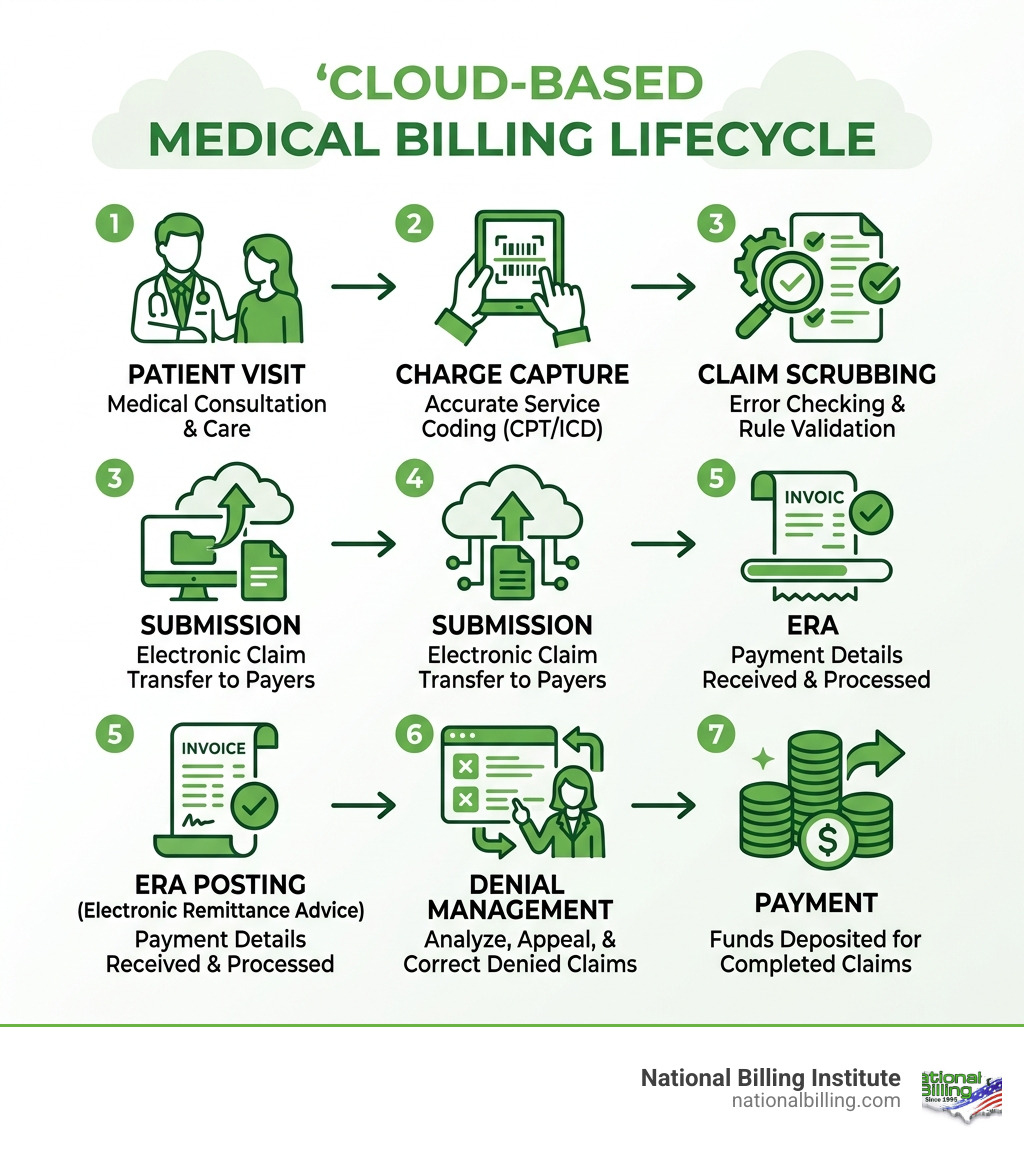
Understanding Cloud-Based Medical Billing Software and Its Evolution
In the "old days" of medical billing (which, let’s be honest, wasn't that long ago), software lived on a clunky server in a back closet. If that server crashed or the office lost power, your billing stopped. Moving to cloud-based medical billing software has changed the game by utilizing the Software as a Service (SaaS) model. Instead of buying a license and installing it on one computer, we now access our billing tools through a secure web browser.
The evolution from on-premises to the cloud has brought several transformative benefits:
Remote Accessibility: Whether you are in our Boca Raton office or working from home, you can access real-time data. This is essential for modern telemedicine and multi-location practices.
Real-Time Synchronization: Gone are the days of "batching" data at the end of the day. When a front-desk staff member updates insurance info, the biller sees it instantly.
Automatic Updates: In 2026, coding regulations and payer rules change overnight. Cloud systems update automatically, ensuring you are always compliant with the latest ICD-11 or HIPAA requirements without manual downloads.
Scalability: As your practice grows from one provider to ten, the cloud expands with you. There’s no need to buy more hardware; you simply scale your subscription.
Traditional legacy systems often feel like a ball and chain. They are expensive to maintain, prone to data loss if not backed up manually, and lack the interoperability needed to talk to modern EHRs. By contrast, cloud solutions offer a "single source of truth" that keeps everyone—from the physician to the patient—on the same page.

Essential Features for High-Performance Revenue Cycle Management
When we evaluate cloud-based medical billing software, we look for features that move the needle on your bottom line. It isn't just about "sending claims"; it's about ensuring those claims are paid the first time.
High-performance platforms in 2026 are defined by their ability to automate the "tedious" stuff. For example, some systems now allow you to send statements to all patients with a single button click - a task that used to take a team of four to six people an entire month to complete manually.
Feature Manual/Legacy Entry AI-Driven Cloud Automation Claim Scrubbing Manual spot-checks for errors Automatic checks for CCI, HIPAA, and LCD errors Eligibility Calling payers or checking portals Real-time verification before the patient arrives Payment Posting Manual entry of paper EOBs Automated ERA posting for ACH, check, and BOP Reporting Static spreadsheets Live dashboards with 150+ standard KPIs Denial Management Reactive (fixing after rejection) Predictive (identifying likely denials before submission)
Key features like claim scrubbing are vital. Top-tier software can achieve nearly 100% first-pass acceptance rates by catching errors before they ever reach the payer. Additionally, robust Services like integrated clearinghouses allow you to connect to over 1,800 carriers from a single platform, drastically reducing the time it takes to get reimbursed.
The best systems also improve visibility across the full revenue cycle. Instead of waiting until month-end to learn that denials are climbing or payments are slowing, managers can view real-time dashboards that show charge lag, claim status, payer turnaround time, and aging trends as they happen. That kind of transparency helps practices make faster staffing and workflow decisions before small billing issues turn into large cash flow problems.
Another must-have is workflow automation for repetitive back-office tasks. Smart work queues can route rejected claims, missing authorizations, and underpaid balances to the right team member automatically. This reduces manual sorting, shortens follow-up time, and creates accountability across the billing team. For practices trying to do more with lean staff, automation like this is often the difference between stable collections and constant backlog.
Patient financial engagement matters too. Modern cloud platforms increasingly support digital statements, payment reminders, and easier balance collection workflows, which is important as patient responsibility continues to rise. When billing data, payer activity, and patient balances all live in one system, the practice gets a more complete picture of what is owed, what is collectible, and where delays are happening. In practical terms, that means fewer missed charges, fewer avoidable denials, and a healthier revenue cycle overall.
Security, HIPAA Compliance, and Implementation Strategies
One of the biggest questions we hear at National Billing Institute is: "Is my data safe in the cloud?" The answer is a resounding yes—provided you choose a platform that prioritizes high-level security.
In 2026, "standard" security isn't enough. We look for:
Data Encryption: Both at rest and in transit.
Multi-Factor Authentication (MFA): To prevent unauthorized access even if a password is stolen.
Disaster Recovery: Automatic, redundant backups across multiple geographic locations (often using stable backbones like AWS).
HIPAA & GDPR Compliance: Ensuring every "click" is audited and every piece of Protected Health Information (PHI) is shielded.
Transitioning from a legacy system to the cloud can feel daunting, but a structured strategy makes it seamless. It starts with a thorough data migration plan to ensure no patient records or outstanding A/R are lost. Staff training is equally important; a tool is only as good as the person using it. We recommend a phased implementation where you run your old system in parallel with the new cloud platform for a short period to ensure total data integrity.
Why Choose National for your billing needs? Because we combine this high-tech cloud security with a 100% USA-based team that understands the nuances of American healthcare law.
Frequently Asked Questions
How does cloud-based medical billing software reduce accounts receivable?
The primary goal of any RCM strategy is to lower your "Days in A/R." Cloud-based medical billing software achieves this through speed and accuracy. Case studies show that practices can see a 30% reduction in accounts receivable and a 50% cut in reimbursement time.
By using automated follow-ups and AI-native "claim alarms," the software alerts billers to issues immediately rather than waiting for a monthly report. When you combine this with high first-pass acceptance rates, the money simply hits your bank account faster. If you’re curious about your current A/R health, you can Schedule Billing Review with our experts to see where the bottlenecks are.
What role does AI play in modern cloud-based medical billing software?
AI is no longer a "future" concept; it is the engine of 2026 billing. Modern platforms use machine learning for predictive analytics, helping us forecast which claims are likely to be denied based on historical payer behavior.
We are also seeing "ambient listening" and computer-assisted coding, where AI helps translate clinical notes into accurate billing codes. This has led to industry-leading clean claim rates of up to 98.4%. AI doesn't replace the human biller; it empowers them to focus on complex appeals while the "robots" handle the repetitive data entry.
How do integrations enhance cloud-based billing platforms?
A billing system shouldn't be an island. The best cloud-based medical billing software integrates seamlessly with EHRs, patient portals, and telehealth tools. With over 277,000 potential clinical integrations (labs, pharmacies, etc.), data flows smoothly from the moment a patient books an appointment to the moment the final payment is posted.
Mobile charge capture is another huge win. Physicians can now capture charges on their mobile devices during rounds, which automatically syncs with the billing office. This eliminates "lost" charges and ensures that the documentation matches the bill perfectly.
Conclusion
Choosing the right cloud-based medical billing software is one of the most significant financial decisions your practice will make this year. Whether you are looking for AI-native power, mobile flexibility, or comprehensive RCM tools, the goal remains the same: maximizing your revenue while minimizing administrative headaches.
At National Billing Institute, we’ve spent over 30 years perfecting the art and science of the revenue cycle. Our Boca Raton-based team uses these advanced cloud tools to help our clients achieve a 15-30% revenue increase and the lowest denial rates in the industry. We believe that when the billing is simple, healthcare is better for everyone.
Ready to transform your practice's financial future? Discover More info about our Services or Contact Us today to see how we can put the power of the cloud to work for you.
