
How to Stop Claim Rejections Before They Happen
Why Rejection in Medical Billing Is Costing Your Practice More Than You Think
Rejection in medical billing is one of the biggest drains on a healthcare practice's revenue — and most of it is preventable.
Here's a quick answer to what you need to know:
Question Quick Answer What is a claim rejection? A claim returned before the payer processes it, due to data or formatting errors What causes most rejections? Patient demographic errors, invalid codes, missing prior auth, duplicate submissions Is a rejection the same as a denial? No — rejections happen before adjudication; denials happen after Can rejected claims be fixed? Yes — correct the error and resubmit quickly How much does it cost? $25–$40 per rejected claim in administrative rework What's a good rejection rate? Under 3% is best-in-class; industry average is 5–8%
Every rejected claim costs your team time, delays your cash flow, and chips away at your bottom line. A mid-size practice submitting 500 claims a month with just a 5% rejection rate can waste up to $1,000 every single month in rework labor alone — money spent fixing problems that should never have happened in the first place.
The good news? Most rejections trace back to a short list of preventable errors. And once you know what they are, you can stop them upstream — before the claim ever leaves your office.
I'm Olivia Harper, Founder and Denial Management & Reimbursement Specialist at National Billing Institute, and over my 30+ years in revenue cycle management I've helped hundreds of practices dramatically reduce their rejection in medical billing by fixing the root causes at the source. In this guide, I'll walk you through exactly how to do the same.
Understanding Rejection in Medical Billing: Levels and Types
To defeat your enemy, you must first understand how they operate. In revenue cycle management (RCM), rejections do not all happen in the same place or for the same reasons.
In fact, a claim must pass through several checkpoints before it is officially accepted by an insurance payer for processing. If it fails a check at any of these checkpoints, it is thrown back to your practice.
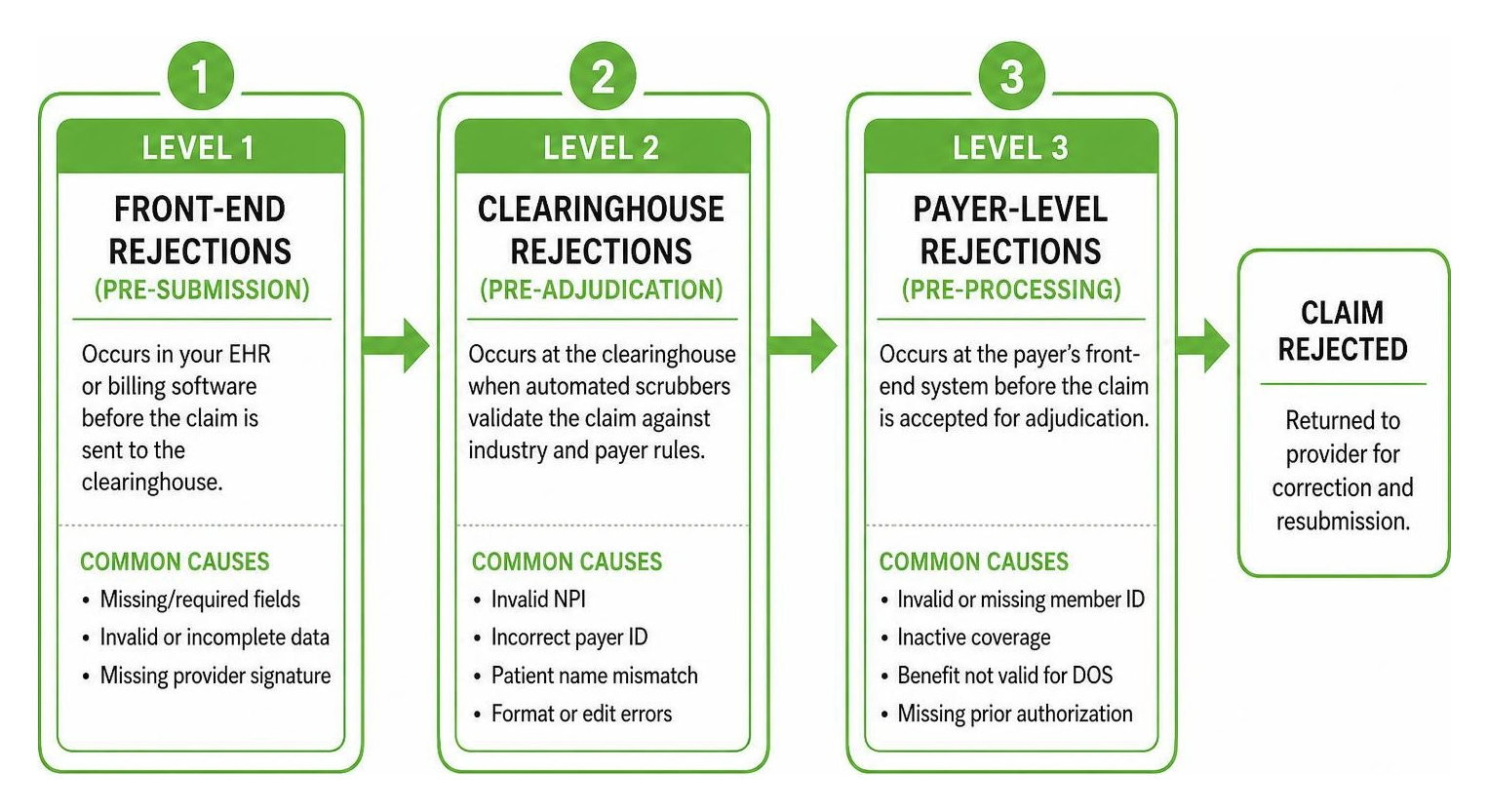
These checkpoints represent the three distinct levels of rejection in medical billing:
Level 1: Front-End Rejections (Pre-Submission): These occur within your own billing or Electronic Health Record (EHR) software before the claim is even sent to the clearinghouse. These are typically basic data-entry omissions, such as a missing provider signature or an empty field that is mandatory for submission.
Level 2: Clearinghouse Rejections (Pre-Adjudication): This is where the clearinghouse's automated "scrubbers" check your claim against industry standards and payer-specific formatting rules. If the clearinghouse finds an invalid National Provider Identifier (NPI), an incorrect payer ID, or a mismatched patient name, it rejects the claim.
Level 3: Payer-Level Rejections (Pre-Processing): These occur after the clearinghouse passes the claim along, but before the payer's adjudication system officially imports it. The payer's front-end system conducts a preliminary check. If it finds that the member ID does not exist or the patient's coverage was inactive on the date of service, the payer rejects the claim before it ever enters their processing system.
To learn more about how these levels affect your overall billing health, you can read about the Types of Rejections in Medical Billing and How To Avoid Them.
What is a Rejection in Medical Billing?
At its core, a rejection in medical billing is a claim that has failed basic data validation, formatting, or compliance checks before it can be received and processed by the insurance company.
Think of it like trying to mail a letter. If you forget to put a stamp on the envelope, or if you write an address that doesn't exist, the postal service will return the letter to you immediately. They don't open the letter, read it, and decide they don't like what you wrote; they simply return it because it didn't meet the basic requirements to be delivered.
In medical billing, those "envelope guidelines" are dictated by HIPAA's X12 EDI (Electronic Data Interchange) standards. When your billing system transmits a claim, it goes through a series of technical handshakes. The most critical of these is the 277CA (Claim Acknowledgment) transaction. The 277CA is the standard electronic report returned by clearinghouses or payers that tells us whether a claim was accepted for processing or rejected due to technical errors.
Because a rejected claim is never officially accepted into the payer's system, it does not exist in their claims history. If you call a payer to ask about a rejected claim, their customer service representative will tell you, "We have no record of this claim."
To dive deeper into the technical codes that trigger these events, check out our guide on How Many Types of Rejections in Medical Billing Are There?.
Soft vs. Hard Rejection in Medical Billing
Not all rejections are created equal. When managing your daily billing workflows, it is helpful to categorize rejections into "soft" and "hard" varieties:
Soft Rejections: These are minor, easily correctable errors that typically occur at the clearinghouse level. They are usually caused by temporary formatting issues, missing non-critical information, or minor data mismatches. For example, if you accidentally reverse two digits in a patient's zip code, the clearinghouse scrubber will flag it as a soft rejection. Your billing team can quickly correct the typo in your practice management system and resubmit the claim within minutes.
Hard Rejections: These typically happen at the payer level before the claim is accepted for adjudication. Hard rejections often involve fundamental policy rules, credentialing issues, or strict submission requirements. For instance, if a provider is not fully credentialed with a specific payer, or if a specialty-specific taxonomy code is missing from the claim, the payer's front-end system will issue a hard rejection. Resolving a hard rejection requires a more structured correction workflow, which may involve updating provider enrollment files or contacting the payer directly to clarify policy rules.
Rejection vs. Denial: The Critical Differences
One of the most common mistakes we see in medical practices is billing staff using the terms "rejection" and "denial" interchangeably. They are entirely different events, and treating them the same way can lead to massive delays in your revenue cycle.
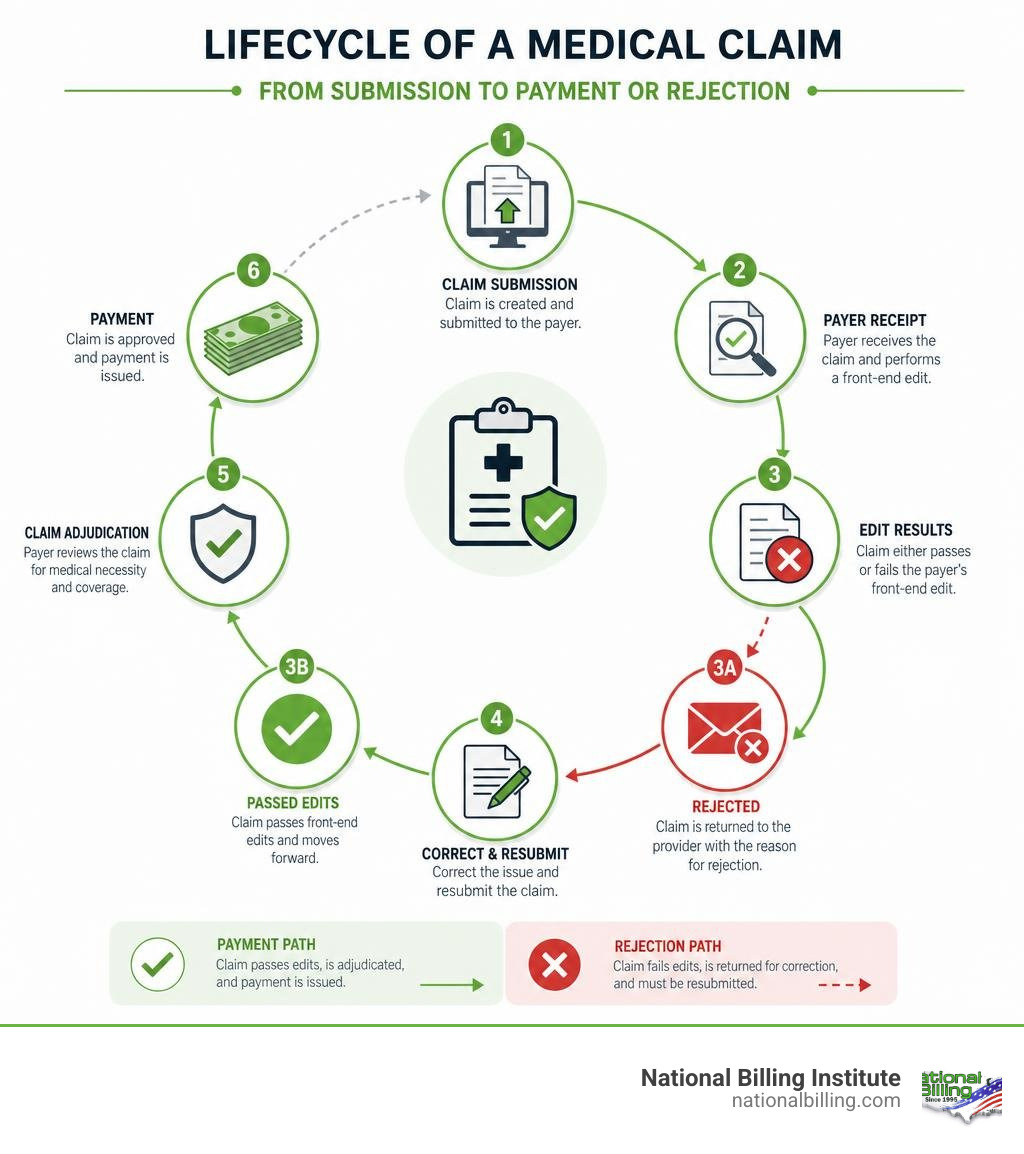
The line of demarcation between a rejection and a denial is adjudication. Adjudication is the formal process where an insurance payer reviews an accepted claim against the patient's benefits, medical necessity guidelines, and clinical policies to determine how much to pay.
Rejections occur before adjudication. Because the claim has formatting or data errors, the payer's system refuses to accept it. It is returned to the sender without being processed.
Denials occur after adjudication. The payer successfully receives, imports, and reviews the claim. However, they decide not to pay all or part of it because of a policy violation, lack of medical necessity, or coverage issue.
When a claim is denied, the payer issues an Explanation of Benefits (EOB) or an Electronic Remittance Advice (ERA). These documents contain specific Claim Adjustment Reason Codes (CARCs) and Remittance Advice Remark Codes (RARCs) explaining exactly why the claim was not paid.
To resolve a rejection, you simply correct the data error and resubmit the claim as a new submission. To resolve a denial, you cannot just resubmit the claim; doing so will result in a duplicate claim denial. Instead, you must go through a formal appeals process or submit a corrected claim with the appropriate resubmission codes.
Here is a side-by-side comparison to help your team keep these straight:
Feature Claim Rejection Claim Denial Timing Occurs before the claim is accepted or processed. Occurs after the claim is processed and adjudicated. Payer System Status Never entered into the payer's database. Entered and stored in the payer's database. Notification Method 277CA Claim Acknowledgment report. EOB (paper) or 835 ERA (electronic). Primary Causes Formatting errors, typos, invalid codes, missing demographics. Lack of medical necessity, missing prior auth, non-covered services. Timely Filing Impact The timely filing clock continues to run until a clean claim is accepted. Timely filing is met once accepted, though appeal deadlines apply. Resolution Action Correct the error and resubmit as a new claim. File a formal appeal or submit a corrected claim.
For a deeper understanding of these post-adjudication hurdles, you can read More info about medical billing denials and explore our comprehensive strategies with More info about denial management.
The Most Common Causes of Claim Rejections
To build a "rejection-proof" billing department, you need to know exactly which errors are slipping through your front-end workflows. In our 30+ years of managing revenue cycles, we have found that nearly 80% of all rejections are caused by just three main categories of errors.

By systematically addressing these areas, you can dramatically reduce your administrative rework and protect your cash flow. If you want to stop these issues before they start, check out More info about denial prevention.
Patient Demographic and Eligibility Errors
It might surprise you to learn that the absolute leading cause of rejection in medical billing has nothing to do with complex coding or clinical documentation. Instead, it comes down to simple data entry at the front desk.
In fact, patient demographic errors account for approximately 33% of preventable medical billing rejections.
These rejections occur when the information entered into your practice management system does not match the payer's eligibility database exactly. Common culprits include:
Name Mismatches: Entering a patient's nickname (e.g., "Bob" instead of "Robert") or omitting a hyphen in a last name.
Invalid Member IDs: Transposing letters or numbers in the insurance ID card, or using an old ID card from an expired policy.
Mismatched Dates of Birth: A simple typo in the birth date will trigger an automatic rejection.
Eligibility Verification Failures: Submitting a claim for a patient whose coverage terminated before the date of service. Eligibility verification failures rejected approximately 13.5% of medical claims in 2021, and that number has remained a major challenge for practices that do not verify coverage at every single visit.
Coding Inaccuracies and Modifier Misuse
Medical coding is a rapidly moving target. Every year, the AMA and CMS release massive updates to CPT and ICD-10-CM code sets. If your billing software's code libraries are not updated immediately, or if your coders are not trained on the latest changes, rejections will spike.
Invalid or Deleted Codes: Submitting a claim with a code that has been retired or deleted.
Modifier Misuse and Omissions: Modifiers tell the payer unique circumstances about a procedure. If they are missing or used incorrectly, the claim will fail automated National Correct Coding Initiative (NCCI) edits.
The "Same-Day" Diagnostic Rejection: Consider a real-world scenario where a patient undergoes an abdominal ultrasound in the morning to evaluate severe abdominal pain. Hours later, due to worsening symptoms, the physician orders a second abdominal ultrasound to reassess the patient. If you submit both services on the same claim without attaching modifier 76 (repeat procedure by same physician) to the second service, the clearinghouse or payer will reject it as a duplicate billing error.
To learn how to resolve these specific coding errors, read More info about medical billing denial codes.
Prior Authorization and Timely Filing Gaps
While prior authorization issues often lead to denials, they can also trigger hard rejections at the payer's front-end system if the authorization number is missing from the required field on the claim form (Loop 2300, REF segment on electronic claims).
Furthermore, timely filing deadlines are a major risk factor when dealing with rejections. Many commercial payers have strict filing windows (some as short as 90 days from the date of service).
Here is the danger: A rejected claim does not stop the timely filing clock. Because a rejected claim was never accepted by the payer, the clock keeps ticking. If a claim is rejected on day 88 of a 90-day filing window, and your team takes five days to notice and fix the rejection, the resubmitted claim will be rejected or denied for untimely filing.
To protect your practice from these costly deadlines, explore More info about untimely filing in medical billing.
The Role of the Clearinghouse in Error Detection
If your billing team is the first line of defense against rejections, the clearinghouse is your second—and strongest—shield.
A clearinghouse acts as a digital translator and gatekeeper between your practice and hundreds of different insurance payers. When you submit a batch of claims from your billing software, they do not go straight to the payers. Instead, they go to the clearinghouse.
The clearinghouse runs every claim through a series of highly sophisticated "claim scrubbing" engines. These scrubbers check the claims for:
Correct formatting according to HIPAA X12 standards.
Valid NPI numbers and Tax IDs.
Correct payer IDs (ensuring the claim is routed to the right insurance company).
Basic coding compliance (such as matching diagnosis codes to gender-specific procedure codes).
During this process, the clearinghouse generates several electronic reports to communicate with your practice:
The TA1 Interchange Acknowledgment: This is an envelope-level check. If there is a massive technical corruption in the file transmission itself, the clearinghouse returns a TA1 report rejecting the entire batch.
The 999 Functional Acknowledgment: This check evaluates the syntax and structure of the file. If the electronic file complies with X12 formatting rules, it passes. If there is a syntax error, the 999 report will identify the specific segment that failed.
The 277CA Claim Acknowledgment: This is the most critical report for your billing team. It provides a claim-by-claim status, confirming which individual claims were accepted by the payer and which ones were rejected, along with specific error codes.
By watching these clearinghouse reports, your billing team can catch and fix errors within hours of submission, long before they can turn into aged accounts receivable. For more strategies on managing this relationship, read our guide on Navigating Insurance Denials and Rejections.
How to Build a Rejection-Resilient Workflow
Reducing your rejection rate requires shifting your billing operations from a reactive "fix-it-when-it-breaks" model to a proactive, prevention-focused workflow.
At National Billing Institute, we have developed a highly effective, multi-step framework that has helped practices reduce their rejection rates from the industry average of 5–8% to under 3%.
Here is how you can implement this strategy in your own practice:
Step 1: Real-Time Eligibility (RTE) Verification: Never assume a patient's insurance coverage is active just because they present a physical ID card. Implement automated eligibility checks using X12 270/271 transactions at three critical touchpoints: when the appointment is scheduled, 24 to 48 hours before the visit, and at check-in on the day of service.
Step 2: Pre-Submission Claim Scrubbing: Use advanced billing software that integrates payer-specific editing rules and NCCI edits. This ensures that coding combinations, modifiers, and provider demographics are checked before the claim ever leaves your system.
Step 3: Daily Rejection Management: Establish a strict policy that all clearinghouse and payer rejections must be reviewed, corrected, and resubmitted within 24 hours of receipt. This prevents claims from falling outside of timely filing windows.
Step 4: Continuous Staff Education: Provide regular training for your front-desk and coding staff. When annual CPT and ICD-10 updates occur, ensure your team is fully briefed on the changes.
Step 5: Root-Cause Analysis and Feedback Loops: Do not just fix rejections; track them. Once a month, pull a report of all rejected claims and categorize them by error type (e.g., patient name mismatch, invalid modifier, missing authorization). Use a Pareto analysis to identify the 20% of error categories causing 80% of your rejections, and address those specific workflows at the source.
To take your practice's performance to the next level, discover how our More info about denial reduction services and specialized More info about RCM denial management can optimize your revenue cycle.
Frequently Asked Questions about Claim Rejections
Can a rejected claim be corrected and resubmitted?
Yes, absolutely. Because a rejected claim was never accepted or processed by the insurance company, you do not need to go through a formal appeals process. You simply need to identify the data or formatting error, make the necessary corrections in your practice management system, and resubmit the claim as a new submission.
However, you must act quickly. Because the claim was never processed, the payer's timely filing clock is still running. If you do not correct and resubmit the claim before the filing deadline, the resubmitted claim will be denied for untimely filing.
What is the difference between a clearinghouse rejection and a payer rejection?
The difference comes down to where the error was caught:
Clearinghouse Rejections: These occur when the clearinghouse's automated scrubbers identify formatting errors, invalid codes, or data mismatches before the claim is sent to the insurance company.
Payer Rejections: These occur after the clearinghouse passes the claim along, but before the payer's system accepts it for adjudication. The payer's front-end system identifies a critical error (such as an inactive member ID or a provider credentialing issue) and returns the claim before processing begins.
How much do claim rejections cost a medical practice?
Medical billing rejections cost healthcare providers an estimated $25 to $40 per rejected claim in administrative rework.
When a claim is rejected, your billing staff must stop what they are doing, research the error, contact the patient or payer to gather the correct information, update the system, and resubmit the claim. This administrative drag quickly adds up.
For a mid-size practice submitting 500 claims monthly with a 5% rejection rate, this results in 25 rejected claims per month, costing between $625 and $1,000 in wasted labor every single month.
Because managing these errors requires highly specialized skills, many growing practices choose to hire dedicated specialists or outsource their billing. You can see the growing demand for these professionals by checking out Medical Claim Rejection Specialist Jobs.
Conclusion
Managing rejection in medical billing is not just about correcting typos; it is about protecting your practice's financial health and ensuring you are paid fully and quickly for the vital care you provide. Every hour your team spends chasing down simple data-entry errors is an hour they are not focusing on patient care or higher-value clinical tasks.
At National Billing Institute, we believe healthcare providers shouldn't have to fight a daily battle against complex billing rules and automated payer systems.
As a premier provider of full-service medical billing, AI-automated claims processing, and telemedicine support, we help practices nationwide streamline their revenue cycles. Our 100% USA-based team in Boca Raton, FL, brings over 30 years of RCM experience to your practice. By leveraging cutting-edge technology and deep industry expertise, we consistently deliver some of the lowest rejection and denial rates in the industry, helping our clients achieve a 15% to 30% increase in revenue.
Ready to stop chasing rejections and start recovering your hard-earned revenue? Get started with National Billing services today for a free, no-obligation billing analysis. Let us show you exactly how much revenue your practice could be recovering.
