
Why Revenue Cycle Management Matters More Than Ever
Why Revenue Cycle Management Is More Important Than Ever
The intro is already written, include it as is and ensure the rest of the article is consistent with the intro.
Understanding why revenue cycle management is important starts with one hard truth: delivering great care does not guarantee getting paid for it.
Right now, about 40% of U.S. hospitals are operating in the red. Revenue cycle activities alone cost hospitals more than $160 billion every year. Claim denials are rising — averaging 11–12% in 2024 — and inefficiencies across the billing process drain an estimated $262 billion annually from U.S. healthcare providers.
Here is a quick answer if you need it now:
Revenue cycle management (RCM) is important because it:
Protects cash flow — ensures providers get paid accurately and on time
Reduces claim denials — catches errors before they become costly rejections
Cuts revenue leakage — recovers the 2–5% of net patient revenue many practices lose silently
Supports regulatory compliance — keeps billing aligned with HIPAA, payer rules, and coding standards
Improves patient experience — transparent, accurate billing builds trust and reduces friction
Enables clinical focus — less time chasing payments means more time on patient care
Strengthens financial resilience — especially critical as high-deductible plans push nearly 30% of revenue responsibility onto patients
Every one of these issues compounds when RCM is weak. And in today's environment — rising payer complexity, shrinking margins, growing patient financial responsibility — there is very little room for error.
I'm Olivia Harper, Founder and Denial Management & Reimbursement Specialist at National Billing Institute, and with over 30 years of hands-on experience in medical revenue cycle management, I've seen why revenue cycle management is important for practices of every size — from small clinics to large multi-specialty groups. In the sections below, I'll walk you through exactly how RCM works, what breaks it, and what you can do to fix it.
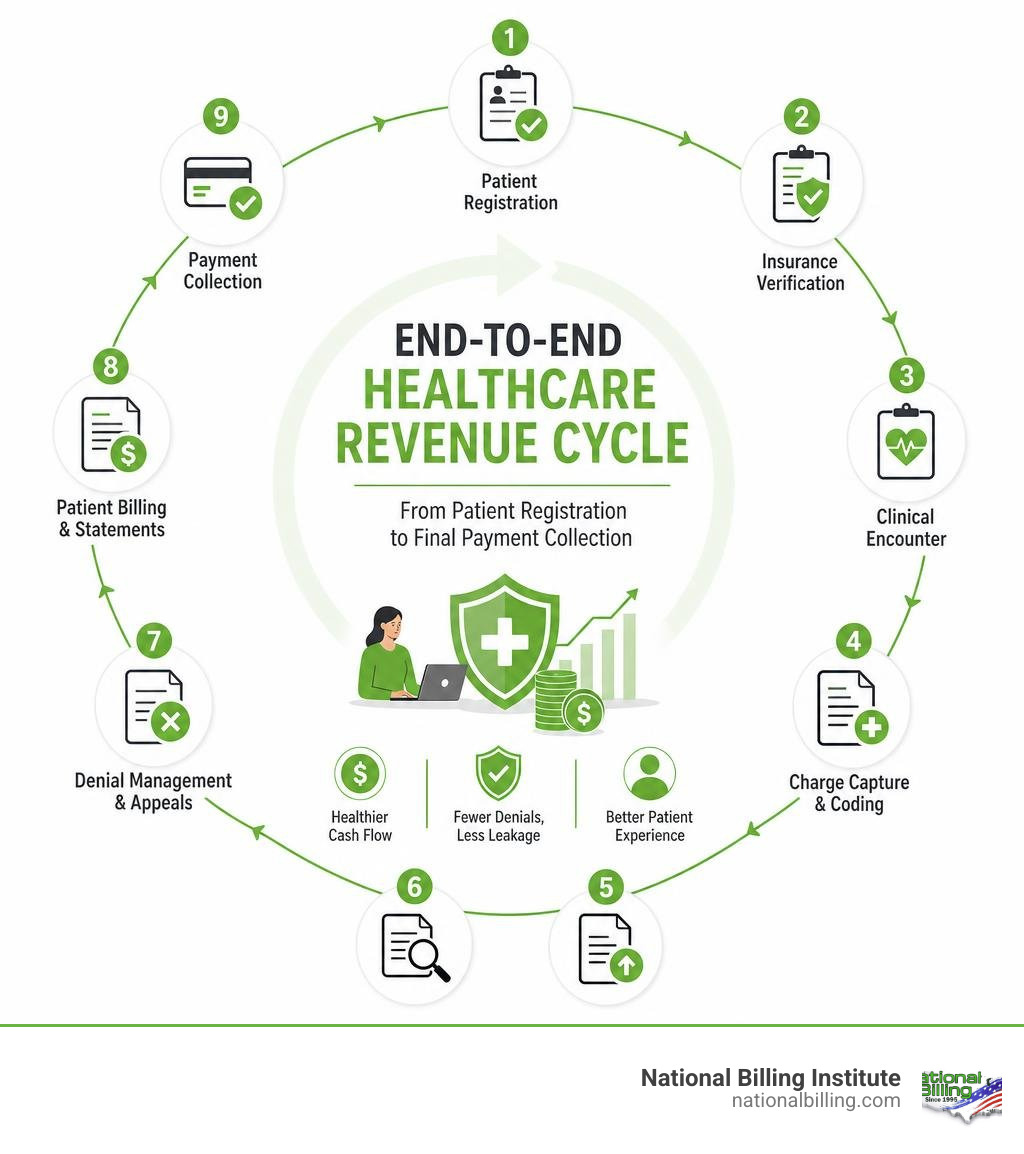
What is Revenue Cycle Management (RCM) in Healthcare?
At its core, Revenue Cycle Management (RCM) is the financial circulatory system of a healthcare organization. It is the end-to-end clinical and administrative process that tracks a single patient encounter from the moment they call to schedule an appointment until the final balance on their account is paid in full.
Many people mistake RCM for simple medical billing. However, medical billing is just one small cog in a much larger machine. While billing focuses primarily on submitting claims and managing unpaid balances, comprehensive RCM encompasses patient registration, insurance verification, clinical documentation, medical coding, payment posting, denial management, and financial analytics.
To understand how these pieces fit together, we must look at the entire lifecycle. According to a detailed breakdown in Revenue Cycle Management in Health Care Explained , an optimized RCM system ensures that clinical care translates directly into accurate, compliant, and timely reimbursement. To see how this flows in practice, organizations rely on a structured Healthcare Revenue Cycle Workflow to eliminate bottlenecks and keep the financial engine running smoothly.
The Core Stages of the Revenue Cycle
The revenue cycle is traditionally divided into three distinct, interconnected phases:
Front-End RCM (Where the Money is Won or Lost): This phase occurs before the patient ever sees a provider. It includes scheduling, patient demographic registration, insurance eligibility verification, and obtaining prior authorizations. Up to 40% of all claim denials can be traced back to errors made during this phase, making front-end accuracy absolutely critical.
Mid-Cycle RCM (Where Documentation Meets Coding): This phase takes place during and immediately after the patient encounter. It involves clinical documentation improvement (CDI), charge capture, and medical coding. Certified coders translate the clinical record into standardized ICD-10, CPT, and HCPCS codes.
Back-End RCM (Where Claims Become Cash): This phase begins after coding is complete. It covers electronic claim submission, payment posting, denial management, appeals, and patient collections. When payers underpay or deny claims, back-end teams step in to analyze, correct, and resubmit them.
Why is Revenue Cycle Management Important for Small Practices vs. Large Hospitals?
While the fundamental steps of RCM remain the same, the operational scale, resource constraints, and payer mixes create distinct challenges for different organizations.
For small physician practices, RCM is a matter of immediate survival. Small practices operate with limited cash reserves and are highly vulnerable to cash flow volatility. A single month of high denials or delayed payments can make it difficult to cover payroll or rent. These practices also face severe resource constraints; often, a single employee handles registration, billing, and clinical scheduling.
For large hospital systems, RCM is an issue of enterprise-wide infrastructure. Hospitals deal with massive operational scale, managing thousands of claims daily across dozens of specialties. They also navigate highly complex reimbursement models, including Medicare prospective payment systems, commercial contracts, and value-based care programs. For a deeper academic look at how these dynamics play out across clinical settings, the study Revenue Cycle Management: The Art and the Science - PMC provides a systematic framework for aligning clinical productivity with operational billing success.
Why is Revenue Cycle Management Important for Financial Stability?

In 2026, healthcare finance leaders are operating in an incredibly hostile economic landscape. Standard operating margins have hovered precariously between 1.3% and 2% for most hospitals, leaving almost no margin for error.
When your revenue cycle is inefficient, you suffer from "silent revenue leakage." Providers routinely fail to collect 2% to 5% of their net patient revenue simply because they do not have the time, staff, or technology to chase down underpayments or appeal complex denials.
To build true organizational resilience, modern healthcare leaders are reframing how they view their billing operations. As detailed by the Healthcare Financial Management Association in Revenue Cycle as enterprise infrastructure: Building financial resilience in 2026 | HFMA , RCM is no longer just a back-office billing function. It is a core piece of enterprise infrastructure that directly impacts capital planning, forecasting accuracy, and long-term organizational viability. By implementing a proactive strategy for Healthcare Revenue Management, organizations can protect their bottom lines against rising operational costs.
Mitigating the Cost of Claim Denials and Underpayments
Claim denials are a massive drain on healthcare resources. In the United States, claim denials cost hospitals an astronomical $262 billion per year.
The problem isn't just the lost revenue from the denied service; it's the cost of fixing the mistake. Reworking a single denied claim costs an average of $25 to $118 in administrative labor. Many busy billing departments simply run out of time to appeal these claims, letting valuable revenue expire. An optimized RCM strategy focuses on "denial prevention" rather than "denial management," catching coding mismatches and eligibility issues before the claim is sent to the payer.
Managing Rising Patient Financial Responsibility
The shift toward High-Deductible Health Plans (HDHPs) has fundamentally changed healthcare collections. Today, nearly 30% of provider revenue must be collected directly from patients rather than insurance companies.
Collecting from individual patients is significantly harder and more expensive than collecting from commercial payers. Once a patient leaves the facility without paying, the collectability of that debt drops dramatically, especially after 90 days. An effective RCM system addresses this by:
Providing clear, upfront cost estimates before care is delivered.
Verifying benefits in real-time so patients know their copayments at check-in.
Offering flexible, automated payment plans and digital payment portals to make settling balances painless.
How RCM Impacts the Patient Experience and Trust
We often think of healthcare billing as a purely financial transaction, but it is actually a major touchpoint in the patient journey. In fact, a confusing, inaccurate, or aggressive billing experience can completely destroy the clinical trust a physician worked so hard to build.
Imagine a patient who receives life-saving surgery, only to be hounded weeks later by confusing, error-ridden bills, unexpected "surprise" charges, or aggressive collections calls. That administrative friction creates immense stress and often leads to the patient delaying necessary follow-up care.
By optimizing your Revenue Cycle Operations, you can bridge this empathy gap. A high-performing RCM system ensures that:
Insurance eligibility is cleared upfront, preventing unexpected out-of-network surprises.
Billing statements are consolidated, clear, and easy to read, outlining exactly what insurance covered and what the patient owes.
Front-desk staff are trained to discuss financial obligations with confidence and compassion, offering payment plans early in the process.
When patients understand what they owe and feel treated with respect, their satisfaction scores rise, they pay their bills faster, and they remain loyal to your practice.
Overcoming Common Challenges in Modern Healthcare RCM

Modern healthcare RCM is more challenging than ever. Organizations are currently grappling with chronic workforce shortages, with 44% of healthcare finance leaders reporting that their teams are only "somewhat prepared" for the complex skills required over the next few years.
At the same time, insurance payers are constantly updating their reimbursement rules, medical necessity guidelines, and filing deadlines. This complexity often leads to the creation of "shadow workflows" — informal workarounds used by clinical staff that bypass official billing processes, leading to massive data silos and severe revenue leakage.
To overcome these barriers, organizations must modernize their approach by adopting dedicated Revenue Cycle Management Healthcare platforms that integrate directly with their existing Electronic Health Records (EHRs) to eliminate data silos and streamline workflows.
Why is Revenue Cycle Management Important for Reducing Claim Denials?
With 73% of providers reporting that claim denials are on the rise, having a systematic way to reduce denials is essential. As we mentioned, up to 40% of denials are caused by front-office mistakes made during registration or scheduling.
By utilizing Automated Revenue Management tools, organizations can run real-time eligibility checks and perform predictive claim scrubbing. These systems compare every claim against a constantly updated database of payer rules, catching missing modifiers, invalid codes, or prior authorization gaps before the claim is submitted.
Leveraging AI and Automation in Modern RCM
The future of RCM is heavily automated. Today, forward-thinking organizations are moving away from reactive, manual processes and embracing intelligent, AI-driven workflows.
According to research highlighted in The Revenue Cycle of the Future: AI boom and workflow redesigns accelerate rev cycle transformation | HFMA , the integration of agentic AI and autonomous coding is radically transforming the industry. Instead of billing staff spending 75% of their time manually fixing errors, AI-native systems can automatically correct common demographic mistakes, predict which claims are at high risk for denial, and even draft appeal letters based on clinical notes.
By implementing Automated Revenue Cycle Management solutions, practices can achieve a massive reduction in their cost-to-collect while freeing up their staff to focus on high-value, complex exception-handling.
Key Performance Indicators (KPIs) to Measure RCM Success
You cannot manage what you do not measure. To evaluate whether your revenue cycle is healthy or leaking cash, you must track specific, standardized financial metrics. The Healthcare Financial Management Association (HFMA) has established the "MAP Keys" — a set of industry-standard KPIs designed to help providers monitor and benchmark their RCM performance.
For comprehensive monitoring, leveraging Healthcare Revenue Cycle Analytics allows leaders to spot negative trends, such as rising days in A/R or spikes in specific denial codes, before they impact cash flow.
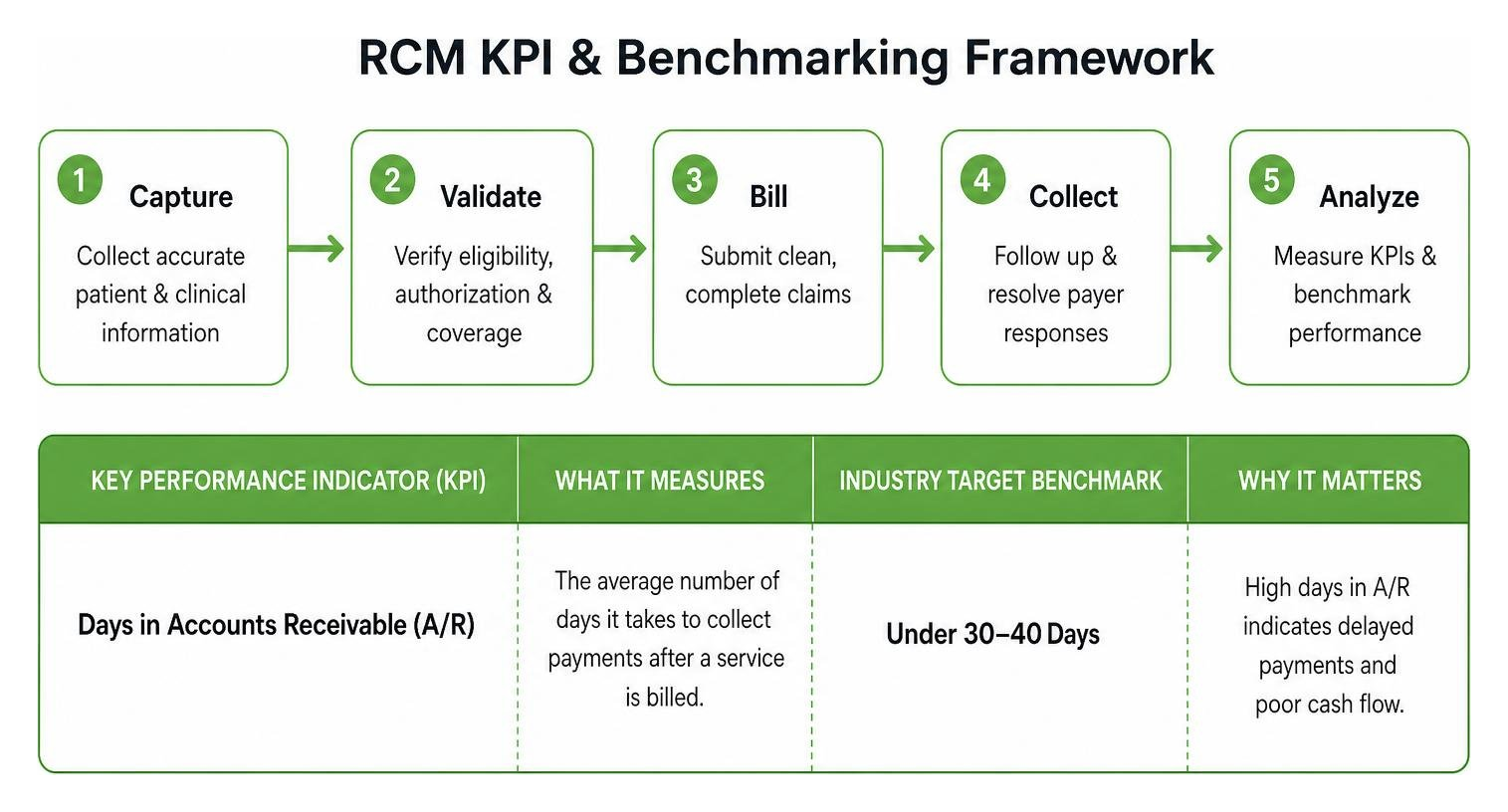
To help you benchmark your organization's performance, here is a comparison of standard RCM KPIs and their target industry benchmarks:
Key Performance Indicator (KPI) What It Measures Industry Target Benchmark Why It Matters Days in Accounts Receivable (A/R) The average number of days it takes to collect payments after a service is billed. Under 30–40 Days High days in A/R indicates delayed payments and poor cash flow. Clean Claim Rate (CCR) The percentage of claims accepted on the first submission without manual intervention. 95% – 97% Higher CCR means fewer denials, faster payments, and less administrative rework. Initial Denial Rate The percentage of submitted claims denied by payers upon first review. Under 5% A rate above 10% indicates systemic front-end or coding errors. Net Collection Rate The percentage of clean, collectible revenue actually recovered from payers and patients. Over 95% – 98% Measures the overall effectiveness of your collections process. A/R Over 90 Days The percentage of outstanding claims that have remained unpaid for more than 90 days. Under 15% Claims older than 90 days are significantly harder to collect and often turn into bad debt. Cost to Collect The total cost of billing operations (staff, software, outsourcing) as a percentage of total cash collected. Under 3% Measures the operational efficiency of your RCM department.
Frequently Asked Questions about Revenue Cycle Management
What is the difference between medical billing and revenue cycle management?
Medical billing is a singular step within the broader revenue cycle. Billing focuses specifically on preparing, submitting, and tracking claims, as well as sending invoices to patients. Revenue Cycle Management (RCM) is a holistic, end-to-end framework that includes everything from initial patient registration, scheduling, and prior authorizations (front-end) to medical coding (mid-cycle) and final payment collection, appeals, and financial analytics (back-end).
How does poor revenue cycle management affect patient care?
When a practice's RCM is inefficient, it leads to severe administrative friction, high denial rates, and clinical administrative burdens. Clinicians and staff spend valuable hours fighting with payers, managing prior authorizations, and chasing unpaid claims instead of focusing on patients. Over time, this administrative burden contributes to severe provider burnout and reduces the resources available to invest in advanced medical equipment, clinical staff, and patient care initiatives.
What are the most common reasons for healthcare claim denials?
Most claim denials are completely avoidable. The most common reasons include:
Front-End Registration Errors: Misspelled patient names, incorrect insurance policy numbers, or outdated demographic data (accounting for up to 40% of denials).
Lack of Prior Authorization: Performing a procedure before securing the necessary approval from the payer.
Medical Necessity Gaps: Failing to document clinical notes that justify why a specific procedure or test was medically necessary.
Coding and Modifier Inaccuracies: Using outdated ICD-10 or CPT codes, or failing to apply the correct modifiers.
Conclusion
In the modern healthcare landscape, building a financially sustainable and operationally resilient practice is impossible without optimized Revenue Cycle Management. From protecting your operating margins against rising inflation to improving the patient experience through transparent billing, RCM is the foundation upon which successful healthcare organizations are built.
If you are ready to stop losing 2% to 5% of your hard-earned revenue to silent leaks, high denials, and administrative bottlenecks, we are here to help. At National Billing, we provide full-service medical billing, state-of-the-art AI-automated claims processing, and integrated telemedicine solutions tailored specifically to your organization's unique needs.
Our 100% USA-based team in Boca Raton, FL, brings over 30 years of industry experience to your practice. We pride ourselves on delivering the industry's lowest denial rates, maintaining full HIPAA compliance, and helping our clients achieve an average 15% to 30% increase in revenue.
Don't let inefficient billing hold your practice back. Get started with National Billing Services today, and let our team of experts handle your financial engine so you can focus on what you do best: delivering exceptional care to your patients.
